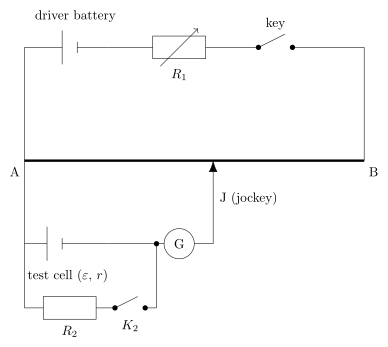
The Intuition: A Cell Isn't a Perfect Battery
Every real cell — whether a dry cell, a lead-acid battery, or a lithium-ion cell — behaves like a perfect voltage source with a small resistor hidden inside it. That hidden resistor is the internal resistance r. You can't see it, but it's always there, wasting a little voltage whenever current flows.
Think of it this way: when you connect a bulb to a cell, the bulb glows. But if you measure the voltage across the cell's terminals while the bulb is on, you'll get a value slightly less than the cell's actual electromotive force (emf). That drop happens because current passing through the internal resistance r causes a voltage drop Ir inside the cell itself. The terminal voltage V is therefore:
V=E−Ir
where E is the cell's emf (the voltage when no current flows).
So how do we measure this hidden r? A voltmeter won't help directly — it draws some current and disturbs the reading. The potentiometer is the perfect tool because it draws zero current from the cell when measuring.
The Setup: Two Measurements, One Potentiometer
A potentiometer is a long uniform wire with a sliding contact. You connect the cell you're testing (with emf E and internal resistance r) across the wire through a galvanometer. By finding the balancing length l where the galvanometer shows zero deflection, you measure the cell's voltage without drawing any current.
We make two measurements:
- Without any external load — the cell is open-circuited. The potentiometer measures its full emf E. Let the balancing length be l1. Since the potentiometer wire has uniform resistance, the voltage is proportional to length:
E∝l1
- With an external shunt resistor R connected across the cell's terminals. Now the cell delivers current through R. The terminal voltage V (which is less than E) is measured by the potentiometer. Let the balancing length be l2:
The same potentiometer, same driver circuit, same wire — only the cell's connection changes. The proportionality constant cancels out, so we never need to know the wire's resistance or the driver cell's voltage.
The Physics: Relating the Two Lengths
When the external resistor R is connected, the cell supplies a current:
I=R+rE
The terminal voltage V across the cell (which is also the voltage across R) is:
V=IR=R+rER
But from the potentiometer measurements:
EV=l1l2
Substitute V:
EER/(R+r)=l1l2
The E cancels:
R+rR=l1l2
Cross-multiply: …