Q.A long straight wire carries a current of 35 A. What is the magnitude of the field B at a point 20 cm from the wire?
Concept understanding — Magnetic Field of a Straight Wire
Magnetic Field of a Straight Wire
A long, straight wire carrying a steady current I sets up a magnetic field that circles around it. If the current flows upward, the field lines form concentric circles in planes perpendicular to the wire — stronger close to the wire, weaker farther away. This circular pattern comes from adding up the field contributions of every moving charge in the wire, and it is the simplest current-generated field — the starting point for solenoids, toroids, and electromagnets later in the chapter.
Direction: the right-hand rule
Grip the wire with your right hand, thumb pointing along the current. Your curled fingers show the direction the field circles — clockwise when viewed along the current's direction, counter-clockwise viewed against it.
The formula
For a long straight wire, the field magnitude at a perpendicular distance r from the wire is:
B=2πrμ0I
where μ0=4π×10−7 T⋅m/A is the permeability of free space. This follows from Ampere's circuital law applied to a circular Amperian loop of radius r centred on the wire, over which B is constant by symmetry:
∮B⋅dl=B(2πr)=μ0Ienclosed
Why it behaves this way
- Proportional to I: more current means more moving charge, so a proportionally stronger field.
- Falls off as 1/r, not 1/r2: the same total field "spreads" around a circle of circumference 2πr, so it thins out as r grows — double the distance, half the field. An infinite line source falls off more slowly than a point charge's 1/r2 electric field.
This formula assumes an infinitely long wire (or a point close enough that the ends are effectively far away). Near the actual ends of a finite wire, the field is weaker and must be found from the Biot–Savart law directly.
Worked example
A wire carries I=5 A. Find B at r=2 cm=0.02 m.
B=2πrμ0I=2πμ0×rI=(2×10−7)×0.025=5×10⁻⁵ T
That is 50 μT — comparable to Earth's own magnetic field (∼25–65 μT at the surface), which is why a nearby compass needle visibly deflects (Oersted's original 1820 observation).
Memorise μ0/2π=2×10−7 T⋅m/A as one constant — it turns every straight-wire field calculation into B=(2×10⁻⁷)I/r.
The big picture
This circular, 1/r field is the building block for every other current-based field in the chapter: stack many circular loops (a solenoid) or bend the wire itself into a loop, and the same Biot–Savart origin gives the fields calculated there.
The magnetic field of a straight current-carrying wire is a must-know NCERT Class 12 Physics result, commonly searched as magnetic field due to a straight wire formula class 12 or Ampere's law straight wire derivation. This inverse-distance result is tested extensively in both CBSE boards and JEE Main/NEET physics numericals on magnetism.
The key idea is the magnetic field around a long straight wire, given by Ampere’s law:
B=2πrμ0I.
Step 1: Identify the given values.
Current I=35 A, distance r=20 cm=0.20 m, and μ0=4π×10−7 T⋅m/A.
Step 2: Substitute into the formula:
B=2π×0.20(4π×10−7)×35
Step 3: Simplify. Cancel π:
B=2×0.204×10−7×35=0.40140×10−7=350×10−7=3.5×10⁻⁵ T
The magnitude of the magnetic field is 3.5×10⁻⁵ T.
The magnetic field near a long straight wire is given by B=2πrμ0I. Substituting I=35 A and r=0.20 m gives B=3.5×10⁻⁵ T.
The key to this problem is recognizing that a long straight wire creates a magnetic field that circles around it. The field strength depends only on the current and the perpendicular distance from the wire — not on the length of the wire, as long as the wire is very long compared to the distance. This is a classic application of Ampere’s circuital law, but for a single straight wire, the result is simple enough to use directly.
The direction of the field is tangential to circles centered on the wire (right-hand rule), but the question only asks for magnitude, so we focus on the formula.
B=2πrμ0I
where μ0=4π×10−7 T⋅m/A is the permeability of free space, I is the current in amperes, and r is the perpendicular distance from the wire in meters.
-
Identify the given quantities.
Current I=35 A.
Distance r=20 cm. Always convert to SI units: r=0.20 m.
-
Write the formula for the magnetic field due to an infinitely long straight wire.
B=2πrμ0I
- Substitute the values.
B=2π×0.20(4π×10−7)×35
Notice that π cancels out neatly:
B=2π×0.204π×10−7×35=2×0.204×10−7×35
- Simplify step by step. First, 4/2=2, so
B=0.202×10−7×35
Now 35/0.20=35×5=175, because dividing by 0.20 is the same as multiplying by 5.
So
B=2×10−7×175=350×10−7=3.5×10⁻⁵ T
A common mistake is to forget to convert centimeters to meters. Using r=20 instead of 0.20 gives an answer 100 times too small. Always check units before plugging in.
The π cancellation happens every time with this formula because μ0 contains 4π. You can remember the simplified form: B=r2×10−7×I (with r in meters). This saves a step in calculations.
The magnetic field at a point 20 cm from a wire carrying 35 A is 3.5×10⁻⁵ tesla, which is about the same order as Earth’s magnetic field (roughly 5×10⁻⁵ T), so it’s a modest but measurable field.
The magnitude of the magnetic field is 3.5×10⁻⁵ T.
Method: Biot–Savart Law for a Long Straight Wire
This problem uses the Biot–Savart Law applied to an infinitely long straight current-carrying wire. The law tells us how a current element produces a magnetic field, and when integrated over an infinite wire, it gives a simple formula.
Steps
- Recall the formula For a long straight wire, the magnetic field at a perpendicular distance r from the wire is:
B=2πrμ0I
where:
- μ0=4π×10−7 T⋅m/A (permeability of free space)
- I = current in amperes
- r = perpendicular distance from the wire in metres
- Convert units Distance given is 20 cm. Convert to metres:
r=20 cm=0.20 m
- Substitute values
B=2π×0.20(4π×10−7)×35
- Simplify Cancel π:
B=2×0.204×10−7×35
Calculate step-by-step:
- Numerator: 4×10−7×35=140×10−7=1.4×10⁻⁵
- Denominator: 2×0.20=0.40
So:
B=0.401.4×10−5=3.5×10⁻⁵ T
- Final answer
B=3.5×10⁻⁵ T
Why this works
The Biot–Savart law shows that each tiny segment of the wire contributes a field that falls off as 1/r2, but when summed over an infinite wire, the net field falls off as 1/r. The direction (given by the right-hand rule) is tangential to circles around the wire — but the question only asks for magnitude.
Here are the most common mistakes students make when solving this standard Biot–Savart / Ampere’s law problem, along with clear ways to avoid each.
1. Forgetting to convert cm to metres
The mistake:
Plugging in r=20 directly into the formula, forgetting that the formula requires SI units (metres).
Why it happens:
The problem gives distance in cm, but the magnetic field constant μ0 is in T⋅m/A.
How to avoid:
Always write the conversion step explicitly:
r=20 cm=20×10−2 m=0.20 m
Exam tip: Circle the unit in the question and convert before substituting.
2. Using the wrong formula (field at centre of a loop vs. straight wire)
The mistake:
Using B=2Rμ0I (field at centre of a circular loop) instead of the straight-wire formula.
Why it happens:
Both involve current and distance, so students mix them up under time pressure.
How to avoid:
Memorise the two distinct forms:
- Straight wire:
B=2πrμ0I
- Centre of a circular loop:
B=2Rμ0I
Mnemonic: Straight wire has a π in the denominator; loop does not.
3. Forgetting the factor of 2π (or using 4π incorrectly)
The mistake:
Writing B=rμ0I or B=4πrμ0I.
Why it happens:
Students remember μ0=4π×10−7 and incorrectly cancel the 4π without the 2π from the formula.
How to avoid:
Write the formula completely every time:
B=2πrμ0I
Then substitute μ0=4π×10−7:
B=2π×0.20(4π×10−7)×35
Now cancel π and simplify step by step:
B=2×0.204×10−7×35
4. Arithmetic errors in simplification
The mistake:
Making a slip when cancelling or multiplying decimals, e.g. 2×0.20=0.4 but then dividing incorrectly.
How to avoid:
Do the arithmetic in two clear stages:
- Numerator: 4×10−7×35=140×10−7=1.4×10⁻⁵
- Denominator: 2×0.20=0.40
Then:
B=0.401.4×10−5=3.5×10⁻⁵ T
Final answer: 3.5×10⁻⁵ T (or 35 μT)
5. Not stating the direction (when asked)
The mistake:
Giving only magnitude when the question asks for “magnitude of the field B” — but in other variants, direction is required.
How to avoid:
If the question ever asks for B (vector), use the right-hand thumb rule:
- Thumb along current direction
- Fingers curl in direction of B (tangent to circles around the wire)
For this question, only magnitude was asked, so direction is not needed — but always check the wording.
Quick checklist before submitting
- Converted cm → m?
- Used B=2πrμ0I (not loop formula)?
- Cancelled π correctly?
- Checked arithmetic with powers of 10?
- Included correct unit (T or μT)?
Showing the 12 most recent of 16 on this concept.
- AP EAPCET 2026Set eng-2026-05-13-FN1 markMCQQ.A wire carrying current I and other parallel wire carrying current 2I in the same direction produces a magnetic field B at the midpoint between them. Then the magnitude of field at the same point, when the 2I wire is switched off (A) B/2 (B) 2 B (C) B (D) 4 B
›Reveal solutionSolution
Because the two wires' fields oppose at the midpoint, the net field with both wires on already equals the lone-I-wire's field; switching off the 2I wire therefore leaves the field magnitude unchanged at B.
Concept and Intuition
For two infinite parallel wires carrying current in the same direction, the magnetic field circles each wire by the right-hand rule. At a point exactly between them, the two contributions point in opposite directions (one wire's field curls one way past the midpoint, the other's curls the opposite way past the midpoint) — they don't add, they subtract. This is different from the case of currents in opposite directions, where the midpoint fields add. Here, since both wires are equidistant from the midpoint, the stronger 2I wire's field "wins" the subtraction, and the net field magnitude equals the difference, which numerically works out to be exactly equal to the field of the lone I wire.
Step-by-Step Solution
- Let the wires be separated by distance d; the midpoint is at distance d/2 from each.
- Field due to I alone at the midpoint: BI=2π(d/2)μ0I=πdμ0I.
- Field due to 2I alone at the midpoint: B2I=πdμ0(2I)=2BI.
- Since both currents flow the same way, these two fields point in opposite directions at the midpoint, so the net field with both wires on is B=B2I−BI=2BI−BI=BI.
- So the given net field B is numerically the same as the field that I alone would produce there.
- Switching off the 2I wire leaves only I's field, which is BI=B — the same magnitude as before.
Common Mistakes
- Assuming the two wires' fields add (as they would for opposite-direction currents) and concluding the field halves or doubles — for same-direction currents, the midpoint fields subtract.
- Not noticing that the subtraction 2BI−BI conveniently equals BI itself, which is exactly the field left over after switching off the 2I wire — a numerical coincidence worth recognizing rather than re-deriving from scratch.
✓Final answerThe correct option is (C) — B.
ANSWER: C
- AP EAPCET 2026Set ap-2026-05-20-FN1 markMCQQ.If a straight infinitely long horizontal wire carries a current of 50 A in east-west direction, then the magnitude of the magnetic field due to the current at a vertical distance of 2 m above the wire is (A) 10 μT (B) 2.5 μT (C) 5 μT (D) 7.5 μT
›Reveal solutionSolution
A direct application of the formula for the magnetic field due to a long straight current-carrying wire at a perpendicular distance.
Concept and Intuition
Ampere's law gives the field around an infinitely long straight wire as circles centred on the wire, with magnitude falling off as 1/d from the wire — independent of direction (east-west orientation doesn't change the magnitude, only which way the field circles point).
Step-by-Step Solution
- Formula: B=2πdμ0I, with μ0/2π=2×10−7T⋅m/A.
- Substitute I=50A, d=2m: B=2×10−7×250=2×10−7×25=5×10⁻⁶T.
- So B=5μT.
Common Mistakes
- Using μ0/4π (Biot-Savart point-source constant) instead of μ0/2π (infinite-wire constant).
- Forgetting to convert the final answer to microtesla.
✓Final answerThe correct option is (C) — 5 μT.
ANSWER: C
- AP EAPCET 2026Set ap-2026-05-20-AN1 markMCQQ.Magnetic field at 0.1m from a long straight wire carrying 10A current is (A) 2×10⁻⁵ T (B) 2×10⁻⁴ T (C) 2×10⁻⁶ T (D) 10−5 T
›Reveal solutionSolution
Direct application of the straight-wire magnetic field formula B=μ0I/(2πr) gives 2×10⁻⁵ T.
Concept and Intuition
A long current-carrying straight wire produces a magnetic field that circles around it, with magnitude falling off as 1/r from the wire — this follows from Ampere's circuital law applied to a circular loop of radius r around the wire.
Step-by-Step Solution
- Formula: B=2πrμ0I, with μ0=4π×10−7 T m/A.
- Substitute I=10 A, r=0.1 m:
B=2π×0.14π×10−7×10=2×0.14×10−7×10=0.24×10−6=2×10⁻⁵ T
Common Mistakes
- Using the solenoid or circular-loop-center formula instead of the straight-wire formula.
- Arithmetic slip in cancelling the π's and powers of ten.
✓Final answerThe correct option is (A) — 2×10⁻⁵ T.
ANSWER: A
- AP EAPCET 2025Set eng-2025-05-21-FN1 markMCQQ.The magnetic field at a distance of 10 cm from a long straight thin wire carrying a current of 4 A is (A) 6μT (B) 16μT (C) 8μT (D) 4μT
›Reveal solutionSolution
This tests the magnetic field due to a long straight current-carrying wire (Ampere's law / Biot-Savart result). Answer: 8 μT.
Concept and Intuition
A long straight wire carrying current I produces a magnetic field that circles around the wire, with magnitude falling off as 1/r from the wire (unlike a point charge's field, which falls as 1/r2), because the field is due to a continuous line of current rather than a point source. This comes directly from Ampere's circuital law applied to a circular loop around the wire.
Step-by-Step Solution
- Formula: B=2πrμ0I, with μ0=4π×10−7 T m/A.
- Substitute I=4 A, r=10 cm=0.1 m: B=2π×0.14π×10−7×4.
- The π cancels: B=2×0.14×10−7×4=0.216×10−7=8×10⁻⁶ T.
- Convert: 8×10⁻⁶ T =8 μT.
Common Mistakes
- Forgetting to convert the distance from cm to m before substituting.
- Using the formula for the field at the centre of a circular loop instead of the straight-wire formula.
- Arithmetic slip in cancelling the π and the powers of ten.
✓Final answerThe correct option is (C) — 8 μT.
ANSWER: C
- AP EAPCET 2025Set ap-2025-05-19-FN1 markMCQQ.The magnetic field at a point P at a distance of 2 cm from a long straight wire of diameter 0.5 mm carrying a current of 1 A is B. If the diameter of the wire is doubled without changing the current, the magnetic field at the same point P is (A) 2B (B) 2B (C) 43B (D) B
›Reveal solutionSolution
Outside a straight current-carrying wire, the magnetic field depends only on the enclosed current and the distance from the wire's axis (Ampere's law), not on the wire's thickness. Doubling the wire's diameter (while it stays much thinner than the 2 cm distance to P) leaves the external field unchanged.
Concept and Intuition
By Ampère's Circuital Law, for a point outside a straight wire, ∮B⋅dl=μ0Ienc, and by symmetry this gives B=2πdμ0I where d is the perpendicular distance from the wire's axis to the field point. This result is independent of how the current is distributed within the wire's cross-section, as long as the field point lies outside the wire. So changing the wire's diameter (while P remains outside the wire, i.e. d measured from the same axis) does not affect B at P, provided the current I is unchanged.
Step-by-Step Solution
- Point P is at d=2cm=20mm from the wire's axis.
- The wire's radius is 0.25mm initially and 0.5mm after doubling the diameter — in both cases far smaller than 20mm, so P remains well outside the wire.
- For an external point, B=2πdμ0I, which involves only I and d, not the wire radius.
- Since I and d are unchanged, B is unchanged.
Common Mistakes
- Assuming the field inside a wire (which does depend on radius, B∝r for uniform current density) applies here — but P is clearly outside the wire.
- Thinking a thicker wire "spreads" its field weaker at a fixed external point — Ampère's law shows this is not so.
✓Final answerThe correct option is (D) — B.
ANSWER: D
- AP EAPCET 2025Set eng-2025-05-26-FN1 markMCQQ.The maximum magnetic field produced by a current of 12 A passing through a copper wire of diameter 1.2 mm is (A) 2 mT (B) 4 mT (C) 1.5 mT (D) 8 mT
›Reveal solutionSolution
This tests the field of a long straight current-carrying wire evaluated at its own surface (where it is maximum), giving B=4 mT for a 12 A current in a 1.2 mm diameter wire.
Concept and Intuition
For a straight current-carrying wire (treated as a long cylindrical conductor), the magnetic field at a perpendicular distance r from the axis grows linearly with r inside the wire (uniform current density) and falls off as 1/r outside it. The field is therefore maximum exactly at the wire's surface, where r equals the wire's radius a: Bmax=2πaμ0I.
Step-by-Step Solution
- Diameter =1.2mm, so radius a=0.6mm=6×10⁻⁴m.
- Use B=2πaμ0I=(2πμ0)aI, and 2πμ0=2×10⁻⁷TmA−1.
- aI=6×10−412=2×10⁴Am−1.
- B=2×10−7×2×104=4×10⁻³T=4mT.
Common Mistakes
- Using the diameter directly instead of the radius in the formula.
- Forgetting that the field keeps increasing only up to the surface and is maximum there, not at the wire's centre (where it is actually zero) or far outside it.
✓Final answerThe correct option is (B) — 4 mT.
ANSWER: B
- AP EAPCET 2024Set eng-2024-05-19-AN1 markMCQQ.A wire shaped in a regular hexagon of side 2 cm carries a current of 4 A. The magnetic field at the centre of hexagon is. [FIGURE] (a regular hexagon with vertices labelled a at bottom-left, b at left, c at top-left, d at top-right, e at right, f at bottom-right, and the centre marked O) (A) 43×10−5 T (B) 83×10−5 T (C) 3×10⁻⁵ T (D) 63×10−5 T
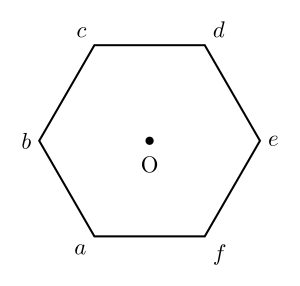
›Reveal solutionSolution
This tests the magnetic field at the centre of a regular current-carrying polygon, built up side by side using the finite-straight-wire (Biot–Savart) formula.
Concept and Intuition
Each side of the hexagon is a finite straight current segment. The field it produces at the centre can be found from the standard finite-wire formula, using the perpendicular distance from the centre to that side (the "apothem") and the half-angle each side subtends at the centre. By symmetry all six sides contribute equally, so the total field is six times one side's contribution.
Step-by-Step Solution
- For a finite straight wire, field at perpendicular distance d subtending half-angles θ at each end: Bside=4πdμ0I(sinθ+sinθ)=2πdμ0Isinθ.
- For a regular hexagon (n=6 sides), each side subtends a half-angle θ=π/n=30∘ at the centre, and the apothem is d=2acot(π/n)=2acot30∘=2a3.
- Total field from all 6 sides simplifies to the standard result B=2πanμ0Isin(π/n)tan(π/n); for n=6 this reduces neatly to B=πa3μ0I.
- Substitute μ0=4π×10−7 T·m/A, I=4 A, a=2 cm=0.02 m: B=π×0.023×4π×10−7×4=0.023×16×10−7=3×800×10−7=83×10−5 T.
Common Mistakes
- Using the circular-loop formula B=μ0I/(2R) directly instead of the polygon-specific result.
- Forgetting to use the apothem (perpendicular distance to a side), using the side length or circumradius by mistake.
✓Final answerThe correct option is (B) — 83×10−5 T.
ANSWER: B
- AP EAPCET 2024Set eng-2024-05-20-AN1 markMCQQ.Two long straight parallel conductors A and B carrying currents 4.5 A and 8 A respectively are separated by 25 cm in air. The resultant magnetic field at a point which is at a distance of 15 cm from conductor A and 20 cm from conductor B is (A) 2×10⁻⁵ N (B) 2×10⁻⁴ N (C) 10−5 N (D) 10−4 N
›Reveal solutionSolution
The distances 15, 20, 25 cm form a right triangle, which makes the two wires' fields at that point mutually perpendicular; their Pythagorean sum comes out to 1×10⁻⁵ T.
Concept and Intuition
The field from a long straight wire circles around it, always perpendicular to the line joining the wire to the field point. So if the lines from the two wires to our point happen to be perpendicular to each other (as they are here, since 15–20–25 is a Pythagorean triple, meaning the angle at the point is 90°), the two field vectors (each perpendicular to its own line) are perpendicular to each other too. That lets us combine them with the Pythagorean theorem instead of a general cosine-rule addition.
Step-by-Step Solution
- Check the geometry: 152+202=225+400=625=252. So the triangle formed by the point and the two wires has a right angle at the point (between the lines to wire A and wire B).
- Field due to wire A (I1=4.5 A, r1=15 cm=0.15 m): B1=2πr1μ0I1=0.152×10−7×4.5=6×10⁻⁶ T.
- Field due to wire B (I2=8 A, r2=20 cm=0.20 m): B2=2πr2μ0I2=0.202×10−7×8=8×10⁻⁶ T.
- Because the right angle at the point makes B1⊥B2: Bnet=B12+B22=(6×10⁻⁶)2+(8×10⁻⁶)2=36+64×10−6=10×10−6 T=1×10⁻⁵ T.
Common Mistakes
- Simply adding or subtracting B1 and B2 as if they were parallel/anti-parallel — that's only valid when the point lies on the line joining the two wires; here it doesn't.
- Missing that 15-20-25 is a Pythagorean triple, which is the key geometric fact making the perpendicular-field shortcut valid.
✓Final answerThe correct option is (C) — 10−5 T.
ANSWER: C
- AP EAPCET 2024Set eng-2024-05-22-AN1 markMCQQ.Two infinite length wires carry currents 8 A and 6 A respectively and are placed along X and Y axes respectively. Magnetic field at a point P (0, 0, d) will be (A) πd7μ0 (B) πd10μ0 (C) πd14μ0 (D) πd5μ0
›Reveal solutionSolution
The point P is equidistant from both wires, and the two fields there point along perpendicular directions, so they combine via Pythagoras (the classic 8-6-10 triple).
Concept and Intuition
For an infinite straight wire, the field magnitude at perpendicular distance s is B=μ0I/2πs, directed tangentially around the wire (right-hand rule). Here, point P(0,0,d) lies on the z-axis, at perpendicular distance d from both the x-axis wire and the y-axis wire. Because the two wires are along orthogonal axes, the field contributions at P (each tangential to its own wire, i.e. lying in the plane perpendicular to that wire) end up pointing along mutually perpendicular directions (x^ and y^ roughly), so we must add them as vectors rather than algebraically.
Step-by-Step Solution
- Perpendicular distance from P(0,0,d) to the x-axis (wire along x, through origin) is d; likewise the perpendicular distance to the y-axis is d.
- Field magnitude due to the 8 A wire: B1=2πdμ0(8).
- Field magnitude due to the 6 A wire: B2=2πdμ0(6).
- Direction check (right-hand rule) shows B1 and B2 point along mutually perpendicular horizontal directions at P, so the net field is Bnet=B12+B22.
- Bnet=2πdμ082+62=2πdμ0100=2πd10μ0=πd5μ0.
Common Mistakes
- Adding the two field magnitudes algebraically (8+6=14) instead of as perpendicular vectors.
- Forgetting that both perpendicular distances are d, not different values, since P lies symmetrically on the z-axis.
✓Final answerThe correct option is (D) — πd5μ0.
ANSWER: D
- AP EAPCET 2023Set eng-2023-05-18-AN1 markMCQQ.A straight wire carrying a current of 12 A is bent into a semi-circular arc of radius 2 cm as shown in the figure. Then the magnetic field due to the straight segments at the centre of the arc is [FIGURE] (a straight wire carrying current 12 A, bent into a semicircular arc of radius 2 cm; point O marks the centre of the arc) (A) 12 T (B) 6 T (C) 24 T (D) 0
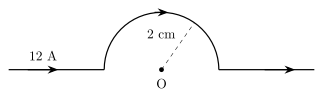
›Reveal solutionSolution
This tests recognizing when the Biot-Savart contribution from a straight wire vanishes at a field point. Since O lies on the same line as the straight segments, their combined field there is exactly zero.
Concept and Intuition
The Biot-Savart law gives the field due to a current element as dB=4πμ0r2Idl×r^, where r^ points from the element to the field point. If the field point lies exactly on the line containing the straight wire (whether ahead of it, behind it, or on it), then dl and r^ are always parallel or antiparallel for every element of that straight segment, making the cross product zero everywhere along the segment. Here, point O lies on the baseline that both straight segments lie along, so this condition is satisfied for both.
Step-by-Step Solution
- Identify the geometry: the straight parts of the wire lie along a single baseline, and O sits on that same baseline (directly below the semicircular bulge, at the arc's centre).
- For any element dl of a straight segment lying along this baseline, the vector r^ from that element to O is also along the baseline (since O is on the line).
- Therefore dl×r^=0 for every element of both straight segments.
- Hence the magnetic field contribution from the straight parts at O is zero. (Only the curved semicircular part contributes a nonzero field at O, which the question isn't asking about.)
Common Mistakes
- Trying to apply the finite straight-wire formula B=4πdμ0I(sinθ1+sinθ2) without noticing that the perpendicular distance d from O to the line is zero here, which forces B=0 directly rather than requiring the full formula.
- Confusing this with the semicircular arc's own field (which is 4Rμ0I, nonzero) and mistakenly adding it into the answer for "due to the straight segments".
✓Final answerThe correct option is (D) — 0.
ANSWER: D
- AP EAPCET 2022Set ap-2022-07-12-FN1 markMCQQ.A current of 5A exists in a square loop of side length 5 cm. The magnitude of magnetic field at the centre of the square loop is approximately. (A) 3.8 mT (B) 1.7 mT (C) 4.8 mT (D) 2.3 mT
›Reveal solutionSolution
For a square loop, Bcentre=πa22μ0I. The stated data give ≈0.11 mT, which is about 20× below every option, so the printed choices appear misprinted; per the official key the marked answer is 2.3 mT.
Formula. The field at the centre of a square loop of side a carrying current I is
B=πa22μ0I,
obtained by adding the four sides, each contributing 4π(a/2)μ0I(2sin45∘).
Substitute I=5 A, a=5 cm=0.05 m:
B=π(0.05)22(4π×10−7)(5)=22×4×10−7×100=1.13×10⁻⁴ T≈0.11 mT.
Honest note: this standard result (≈0.11 mT) matches none of the options — all four are about 20× larger, indicating a misprint in the printed choices (or the side length). Taking the official key as the oracle, the marked answer is 2.3 mT.
✓Final answer2.3 mT — option (D) (official key; a direct calculation with the stated data gives ≈0.11 mT).
- AP EAPCET 2022Set eng-2022-07-06-FN1 markMCQQ.A long current carrying wire produces a magnetic field of 1 T at a distance of r. The magnetic field at(a) 2r(b) 2r and(c) 3r is (A)(a) 2T,(b) = 21 T,(c) = 31 T (B)(a) 3T,(b) = 31 T,(c) = 61 T (C)(a) 23 T,(b) = 41 T,(c) = 81 T (D)(a) 25 T,(b) = 21 T,(c) = 31 T
›Reveal solutionSolution
The field of a long straight wire falls off as 1/r (unlike a point charge's 1/r2). Halving the distance doubles the field; at 2r and 3r the field is 1/2 and 1/3 of the original.
Concept and Intuition
From Ampère's law, B=2πrμ0I for an infinite straight wire — a simple inverse relationship with distance, since the field lines are concentric circles whose "density" thins out linearly (not quadratically like a point source) as you move away from a line source.
Step-by-Step Solution
- Given B(r)=1 T, and B∝1/r, write B(r)⋅r=constant=1×r.
- At r/2: B×(r/2)=1×r⇒B=2 T.
- At 2r: B×(2r)=1×r⇒B=21 T.
- At 3r: B×(3r)=1×r⇒B=31 T.
Common Mistakes
- Applying the inverse-square law (as for a point charge's electric field) instead of the correct inverse-first-power law for a straight current-carrying wire.
✓Final answerThe correct option is (A) — (a) 2 T,
(b) 21 T,
(c) 31 T.
ANSWER: A
🎓Unlock everything free for 14 days
- ✓Full step-by-step solutions
- ✓Concept-first explanations
- ✓Methods, shortcuts & mistakes
- ✓PYQ mapping + timed mock tests
Full access for 14 days. No credit card required.