Q.(a) Answer the following (1+1+1=3):
You're viewing a preview — the full solution, concept, methods & PYQ mapping are locked.
Start your 14-day free trial to unlock the full solution →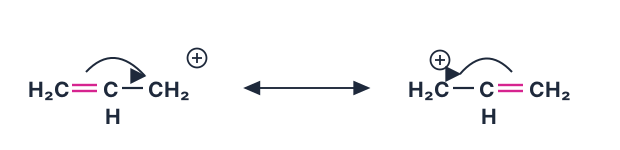
Branching lowers boiling point via reduced surface contact; SN1 rate depends on both carbocation stability and leaving-group ability; Finkelstein swaps Cl/Br for I; the two 'complete the reaction' items are the Fittig reaction and diazotisation; the OR alternative is solved backward from the Grignard product.
(a)(i) n-Butyl bromide vs t-butyl bromide boiling points:
n-Butyl bromide is a straight-chain (unbranched) molecule, giving it a larger effective surface area for intermolecular contact, which strengthens van der Waals (London dispersion) forces between neighbouring molecules. t-Butyl bromide is branched and more compact/spherical, reducing the surface area available for such contacts and weakening intermolecular forces. Hence the unbranched n-butyl bromide has the higher boiling point.
(a)(ii) Increasing order of SN1 rate — (allyl chloride), (tert-butyl chloride), (allyl iodide):
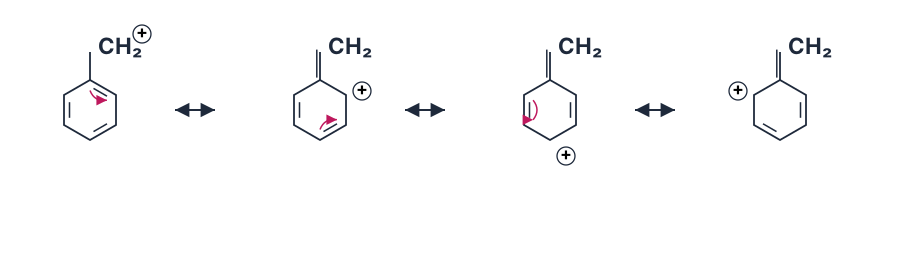
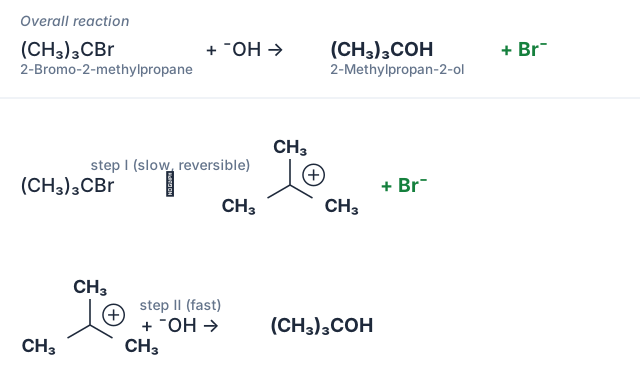
SN1 rate depends on (1) stability of the carbocation formed and (2) leaving-group ability. Allyl chloride and tert-butyl chloride share the same (chloride) leaving group, so their relative rates come down to carbocation stability: the fully alkyl-substituted 3° cation of tert-butyl chloride (stabilised by hyperconjugation from 9 β-hydrogens) reacts faster than the resonance-stabilised but less-substituted allylic cation from allyl chloride. Allyl iodide forms the SAME resonance-stabilised allylic cation as allyl chloride, but because iodide is a much better leaving group (larger, more polarisable, weaker C–I bond) than chloride, it ionises fastest of the three.
(a)(iii) Finkelstein reaction: Alkyl chlorides/bromides are converted to the corresponding alkyl iodide by treatment with sodium iodide in dry acetone; NaCl/NaBr, being insoluble in acetone, precipitates out and drives the equilibrium forward:
(b)(i) Chlorobenzene + Na, dry ether: This is the Fittig reaction (the aryl analogue of the Wurtz reaction) — two aryl halide molecules couple in the presence of sodium metal in dry ether to give a biaryl:
(b)(ii) Nitrobenzene → Fe/HCl → HNO₂, 0–5 °C: Step (i), , reduces the nitro group to an amine: (aniline). Step (ii), treating this aniline with nitrous acid (, generated from ) at 0–5 °C, is a diazotisation, giving benzenediazonium chloride:
OR — Alternative for (a): identifying the optically active : …
Unlock everything free for 14 days
- Full step-by-step solutions
- Concept-first explanations
- Methods, shortcuts & mistakes
- PYQ mapping + timed mock tests
Full access for 14 days. No credit card required.