Q.Describe with diagram the working method of p-n-p and n-p-n transistors.
You're viewing a preview — the full solution, concept, methods & PYQ mapping are locked.
Start your 14-day free trial to unlock the full solution →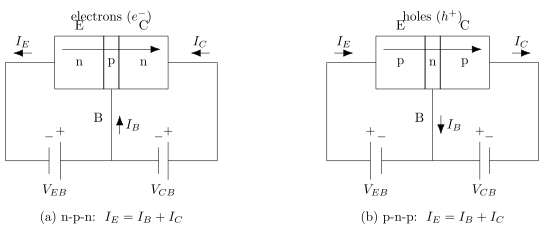
A transistor = two p–n junctions (E–B forward biased, C–B reverse biased). Carriers injected by the emitter cross the thin, lightly-doped base and are collected; a small base current controls a large collector current, with . In n-p-n electrons carry the current; in p-n-p holes do, with reversed battery polarities.
Structure. A junction transistor has three regions — the heavily-doped Emitter (E), the very thin and lightly-doped Base (B), and the moderately-doped Collector (C) — forming two p–n junctions. Depending on the arrangement it is either n-p-n or p-n-p.
Biasing (common to both). For amplifying action the transistor is biased so that:
- the Emitter–Base (EB) junction is forward biased, and
- the Collector–Base (CB) junction is reverse biased.
Working of an n-p-n transistor.
(Diagram: an n-type emitter and n-type collector on either side of a thin p-type base; EB junction forward biased by battery , CB junction reverse biased by battery .)
The forward-biased EB junction makes the n-type emitter inject a large number of electrons into the p-type base. Because the base is very thin and lightly doped, only a small fraction of these electrons combine with holes there (this constitutes the small base current ); the large majority (about 95–98 %) diffuse across the base and reach the reverse-biased collector junction, where the collector's positive potential sweeps them into the collector, forming the collector current . Thus the emitter current divides as
with and very small. A small change in the base current therefore produces a large change in the collector current — the basis of amplification.
Working of a p-n-p transistor. …
Unlock everything free for 14 days
- Full step-by-step solutions
- Concept-first explanations
- Methods, shortcuts & mistakes
- PYQ mapping + timed mock tests
Full access for 14 days. No credit card required.