Political Science · Ch 1 — Constitution: Why and How?
Institutional arrangements
Institutional arrangements
A third factor, beyond a credible mode of promulgation and substantive provisions that give everyone reason to comply, decides how effective a constitution turns out to be: a genuinely balanced arrangement of the institutions of government. The basic underlying principle here is that government must be both democratic and committed to the welfare of the people, and the Constituent Assembly spent a great deal of time working out precisely the right balance among institutions such as the executive, the legislature and the judiciary. This deliberation eventually produced two of the Constitution's most fundamental institutional choices: a parliamentary form of government, and a federal arrangement that distributes governmental power between the Centre and the States.

Drawn by us to help you understand the concept clearly, and verified to make sure it's accurate. For exams, practice from your NCERT textbook's own diagram.
An own-illustrated flat pictogram of Dr. B.R. Ambedkar seated at the head of a long committee table, gesturing as he presides over a discussion among fellow members of the Constituent Assembly. Own-illustrated for this platform from the real NCERT page's own facts (composition, labels, and content are recreated; the specific artistic rendering of any real …
Drawn by us to help you understand the concept clearly, and verified to make sure it's accurate. For exams, practice from your NCERT textbook's own diagram.
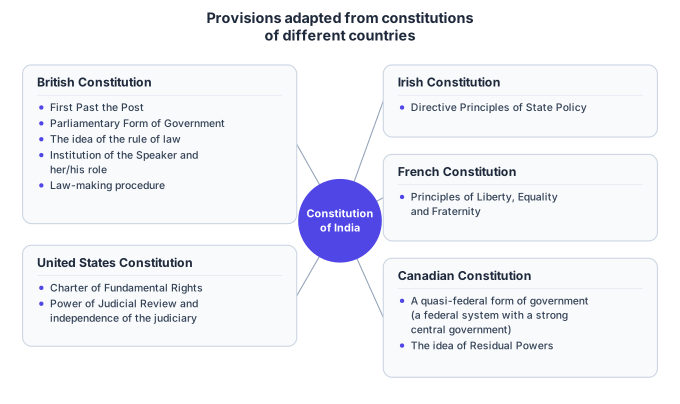
A hub-and-spoke infographic showing the specific provisions the Indian Constitution's framers adapted from five countries' constitutions: First Past the Post, the Parliamentary Form of Government, the idea of the rule of law, the institution of the Speaker and her/his role, and law-making procedure from the British Constitution; Directive Principles of State Policy from the Irish Constitution; the principles of Liberty, Equality and Fraternity from the French Constitution; the Charter of Fundamental Rights and the power of Judicial Review with independence of the judiciary from the United States Constitution; and a quasi-federal form of government with the idea of Residual Powers from the Canadian Constitution. Own-illustrated for this platform from the real NCERT page's own facts (composition …
In arriving at this balanced arrangement, the framers of the Constitution did not hesitate to draw on the experiences and experiments of other countries — far from treating this as a weakness, the chapter treats it as a genuine strength, a testament to the framers' wide learning that they could draw on almost any useful intellectual argument or historical example from anywhere in the world that was relevant to the task at hand. A significant number of specific provisions were adopted after being adapted from other constitutions: from the British Constitution came the First-Past-the-Post electoral system, the parliamentary form of government, the idea of the rule of law, the institution of the Speaker and the Speaker's role, and law-making procedure; from the Irish Constitution came the idea of Directive Principles of State Policy; from the French Constitution came the principles of Liberty, Equality and Fraternity; from the United States Constitution came the Charter of Fundamental Rights and the power of judicial review together with an independent judiciary; and from the Canadian Constitution came a quasi-federal form of government — that is, a federal system with a comparatively strong central government — along with the idea of residual powers resting with the Centre. …