Political Science · Ch 1 — Constitution: Why and How?
Procedures
Procedures
The importance the Assembly placed on public reason was not confined to its big philosophical debates — it showed up just as clearly in its everyday, seemingly mundane procedures. The Constituent Assembly organised its work through eight major Committees, each dealing with a different subject area, and these Committees were usually chaired by figures such as Jawaharlal Nehru, Rajendra Prasad, Sardar Patel, or B.R. Ambedkar. It is worth noting that these were not men who agreed with each other on very much: Ambedkar himself had been a sharp, longstanding critic of both the Congress and Gandhi, accusing them of not doing enough to uplift the Scheduled Castes, and Patel and Nehru disagreed with one another on numerous issues too. Despite this, they all worked together within the Assembly's structure. Each Committee would typically draft particular provisions of the Constitution, which were then subjected to debate by the entire Assembly; the usual working method was to try to reach a consensus that would not be detrimental to any particular interest, though some provisions were, in the end, put to a formal vote. Whichever way a matter was resolved, every single argument, query or concern raised by a member was addressed carefully and in writing — nothing was simply brushed aside.
Drawn by us to help you understand the concept clearly, and verified to make sure it's accurate. For exams, practice from your NCERT textbook's own diagram.
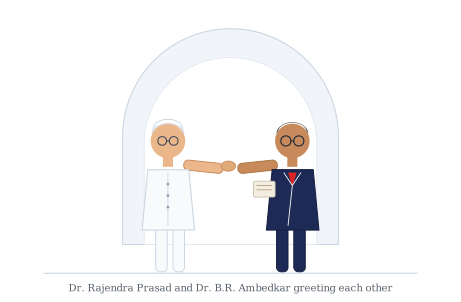
An own-illustrated flat pictogram of Dr. Rajendra Prasad, President of the Constituent Assembly, and Dr. B.R. Ambedkar, Chairman of the Drafting Committee, shaking hands and greeting each other in a formal ceremonial setting. Own-illustrated for this platform from the real NCERT page's own facts (composition, labels, and content are recreated; the specific artistic rendering of any …
…