Political Science · Ch 4 — Executive
Permanent Executive: Bureaucracy
Permanent Executive: Bureaucracy
Who implements the decisions taken by ministers? The executive organ of government includes the Prime Minister, the ministers, and a large organisation called the bureaucracy or the administrative machinery. To underline the difference between this machinery and the military services, it is described as the civil service. Trained and skilled officers who work as permanent employees of the government are assigned the task of assisting ministers in formulating policies and in implementing those policies.
Drawn by us to help you understand the concept clearly, and verified to make sure it's accurate. For exams, practice from your NCERT textbook's own diagram.
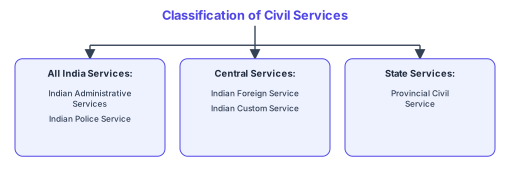
Classification of Civil Services chart showing the three-way split into All India Services (Indian Administrative Services, Indian Police Service), Central Services (Indian Foreign Service, Indian Custom Service), and State Services (Provincial Civil Service). Own-illustrated for this platform from the real NCERT page's own facts (composition, labels, and content are recreated; the specific artistic rendering …
In a democracy, elected representatives and ministers are in charge of government, and the administration functions under their control and supervision. In the parliamentary system, the legislature also exercises control over the administration; administrative officers cannot act in violation of policies adopted by the legislature, and it is the responsibility of ministers to retain political control over the administration. India has established a professional administrative machinery that is, at the same time, made politically accountable. The bureaucracy is also expected to be politically neutral — it will not take a political position on policy matters, since it is always possible that a party is defeated in elections and the new government wants to replace the previous government's policies with its own; in such a situation, it is the responsibility of the administrative machinery to faithfully and efficiently participate in drafting the new policy and in implementing it.
The Indian bureaucracy today is an enormously complex system, consisting of the All-India Services, State services, employees of local governments, and technical and managerial staff running public sector undertakings. The makers of the Constitution were aware of the importance of a non-partisan and professional bureaucracy; they also wanted members of the civil services to be impartially selected on the basis of merit. So the Union Public Service Commission (UPSC) has been entrusted with the task of conducting the recruitment process for civil servants of the Government of India; similar public service commissions are provided for the States. Members of the Public Service Commissions are appointed for a fixed term, and their removal or suspension is subject to a thorough enquiry made by a judge of the Supreme Court.
While efficiency and merit are the norms for recruitment, the Constitution also ensures that all sections of society, including the weaker sections, have an opportunity to be part of the public bureaucracy. For this purpose, the Constitution has provided reservation in jobs for Scheduled Castes and Scheduled Tribes; subsequently, reservations have also been provided for women, Other Backward Classes (OBC), and Economically Weaker Sections (EWS). These provisions ensure the bureaucracy is more representative, and that social inequalities do not come in the way of recruitment to the civil service.
The classification of civil services divides them into three groups: the All India Services — the Indian Administrative Service (IAS) and the Indian Police Service (IPS); the Central Services — the Indian Foreign Service and the Indian Customs Service; and the State Services — the Provincial Civil Service. Persons selected by the UPSC for the IAS and IPS constitute the backbone of the high-level bureaucracy in the States. The collector of a district is normally the most important officer of government at the district level, is normally an IAS officer, and is governed by the service conditions laid down by the central government. An IAS or IPS officer is assigned to a particular State, where he or she works under the supervision of the State government; however, since IAS and IPS officers are appointed by the central government, they can go back into central government service and, most importantly, only the central government can take disciplinary action against them. This means the key administrative officers of the States are, in an important sense, under the supervision and control of the central government — a feature of the bureaucracy that strengthens the central government's control over the administration of the States, as the later chapter on federalism explores further. Apart from IAS and IPS officers, State administration is also staffed by officers appointed through the State Public Service Commissions. …