Political Science · Ch 4 — Executive
What are the different types of Executives?
What are the different types of Executives?
Not every country has the same type of executive. The powers of the President of the USA are very different from the powers of the President of India; the powers of the Queen of England are different from those of the King of Bhutan; India and France both have prime ministers, but their roles differ sharply. Broadly, executives fall into three types, built on two underlying principles.
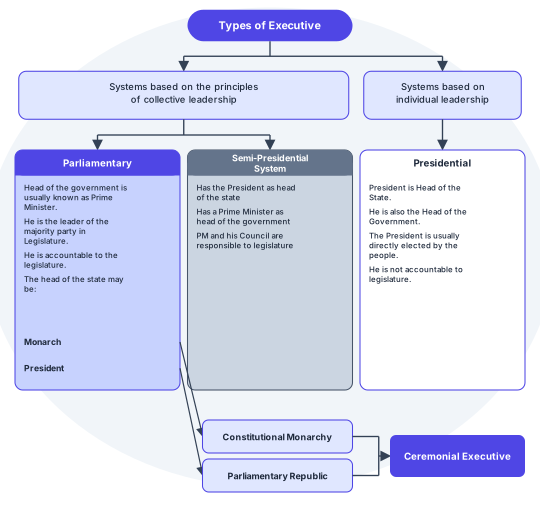
Drawn by us to help you understand the concept clearly, and verified to make sure it's accurate. For exams, practice from your NCERT textbook's own diagram.
Types of Executive flowchart: systems based on collective leadership (Parliamentary and Semi-Presidential) versus individual leadership (Presidential), showing how a Parliamentary system's Monarch or President head of state leads to a Constitutional Monarchy or Parliamentary Republic, both converging on a Ceremonial Executive. Own-illustrated for this platform from the real NCERT page's own facts (composition, labels, and content are recreated; the specific artistic …
Systems based on the principle of collective leadership divide into: (i) the Parliamentary executive — the head of government (usually called the Prime Minister) is the leader of the majority party in the legislature and is accountable to it; the separate head of state may be a hereditary Monarch (a Constitutional Monarchy) or an elected President (a Parliamentary Republic) — both forms give what the textbook's own chart calls a Ceremonial Executive, since the head of state in either case is a largely formal figurehead while the Prime Minister and Council hold effective power; and (ii) the Semi-Presidential system — has a President as head of state and a Prime Minister as head of government, with the Prime Minister and Council of Ministers responsible to the legislature, but unlike a purely parliamentary system, the President here holds real, independent day-to-day powers.
Systems based on individual leadership give the third type, the Presidential executive: a single President is Head of State as well as Head of Government, usually directly elected by the people, and not accountable to the legislature. The office of president in such systems is very powerful, both in theory and in practice; the United States, Brazil, and most Latin American nations follow this model.
A quick country survey makes the pattern concrete. The USA has a presidential system, with executive power entirely in the President's hands. Canada is a parliamentary democracy with a constitutional monarchy — Queen Elizabeth II is the formal head of state, while the Prime Minister is head of government. France has a semi-presidential system: the President appoints the Prime Minister and the ministers, but cannot dismiss them, since they remain responsible to Parliament. Japan is parliamentary, with the Emperor as head of state and the Prime Minister as head of government. Italy is parliamentary, with the President as the formal head of state and the Prime Minister as head of government. Russia is semi-presidential — the President is head of state, and the Prime Minister, appointed by the President, is head of government. Germany is parliamentary, with a ceremonial President as head of state and the Chancellor as head of government. The United Kingdom and Portugal are also parliamentary systems, where the head of state's role is primarily ceremonial while the Prime Minister and cabinet wield effective power. …