Psychology · Ch 8 — Motivation and Emotion
Maslow's Hierarchy of Needs
Maslow's Hierarchy of Needs
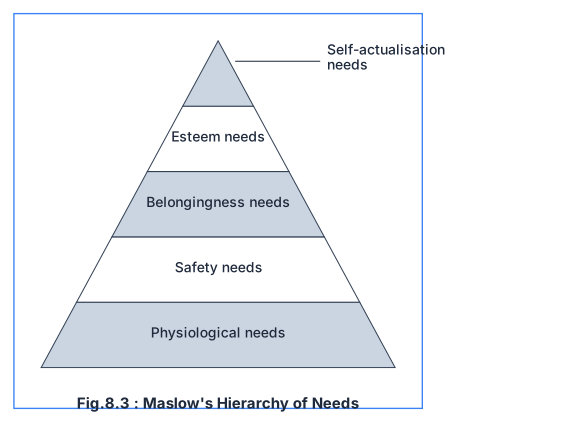
Among the many views on human motivation, the most widely known is the one proposed by Abraham H.
Drawn by us to help you understand the concept clearly, and verified to make sure it's accurate. For exams, practice from your NCERT textbook's own diagram.
Fig.8.3: Maslow's Hierarchy of Needs — a five-level pyramid of human needs, from Physiological needs at the base through Safety, Belongingness, Esteem, up to Self-actualisation needs at the apex. Own-illustrated for this platform from the real NCERT page's own facts (composition, labels, and layout are recreated; the specific artisti …
Maslow, popularly called the 'Theory of Self-actualisation'. Maslow's model pictures human needs arranged as a pyramid-shaped hierarchy, moving from the most basic needs at the bottom to the most advanced at the top. At the base sit physiological needs — basic biological requirements for survival, such as hunger and thirst. Once these are reasonably satisfied, safety needs come to the fore — the need to be free from threatened danger, of both a physical and a psychological kind. Next come belongingness needs — the need to seek out other people, and to love and be loved. After these are met, a person's attention turns to esteem needs — the need to develop a genuine sense of self-worth. At the very apex of the pyramid sits the need for self-actualisation — an individual's motivation toward the fullest possible development of their own potential. A self-actualised person, in Maslow's description, is self-aware, socially responsive, creative, spontaneous, open to novelty and challenge, has a sense of humour, and is capable of deep interpersonal relationships. …