Psychology · Ch 8 — Motivation and Emotion
Nature of Motivation
Nature of Motivation
The word motivation comes from the Latin word 'movere', meaning to move — so, quite literally, motivation is about what moves or activates behaviour. Everyday explanations of why people do things are usually given in terms of motives: a student might attend college to learn a subject, to earn a qualification needed for a good job, or to make their parents proud — usually some combination of such reasons. Because motives are general states that hold across many different situations, they let psychologists make predictions about behaviour: a person with a strong need for achievement, for instance, will tend to work hard across school, sport, business or music alike.
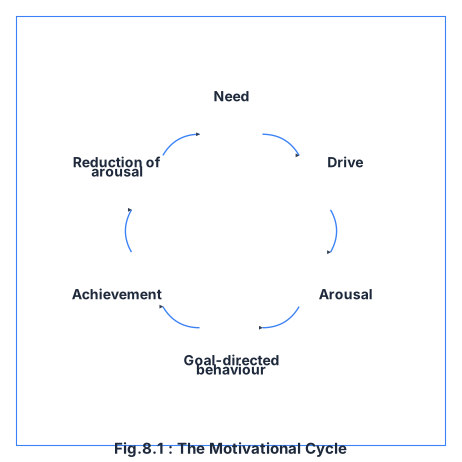
Drawn by us to help you understand the concept clearly, and verified to make sure it's accurate. For exams, practice from your NCERT textbook's own diagram.
Fig.8.1: The Motivational Cycle — a six-stage circular flow: Need, Drive, Arousal, Goal-directed behaviour, Achievement, Reduction of arousal, looping back to Need. Own-illustrated for this platform from the real NCERT page's own facts (composition, labels, and layout are recreated; the specific artistic ren …
Motivation is therefore one of the key determinants of behaviour, and concepts such as drives, needs, goals and incentives all fall under this broad umbrella. …