Physics · Ch 6 — System of Particles and Rotational Motion
Centre of Gravity
Centre of Gravity
The Centre of Gravity
Every particle on Earth experiences a gravitational pull toward the planet's centre. For a body made of many particles, each particle has its own weight acting vertically downward. These forces are all parallel to one another (since the Earth's radius is enormous compared to any object we handle), and they point in the same direction — toward the Earth's centre.
The centre of gravity (CG) of a body is that single point where the entire weight of the body can be considered to act, regardless of how the body is oriented. If you support a body at its centre of gravity, it will balance perfectly in any orientation.
For objects near the Earth's surface, the gravitational acceleration is essentially constant over the object's size. This constancy is what makes the centre of gravity coincide with the centre of mass — a fact we will prove below.
Relation Between Centre of Gravity and Centre of Mass
Consider a body composed of particles. The -th particle has mass and is located at position relative to some origin. The weight of this particle is , and the total weight of the body is , where is the total mass.
The centre of gravity is defined as the point such that the total torque due to gravity about any point equals the torque due to the total weight acting at . Choose the origin as the reference point. The torque due to the weight of the -th particle is , where is the unit vector pointing downward (taking the direction of gravity as the negative -axis, for instance). The total torque is:
If the total weight acts at the centre of gravity , the torque about the origin is:
Equating the two expressions for torque:
Since is a scalar constant, we can cancel from both sides:
This vector equation must hold for any orientation of the body (i.e., for any direction of relative to the body). The only way this can be true for all orientations is if:
›Proof
To see why the equality of cross products forces the equality of the vectors themselves, consider two vectors and . If for every direction , then . Proof: Take along the -axis, then along the -axis, then along the -axis. Each choice gives one component equation, and together they force . Since the centre of gravity must work for any orientation of the body, the condition holds for all , and therefore the vectors themselves must be equal.
Thus:
But this is exactly the definition of the centre of mass ! Therefore:
The centre of gravity coincides with the centre of mass whenever the gravitational acceleration is uniform over the entire body.
This equality holds only when is constant. If the body is large enough that varies significantly across it (e.g., a tall mountain or a satellite in orbit), the centre of gravity and centre of mass are different points. For all problems in Class 11 Physics, you may assume is constant and treat the two points as identical.
Practical Significance …
Drawn by us to help you understand the concept clearly, and verified to make sure it's accurate. For exams, practice from your NCERT textbook's own diagram.
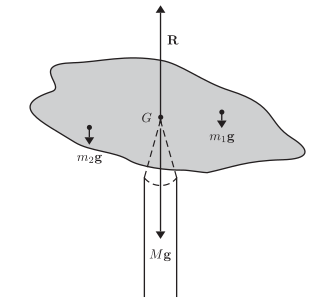
The figure shows an irregularly shaped cardboard sheet balanced perfectly on the tip of a pencil. The pencil tip is placed at a point labelled G, and the cardboard remains horizontal and stationary — it does not tilt or fall off. Two forces are drawn acting on the cardboard: its total weight (where is the mass of the cardboard and is the acceleration due to gravity) acts vertically downward through G, and the upward normal reaction from the pencil tip acts vertically upward, also through G. In addition, the figure schematically indicates several small masses distributed across the cardboard, each with its own weight acting at its own location.
The physical idea is straightforward: the cardboard is in translational equilibrium because the net external force on it is zero — the upward reaction exactly balances the downward weight . But more importantly, it is also in rotational equilibrium: because the pencil tip is placed exactly at the centre of gravity G, the line of action of every individual weight passes through G, so none of them produces a torque about G. The cardboard therefore does not rotate.
The key formula the textbook develops from this figure is the condition for a rigid body to be in static equilibrium:
The first condition says the vector sum of all external forces must be zero — for the cardboard, . The second condition says the sum of all external torques about any point must be zero. When the support is at the centre of gravity, the torque due to each particle weight about G is , so the net torque is automatically zero. If the pencil tip were placed anywhere else, the weights would produce a net torque and the cardboard would tilt.
The centre of gravity is the point where the entire weight of the body can be considered to act. For a body in a uniform gravitational field, the centre of gravity coincides with the centre of mass. Balancing a body on a support at its centre of gravity ensures zero net torque from gravity. …
Drawn by us to help you understand the concept clearly, and verified to make sure it's accurate. For exams, practice from your NCERT textbook's own diagram.
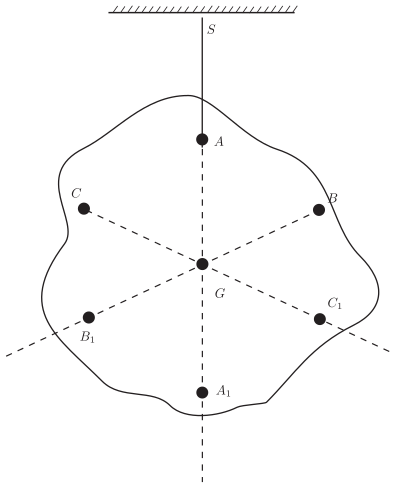
The figure shows an irregularly shaped lamina hanging freely from a ceiling. A hook or pin at point S on the ceiling holds the body at a point on its edge labelled A. The body is free to rotate about A. A dashed vertical line, labelled AA₁, runs downward from A through the interior of the body. The centre of gravity G is marked on this dashed line, inside the body. Two other suspension points, B and C, are also marked on the edge of the body, with corresponding vertical dashed lines BB₁ and CC₁ that would appear if the body were hung from those points instead.
The physical idea is straightforward: a freely suspended body always comes to rest with its centre of gravity directly below the point of suspension. Gravity pulls straight down, so the line from the suspension point to the centre of gravity must be vertical. By hanging the body from three different points (A, B, C) and drawing the vertical line through each suspension point, you get three lines that all intersect at the same point — the centre of gravity G. The figure captures the first of these three steps: the body hung from A, with the vertical AA₁ drawn, and G lying somewhere on that line.
The key formula is not a new equation but the condition for rotational equilibrium that this method exploits. For a rigid body suspended at a point, the torque due to gravity about the suspension point must be zero when the body is at rest. The torque is the vector cross product of the position vector of the centre of gravity relative to the suspension point and the weight vector. Mathematically, if is the position of G relative to A, and is the weight, equilibrium requires:
Since is vertically downward, the cross product is zero only when is parallel to — that is, when G lies directly below A along the vertical line. The figure shows this vertical line as AA₁.
The centre of gravity of any rigid body is the single point where the entire weight can be considered to act. For a uniform gravitational field, the centre of gravity coincides with the centre of mass. …