Physics · Ch 6 — System of Particles and Rotational Motion
Conservation of Angular Momentum
Conservation of Angular Momentum
Opening the Idea
The conservation of angular momentum is the rotational twin of the conservation of linear momentum. Just as the linear momentum of an isolated system remains constant when no external force acts, the total angular momentum of a system is constant when no external torque acts. This principle governs everything from a spinning ice skater pulling in her arms to the orbital motion of planets.
For a system of particles, the total angular momentum is the vector sum of the angular momenta of all individual particles. When the net external torque on the system is zero, we have:
which immediately tells us that is constant in both magnitude and direction. This is the law of conservation of angular momentum.
The Law in Detail
For a rigid body rotating about a fixed axis, the angular momentum about that axis is , where is the moment of inertia about the axis and is the angular speed. If no external torque acts about that axis, then:
This single equation explains a wide range of phenomena. When changes, must change in the opposite way to keep the product constant.
Properties and Their Derivations
Property (I): The Spinning Ice Skater Effect
When a rotating body changes its moment of inertia without any external torque, its angular speed changes inversely.
Proof: Consider a person sitting on a rotating stool with arms outstretched, holding heavy weights. The system (person + stool + weights) rotates with angular speed and has moment of inertia . When the person pulls the arms inward, the moment of inertia decreases to . Since no external torque acts about the vertical axis, angular momentum about that axis is conserved:
Therefore:
Since , we get — the rotation speeds up.
A common mistake is to think that angular velocity changes because of some "force" pulling the arms in. The change happens because angular momentum is conserved — the decrease in moment of inertia forces an increase in angular speed to keep constant.
Property (II): The Dancer's Pirouette
A ballet dancer spinning on one toe demonstrates the same principle. Starting with arms extended, the moment of inertia is large and the spin is slow. Bringing the arms close to the body reduces the moment of inertia dramatically, and the spin becomes very fast.
Quantitative example: If a dancer's initial moment of inertia is and she spins at , then after pulling arms in to :
The spin rate increases by a factor of 2.5.
Property (III): The Diver's Tuck
A diver jumping off a springboard has some initial angular momentum about the centre of mass. In mid-air, no external torque acts (ignoring air resistance), so angular momentum is conserved. By tucking the body (reducing ), the diver increases angular speed, allowing multiple somersaults before entering the water. Just before entry, the diver extends the body (increasing ), which reduces angular speed to nearly zero for a clean entry.
The diver's angular momentum is constant throughout the dive — only the distribution of mass changes, altering the moment of inertia and therefore the angular velocity.
The Vector Nature of Conservation
Angular momentum is a vector quantity. Conservation means both magnitude and direction remain constant. This is why a spinning gyroscope or a bicycle wheel resists changes to its orientation — the direction of its angular momentum vector tends to stay fixed in space unless a torque acts. …
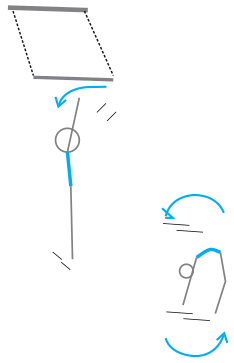
Drawn by us to help you understand the concept clearly, and verified to make sure it's accurate. For exams, practice from your NCERT textbook's own diagram.
The same principle that slows or speeds up the girl on the swivel chair is what lets an acrobat control her spin in mid-air. The instant she leaves the bar, no external torque acts on her about her own axis of rotation (gravity acts through her centre of mass and does not twist her), so her angular momentum L about that axis is fixed for the rest of the flight. While she is fully stretched out -- arms and legs extended, as in the first sketch -- her mass is spread far from the rotation axis, so her moment of inertia I is large and her angular speed omega is correspondingly small: she rotates slowly. The moment she curls into a tight tuck -- pulling her arms and legs in close to her body, as in the second sketch -- I drops sharply, and because L = I*omega cannot change mid-air, omega must rise to compensate: she spins much faster in the tuck. She then re-extends just before landing to slow th …