Q.(a) Explain the criticisms faced by the World Trade Organization.
You're viewing a preview — the full solution, concept, methods & PYQ mapping are locked.
Start your 14-day free trial to unlock the full solution →Concept understanding — General Agreement On Tariffs And Trade
Imagine you and your neighbour both grow vegetables. You decide that you will only grow tomatoes, and your neighbour will only grow potatoes. Then you trade — you give him some tomatoes, he gives you some potatoes. Both of you end up with a more varied meal than if you each tried to grow everything alone. That is the basic idea behind trade between countries: specialise in what you do best, and exchange the rest.
Now, what happens if your neighbour suddenly says, "I'll only trade with you if you pay me an extra potato for every tomato"? That extra potato is like a tariff — a tax on imported goods. Tariffs make imported things more expensive, so people buy more from local producers. But if every country does this, trade slows down, goods become costlier, and everyone ends up poorer.
This is where the General Agreement on Tariffs and Trade (GATT) comes in. It was a post-World War II agreement, signed in 1947, aimed at reducing tariffs and other trade barriers between countries. Think of it as a set of rules that countries agreed to follow so that trade could flow more freely and predictably.
GATT was not an organisation — it was a treaty. It had no permanent staff or enforcement powers. Countries that signed it (called "contracting parties") met periodically to negotiate tariff reductions and settle disputes. It operated from 1948 until 1994, when it was replaced by the World Trade Organization (WTO) .
What did GATT actually do?
GATT's core principle was non-discrimination. This had two main parts:
- Most-Favoured-Nation (MFN) principle: If a country gives a trade advantage (like a lower tariff) to one trading partner, it must give the same advantage to all other GATT members. No special deals for favourites.
- National treatment: Imported goods, once they have cleared customs, must be treated no less favourably than domestically produced goods. No extra taxes or regulations just because something is foreign.
Beyond these principles, GATT provided a forum for countries to negotiate tariff reductions — round after round of talks where countries agreed to cut tariffs on thousands of products. The most famous was the Uruguay Round (1986–1994), which led to the creation of the WTO.
Why does GATT matter for a commerce/humanities student?
GATT is the foundation of the modern global trading system. Before it, the world had seen a disastrous spiral of protectionism in the 1930s — countries raised tariffs to protect their own industries, which caused trade to collapse and deepened the Great Depression. GATT was designed to prevent that from happening again. …
Part (a): The WTO is criticised for favouring developed nations, tolerating their farm subsidies, enforcing IP rules that restrict medicines, ignoring environment and labour, and eroding sovereignty.
Part (b): Balance of Trade is the value of visible exports minus visible imports — goods only, part of the current account, favourable or unfavourable, a flow concept, and a competitiveness indicator.
The World Trade Organization was set up to make global trade flow smoothly and freely, yet it has drawn substantial criticism.
- Bias towards developed countries: Its rules and negotiations are seen as serving developed nations and multinational corporations, so free trade has widened rather than narrowed the gap between rich and poor countries.
- Agricultural subsidies: Developed countries maintain heavy farm subsidies that let their produce undercut farmers in developing countries, even as those countries are pressed to open their own markets.
- Intellectual property (TRIPS): Strong patent protection benefits large corporations but restricts access to affordable medicines, seeds and technology in poorer nations.
- Neglect of environment, labour and health: The single-minded pursuit of trade liberalisation can encourage a "race to the bottom" in environmental and labour standards, and WTO rules have sometimes been used to challenge national health or environmental regulations.
- Erosion of sovereignty and transparency: Member states must conform to WTO rulings; the closed "Green Room" style of decision-making is criticised as undemocratic and as forcing countries to alter domestic policies.
Concept understanding — Balance Of Payments
Let’s start with something you already know. Think of a seesaw in a playground. If two children of roughly equal weight sit on opposite ends, the seesaw stays level — neither side can simply slam the other to the ground. But if a heavy adult sits on one side, the child on the other end is stuck in the air, helpless. The seesaw works only when both sides have enough weight to check each other.
That is the core intuition behind Balance of Power in international relations. It is the idea that peace and stability are most likely when no single country or group is so powerful that it can dominate all others. Instead, power is distributed in such a way that any one actor who tries to push too far will be met by a combination of others strong enough to push back.
The precise meaning
In the NCERT Class 12 Political Science textbook (Chapter 1, The Cold War Era), Balance of Power is described as a situation in which no one nation or alliance is so powerful that it can threaten the security of others. It is not about everyone being equally strong — that is impossible. It is about a rough equilibrium, where the cost of aggression becomes too high for any would‑be bully.
The textbook explains that during the Cold War, the world saw a classic example: the United States and the Soviet Union were the two superpowers. Each had a huge arsenal of nuclear weapons and a network of allies. Neither could defeat the other without suffering unacceptable damage. That mutual fear — not goodwill — kept the peace between them for decades. This is Balance of Power working at the global level.
Why does it matter?
Balance of Power is not a law of nature; it is a strategy that countries deliberately pursue. Here is why it matters:
- It prevents one country from becoming a hegemon — a single power that can dictate terms to everyone else. History shows that when one state becomes overwhelmingly strong, it tends to bully its neighbours, and war becomes more likely.
- It creates a system of deterrence. If you know that attacking another country will bring in its allies against you, you think twice. This is why countries form alliances (like NATO during the Cold War) — to pool their strength and make the balance tilt against an aggressor.
- It gives smaller countries room to survive. A small nation can stay independent not because it is strong, but because the big powers are too busy checking each other to swallow it up. This is called the security dilemma in reverse: the very rivalry of the strong protects the weak.
Balance of Power is not the same as peace. It can lead to intense rivalry, arms races, and proxy wars — as happened during the Cold War. But it does tend to prevent a direct, all‑out war between the major powers. The peace it gives is a tense, armed peace, not a harmonious one.
How do countries maintain a balance?
Countries use several tools to keep the balance from tipping:
- Alliances — binding agreements to come to each other’s aid if attacked. Example: the North Atlantic Treaty Organization (NATO) or the Warsaw Pact.
- Armaments — building up one’s own military strength so that an adversary cannot easily win.
- Buffer states — keeping a neutral country between two rivals so they do not share a direct border (e.g., Afghanistan between the British and Russian empires in the 19th century). …
Part (a): The WTO is criticised for favouring developed nations, tolerating their farm subsidies, enforcing IP rules that restrict medicines, ignoring environment and labour, and eroding sovereignty.
Part (b): Balance of Trade is the value of visible exports minus visible imports — goods only, part of the current account, favourable or unfavourable, a flow concept, and a competitiveness indicator.
Balance of Trade is the monetary difference between the total value of a country's visible exports and its total value of visible imports over a given period. It measures only the exchange of physical goods.
Its main characteristics are:
- Visible items only — It records tangible goods that can be seen and touched (machinery, textiles, oil, food), and excludes services, remittances and capital transfers.
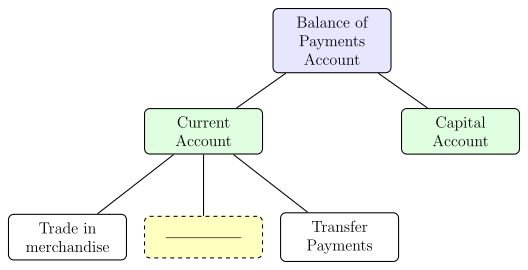
- Part of the current account — It is one element of the current account within the broader Balance of Payments. …
Unlock everything free for 14 days
- Full step-by-step solutions
- Concept-first explanations
- Methods, shortcuts & mistakes
- PYQ mapping + timed mock tests
Full access for 14 days. No credit card required.