English (Core) · Ch 1 — The Last Lesson
About the Author and the Text
About the Author and the Text
About the Author and the Text
Alphonse Daudet (1840–1897) was a French novelist and short-story writer known for his keen observation of ordinary life and his ability to blend humour with pathos. Born in Nîmes in southern France, Daudet moved to Paris as a young man and began writing for newspapers and the theatre. His most famous works include Lettres de mon moulin (Letters from My Windmill), a collection of short stories set in Provence, and the novel Le Petit Chose (The Little Good-for-Nothing). Daudet’s writing is marked by a warm, often nostalgic tone and a sharp eye for social detail.
Words to Notice in the Text — the NCERT vocabulary box
The NCERT text prints these expressions and asks you to infer each meaning from the way the story uses it:
- in great dread of — very much afraid of; dreading something greatly. (Franz set out “in great dread of a scolding.”)
- in unison — all together, at the same time, as one voice. (The class’s “lessons repeated in unison”.)
- counted on — relied on; depended on something happening. (Franz had “counted on the commotion” to slip in unseen.)
- a great bustle — a lot of noisy, busy activity. (The usual noisy start of school was “a great bustle”.)
- thumbed at the edges — worn and frayed at the edges from being handled many times. (Hauser’s “old primer, thumbed at the edges”.)
- reproach ourselves with — blame ourselves for; feel guilty about. (M. Hamel: “We’ve all a great deal to reproach ourselves with.”)
The Last Lesson is a short story drawn from Daudet’s collection Contes du Lundi (Monday Tales), published in 1873. The collection was written in the aftermath of the Franco-Prussian War, and many of its stories reflect the pain of national defeat and the loss of French identity under Prussian occupation. The story is told from the perspective of a young schoolboy, Franz, who arrives at school one morning to discover that this will be the last day of French-language instruction. The Prussian authorities, now in control of the districts of Alsace and Lorraine, have decreed that only German shall be taught in all schools from the following day.
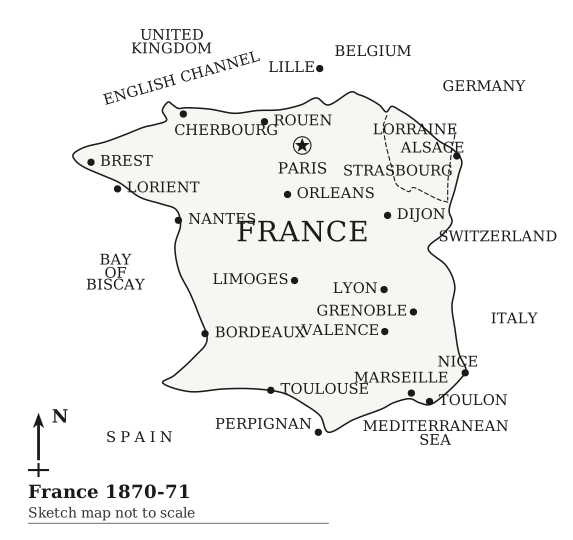
Drawn by us to help you understand the concept clearly, and verified to make sure it's accurate. For exams, practice from your NCERT textbook's own diagram.
France 1870-71 — sketch map (not to scale) showing the districts of Alsace and Lorraine, on France's north-eastern border, which passed into Prussian hands after the Franco-Prussian War.
The historical event that frames the entire story is the Franco-Prussian War of 1870–71, in which France was defeated by Prussia led by Bismarck. Prussia then consisted of what are now Germany, Poland and parts of Austria. Under the peace that followed, the French districts of Alsace and Lorraine passed into Prussian hands, and the new authorities imposed German as the language of administration and education in these regions.
This is the context that gives the story its title and its emotional weight. The "last lesson" is not merely the final class of the school year or the end of a teacher's career — it is the last time these children will ever be taught in their mother tongue. The French language, which had been the medium of their culture, their identity, and their everyday lives, is being erased from the classroom by political decree. Daudet uses this small, intimate scene — a village schoolroom on an ordinary morning — to dramatise a vast historical tragedy. The story becomes a meditation on what it means to lose one's language, and through it, one's connection to the past.
Daudet himself was not from Alsace or Lorraine; he was a Provençal who wrote in French about the loss of regional identity. But he understood deeply that language is not merely a tool for communication — it is the vessel of a people's memory, their songs, their stories, their way of seeing the world. In The Last Lesson, he gives that understanding a concrete, unforgettable form.
The story is often read as a patriotic allegory, but it is also a deeply personal one. Daudet was writing only two years after the war ended, when the wounds were still raw. The story's power comes from its refusal to preach — it simply shows us a classroom, a teacher, a boy, and the quiet grief of a community saying goodbye to something irreplaceable.