Q.(a) IVF is a very popular method these days that is helping childless couples to bear a child. Describe the different steps that are carried out in this technique.
You're viewing a preview — the full solution, concept, methods & PYQ mapping are locked.
Start your 14-day free trial to unlock the full solution →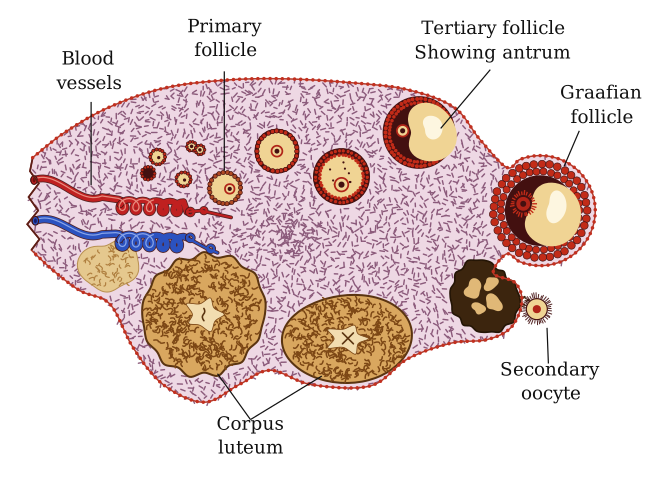
Part (a) describes IVF — ovarian stimulation, ovum and sperm collection, fertilisation outside the body, embryo culture and transfer (ZIFT/IUT) — and explains that GIFT is not IVF because in GIFT fertilisation happens inside the fallopian tube. Part (b) describes a sectional view of the ovary (primary, tertiary and Graafian follicles and the corpus luteum) and names the gonadotropins FSH and LH, whose roles are follicular growth/oogenesis (FSH) and ovulation plus corpus-luteum formation (LH surge).
Part (a)
(a) The Steps of IVF
For many couples who cannot conceive naturally, In Vitro Fertilisation (IVF) offers a well-established assisted reproductive technology. The term in vitro literally means "in glass" — fertilisation is carried out in laboratory glassware, outside the woman's body. The procedure is a sequence of carefully timed steps.
1. Ovarian stimulation and ovum retrieval. Normally only one ovum is released per cycle. For IVF the woman is given hormonal injections (FSH/LH-type drugs) so that her ovaries mature several follicles at once — this is superovulation. The mature ova are then collected from the ovaries by follicular aspiration, a minor procedure using a fine needle guided by ultrasound.
2. Sperm collection and preparation. A semen sample is obtained from the husband (or a donor). The sperm are washed and concentrated in a culture medium so that only healthy, motile sperm remain.
3. Fertilisation in vitro. The retrieved ova and prepared sperm are placed together in a dish of nutrient culture medium kept in an incubator at body temperature. The sperm fertilise the ovum to form a zygote. Where the male has very few motile sperm, a single sperm may be injected directly into the ovum — Intracytoplasmic Sperm Injection (ICSI), a variant of IVF.
4. Embryo culture. The zygote divides over the next few days, developing up to the 8-blastomere stage or the blastocyst stage. The healthiest embryos are selected for transfer.
5. Embryo transfer. The embryo is transferred back into the female's genital tract. An embryo up to the 8-cell stage is transferred into the fallopian tube (ZIFT — Zygote Intra Fallopian Transfer), while an embryo beyond the 8-cell stage is transferred into the uterus (IUT — Intra Uterine Transfer) to complete its further development.
The defining feature of IVF is that fertilisation is achieved outside the body. This makes IVF valuable when the fallopian tubes are blocked or when other fertility barriers exist.
(b) Is GIFT the same as IVF? No — here's why
Gamete Intrafallopian Transfer (GIFT) is often listed alongside IVF, but it is a different technique, and the key difference is where fertilisation occurs.
In GIFT, an ovum collected from a donor is transferred, together with sperm, directly into the fallopian tube of a woman who cannot produce an ovum of her own but can provide a suitable environment for fertilisation and further development. Fertilisation then takes place inside the woman's body, in the natural environment of the fallopian tube. …
Unlock everything free for 14 days
- Full step-by-step solutions
- Concept-first explanations
- Methods, shortcuts & mistakes
- PYQ mapping + timed mock tests
Full access for 14 days. No credit card required.