Q.(a) Draw the sectional view of a seminiferous tubule of human. Label its any six parts.
🔒You're viewing a preview — the full solution, concept, methods & PYQ mapping are locked.
🔒 Start your 14-day free trial to unlock the full solution →Part (a)Concept understanding — Hormonal Regulation Spermatogenesis
Let’s begin with an everyday picture. Think of a factory that produces a specific product — say, a car factory. The factory doesn’t just run on its own; it needs a central command centre that sends signals to start production, keep it steady, and stop it when enough cars are made. In the male body, the “factory” is the testes, and the “product” is sperm. The command centre is the brain — specifically two tiny glands: the hypothalamus and the pituitary gland. The signals they send are hormones (chemical messengers that travel through the blood).
Hormonal regulation of spermatogenesis means that the entire process of sperm production is controlled by a chain of hormones, each one triggering or suppressing the next. This ensures that sperm are made at the right time, in the right quantity, and that the body doesn’t overproduce them.
The Hormonal Chain (Step by Step)
-
Hypothalamus releases GnRH
The hypothalamus, a region at the base of the brain, secretes Gonadotropin-Releasing Hormone (GnRH). This is the “start” signal. GnRH travels a short distance to the pituitary gland, telling it to get ready.
-
Pituitary releases two key hormones
In response to GnRH, the anterior pituitary releases two hormones into the bloodstream:
- LH (Luteinizing Hormone) — targets the Leydig cells in the testes.
- FSH (Follicle-Stimulating Hormone) — targets the Sertoli cells in the seminiferous tubules (the actual “assembly line” where sperm are made).
-
LH stimulates testosterone production
Leydig cells, when activated by LH, produce testosterone. Testosterone is the main male sex hormone and is absolutely essential for spermatogenesis. It acts directly on the seminiferous tubules to drive sperm production.
-
FSH supports the Sertoli cells
Sertoli cells are like the “nourishers” and “quality controllers” inside the tubules. FSH makes them produce nutrients and other factors that help developing sperm cells survive and mature. Sertoli cells also convert some testosterone into a more active form.
Both LH and FSH are needed for normal sperm production. LH provides the fuel (testosterone), and FSH ensures the assembly line runs smoothly. If either is missing, spermatogenesis slows down or stops.
The Feedback Loop (Why It Doesn’t Go Wild)
The body hates waste. If too much testosterone is produced, it sends a message back to the brain to slow down. This is called negative feedback.
- High testosterone in the blood signals the hypothalamus to reduce GnRH release, and the pituitary to reduce LH and FSH release.
- Low testosterone does the opposite — the brain increases GnRH, LH, and FSH to boost production.
This keeps testosterone levels within a narrow, healthy range. Sertoli cells also produce a hormone called inhibin, which specifically suppresses FSH when sperm production is adequate.
Think of it like a thermostat: when the room gets warm enough, the heater turns off. When it cools, the heater turns back on. The hypothalamus and pituitary are the thermostat; testosterone is the heat.
Why This Matters (Even for a Commerce/Humanities Student) …
Part (b)Concept understanding — Reproductive Health
Reproductive Health Significance — A First Look
Think of health as a state of complete well-being — not just the absence of disease. Now apply that to the part of your life that involves reproduction, the biological process by which new individuals are created. That is reproductive health: it is not merely about being free from infections or disorders of the reproductive system. It means having a healthy body, a clear understanding of reproductive processes, and the ability to make informed, responsible choices.
The NCERT textbook defines reproductive health as "a total well-being in all aspects of reproduction — physical, emotional, behavioural, and social." That is the core idea. It is not a narrow medical term; it is a broad, positive concept that touches every person, regardless of gender or age.
Why does it matter?
Reproductive health is significant because it directly affects the quality of life of individuals, families, and communities. When people are reproductively healthy, they can:
- Make informed decisions about marriage, family size, and childbearing.
- Prevent and manage sexually transmitted infections (STIs), including HIV/AIDS.
- Avoid unwanted pregnancies and unsafe abortions, which are major causes of maternal death.
- Ensure safe motherhood — proper care during pregnancy, delivery, and after birth reduces risks for both mother and child.
- Recognise and address problems like infertility, menstrual disorders, or reproductive cancers early.
Reproductive health is not only about problems. It also includes positive aspects like sexual well-being, the ability to have a satisfying and safe sex life, and the freedom to decide if, when, and how often to reproduce.
The bigger picture
On a national scale, reproductive health is linked to population control, maternal and child mortality rates, and the spread of diseases. The Indian government has run programmes like the Reproductive and Child Health (RCH) programme to improve access to services, education, and contraception. The goal is not just to reduce numbers — it is to ensure that every birth is wanted, every pregnancy is safe, and every child is healthy.
Reproductive health is a fundamental right, not a privilege. It requires awareness, access to healthcare, and the removal of social taboos that prevent open discussion.
Key components you should know
- Family planning — spacing and limiting births through contraception. …
Part (a)
(a) Sectional view of a seminiferous tubule. Draw a circular cross-section bounded by a basement membrane; inside, the germ cells lie in layers from the wall towards the lumen. Label any six of:
- Spermatogonia (stem cells, outermost)
- Primary spermatocyte
- Secondary spermatocyte
- Spermatid
- Spermatozoa (lining the lumen)
- Sertoli cell (tall nurse cell spanning wall to lumen)
- Leydig (interstitial) cell (in the space outside the tubule)
- Basement membrane / Lumen
(b) Pituitary hormones in spermatogenesis.
- FSH acts on the Sertoli cells, stimulating them to nourish and support the developing germ cells (and secrete factors including inhibin). …
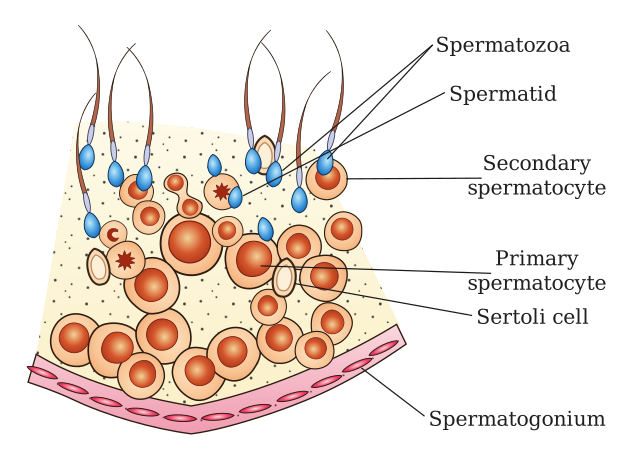
Part (a): a seminiferous-tubule section shows spermatogonia, spermatocytes, spermatids, sperms, Sertoli and Leydig cells; FSH stimulates Sertoli cells and LH stimulates Leydig cells (testosterone) to drive spermatogenesis.
Part (b): IUDs like Copper T and LNG-20 prevent fertilisation/implantation; sterilisation for couples wanting no more children is done by vasectomy in males and tubectomy in females.
Part (a)
- Sectional view of a human seminiferous tubule. In cross-section the tubule is bounded by a basement membrane. Against it lie the spermatogonia (diploid stem cells). Moving inward towards the lumen are the primary spermatocytes, then the smaller secondary spermatocytes, then the spermatids, and finally the spermatozoa lining the central lumen. Spanning the whole thickness are the tall Sertoli cells ("nurse cells") that nourish the germ cells and form the blood-testis barrier. In the interstitial spaces outside the tubule lie the Leydig (interstitial) cells. For the diagram, draw a circular tubule and label any six of: spermatogonia, primary spermatocyte, secondary spermatocyte, spermatid, spermatozoon, Sertoli cell, Leydig cell, basement membrane, lumen.
- Pituitary hormones controlling spermatogenesis. Spermatogenesis is driven by two gonadotropins from the anterior pituitary:
- Follicle Stimulating Hormone (FSH) — acts directly on the Sertoli cells, stimulating them to secrete substances that nourish and support the developing germ cells; the Sertoli cells also release inhibin, which feeds back to suppress FSH.
- Luteinising Hormone (LH) — acts on the Leydig cells of the interstitium, stimulating them to synthesise and secrete testosterone (androgens). Testosterone then acts on the seminiferous tubules to promote spermatogenesis and maintains male secondary sexual characters. …
Showing the 12 most recent of 31 on this concept.
- CBSE 2026Set 57/2/11 markMCQQ.How many of the following features are related to Nirodh – a popular brand of condoms ?(i) Prevention of sexually transmitted infections.(ii) Phagocytosis of sperms.(iii) Male contraceptive device.(iv) Acts as chemical barrier.(v) Physiological changes in cervical mucus. (A) (i), (ii),(iv) (B)(i) and(iii) (C) (i), (ii),(v) (D)(ii) and (iv)
›Reveal solutionSolution
Nirodh is a male contraceptive device (condom) that prevents sexually transmitted infections by acting as a physical barrier; it does not involve phagocytosis, chemical action, or physiological changes in cervical mucus.
Nirodh holds a special place in India's reproductive health history as one of the earliest and most widely promoted brands of condoms under the national family planning programme. Launched in the 1960s, the name itself—derived from the Sanskrit word for "prevention"—reflected the government's effort to make contraception culturally acceptable and accessible. Understanding what condoms actually do, versus what they don't, is essential to answering this question correctly.
Condoms are barrier contraceptives. They work by creating a physical sheath that prevents sperm from entering the female reproductive tract. Because they block direct contact between genital surfaces and bodily fluids, they also offer protection against sexually transmitted infections (STIs) including HIV, gonorrhea, and syphilis. This dual function—contraception and disease prevention—makes them unique among contraceptive methods. So feature (i) Prevention of sexually transmitted infections is absolutely correct for Nirodh.
As a device worn by the male partner during intercourse, Nirodh is clearly a (iii) Male contraceptive device. This is straightforward and indisputable.
Now let's examine what condoms do not do. Feature (ii) Phagocytosis of sperms refers to the engulfing and destruction of sperm cells by immune cells—a biological process that has nothing to do with barrier methods. Phagocytosis occurs naturally in the female reproductive tract as part of the immune response, but it is not a mechanism employed by condoms. Condoms simply block sperm mechanically; they don't trigger or involve any cellular immune activity. …
- CBSE 2026Set ANNUAL1 markQ.Fill in the blank: Leydig cells, synthesise and secrete testicular hormone called as ______.
›Reveal solutionSolution
Leydig (interstitial) cells located between the seminiferous tubules secrete testosterone, the main male sex hormone.
Within the testis, the region outside the seminiferous tubules contains Leydig (interstitial) cells, which synthesise and secrete androgens, principally testosterone, under LH stimula …
- CBSE 2026Set ANNUAL1 markQ.Fill in the blank: ______ a contraceptive tablet developed by the Central Drug Research Institute of Lucknow in India.
›Reveal solutionSolution
The contraceptive tablet developed by CDRI, Lucknow is Saheli.
Saheli is an important indigenous contraceptive achievement of India. It is a non-steroidal, once-a-week oral pill developed by the scientists of the Central Drug Research Institute (CDRI) at Lucknow. It has few side e …
- CBSE 2026Set ANNUAL1 markMCQQ.Diaphragms are contraceptive devices used by females. Which of the following statement is correct about diaphragm?(a) They are introduced into the uterus to prevent implantation.(b) They are placed to cover the cervical region and act as a physical barrier for sperm entry.(c) They act as spermicidal agents.(d) They prevent ovulation by hormonal regulation.
›Reveal solutionSolution
A diaphragm is a barrier contraceptive that fits over the cervix and physically stops sperm from entering the female tract, so (b) is correct.
In the CBSE/NCERT Reproductive Health chapter, contraceptives are grouped as natural, barrier, IUD, hormonal (pills), and surgical. Diaphragms, cervical caps and vaults are barrier methods made of rubber that are inserted to cover the cervix, physically blocking sperm entry. They are reusable and are often used with a spermicidal cream/jelly for extra effect — but the diaphr …
- CBSE 2026Set ANNUAL1 markQ.Write True or False. Surgical methods of contraception prevent gamete formation.
›Reveal solutionSolution
False — sterilisation surgery blocks the vas deferens or fallopian tubes so gametes cannot meet; sperm and eggs are still formed.
In the CBSE/NCERT Reproductive Health chapter, surgical (terminal) contraception means:
- Vasectomy — the vas deferens is cut and tied, so sperm cannot travel out (though the testes keep producing sperm).
- Tubectomy — the fallopian tubes are cut and tied, so the ovum cannot travel down (though the ovary keeps ovulating). …
- CBSE 2025Set 57/4/11 markMCQQ.Assertion (A) : 'Saheli', an oral contraceptive inhibits ovulation and increases phagocytosis of sperms. Reason (R) : It is a non-steroidal preparation.
›Reveal solutionSolution
Saheli is a non-steroidal, once-a-week oral contraceptive, so the Reason (R) is true. But "increasing phagocytosis of sperms" is an action of intrauterine devices (IUDs), not of Saheli, which makes the Assertion (A) false. The correct assertion–reason code is therefore (D): A is false, R is true.
This assertion–reason question, a common NCERT-based CBSE Class 12 pattern, tests whether you can separate the mechanism of the oral pill 'Saheli' from the mechanism of an IUD.
What NCERT actually says about Saheli
Saheli is described as a 'once-a-week' oral contraceptive for females that contains a non-steroidal preparation, with very few side effects and high contraceptive value. NCERT does not credit Saheli with increasing phagocytosis of sperms. General oral pills act mainly by inhibiting ovulation and implantation and by altering the cervical mucus so that the entry of sperms is retarded — not by phagocytosis of sperms.
Where 'phagocytosis of sperms' really belongs
In NCERT, the phrase "increase phagocytosis of sperms within the uterus" is used specifically for intrauterine devices (IUDs). Copper-releasing IUDs increase the phagocytosis of sperms in the uterus, and the released Cu ions suppress sperm motility and the fertilising capacity of sperms. Hormone-releasing IUDs additionally make the uterus unsuitable for implantation and the cervix hostile to sperms.
Evaluating the statements …
- CBSE 2025Set 57/5/11 markMCQQ.Assertion (A) : Cu-T, Cu-7 and LNG-20 are the most widely used copper-releasing IUDs. Reason (R) : Cu-ions in IUDs effectively suppress sperm motility and the fertilising capacity of sperms.
›Reveal solutionSolution
Copper-releasing IUDs work by releasing Cu²⁺ ions that impair sperm function and prevent fertilisation; both the assertion about widely used IUDs and the reason explaining their mechanism are correct and linked.
The question tests your understanding of intrauterine devices (IUDs) as a contraceptive method, specifically the mechanism by which copper-releasing IUDs prevent pregnancy. This is a classic assertion-reason question where you need to evaluate two statements: whether each is true, and whether the reason correctly explains the assertion.
Let's first understand what makes copper IUDs effective. When a copper-releasing IUD is placed in the uterus, it continuously releases cupric ions (Cu²⁺) into the uterine and tubal fluids. These ions create a hostile environment for sperm in multiple ways: they damage sperm membranes, reduce sperm motility (movement), and critically impair the sperm's ability to undergo capacitation and the acrosome reaction—both essential for fertilisation. The copper ions also trigger a local inflammatory response that further enhances the contraceptive effect. Importantly, this is primarily a spermicidal mechanism, not an abortifacient one; fertilisation itself is prevented.
Now let's evaluate each statement:
Evaluating Assertion (A):
-
Cu-T is indeed one of the most common copper IUDs, shaped like the letter T with copper wire wound around the stem.
-
Cu-7 (also called Copper-7) was historically significant and widely used, though it has been largely replaced by newer models in many countries. It had a "7" shape.
-
LNG-20 refers to the levonorgestrel-releasing intrauterine system (Mirena being a brand name), which releases 20 μg of the hormone levonorgestrel per day. Here's the critical point: LNG-20 is not a copper-releasing IUD—it's a hormonal IUD.
The assertion mixes copper IUDs (Cu-T, Cu-7) with a hormonal IUD (LNG-20). While all three are IUDs, only the first two release copper. More accurate examples of copper IUDs would be Cu-T 380A, Cu-375, or Multiload 375.
Watch outA common confusion: not all IUDs work the same way. Copper IUDs release Cu²⁺ ions, while hormonal IUDs like LNG-20 release progestogen. They have different mechanisms of action.
Evaluating Reason (R):
The reason states that Cu-ions suppress sperm motility and fertilising capacity. This is absolutely correct. The mechanism includes:
- Direct toxic effect on sperm
- Inhibition of sperm motility
- Interference with sperm metabolism
- Prevention of sperm capacitation
- Alteration of cervical mucus
- Changes in the endometrium that prevent implantation (secondary mechanism) …
-
- CBSE 2025Set 57/6/11 markMCQQ.Assertion (A) : Male contraceptive 'Nirodh' works on the principle of avoiding chances of ovum and sperm meeting. Reason (R) : It is made of thin rubber/latex sheath and is used to cover the penis before coitus.
›Reveal solutionSolution
Both the assertion and the reason are correct, and the reason accurately explains how the male contraceptive 'Nirodh' prevents conception by acting as a physical barrier.
Reproductive health encompasses a state of complete physical, mental, and social well-being in all matters relating to the reproductive system, not merely the absence of disease or infirmity. A crucial aspect of reproductive health is family planning, which often involves contraception – methods designed to prevent unwanted pregnancies. Contraceptive methods work on various principles, but a fundamental one is preventing the union of male gametes (sperm) and female gametes (ova).
The Assertion (A) states that the male contraceptive 'Nirodh' works on the principle of avoiding the chances of ovum and sperm meeting. This is entirely correct. 'Nirodh' is a brand name for a male condom, which falls under the category of barrier methods of contraception. Barrier methods, as their name suggests, physically prevent the sperm from reaching the ovum. For conception to occur, a sperm must fertilize an ovum. By creating a physical obstruction, condoms ensure that the ejaculated semen, which contains sperm, does not enter the female reproductive tract, thereby effectively preventing the meeting of the gametes.
NoteBarrier methods are highly effective when used correctly and consistently. They also offer the added benefit of protecting against sexually transmitted infections (STIs), a crucial aspect of overall reproductive health.
The Reason (R) explains that 'Nirodh' is made of a thin rubber/latex sheath and is used to cover the penis before coitus. This statement accurately describes the composition and application of a male condom. The thin, elastic material (rubber or latex) is designed to be strong enough to contain the semen while being flexible and comfortable for use. When placed over the erect penis before sexual intercourse, it acts as a physical barrier. …
- CBSE 2025Set X11 markMCQQ.The process of transformation of spermatids into sperms is called(a) Spermatogenesis(b) Spermiogenesis(c) Spermiation(d) Oogenesis
›Reveal solutionSolution
The transformation of spermatids into mature spermatozoa is called spermiogenesis.
During spermatogenesis, spermatids are produced. The subsequent morphological transformation of these non-motile spermatids into motile spermatozoa (sperms) is termed spermiogenesis. Spermatogenesis is the whole process of sperm formation; spermiation is the release of sperms from the Sertoli cells into the …
- CBSE 2025Set F1 markMCQQ.Sertoli cells are controlled by which of the following hormones?(a) LH(b) FSH(c) Prolactin(d) GH
›Reveal solutionSolution
Sertoli (nurse) cells are stimulated by FSH from the anterior pituitary.
In the male, the anterior pituitary secretes two gonadotropins. LH (Luteinising Hormone / ICSH) acts on the Leydig (interstitial) cells to stimulate secretion of testosterone (androgens). FSH (Follicle Stimulating Hormone) acts on the Sertoli cells located within the seminiferous tubules; these nurse cells then …
- CBSE 2025Set A1 markMCQQ.What is the age duration of adolescence?(a) 0 - 11 years(b) 12 - 18 years(c) 19 - 45 years(d) 45 - 70 years
›Reveal solutionSolution
Adolescence is the period of transition from childhood to adulthood, roughly the teenage years.
Adolescence is marked by the onset of puberty, rapid physical growth, and significant physiological, hormonal, and psychological changes as an individual matures from a child into an adult. Of the given options, the span that correctly represents this transitional teenage period is 12 to 18 years. This period is important in the study of reproductive health because reproducti …
- CBSE 2025Set A1 markQ.Fill in the blank with the correct answer: Physical, emotional, behavioural and social well being refers to ______.
›Reveal solutionSolution
Reproductive health is defined by the WHO as complete physical, emotional, behavioural and social well-being related to reproduction, not merely the absence of disease.
The World Health Organisation (WHO) defines reproductive health in a broad sense: a person (or couple) who is reproductively healthy has healthy reproductive organs functioning normally, and also experiences emotional and behavioural well-being in matters related to sex/reproduction, along with the social maturity and responsibility to make informed reproductive decisions. This is much more than the mere absence of disease or a functioni …
🎓Unlock everything free for 14 days
- ✓Full step-by-step solutions
- ✓Concept-first explanations
- ✓Methods, shortcuts & mistakes
- ✓PYQ mapping + timed mock tests
Full access for 14 days. No credit card required.