Q.(a) Write how parasites have evolved with adaptation to co-exist with their hosts in an ecosystem.
🔒You're viewing a preview — the full solution, concept, methods & PYQ mapping are locked.
🔒 Start your 14-day free trial to unlock the full solution →Part (a)Concept understanding — Ecological Interactions
Ecological Interactions: A First Look
Imagine a city. People live in apartments, work in offices, buy food from shops, and throw away garbage that someone else collects. Some people compete for the same job. Others help each other—a landlord provides space, a tenant pays rent. Now shrink that city to a forest, a pond, or even your backyard garden. Replace people with plants, animals, fungi, and bacteria. What you get is a web of relationships between living organisms—that is what ecologists call ecological interactions.
The Core Idea
Every living thing on Earth is connected to others. No organism exists in isolation. A tiger needs deer to eat; the deer needs grass; the grass needs sunlight and soil nutrients made available by bacteria and fungi. These connections are not random—they follow patterns. Some interactions help both partners, some help one at the expense of the other, and some harm both.
The NCERT textbook defines ecological interactions as the relationships between different species in a community. These interactions shape who lives where, how many of them exist, and how energy flows through an ecosystem.
Why Should a Commerce/Humanities Student Care?
You might think this is only for biology students. But consider this: every business operates within an ecosystem of suppliers, competitors, customers, and regulators. A startup that helps its suppliers grow (mutualism) survives longer than one that squeezes them dry (parasitism). A company that competes aggressively with rivals (competition) may drive prices down for consumers. The same logic that governs a forest governs a market—because both are systems of interacting agents.
Ecological interactions are not just "nature facts." They are a lens to understand any system where different entities depend on, compete with, or exploit each other—including economies, societies, and organizations.
The Main Types of Interactions
Ecologists classify interactions based on who benefits (+) and who is harmed (−). A zero (0) means no effect.
1. Mutualism (+ / +)
Both species benefit. Think of bees and flowers: bees get nectar (food), flowers get pollinated (reproduction). In human terms, this is a win-win partnership—like a coffee shop and a bookstore sharing the same space to attract more customers.
2. Competition (− / −)
Both species are harmed because they fight for the same limited resource—food, water, space, light. When two businesses open identical stores on the same street, both may earn less profit. In nature, two species of birds eating the same insect will both struggle if insects become scarce.
3. Predation (+ / −)
One species (predator) kills and eats the other (prey). The predator benefits; the prey is harmed. This is the tiger-deer example. In business, think of a large corporation acquiring a smaller competitor—the acquirer grows, the acquired loses independence.
4. Parasitism (+ / −)
One species (parasite) lives on or inside another (host) and feeds on it, usually without killing it immediately. The parasite benefits; the host is harmed. A tick on a dog, or a virus in a human. In economics, this resembles a monopolist that extracts value from suppliers without providing fair returns.
5. Commensalism (+ / 0)
One species benefits; the other is neither helped nor harmed. Barnacles attaching to a whale get a free ride to food-rich waters; the whale is unaffected. In a city, a street vendor setting up near a popular metro station benefits from foot traffic without affecting the station.
6. Amensalism (− / 0)
One species is harmed; the other is unaffected. A large tree casts shade that kills smaller plants beneath it—the tree does not care. In business, a giant retailer opening next to a small shop may drive the shop out of business without intending to.
| Interaction | Effect on Species A | Effect on Species B | Real-world analogy |
|-------------|---------------------|---------------------|---------------------|
| Mutualism | + | + | Joint venture |
| Competition | − | − | Price war |
| Predation | + | − | Acquisition |
| Parasitism | + | − | Exploitative contract |
| Commensalism | + | 0 | Free rider |
| Amensalism | − | 0 | Collateral damage |
The Bigger Picture
No interaction exists in isolation. A single species may be involved in multiple relationships simultaneously. A tree competes with other trees for sunlight, provides shelter for birds (commensalism), hosts fungi that help it absorb nutrients (mutualism), and is eaten by insects (predation). This complexity is what makes ecosystems resilient—or fragile. …
Part (b)Concept understanding — Ecological Pyramid
Picture a real pyramid -- wide at the base, narrowing all the way up to a single point at the top. Ecologists borrow exactly this shape to describe something that has nothing to do with stone: how numbers, weight (biomass), or energy are distributed across the feeding levels of a food chain. This visual model is called an ecological pyramid.
Every ecological pyramid works the same way. In your NCERT textbook (Class 12 Biology, Chapter 12, Ecosystem, section 12.5), the base always represents the producers -- the first trophic level -- and each successive tier above it represents the next trophic level up (herbivores, then primary carnivores, then secondary or top carnivores), with the apex representing the top-level consumer. Three distinct types are studied, because the same food-chain relationship can be measured in three different ways:
- Pyramid of numbers -- plots the count of individual organisms at each trophic level. NCERT's own grassland example is dramatic: nearly 6 million producer plants are needed to support just three top-carnivores at the apex.
- Pyramid of biomass -- plots the standing crop (usually expressed as dry weight, which is more accurate than fresh weight) of organisms at each level, rather than headcount.
- Pyramid of energy -- plots the amount of energy present at each trophic level, measured per unit area, usually annually.
In most ecosystems, all three pyramids come out upright -- producers are more numerous and have more biomass than herbivores, and herbivores more than carnivores -- because energy shrinks at every step up the food chain (the same 10 per cent law behind energy flow: only about 10 per cent of the energy at one trophic level is transferred to the next).
When a pyramid turns upside down -- numbers and biomass pyramids don't always come out upright, and NCERT points to genuine exceptions you're expected to reason through, not just memorise:
- A single large tree can support so many feeding insects that a pyramid of numbers built around it is inverted right at the base -- one producer, many primary consumers.
- The pyramid of biomass in the sea is commonly inverted: at any given moment the standing crop of tiny, fast-reproducing phytoplankton is small, yet it is turning over fast enough to support a much larger standing crop of the zooplankton feeding on it.
The pyramid of energy is the one type that is never inverted -- it is always upright, in every ecosystem, without exception. Energy is lost as heat at every transfer between trophic levels (unlike nutrients, it is never recycled back), so the level below always has to hold more usable energy than the level feeding on it. …
Part (a)
(a) Adaptations of parasites to co-exist with hosts. Parasitism has favoured special adaptations that let the parasite live on/in the host without necessarily killing it:
- loss of unnecessary sense organs;
- presence of adhesive organs, suckers or hooks to cling to the host;
- loss of the digestive system (they absorb the host's already-digested food);
- high reproductive capacity to offset the low chance of reaching a new host;
- protective coverings that resist the host's digestive/immune defences, and usually host specificity. …
Part (a): parasites adapt with suckers/hooks, loss of sense organs and gut, high fecundity and host specificity; when the host evolves resistance, the parasite co-evolves to overcome it.
Part (b): the pyramid of energy is the ideal, always-upright pyramid; from 1,000,000 J of sunlight the first trophic level receives 10,000 J and the third receives 100 J.
Part (a)
How parasites have evolved to co-exist with their hosts. A parasite lives at the expense of a host, taking shelter and food from it. Natural selection has fitted parasites with adaptations that make this way of life efficient while, in most cases, keeping the host alive (a dead host is a lost home). These include:
- loss of unnecessary organs — sense organs and, often, the digestive system are reduced or lost because the parasite absorbs food already digested by the host;
- attachment devices — adhesive organs, suckers, hooks and clamps that anchor it firmly to the host;
- very high reproductive capacity — since the chance of any one offspring finding a new host is small, parasites produce enormous numbers of eggs;
- resistant body coverings that withstand the host's digestive enzymes and immune attack;
- host specificity — a parasite is usually restricted to one or a few host species with which it is closely adjusted. …
Showing the 12 most recent of 75 on this concept.
- CBSE 2026Set 57/2/11 markMCQQ.What could be the reason of extinction of Abingdon Tortoise from Galapagos Islands ? (A) Intraspecific Competition (B) Predation (C) Parasitism (D) Interspecific Competition
›Reveal solutionSolution
The Abingdon tortoise was driven to extinction primarily by interspecific competition — specifically, competition from introduced feral goats that destroyed its food supply.
The story of the Abingdon tortoise is one of the most poignant examples of how a single introduced species can unravel an entire ecosystem. To understand what happened, we need to look at the Galapagos Islands not as a pristine paradise, but as a fragile web of life that evolved in isolation for millions of years. The Abingdon tortoise, a subspecies of the giant Galapagos tortoise, lived only on Pinta Island (also called Abingdon Island). Its extinction was not caused by a dramatic volcanic eruption or a sudden disease. It was caused by something far quieter, and far more human-driven.
The key event was the arrival of feral goats. Sailors and whalers, over centuries, deliberately left goats on islands as a future source of fresh meat. On Pinta, these goats found a paradise with no natural predators. They multiplied explosively. And here is where the ecological interaction becomes critical: goats and tortoises both eat vegetation — grasses, shrubs, and low-lying plants. But goats are far more efficient and destructive. They can climb, they can strip bark, they can eat plants down to the root. The tortoise, slow and with a limited diet, simply could not compete.
This is a textbook case of interspecific competition — competition between individuals of different species for the same limited resource. The goats did not attack the tortoises directly. They did not parasitise them. They simply outcompeted them for food. As the goat population boomed, the island’s vegetation was decimated. The tortoises, which had evolved with no such competitor, starved. Their population collapsed. By the time scientists realised what was happening, only a single individual — famously named Lonesome George — remained. Despite decades of effort, he never reproduced, and with his death in 2012, the subspecies was gone. …
- CBSE 2026Set 57/3/11 markMCQQ.Every trophic level has a certain mass of living material at a particular time. What is it called ? (A) Standing crop (B) Primary productivity (C) Standing state (D) Ecological efficiency
›Reveal solutionSolution
The mass of living material present at each trophic level at any given moment is called the standing crop.
When ecologists study how energy and matter flow through an ecosystem, they need a way to measure what's actually present at each feeding level at any snapshot in time. Imagine walking into a grassland and asking: how much grass is there right now? How many grasshoppers? How many birds feeding on those grasshoppers? Each of these groups represents a trophic level, and the total mass of all organisms at that level, measured at a particular moment, has a specific name.
This measurement is called the standing crop. It represents the biomass—the total dry weight of all living organisms—at a given trophic level at a specific point in time. Think of it as taking inventory of life: if you could weigh all the producers, or all the primary consumers, or all the secondary consumers in an ecosystem right now, that weight would be the standing crop for that level.
The standing crop is crucial because it forms the basis of ecological pyramids. When we draw a pyramid of biomass, each bar represents the standing crop at that trophic level. In most terrestrial ecosystems, you'll see a classic pyramid shape—lots of plant biomass at the base, less herbivore biomass in the middle, and even less carnivore biomass at the top. But in some aquatic ecosystems, the pyramid can be inverted because phytoplankton (though small in total mass at any moment) reproduce so rapidly that they can support a larger standing crop of zooplankton. …
- CBSE 2026Set V11 markMCQQ.Herbivores in a broad ecological context not very different from(a) Commensals(b) Predators(c) Parasites(d) Producers
›Reveal solutionSolution
In a broad ecological sense a herbivore that feeds on a plant is, functionally, a predator on that plant.
Predation is any interaction in which one organism (the predator) consumes another living organism (the prey) for its nutrition. When this idea is applied broadly, a herbivore eating a plant is essentially a "predator" of that plant, because it is a consumer that lives on another living organism and transfers energy from the producer level to higher trophic levels. This is why the NCERT text states that, in a broad ecological context, herbivores are not very different from p …
- CBSE 2026Set A1 markMCQQ.Which of the following was used to control the cactus that had been introduced in Australia?(a) Moth(b) Calotropis(c) Phytophagous insects(d) Virus
›Reveal solutionSolution
The cactus moth Cactoblastis controlled the introduced Opuntia cactus in Australia — a classic biological-control example.
When the prickly-pear cactus (Opuntia) was introduced into Australia in the early 1900s, it spread uncontrollably because it had no natural enemies there. It was brought under control by introducing a natural predator (a herbivore) — the cactus-feeding moth Cactoblastis cactorum. Thi …
- CBSE 2026Set A1 markMCQQ.What is lichen an example of?(a) Mutualism(b) Competition(c) Parasitism(d) Commensalism
›Reveal solutionSolution
Lichens are a mutualism between a fungus and an alga, where both partners benefit.
A lichen is an intimate, mutually beneficial partnership between a fungus and a photosynthetic partner (an alga or a cyanobacterium). The alga carries out photosynthesis and supplies food, while the fungus provides shelter, anchorage, water and min …
- CBSE 2026Set BOTANY1 markMCQQ.In terms of population interactions, mycorrhiza is an example of _____.(a) competition(b) predation(c) parasitism(d) mutualism
›Reveal solutionSolution
Mycorrhiza is a mutualistic association between a fungus and the roots of a higher plant, in which both partners benefit.
Population interactions between two species can be classified by their net effect (+, -, 0) on each partner: mutualism (+ +), competition (- -), predation/parasitism (+ -), commensalism (+ 0), and amensalism (- 0). Mycorrhiza is the intimate association of a fungus with the root system of a vascular plant. The fungal hyphae greatly increase the absorptive surface area of the root system, so the fungus helps the plant take up phosphorus and other minerals (and sometimes water) from the soil more efficiently. In return, the plant supplies the fungus with photosynthetically fixed carbohydrates (sugars) that the non-photosynthetic fungus cannot make for itself. Because BOTH pa …
- CBSE 2026Set BOTANY1 markMCQQ.In an ecological pyramid of energy, _____ trophic level is occupied by the herbivores.(a) first(b) second(c) third(d) fourth
›Reveal solutionSolution
In any ecological pyramid (of energy, numbers, or biomass), producers occupy the first trophic level and herbivores (primary consumers) occupy the second.
An ecological pyramid represents the trophic structure of an ecosystem as successive trophic levels, arranged from producers at the base upward through consumers. The general sequence is:
- First trophic level - producers (green plants/algae), which fix solar energy through photosynthesis.
- Second trophic level - primary consumers, i.e. herbivores, which feed directly on producers (e.g. a grasshopper eating grass, or zooplankton eating phytoplankton).
- Third trophic level - secondary consumers (primary carnivores), which eat herbivores.
- Fourth trophic level - tertiary consumers (secondary/top carnivores), which eat other carnivores. …
- CBSE 2026Set ANNUAL1 markMCQQ.If species 'A' + (Positive) and species 'B' - (Negative) in population, the name of interaction will be(a) Mutualism(b) Competition(c) Predation(d) Parasitism
›Reveal solutionSolution
A +/- interaction, where one species benefits and the other is harmed, describes parasitism; of the given options 'Parasitism' is the standard population interaction named for this sign pattern.
Ecological population interactions are often summarised by the effect on each species: Mutualism is (+,+) - both benefit; Competition is (-,-) - both are harmed; Commensalism is (+,0) - one benefits, the other unaffected. When one species benefits (+) at the cost of the other, which is harmed (-), the interaction is parasitism - the parasite (species A) derives nutrition from the h …
- CBSE 2026Set ANNUAL1 markMCQQ.Pyramid of biomass in the sea are generally(a) Straight(b) Upright(c) Invert(d) All kinds
›Reveal solutionSolution
Unlike a pond or forest, the biomass pyramid in the sea is typically inverted because the producers (phytoplankton) have very small standing biomass but a very high turnover/reproduction rate.
In a marine ecosystem, producer biomass at any instant (phytoplankton) is small, since they are rapidly consumed and have short life spans and fast reproduction, while the standing biomass of consumers (zooplankton, fish etc.) at higher trophic levels is comparatively larger. So when biomass is plo …
- CBSE 2026Set ANNUAL1 markQ.What is brood parasitism? Give one example.
›Reveal solutionSolution
Brood parasitism is a special case of exploitative interaction where a parasitic bird lays eggs in a host bird's nest, and the unsuspecting host raises the parasite's chick as its own.
Brood parasitism is an interesting interspecific interaction (studied alongside predation, parasitism, and other population interactions) in which a bird species lays its eggs in the nest of another species, so the host bird ends up incubating and rearing the parasite's young, often at the expense of its own offspring.
…
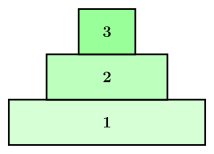
- CBSE 2026Set ANNUAL1 markMCQQ.The diagram given below shows the type of an ecological pyramid. A sharp decrease is seen at higher trophic levels. Choose the correct option for the indication of this pyramid.(a) The energy is increasing at higher trophic level(b) The energy is same in all trophic levels(c) The energy is constant in all trophic levels(d) The energy is decreasing at higher trophic level
›Reveal solutionSolution
Energy decreases progressively at each successive trophic level because a large fraction (~90%) is lost as heat/respiration at every transfer (the 10% law), so the pyramid of energy is always upright and each tier is smaller than the one below it.
At each trophic level, organisms use most of the energy they receive for their own respiration, movement and metabolism, and only a small fraction (roughly 10%, per Lindeman's 10% law) is stored in biomass and passed on to the next trophic level when consumed. This progressive energy loss means producers (tier 1, widest base) always have the most energy, prim …
- CBSE 2026Set ANNUAL1 markMCQQ.This type of interaction confers benefits on both interacting species are called:(a) Commensalism(b) Mutualism(c) Parasitism(d) Competition
›Reveal solutionSolution
An interaction that benefits both species is mutualism.
Interspecific interactions are classified by their effect on the two species. Mutualism is the interaction in which both species are benefited (a +/+ relationship), for example the pollination of flowers by bees, or lichens (fungus and alga). In commensalism one benefits and the other is unaffected (+/0), in parasitism one benefits …
🎓Unlock everything free for 14 days
- ✓Full step-by-step solutions
- ✓Concept-first explanations
- ✓Methods, shortcuts & mistakes
- ✓PYQ mapping + timed mock tests
Full access for 14 days. No credit card required.