Q.Study the diagrammatic representation of S.L. Miller’s experiment given below and answer the questions that follow :
You're viewing a preview — the full solution, concept, methods & PYQ mapping are locked.
Start your 14-day free trial to unlock the full solution →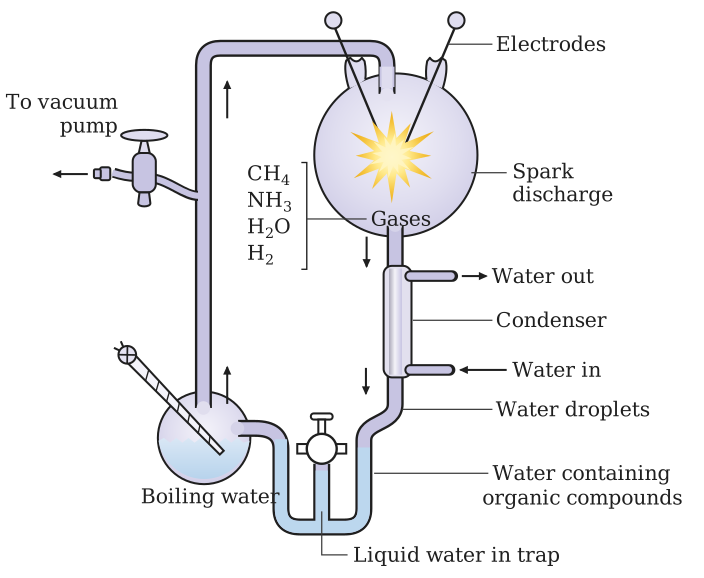
Miller recreated early Earth's reducing atmosphere by circulating methane, ammonia, hydrogen, and water vapour through electric sparks; he collected amino acids (simple organic molecules), demonstrating that chemical evolution could produce life's building blocks from inorganic precursors.
Stanley Miller's 1953 experiment stands as one of the most elegant demonstrations in biology: that the raw materials of life could assemble spontaneously under the harsh conditions of primordial Earth. The experiment tested Oparin and Haldane's hypothesis that organic molecules arose from inorganic matter before biological evolution began.
The genius lay in simulation. Rather than speculate, Miller built a miniature early Earth in glassware and let chemistry speak.
(a) Recreating Pre-biotic Conditions
Miller needed to mimic the environment that existed roughly 3.8 billion years ago, before any living organism appeared. Based on the prevailing theory, early Earth had:
- A reducing atmosphere — no free oxygen, rich in simple gases.
- Energy sources — lightning storms, UV radiation, volcanic heat.
- Water — oceans where reactions could occur and products accumulate.
His apparatus achieved this through three components:
The gas mixture: Miller filled a sealed glass system with methane (CH4), ammonia (NH3), hydrogen (H2), and water vapour (H2O). This cocktail represented the hypothesized reducing atmosphere, devoid of molecular oxygen that would otherwise oxidize and destroy organic molecules as they formed.
The energy source: He passed continuous electric sparks through the gas chamber. These sparks simulated lightning, providing the activation energy needed to break stable bonds in the simple gases and drive synthesis of more complex molecules.
The condensation trap: Water was boiled in one flask, circulated as vapour through the spark chamber, then condensed and collected in a cooled trap. This mimicked the water cycle — evaporation from warm oceans, reaction in the atmosphere, and return as rain carrying newly formed compounds into a "primordial soup."
The system ran continuously for about a week, cycling gases and water while sparks crackled through the mixture.
The key insight: Miller didn't try to create life. He asked a simpler question — can chemistry alone, without enzymes or cells, build organic molecules from inorganic starting materials?
(b) The Organic Products
After a week, the water in the collection flask turned noticeably pink-brown. Chemical analysis revealed something remarkable:
Miller had synthesized amino acids — specifically glycine, alanine, aspartic acid, and several others. These are the monomers that link together to form proteins, the workhorses of all living cells.
Beyond amino acids, the mixture contained:
| Compound Type | Examples |
|---|---|
| Amino acids | Glycine, alanine, aspartic acid, glutamic acid |
| Organic acids | Formic acid, acetic acid |
| Urea | A simple nitrogen-containing compound |
| Other organics | Aldehydes, HCN polymers |
The most significant finding was the amino acids, because they demonstrated that the fundamental building blocks of life could form spontaneously from simple atmospheric gases under plausible early-Earth conditions.
A common mistake: Miller did not create life, nor even proteins. He synthesized only the monomers (amino acids), not the polymers (proteins), and certainly not self-replicating systems. The experiment addressed chemical synthesis, not biological organization. …
Unlock everything free for 14 days
- Full step-by-step solutions
- Concept-first explanations
- Methods, shortcuts & mistakes
- PYQ mapping + timed mock tests
Full access for 14 days. No credit card required.