Q.The pyramid of biomass in sea is generally inverted because in sea : (A) Biomass of fishes exceeds that of phytoplankton. (B) Number of phytoplanktons is more. (C) Number of phytoplanktons is less. (D) Large fishes feed on small fishes.
🔒You're viewing a preview — the full solution, concept, methods & PYQ mapping are locked.
🔒 Start your 14-day free trial to unlock the full solution →Concept understanding — Ecological Pyramid
Picture a real pyramid -- wide at the base, narrowing all the way up to a single point at the top. Ecologists borrow exactly this shape to describe something that has nothing to do with stone: how numbers, weight (biomass), or energy are distributed across the feeding levels of a food chain. This visual model is called an ecological pyramid.
Every ecological pyramid works the same way. In your NCERT textbook (Class 12 Biology, Chapter 12, Ecosystem, section 12.5), the base always represents the producers -- the first trophic level -- and each successive tier above it represents the next trophic level up (herbivores, then primary carnivores, then secondary or top carnivores), with the apex representing the top-level consumer. Three distinct types are studied, because the same food-chain relationship can be measured in three different ways:
- Pyramid of numbers -- plots the count of individual organisms at each trophic level. NCERT's own grassland example is dramatic: nearly 6 million producer plants are needed to support just three top-carnivores at the apex.
- Pyramid of biomass -- plots the standing crop (usually expressed as dry weight, which is more accurate than fresh weight) of organisms at each level, rather than headcount.
- Pyramid of energy -- plots the amount of energy present at each trophic level, measured per unit area, usually annually.
In most ecosystems, all three pyramids come out upright -- producers are more numerous and have more biomass than herbivores, and herbivores more than carnivores -- because energy shrinks at every step up the food chain (the same 10 per cent law behind energy flow: only about 10 per cent of the energy at one trophic level is transferred to the next).
When a pyramid turns upside down -- numbers and biomass pyramids don't always come out upright, and NCERT points to genuine exceptions you're expected to reason through, not just memorise:
- A single large tree can support so many feeding insects that a pyramid of numbers built around it is inverted right at the base -- one producer, many primary consumers.
- The pyramid of biomass in the sea is commonly inverted: at any given moment the standing crop of tiny, fast-reproducing phytoplankton is small, yet it is turning over fast enough to support a much larger standing crop of the zooplankton feeding on it.
The pyramid of energy is the one type that is never inverted -- it is always upright, in every ecosystem, without exception. Energy is lost as heat at every transfer between trophic levels (unlike nutrients, it is never recycled back), so the level below always has to hold more usable energy than the level feeding on it. …
An ecological pyramid of biomass represents the total dry weight of organisms at each trophic level per unit area at a given time. In most terrestrial ecosystems this pyramid is upright—producers have the greatest biomass, followed by herbivores, then carnivores.
In aquatic ecosystems, particularly the open sea, the pyramid of biomass is typically inverted. Phytoplankton (the producers) have a very small standing biomass compared to the zooplankton and fish that feed on them. This happens because phytoplankton reproduce extremely rapidly—they have a high turnover rate. Even though their biomass at any snapshot is low, they produce enough organic matter over time to support a much larger biomass of consumers above them. The consumers (fish, zooplankton) are longer-lived and accumulate biomass, so at any given moment their total weight exceeds that of the phytoplankton. …
The pyramid of biomass in the sea is inverted because the standing crop (biomass at any given moment) of phytoplankton is smaller than that of zooplankton and fish, even though phytoplankton reproduce rapidly and support the entire food chain.
An ecological pyramid is a graphical representation that shows the relationship between different trophic levels in an ecosystem. When we talk about a pyramid of biomass, we're measuring the total dry weight of all living organisms at each level at a particular moment in time — what ecologists call the "standing crop."
In most terrestrial ecosystems, the pyramid of biomass is upright. Think of a forest: the biomass of trees (producers) far exceeds that of herbivores, which in turn exceeds that of carnivores. This makes intuitive sense — you need a large base of producers to support the levels above.
But marine ecosystems, particularly the open ocean, present a fascinating exception. Here the pyramid of biomass is typically inverted, meaning the biomass of producers is actually less than that of consumers at higher trophic levels. This seems to violate basic ecological logic — how can a smaller base support a larger structure?
The answer lies in the nature of phytoplankton, the primary producers of marine ecosystems. These microscopic organisms have an extraordinarily high rate of reproduction and turnover. A single phytoplankton cell might live only a few days, but during that time it reproduces rapidly. So while the standing biomass of phytoplankton at any given moment is small, their productivity — the rate at which they produce new biomass — is enormous.
Think of it like a busy restaurant with a small kitchen but very fast service. At any moment there aren't many dishes ready (small standing crop), but over the course of a day, hundreds of meals are produced (high productivity). …
Showing the 12 most recent of 19 on this concept.
- CBSE 2026Set 57/3/11 markMCQQ.Every trophic level has a certain mass of living material at a particular time. What is it called ? (A) Standing crop (B) Primary productivity (C) Standing state (D) Ecological efficiency
›Reveal solutionSolution
The mass of living material present at each trophic level at any given moment is called the standing crop.
When ecologists study how energy and matter flow through an ecosystem, they need a way to measure what's actually present at each feeding level at any snapshot in time. Imagine walking into a grassland and asking: how much grass is there right now? How many grasshoppers? How many birds feeding on those grasshoppers? Each of these groups represents a trophic level, and the total mass of all organisms at that level, measured at a particular moment, has a specific name.
This measurement is called the standing crop. It represents the biomass—the total dry weight of all living organisms—at a given trophic level at a specific point in time. Think of it as taking inventory of life: if you could weigh all the producers, or all the primary consumers, or all the secondary consumers in an ecosystem right now, that weight would be the standing crop for that level.
The standing crop is crucial because it forms the basis of ecological pyramids. When we draw a pyramid of biomass, each bar represents the standing crop at that trophic level. In most terrestrial ecosystems, you'll see a classic pyramid shape—lots of plant biomass at the base, less herbivore biomass in the middle, and even less carnivore biomass at the top. But in some aquatic ecosystems, the pyramid can be inverted because phytoplankton (though small in total mass at any moment) reproduce so rapidly that they can support a larger standing crop of zooplankton. …
- CBSE 2026Set BOTANY1 markMCQQ.In an ecological pyramid of energy, _____ trophic level is occupied by the herbivores.(a) first(b) second(c) third(d) fourth
›Reveal solutionSolution
In any ecological pyramid (of energy, numbers, or biomass), producers occupy the first trophic level and herbivores (primary consumers) occupy the second.
An ecological pyramid represents the trophic structure of an ecosystem as successive trophic levels, arranged from producers at the base upward through consumers. The general sequence is:
- First trophic level - producers (green plants/algae), which fix solar energy through photosynthesis.
- Second trophic level - primary consumers, i.e. herbivores, which feed directly on producers (e.g. a grasshopper eating grass, or zooplankton eating phytoplankton).
- Third trophic level - secondary consumers (primary carnivores), which eat herbivores.
- Fourth trophic level - tertiary consumers (secondary/top carnivores), which eat other carnivores. …
- CBSE 2026Set ANNUAL1 markMCQQ.Pyramid of biomass in the sea are generally(a) Straight(b) Upright(c) Invert(d) All kinds
›Reveal solutionSolution
Unlike a pond or forest, the biomass pyramid in the sea is typically inverted because the producers (phytoplankton) have very small standing biomass but a very high turnover/reproduction rate.
In a marine ecosystem, producer biomass at any instant (phytoplankton) is small, since they are rapidly consumed and have short life spans and fast reproduction, while the standing biomass of consumers (zooplankton, fish etc.) at higher trophic levels is comparatively larger. So when biomass is plo …
- CBSE 2026Set ANNUAL1 markMCQQ.The diagram given below shows the type of an ecological pyramid. A sharp decrease is seen at higher trophic levels. Choose the correct option for the indication of this pyramid.(a) The energy is increasing at higher trophic level(b) The energy is same in all trophic levels(c) The energy is constant in all trophic levels(d) The energy is decreasing at higher trophic level
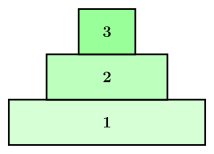
›Reveal solutionSolution
Energy decreases progressively at each successive trophic level because a large fraction (~90%) is lost as heat/respiration at every transfer (the 10% law), so the pyramid of energy is always upright and each tier is smaller than the one below it.
At each trophic level, organisms use most of the energy they receive for their own respiration, movement and metabolism, and only a small fraction (roughly 10%, per Lindeman's 10% law) is stored in biomass and passed on to the next trophic level when consumed. This progressive energy loss means producers (tier 1, widest base) always have the most energy, prim …
- CBSE 2026Set ANNUAL1 markMCQQ.Assertion : The pyramid of energy is always upright. Reason : At each trophic level some energy is lost as heat.(a) If both Assertion and Reason are true and Reason is a correct explanation of the Assertion.(b) If both Assertion and Reason are true but Reason is not a correct explanation of the Assertion.(c) If Assertion is true but Reason is false.(d) If both Assertion and Reason are false.
›Reveal solutionSolution
Both statements are true and the loss of energy as heat at each trophic level is exactly why the energy pyramid is always upright — so the answer is (A).
Assertion: The pyramid of energy is always upright — TRUE. Unlike pyramids of number or biomass (which can be inverted), the energy pyramid can never be inverted.
Reason: At each trophic level some energy is lost as heat — TRUE. As energy flows from one trophic level to the next, only about 10% is transferred; the rest is lost mainly as heat during respiration and metabolism (Lindeman's 10% law).
…
- CBSE 2025Set ANNUAL1 markMCQQ.The pyramid of energy is-(a) Always inverted(b) Always upright(c) Some times uprighted and some time inverted(d) None of these
›Reveal solutionSolution
The pyramid of energy is always upright because energy loss occurs at every trophic level.
As per the second law of thermodynamics, energy flow through an ecosystem is unidirectional and a substantial part of the energy is always lost as heat (through respiration) at every trophic transfer. Because of this progressive loss, the amount of energy available decreases from producers to successive consumer levels. Hence, when energy content is plotted against trophic level, the pyramid of energy always ha …
- CBSE 2025Set ANNUAL1 markQ.The pyramid of _________ is always upright and can never be inverted.
›Reveal solutionSolution
Because energy is progressively lost as heat at each trophic transfer, the pyramid of energy can never be inverted; it is always upright, unlike pyramids of numbers or biomass in some ecosystems.
Ecological pyramids can be of three types: pyramid of number, pyramid of biomass, and pyramid of energy.
- Pyramids of number and biomass may sometimes be inverted (e.g., a pyramid of numbers is inverted in a tree ecosystem where one tree supports many insects; a pyramid of biomass is inverted in a pond/sea ecosystem where a small standing crop of phytoplankton supports a larger biomass of zooplankton and fish). …
- CBSE 2025Set ANNUAL1 markMCQQ.An inverted pyramid of biomass can be found in(a) deserts(b) marine(c) grassland(d) tundra
›Reveal solutionSolution
Marine ecosystems commonly show an inverted biomass pyramid, since the standing crop of tiny, fast-reproducing phytoplankton is much smaller than the biomass of the zooplankton and fish that depend on it.
A pyramid of biomass represents the total mass of living organisms at each trophic level. It is usually upright in most terrestrial ecosystems (like deserts, grasslands, and tundra), since producer biomass exceeds that of the consumers feeding on it. However, in marine (e.g., open ocean) ecosystems, the producers (phytoplankton) have a very small standing biomass at any given time (because they are tiny, short-lived, and reproduce rapidly, being continuously consumed and replac …
- CBSE 2024Set 57/2/11 markMCQQ.The pyramid of biomass in sea is generally inverted because in sea : (A) Biomass of fishes exceeds that of phytoplankton. (B) Number of phytoplanktons is more. (C) Number of phytoplanktons is less. (D) Large fishes feed on small fishes.
›Reveal solutionSolution
The pyramid of biomass in the sea is inverted because the standing crop (biomass at any given moment) of phytoplankton is smaller than that of zooplankton and fish, even though phytoplankton reproduce rapidly and support the entire food chain.
An ecological pyramid is a graphical representation that shows the relationship between different trophic levels in an ecosystem. When we talk about a pyramid of biomass, we're measuring the total dry weight of all living organisms at each level at a particular moment in time — what ecologists call the "standing crop."
In most terrestrial ecosystems, the pyramid of biomass is upright. Think of a forest: the biomass of trees (producers) far exceeds that of herbivores, which in turn exceeds that of carnivores. This makes intuitive sense — you need a large base of producers to support the levels above.
But marine ecosystems, particularly the open ocean, present a fascinating exception. Here the pyramid of biomass is typically inverted, meaning the biomass of producers is actually less than that of consumers at higher trophic levels. This seems to violate basic ecological logic — how can a smaller base support a larger structure?
The answer lies in the nature of phytoplankton, the primary producers of marine ecosystems. These microscopic organisms have an extraordinarily high rate of reproduction and turnover. A single phytoplankton cell might live only a few days, but during that time it reproduces rapidly. So while the standing biomass of phytoplankton at any given moment is small, their productivity — the rate at which they produce new biomass — is enormous.
NoteThink of it like a busy restaurant with a small kitchen but very fast service. At any moment there aren't many dishes ready (small standing crop), but over the course of a day, hundreds of meals are produced (high productivity). …
- CBSE 2024Set ANNUAL1 markMCQQ.The following ecological pyramid represents :(a) Pyramid of Number(b) Pyramid of Biomass(c) Inverted Pyramid of number(d) Inverted Pyramid of energy
›Reveal solutionSolution
A pyramid plotting dry weight (biomass) at each trophic level, narrowing steadily from producers to top carnivores, is an (upright) Pyramid of Biomass.
The pyramid shown plots dry weight (kg m⁻²) — a standard measure of standing crop biomass — against trophic level, with values PP = 809, PC = 37, SC = 11, TC = 1.5, each bar narrower than the one below it. Because the y-axis is biomass (not the count of organisms) and the bars shrink steadily from the producer level up to the tertiary consumer level, this is an upright pyramid of biomass, reflecting the fact that biomass generally decreases at each successive trophic level as energy and matter are lost at each transfer (in …
- CBSE 2023Set A1 markQ.Fill in the blank: Pyramid of energy is always ______.
›Reveal solutionSolution
Energy pyramids are always upright because energy decreases at each successive trophic level due to loss as heat and in metabolism.
At every transfer of energy from one trophic level to the next (producers → herbivores → carnivores), a large fraction (roughly 90%) of the energy is lost as heat, through respiration, and in unused/undigested matter, following the second law of thermodynamics. Only about 10% is passed on to the next level (the '10% law'). Because energy input at the producer level is always the greatest and keeps decreasing at every subsequent level, …
- CBSE 2023Set ANNUAL1 markQ.What are found in maximum number in a food-chain?
›Reveal solutionSolution
In an upright pyramid of numbers, producers occupy the base and are present in the greatest number of any trophic level.
A food chain is a series of organisms in which each is eaten by the next, transferring energy from producers through successive trophic levels of consumers. In most ecosystems (e.g., a grassland), the pyramid of numbers is upright — the number of individuals decreases from the producer level to the top-carnivore level. This happens because the energy available decreases at each successive trophic level (following the 10% law), and each higher-level consumer needs to eat many organisms of the …
🎓Unlock everything free for 14 days
- ✓Full step-by-step solutions
- ✓Concept-first explanations
- ✓Methods, shortcuts & mistakes
- ✓PYQ mapping + timed mock tests
Full access for 14 days. No credit card required.