Q.Given below is a pie chart representing global diversity of vertebrates. [Figure: pie chart of global vertebrate diversity with segments labelled Fishes, A, B, C and D.]
You're viewing a preview — the full solution, concept, methods & PYQ mapping are locked.
Start your 14-day free trial to unlock the full solution →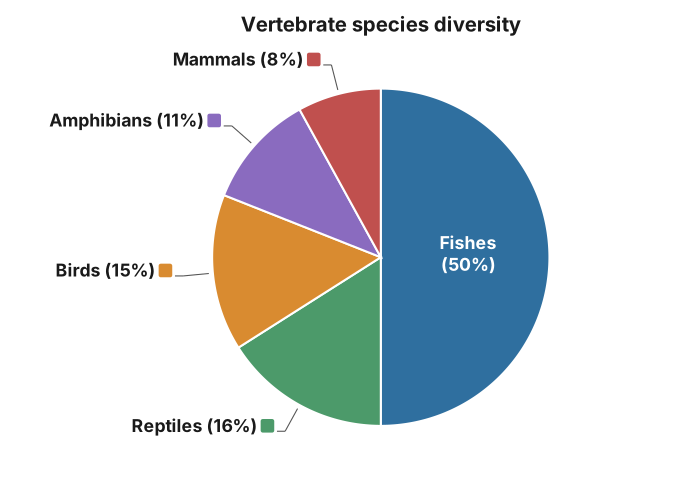
Vertebrate diversity, ranked by species richness, is: Fishes (largest) > Reptiles ≈ Birds > Amphibians > Mammals (smallest). The actual pie-chart image for this question was not preserved in transcription, so groups A-D cannot be confidently assigned specific letters here — this answer teaches the ranking so you can match it against your own paper's chart, and gives two verified examples of recently extinct animals for part (b).
Understanding vertebrate diversity patterns
The global distribution of vertebrate species follows a clear hierarchy driven by evolutionary success and ecological adaptability. Fishes, having radiated across marine and freshwater habitats for over 500 million years, constitute roughly half of all known vertebrate species. The remaining vertebrates — the tetrapods — split into four major classes, each with a characteristic diversity level that reflects its evolutionary history and ecological constraints:
- Reptiles (Reptilia) and Birds (Aves) — the two next-largest groups after Fishes, broadly comparable in species count to each other.
- Amphibians (Amphibia) — smaller than Reptiles and Birds.
- Mammals (Mammalia) — the smallest of the five vertebrate classes by species count.
(a) Identifying groups A, B, C, and D
This question asks you to redraw and label a specific pie chart printed on your question paper. The platform's transcription of this paper preserved the question text but not the chart's image or its exact segment proportions, so the letters A, B, C, D cannot be confidently matched to specific vertebrate classes here — doing so would risk teaching a guess as if it were the confirmed answer. Instead, use the ranking below against the actual segment sizes you see in your own paper.
How to read the chart in your paper:
- The largest segment is always Fishes.
- The next two largest segments (broadly similar in size to each other) are Reptiles and Birds — match A/B to whichever two segments are the next-biggest after Fishes.
- The next segment down in size is Amphibians.
- The smallest segment is Mammals.
Redraw the chart with Fishes as the largest slice, Reptiles and Birds as the next two largest (roughly equal to each other), Amphibians smaller still, and Mammals as the smallest slice.
(b) Two examples of recently extinct animals
Recent extinctions — those occurring in the past few centuries — serve as stark reminders of anthropogenic impact on biodiversity. Two well-documented examples are:
1. Dodo (Raphus cucullatus) …
Unlock everything free for 14 days
- Full step-by-step solutions
- Concept-first explanations
- Methods, shortcuts & mistakes
- PYQ mapping + timed mock tests
Full access for 14 days. No credit card required.