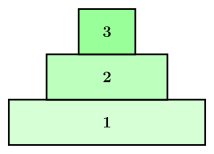
Q.(a) Given below is a pyramid found in an ecosystem, where each bar represents the standing crop available in the trophic level.
You're viewing a preview — the full solution, concept, methods & PYQ mapping are locked.
Start your 14-day free trial to unlock the full solution →Concept understanding — Ecological Pyramid
Picture a real pyramid -- wide at the base, narrowing all the way up to a single point at the top. Ecologists borrow exactly this shape to describe something that has nothing to do with stone: how numbers, weight (biomass), or energy are distributed across the feeding levels of a food chain. This visual model is called an ecological pyramid.
Every ecological pyramid works the same way. In your NCERT textbook (Class 12 Biology, Chapter 12, Ecosystem, section 12.5), the base always represents the producers -- the first trophic level -- and each successive tier above it represents the next trophic level up (herbivores, then primary carnivores, then secondary or top carnivores), with the apex representing the top-level consumer. Three distinct types are studied, because the same food-chain relationship can be measured in three different ways:
- Pyramid of numbers -- plots the count of individual organisms at each trophic level. NCERT's own grassland example is dramatic: nearly 6 million producer plants are needed to support just three top-carnivores at the apex.
- Pyramid of biomass -- plots the standing crop (usually expressed as dry weight, which is more accurate than fresh weight) of organisms at each level, rather than headcount.
- Pyramid of energy -- plots the amount of energy present at each trophic level, measured per unit area, usually annually.
In most ecosystems, all three pyramids come out upright -- producers are more numerous and have more biomass than herbivores, and herbivores more than carnivores -- because energy shrinks at every step up the food chain (the same 10 per cent law behind energy flow: only about 10 per cent of the energy at one trophic level is transferred to the next).
When a pyramid turns upside down -- numbers and biomass pyramids don't always come out upright, and NCERT points to genuine exceptions you're expected to reason through, not just memorise:
- A single large tree can support so many feeding insects that a pyramid of numbers built around it is inverted right at the base -- one producer, many primary consumers.
- The pyramid of biomass in the sea is commonly inverted: at any given moment the standing crop of tiny, fast-reproducing phytoplankton is small, yet it is turning over fast enough to support a much larger standing crop of the zooplankton feeding on it.
The pyramid of energy is the one type that is never inverted -- it is always upright, in every ecosystem, without exception. Energy is lost as heat at every transfer between trophic levels (unlike nutrients, it is never recycled back), so the level below always has to hold more usable energy than the level feeding on it. …
Part (a): the figure is an inverted pyramid of biomass (aquatic, phytoplankton low standing crop but high turnover); pyramids ignore food-web complexity/omnivores and omit decomposers.
Part (b): biodiversity loss reduces productivity and ecosystem services and lowers stability/resilience; its main causes are habitat loss & fragmentation and over-exploitation.
(i) Because each bar (standing crop) is larger at the higher levels, the figure is an inverted pyramid of biomass. Normally producers have the greatest biomass, but this inverted form arises in aquatic ecosystems. There the producers are phytoplankton, which have a very small standing crop at any instant yet reproduce extremely rapidly (high turnover). Their fast replacement lets a small producer biomass support a much larger biomass of longer-lived zooplankton and fish above them. A classic instance is the English Channel, where the standing biomass of zooplankton exceeds that of the phytoplankton they feed on.
Distinguish standing crop (biomass present now) from productivity (rate of biomass formation): phytoplankton are low in the former but high in the latter.
(ii) Two limitations of ecological pyramids:
- They oversimplify to a straight food chain and cannot depict a real food web; a single species that feeds at several trophic levels (an omnivore, e.g. a sparrow eating grain and insects) cannot be placed on one level.
- They leave out decomposers and detritivores (bacteria, fungi, earthworms), which are essential for nutrient cycling yet do not fit the producer-to-consumer hierarchy.
Concept understanding — Biodiversity Explanation
Biodiversity: The Web of Life Around You
Imagine walking into a kitchen garden. You see a few tomato plants, some mint, maybe a rose bush. Now imagine walking into a forest — hundreds of tree species, birds calling from every direction, insects crawling under leaves, fungi on the bark, and a stream with tiny fish. That staggering variety of living things — from the tallest tree to the invisible bacteria in the soil — is what we call biodiversity.
The Simple Intuition
Biodiversity is short for biological diversity. Think of it as the "variety of life" on Earth. Just as a library with only one kind of book is boring and limited, an ecosystem with only one kind of plant or animal is fragile and poor. Biodiversity is nature's library — the more species, the richer and more stable the system.
The Precise Meaning
The NCERT textbook defines biodiversity as:
The variety of living organisms present on Earth, including the different plants, animals, fungi, and microorganisms, their genes, and the ecosystems they form.
This definition has three layers, and each matters:
- Genetic diversity — variation within a species. For example, all humans are one species, but we have different eye colours, heights, and resistance to diseases. In crops, genetic diversity means some wheat varieties resist drought while others resist pests.
- Species diversity — the number of different species in a region. A tropical rainforest has thousands of species; a cold desert has very few.
- Ecological diversity — the variety of habitats, ecosystems, and communities. A forest, a grassland, a coral reef, and a pond are all different ecosystems.
Biodiversity is not just about counting species. It includes the genes inside each species and the ecosystems they create together. Lose one layer, and the others suffer.
Why Does Biodiversity Matter?
For a commerce or humanities student, the question is natural: why should I care about how many beetles live in a forest? The answer is that biodiversity is the foundation of everything we use and consume.
Direct economic value — We depend on biodiversity for food (crops, fish, livestock), medicine (many drugs come from plants and fungi), raw materials (timber, cotton, rubber), and tourism (wildlife sanctuaries, national parks).
Indirect value — This is harder to see but more critical. Forests clean the air, wetlands purify water, bees pollinate crops, and soil microbes recycle nutrients. These are called ecosystem services. If biodiversity collapses, these services stop — and no technology can replace them at scale.
Ethical and cultural value — Every species has a right to exist, regardless of its usefulness to humans. Many cultures, especially in India, revere certain trees, animals, and rivers as sacred. Biodiversity is also a source of beauty, inspiration, and knowledge.
The NCERT textbook emphasises that biodiversity is our life insurance. It gives us resilience — when one species fails due to disease or climate change, another can take its place. A system with low biodiversity (like a wheat monoculture) is one disease away from collapse.
A Quick Look at India's Biodiversity
India is one of the world's mega-diverse countries. Though it has only 2.4% of the world's land area, it contains about 8% of all known species. This includes:
- Over 45,000 plant species
- More than 90,000 animal species
- 10 biogeographic zones — from the Himalayas to the Western Ghats to the Andaman Islands
This richness is not accidental. India's varied climate, geography, and ancient landmass have allowed many species to evolve and survive here.
The Threat: Why We Talk About It …
Part (a): the figure is an inverted pyramid of biomass (aquatic, phytoplankton low standing crop but high turnover); pyramids ignore food-web complexity/omnivores and omit decomposers.
Part (b): biodiversity loss reduces productivity and ecosystem services and lowers stability/resilience; its main causes are habitat loss & fragmentation and over-exploitation.
(i) When a project degrades an area, biodiversity suffers in interlinked ways:
- Fall in species richness and productivity / loss of ecosystem services. Removing habitat eliminates plants and the animals, pollinators and microbes tied to them, lowering biomass and the energy available up the chain and weakening services such as pollination, nutrient cycling and water purification. …
Unlock everything free for 14 days
- Full step-by-step solutions
- Concept-first explanations
- Methods, shortcuts & mistakes
- PYQ mapping + timed mock tests
Full access for 14 days. No credit card required.