Q.(a) Give one chemical test as an evidence to show that and are ionisation isomers.
You're viewing a preview — the full solution, concept, methods & PYQ mapping are locked.
Start your 14-day free trial to unlock the full solution →Ionisation isomers differ in which anion is free in solution — a precipitation test with BaCl₂ or AgNO₃ distinguishes them. The paramagnetism of vs diamagnetism of arises from different oxidation states and ligand field strengths. For Fe(III) in an octahedral field, strong ligands give a low-spin configuration, while weak ligands give a high-spin configuration.
(a) Chemical test for ionisation isomers
Ionisation isomers exchange a ligand inside the coordination sphere with an anion outside it. When dissolved, they release different ions into solution. The classic test uses precipitation reactions.
-
Identify the free ions:
will release ions in solution.
will release ions in solution.
-
Choose a specific precipitating agent:
Add aqueous to separate solutions of each isomer.
- reacts with to form a white precipitate of .
- does not react with .
-
Observe the result:
- The isomer gives a white precipitate with .
- The isomer gives no precipitate with .
You could also use to test for free ions — the first isomer gives no precipitate, the second gives a white precipitate of . Either test works; the key is that the free anion is different.
(b) Paramagnetism of vs diamagnetism of
Both complexes are tetrahedral, but the nickel atom is in different oxidation states, leading to different numbers of d-electrons and different ligand field strengths.
-
Determine the oxidation state and d-count:
- In : Each is , so . Ni(II) has electron configuration .
- In : CO is a neutral ligand, so Ni is in the 0 oxidation state. Ni(0) has configuration , but in complexes the 4s electrons are lost first, giving (more on this below).
-
Apply crystal field theory for tetrahedral geometry:
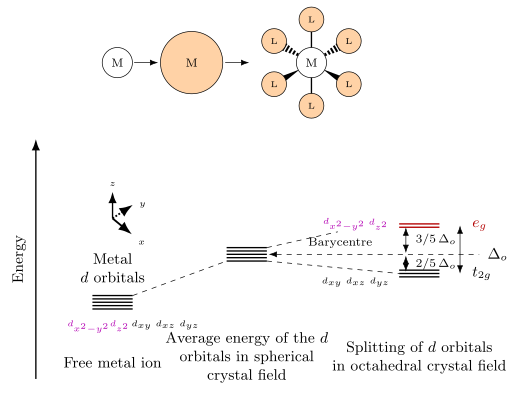
In a tetrahedral field, the d-orbitals split into a lower-energy set () and a higher-energy set (). The splitting energy is much smaller than for octahedral complexes (roughly of ).
-
Analyse :
- is a weak field ligand, so is small.
- For in a tetrahedral field, the electrons fill according to Hund's rule: two electrons go into each of the three orbitals, and the remaining two go into the orbitals. This gives two unpaired electrons.
- Hence, is paramagnetic.
-
Analyse :
- CO is a very strong field ligand. It also causes pairing of the 4s electrons into the 3d orbitals, effectively giving a configuration for Ni(0).
- In a tetrahedral field, means all five d-orbitals are completely filled — no unpaired electrons.
- Hence, is diamagnetic.
A common mistake is to think both complexes have the same d-count because both are tetrahedral. Always check the oxidation state first — Ni(II) is , Ni(0) is . The ligand field strength then determines whether pairing occurs.
(c) Electronic configuration of Fe(III) in octahedral complexes …
Unlock everything free for 14 days
- Full step-by-step solutions
- Concept-first explanations
- Methods, shortcuts & mistakes
- PYQ mapping + timed mock tests
Full access for 14 days. No credit card required.