Q.The conversion of an alkyl halide into an alkene by alcoholic KOH is classified as (A) a substitution reaction (B) an addition reaction (C) a dehydrohalogenation reaction (D) a dehydration reaction
Concept understanding — Dehydrohalogenation
Dehydrohalogenation — First Look
Imagine you have a molecule that is "unstable" in a specific way — it carries a halogen atom (like Cl, Br, I) on one carbon and a hydrogen atom on the neighbouring carbon. If you treat it with a strong base, the base can pull off that hydrogen, and simultaneously the halogen leaves as a negative ion. The two carbons that lost these atoms now form a double bond between them. That's the core idea: dehydrohalogenation is the elimination of H and X (halogen) from adjacent carbons, producing an alkene.
The name itself tells you what happens: dehydro (removal of hydrogen) + halogenation (removal of halogen). So you are literally removing a hydrogen halide (HX) from the molecule.
The Precise Reaction
A haloalkane (alkyl halide) is treated with alcoholic KOH (potassium hydroxide dissolved in ethanol). The KOH acts as a strong base. The reaction follows this general pattern:
R−CH2−CH2−XKOHalcoholicR−CH=CH2+KX+H2O
For example, bromoethane gives ethene:
CH3−CH2−BrKOHalcoholicCH2=CH2+KBr+H2O
Aqueous KOH (KOH in water) does not cause elimination — it gives substitution (an alcohol). The alcoholic medium is essential because it keeps the base strong enough to pull off the hydrogen, and it does not favour the competing substitution reaction.
Why Alcoholic KOH and Not Aqueous?
In water, the hydroxide ion (OH−) is heavily solvated — surrounded by water molecules — which reduces its basic strength. In ethanol, the solvation is weaker, so OH− is a much stronger base. A strong base is needed to abstract the β-hydrogen (the hydrogen on the carbon next to the one bearing the halogen). The reaction proceeds via a one-step concerted mechanism (E2) where the base pulls the H, the halogen leaves, and the double bond forms — all at once.
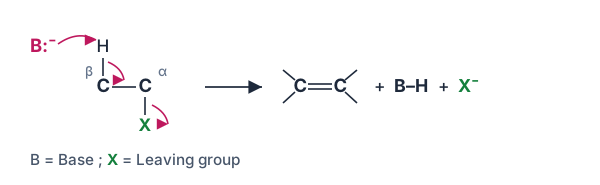
Saytzeff's Rule — Which Alkene Forms?
When the haloalkane has more than one possible β-hydrogen (i.e., the carbon next to the halogen is attached to two different sets of hydrogens), more than one alkene can form. Saytzeff's rule tells you which one is the major product:
In dehydrohalogenation, the alkene with the more substituted double bond (the one with more alkyl groups attached to the double-bonded carbons) is the major product.
Why? More substituted alkenes are more stable (hyperconjugation and inductive effects). The reaction favours the pathway that leads to the more stable alkene.
NCERT's own example uses 2-bromopentane, and the preference is just as clear there:
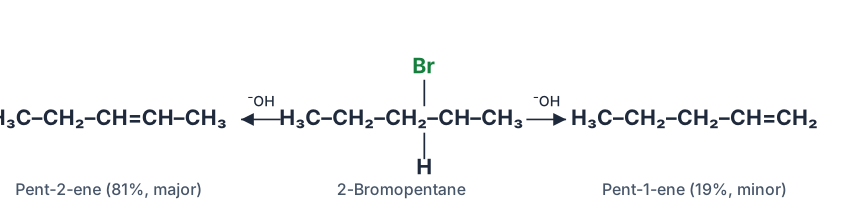
Example: 2-bromobutane has two possible β-hydrogens:
- Elimination involving H from C1 gives but-1-ene (less substituted, minor)
- Elimination involving H from C3 gives but-2-ene (more substituted, major)
CH3−CHBr−CH2−CH3alc. KOHmajor (but-2-ene)CH3−CH=CH−CH3+minor (but-1-ene)CH2=CH−CH2−CH3
Saytzeff's rule applies to dehydrohalogenation only when the base is bulky enough? Actually, no — for alcoholic KOH (a moderately bulky base), Saytzeff's rule holds. For very bulky bases like potassium tert-butoxide, the opposite (Hofmann product) may dominate, but that is a special case. For standard exam problems with alcoholic KOH, always apply Saytzeff's rule.
Summary in One Line
Dehydrohalogenation = removal of H and X from adjacent carbons of a haloalkane using a strong base (alcoholic KOH) to form an alkene, with the more substituted alkene being the major product (Saytzeff's rule).
R−CH2−CHX−R′heatalc. KOHR−CH=CH−R′+KX+H2O
As a standard named reaction from the Haloalkanes and Haloarenes chapter of the Class 12 NCERT/CBSE Chemistry syllabus, Dehydrohalogenation is a favourite for reaction-based and mechanism-writing questions in board exams, JEE Main, and NEET — a common search pattern is "Dehydrohalogenation: Definition, Formula & Real-World Examples" or "Dehydrohalogenation class 12 important questions".
The key idea is dehydrohalogenation — the elimination of a hydrogen halide (HX) from an alkyl halide using a strong base like alcoholic KOH.
Reasoning:
- Alcoholic KOH is a strong base but a poor nucleophile (due to solvation by ethanol), so it favours elimination over substitution.
- The base abstracts a β-hydrogen, while the halogen leaves as a halide ion, forming a π-bond (alkene).
- This is specifically the loss of H and X from adjacent carbons — hence dehydrohalogenation (not dehydration, which removes H2O from an alcohol).
The correct classification is dehydrohalogenation reaction, option (C).
The reaction of an alkyl halide with alcoholic KOH is a dehydrohalogenation — it eliminates H and X from adjacent carbons to form a double bond, not a substitution or addition.
The key here is to recognise what alcoholic KOH does. In organic chemistry, the solvent and reagent together decide the reaction path. Aqueous KOH gives you substitution (OH replaces the halogen). But alcoholic KOH is a strong base in a poorly nucleophilic medium — it favours elimination over substitution.
Let’s break it down.
-
What is the reactant? An alkyl halide (R−X). It has a carbon–halogen bond, polarised so that carbon is slightly positive (δ+) and halogen is slightly negative (δ−). This makes the carbon electrophilic.
-
What is alcoholic KOH? KOH dissociates into K+ and OH− ions. In alcohol (usually ethanol), the OH− ion is a strong base but a weaker nucleophile than in water (because alcohol solvates it differently). The high basicity of OH− in alcohol means it prefers to abstract a proton rather than attack the carbon.
-
What actually happens? The OH− pulls a hydrogen from the β-carbon (the carbon next to the one bearing the halogen). The electrons from that C–H bond move to form a π bond between α and β carbons, and the halogen leaves as X−. This is an E2 elimination — bimolecular, one step, no intermediate.
The general equation:
R−CH2−CH2−X+KOH (alc.)⟶R−CH=CH2+KX+H2O
-
Why not substitution? Substitution (SN2) would require the OH− to attack the α-carbon. But in alcoholic medium, the base is strong and the solvent is not very polar protic for stabilising the transition state of substitution — elimination is kinetically favoured, especially with secondary or tertiary halides.
-
Why not addition? Addition reactions happen across multiple bonds (like alkenes or carbonyls). Here we start with a saturated alkyl halide — no multiple bond to add to. So addition is out.
-
Why not dehydration? Dehydration specifically means loss of water (H2O). Here we lose HX (hydrogen halide), not water. Dehydration is typical of alcohols with concentrated H2SO4, not alkyl halides with base.
A common mistake is to confuse dehydrohalogenation (loss of H and X from an alkyl halide) with dehydration (loss of H and OH from an alcohol). They are different reactions with different reagents and products.
So the reaction is the elimination of hydrogen halide from adjacent carbons — exactly what “dehydrohalogenation” means.
R−CH2−CH2−Xalc. KOHR−CH=CH2+HX
To remember: alcoholic KOH = elimination (makes alkenes), aqueous KOH = substitution (makes alcohols). The solvent changes the game.
The correct option is (C) a dehydrohalogenation reaction.
Showing the 12 most recent of 14 on this concept.
- CBSE 2026Set V11 markMCQQ.The major product formed in the following reaction is H3C−CH2−Br∣CH−CH3Alc.KOHΔ(a) 1-butene(b) 2-butanol(c) 1-bromobutane(d) 2-butene
›Reveal solutionSolution
Alcoholic KOH removes HBr from 2-bromobutane; by Saytzeff's rule the more substituted alkene, but-2-ene, is the major product.
The reactant H3C−CH2−BrCH−CH3 is 2-bromobutane. Alcoholic KOH is a strong base that promotes β-elimination (dehydrohalogenation), not substitution.
A β-hydrogen can be removed from either the C-1 side or the C-3 side of the C-Br carbon:
- Removal from C-3 (CH2) gives CH3CH=CHCH3 (but-2-ene) — a disubstituted double bond.
- Removal from C-1 (CH3) gives CH2=CHCH2CH3 (but-1-ene) — a monosubstituted double bond.
By Saytzeff's rule, the more highly substituted (more stable) alkene predominates. Hence but-2-ene is the major product:
CH3CH2CHBrCH3Alc. KOHΔCH3CH=CHCH3+KBr+H2O
(Options (b) 2-butanol needs aqueous KOH — substitution — and (c) 1-bromobutane is not a product.)
✓Final answer(d) 2-butene
- CBSE 2026Set A1 markMCQQ.Ethyl bromide on boiling with alcoholic caustic potash gives(a) Ethyl alcohol(b) Ethylene(c) Acetylene(d) Ethane
›Reveal solutionSolution
Alcoholic KOH removes HBr from ethyl bromide (E2 elimination) to give ethylene.
Alcoholic potassium hydroxide furnishes the strong base ethoxide/hydroxide in an alcoholic medium, which favours elimination over substitution. Ethyl bromide loses a molecule of HBr:
CH3-CH2-Br --(alc. KOH, heat)--> CH2=CH2 + KBr + H2O
(Note: aqueous KOH would instead give ethyl alcohol by substitution — the alcoholic medium is what makes it eliminate.)
✓Final answer(b) Ethylene.
- CBSE 2026Set ANNUAL1 markMCQQ.Assertion [A]: 1-chlorobutane on heating with alc. KOH gives mainly Bute-1-ene. Reason [R]: Bute-1-ene is more stable than Bute-2-ene.(a) Both [A] and [R] are true and [R] is the correct explanation of [A].(b) Both [A] and [R] are true, but [R] is not the correct explanation of [A].(c) [A] is true, but [R] is false.(d) [A] is false, but [R] is true.
›Reveal solutionSolution
1-Chlorobutane does give but-1-ene on heating with alcoholic KOH — but only because it is the ONLY elimination product possible (Cl is on the terminal carbon), not because but-1-ene is more stable than but-2-ene. In fact but-2-ene (especially the trans isomer) is MORE stable than but-1-ene, so the Reason is false.
Assertion: 1-Chlorobutane is CH3CH2CH2CH2Cl — the leaving group (Cl) is on C1, a terminal carbon. β-elimination (E2, Zaitsev/Hofmann considerations) can only remove a β-hydrogen from C2 (there is no carbon "before" C1 to eliminate towards). This necessarily gives:
CH3CH2CH2CH2Clalc. KOH, ΔCH3CH2CH=CH2 (but-1-ene)+KCl+H2O
So yes, but-1-ene IS the (essentially only) product — the Assertion is TRUE.
Reason: This claims but-1-ene is more stable than but-2-ene. This is FALSE — by Zaitsev's rule / alkene stability trends, the more substituted alkene is more stable due to greater hyperconjugation. But-2-ene (a disubstituted alkene, especially the trans isomer) is MORE stable than but-1-ene (a monosubstituted, terminal alkene). But-1-ene forms here not because it's more stable, but because it's structurally the only possible elimination product from this particular substrate.
✓Final answer(c) [A] is true, but [R] is false.
- CBSE 2026Set ANNUAL1 markMCQQ.C2H5Cl on heating with alcoholic KOH will produce:(a) C2H5OH(b) C2H4(c) C2H2(d) C2H6
›Reveal solutionSolution
Alcoholic KOH promotes elimination (dehydrohalogenation), so ethyl chloride gives ethene, not the substitution product ethanol.
When an alkyl halide is heated with KOH dissolved in alcohol, the hydroxide ion acts as a strong base rather than a nucleophile, abstracting a β-hydrogen and eliminating the halide to form an alkene (E2 elimination):
CH3CH2Clalc. KOHΔCH2=CH2+KCl+H2O
This is in contrast to aqueous KOH, which favours nucleophilic substitution to give the alcohol (C2H5OH) instead — the solvent (alcoholic vs aqueous) is exactly what decides substitution vs elimination here.
✓Final answer(b) C2H4 — alcoholic KOH causes elimination of HCl to give ethene.
- CBSE 2026Set ANNUAL1 markQ.Write the products of the following reaction: CH3−CH2−CH2−CH(Br)−CH3Alc. KOHA+B
›Reveal solutionSolution
E2 dehydrohalogenation of the secondary bromide 2-bromopentane with alcoholic KOH gives two alkenes; by Zaitsev's rule, the more-substituted one dominates.
Numbering the given chain from the bromine end for IUPAC purposes: CH3(C1)−CHBr(C2)−CH2(C3)−CH2(C4)−CH3(C5) — this is 2-bromopentane. Two sets of β-hydrogens are available for E2 elimination: on C1 (the adjacent methyl) and on C3.
Elimination toward C3 (removing a β-H from C3) gives the internal, more substituted (disubstituted) alkene:
CH3−CH=CH−CH2−CH3(pent-2-ene)
By Zaitsev's rule, the more substituted, more stable alkene (better stabilised by hyperconjugation/alkyl substitution across the double bond) is the major product (A).
Elimination toward C1 (removing a β-H from the terminal CH3) gives the less-substituted terminal alkene:
CH2=CH−CH2−CH2−CH3(pent-1-ene)
This is the minor (Hofmann) product (B).
✓Final answerA = pent-2-ene, CH3−CH=CH−CH2−CH3 (major product); B = pent-1-ene, CH2=CH−CH2−CH2−CH3 (minor product).
- CBSE 2025Set ANNUAL1 markMCQQ.Alkyl halides react with alcoholic KOH to give:(a) Alkanes(b) Alkenes(c) Alcohols(d) Ethers
›Reveal solutionSolution
Alcoholic KOH is a strong base used for elimination; it removes H and X from adjacent carbons of an alkyl halide to give an alkene.
When an alkyl halide (R-CH2-CH2-X) is treated with KOH dissolved in alcohol, the hydroxide ion acts as a base rather than a nucleophile. It abstracts a β-hydrogen (a hydrogen on the carbon next to the one bearing the halogen), and the halide ion leaves simultaneously (E2 mechanism), forming a carbon-carbon double bond:
CH3-CH2-X + KOH(alc.) → CH2=CH2 + KX + H2O
This is different from aqueous KOH, which favours substitution (SN1/SN2) to give an alcohol, because water solvates the hydroxide ion and reduces its basicity while it remains a good nucleophile. In alcohol, KOH is a poorer nucleophile but a strong enough base to favour elimination (Saytzeff's rule gives the more substituted alkene as the major product).
✓Final answer(b) Alkenes.
- CBSE 2023Set 56/2/11 markMCQQ.The conversion of an alkyl halide into an alkene by alcoholic KOH is classified as (A) a substitution reaction (B) an addition reaction (C) a dehydrohalogenation reaction (D) a dehydration reaction
›Reveal solutionSolution
The reaction of an alkyl halide with alcoholic KOH is a dehydrohalogenation — it eliminates H and X from adjacent carbons to form a double bond, not a substitution or addition.
The key here is to recognise what alcoholic KOH does. In organic chemistry, the solvent and reagent together decide the reaction path. Aqueous KOH gives you substitution (OH replaces the halogen). But alcoholic KOH is a strong base in a poorly nucleophilic medium — it favours elimination over substitution.
Let’s break it down.
-
What is the reactant? An alkyl halide (R−X). It has a carbon–halogen bond, polarised so that carbon is slightly positive (δ+) and halogen is slightly negative (δ−). This makes the carbon electrophilic.
-
What is alcoholic KOH? KOH dissociates into K+ and OH− ions. In alcohol (usually ethanol), the OH− ion is a strong base but a weaker nucleophile than in water (because alcohol solvates it differently). The high basicity of OH− in alcohol means it prefers to abstract a proton rather than attack the carbon.
-
What actually happens? The OH− pulls a hydrogen from the β-carbon (the carbon next to the one bearing the halogen). The electrons from that C–H bond move to form a π bond between α and β carbons, and the halogen leaves as X−. This is an E2 elimination — bimolecular, one step, no intermediate.
The general equation:
R−CH2−CH2−X+KOH (alc.)⟶R−CH=CH2+KX+H2O
-
Why not substitution? Substitution (SN2) would require the OH− to attack the α-carbon. But in alcoholic medium, the base is strong and the solvent is not very polar protic for stabilising the transition state of substitution — elimination is kinetically favoured, especially with secondary or tertiary halides.
-
Why not addition? Addition reactions happen across multiple bonds (like alkenes or carbonyls). Here we start with a saturated alkyl halide — no multiple bond to add to. So addition is out.
-
Why not dehydration? Dehydration specifically means loss of water (H2O). Here we lose HX (hydrogen halide), not water. Dehydration is typical of alcohols with concentrated H2SO4, not alkyl halides with base.
Watch outA common mistake is to confuse dehydrohalogenation (loss of H and X from an alkyl halide) with dehydration (loss of H and OH from an alcohol). They are different reactions with different reagents and products.
So the reaction is the elimination of hydrogen halide from adjacent carbons — exactly what “dehydrohalogenation” means.
R−CH2−CH2−Xalc. KOHR−CH=CH2+HX
TipTo remember: alcoholic KOH = elimination (makes alkenes), aqueous KOH = substitution (makes alcohols). The solvent changes the game.
✓Final answerThe correct option is (C) a dehydrohalogenation reaction.
-
- CBSE 2023Set ANNUAL1 markQ.How would you convert the following? But-1-ene to but-2-ene
›Reveal solutionSolution
Markovnikov addition of HBr moves the halogen to the internal carbon of but-1-ene (2-bromobutane), and subsequent base-induced elimination follows Zaitsev's rule to give the more substituted, more stable but-2-ene as the major product — net effect: the double bond has migrated from the terminal to the internal position.
Step 1 — Markovnikov hydrobromination: Addition of HBr (no peroxide present) to but-1-ene proceeds by the ionic mechanism: protonation of the alkene occurs so as to generate the more stable (secondary) carbocation, i.e. H+ adds to the terminal CH2= carbon, placing the positive charge on C-2; Br− then attacks this secondary carbocation:
CH2=CH−CH2CH3HBrCH3−CHBr−CH2CH3(2-bromobutane)
Step 2 — Dehydrohalogenation (E2 elimination, Zaitsev's rule): Heating 2-bromobutane with alcoholic KOH promotes base-induced elimination of HBr. Since C-2 has β-hydrogens available on both the C-1 side and the C-3 side, elimination can in principle give either but-1-ene (removing a C-1 H) or but-2-ene (removing a C-3 H). Zaitsev's rule states that the more substituted (thermodynamically more stable) alkene is the major product of such eliminations; but-2-ene (a disubstituted, internal alkene) is more stable than but-1-ene (a monosubstituted, terminal alkene), so it predominates:
CH3−CHBr−CH2CH3alc.KOHΔCH3−CH=CH−CH3(but-2-ene, major)
✓Final answerBut-1-ene HBr 2-bromobutane alc.KOHΔ but-2-ene (Zaitsev-favoured major elimination product).
- CBSE 2022Set E1 markMCQQ.Monohalogen derivative on reaction with alcoholic KOH gives(a) Alkane(b) Alkene(c) Alkyne(d) Alicyclic hydrocarbon
›Reveal solutionSolution
Monohaloalkane + alcoholic KOH → dehydrohalogenation (elimination) → alkene.
With alcoholic KOH, a monohalogen derivative (alkyl halide) loses a molecule of HX in a beta-elimination (dehydrohalogenation) reaction, forming a carbon-carbon double bond, i.e. an alkene.
Example: CH3-CH2-Br + KOH(alc.) → CH2=CH2 + KBr + H2O.
(Note: aqueous KOH would instead give substitution to an alcohol. Alcoholic KOH favours elimination → alkene.)
✓Final answer(b) Alkene.
- CBSE 2021Set A1 markMCQQ.The product of the reaction C2H5Br --KOH/Alcoholic--> is(a) CH2 = CH2(b) CH3CH2OH(c) CH3CH2OCH2CH3(d) none of these
›Reveal solutionSolution
Alcoholic KOH promotes beta-elimination (dehydrohalogenation) of an alkyl halide, giving an alkene.
The reagent is critical here. Alcoholic KOH favours elimination (E2, dehydrohalogenation), removing HBr from bromoethane to form the alkene:
CH3CH2Br + KOH(alcoholic) ---> CH2=CH2 + KBr + H2O
Contrast this with aqueous KOH, which favours substitution and would give ethanol (CH3CH2OH). Since the reagent specified is alcoholic KOH, the product is ethene.
✓Final answer(a) CH2=CH2 (ethene).
- CBSE 2018Set ANNUAL1 markQ.Name the reagent used in the dehydrohalogenation of haloalkanes.
›Reveal solutionSolution
Alcoholic KOH removes HX from a haloalkane (dehydrohalogenation) to give an alkene.
Concept. Dehydrohalogenation (a β-elimination) removes a hydrogen halide from a haloalkane to form an alkene. It requires a strong base in an alcoholic medium. Alcoholic potassium hydroxide (KOH in ethanol) is the standard reagent — the ethoxide/hydroxide acts as a base and abstracts the β-hydrogen.
Example.
CH3CH2Bralc. KOHCH2=CH2+KBr+H2O
(Note: aqueous KOH instead gives substitution to an alcohol — the medium decides.)
✓Final answerAlcoholic KOH (potassium hydroxide in ethanol).
- CBSE 2018Set 56/11 markQ.Predict the major product formed when sodium ethoxide reacts with tert.Butyl chloride.
›Reveal solutionSolution
A strong bulky base (C2H5O−Na+) on a 3∘ halide gives β-elimination (E2), so the major product is 2-methylpropene.
Concept. The competition between substitution and elimination for haloalkanes — a core CBSE Class-12 haloalkanes-and-haloarenes idea.
Why. Tert-butyl chloride, (CH3)3C-Cl, is sterically crowded, so nucleophilic attack at carbon (substitution) is hindered. Ethoxide is a strong base; it abstracts a β-hydrogen and eliminates HCl.
Steps.
(CH3)3C-Cl+C2H5O−Na+→(CH3)2C=CH2+C2H5OH+NaCl
✓Final answerMajor product = 2-methylprop-1-ene (isobutylene), (CH3)2C=CH2.
🎓Unlock everything free for 14 days
- ✓Full step-by-step solutions
- ✓Concept-first explanations
- ✓Methods, shortcuts & mistakes
- ✓PYQ mapping + timed mock tests
Full access for 14 days. No credit card required.