Q.Write two differences between DNA and RNA. (1 × 2)
🔒You're viewing a preview — the full solution, concept, methods & PYQ mapping are locked.
🔒 Start your 14-day free trial to unlock the full solution →Concept understanding — Nucleic Acid Components
Nucleic Acid Components: The Alphabet of Life
Imagine you want to write a book that contains all the instructions for building and running a living organism. You'd need an alphabet — a set of letters that can be combined in endless ways to form words, sentences, and chapters. In living cells, that alphabet is made of nucleic acids (DNA and RNA), and each "letter" is called a nucleotide.
The Big Picture: What Are Nucleic Acids?
Nucleic acids are long, chain-like molecules that store and transmit genetic information. DNA holds the master blueprint; RNA helps execute it. But both are built from the same basic building block: the nucleotide.
Think of a nucleotide as a single Lego brick. DNA and RNA are long chains of these bricks, each brick slightly different from the next.
The Three Parts of a Nucleotide
Every nucleotide has three components, like a three-part key:
- A phosphate group — a small, negatively charged group (PO43−). It acts like the "handle" that links nucleotides together.
- A sugar — either ribose (in RNA) or deoxyribose (in DNA). This is the "body" of the brick.
- A nitrogenous base — a ring-shaped molecule containing nitrogen. This is the "colored part" that carries the actual information.
The sugar and base together form a nucleoside. When you add the phosphate, you get a nucleotide.
Nucleoside = Sugar + Base
Nucleotide = Sugar + Base + Phosphate
The Two Families of Bases
The bases come in two structural types:
- Purines (double-ring structures): Adenine (A) and Guanine (G)
- Pyrimidines (single-ring structures): Cytosine (C), Thymine (T) (only in DNA), and Uracil (U) (only in RNA)
A mnemonic: Purines are Pure as All Gold (A and G). Pyrimidines are CUT (C, U, T).
DNA vs. RNA: The Key Differences
| Feature | DNA | RNA |
|---|---|---|
| Sugar | Deoxyribose (missing one oxygen) | Ribose (has that oxygen) |
| Bases | A, G, C, T | A, G, C, U |
| Structure | Double-stranded helix | Usually single-stranded |
| Function | Stores genetic information | Carries and executes instructions |
A common mistake: thinking "nucleoside" and "nucleotide" are the same. Remember: nucleotide has the phosphate; nucleoside does not. ATP (adenosine triphosphate) is a nucleotide — it's the energy currency of the cell.
Why This Matters
The sequence of bases along a DNA strand spells out the genetic code. A change in even one base (a mutation) can alter a protein, sometimes with dramatic consequences — like sickle cell anemia, where a single base change in the hemoglobin gene causes red blood cells to deform. …
Why this formula?
Nucleic Acid Components: Understanding the "Why" Behind the Key Relationships
Let’s start with the big picture: Nucleic acids (DNA and RNA) are polymers made of nucleotides. Each nucleotide has three parts: a nitrogenous base, a pentose sugar, and a phosphate group. The key formulas and relationships in this topic arise from how these parts are linked and how they behave chemically.
1. The Basic Composition Formula
What it says:
A nucleotide = Base + Sugar + Phosphate
Why this holds:
- Chemical necessity: The sugar (ribose in RNA, deoxyribose in DNA) has a 5-carbon ring. The base attaches to the 1' carbon (via a glycosidic bond), and the phosphate attaches to the 5' carbon (via an ester bond).
- Directionality: This creates a 5' → 3' linkage in the polymer. The phosphate of one nucleotide bonds to the 3' carbon of the next sugar.
- Reasoning: Without the phosphate, you have a nucleoside (base + sugar). Adding the phosphate makes it a nucleotide — the monomer that can polymerize.
Key takeaway: The formula isn’t arbitrary — it reflects the specific carbon positions on the sugar that allow for stable, directional chain formation.
2. Chargaff’s Rules (for DNA)
What it says:
In double-stranded DNA:
- [A]=[T]
- [G]=[C]
- [A]+[G]=[T]+[C]
Why this holds:
- Base pairing: Adenine (A) forms two hydrogen bonds with Thymine (T). Guanine (G) forms three hydrogen bonds with Cytosine (C).
- Structural constraint: The DNA double helix has a constant width (20 Å). A purine (A or G) always pairs with a pyrimidine (T or C) — otherwise the helix would bulge or narrow.
- Derivation: If every A on one strand must pair with a T on the opposite strand, then the number of A equals number of T in the whole molecule. Same for G and C.
- Consequence: The sum of purines equals sum of pyrimidines (A+G=T+C).
Why it’s not just a rule: It’s a geometric and energetic necessity — hydrogen bonding and helix stability force this equality.
3. The Phosphodiester Bond Energy Formula
What it says:
Formation of a phosphodiester bond requires ~30 kJ/mol of energy (from ATP).
Why this holds:
- Mechanism: The 3' hydroxyl of one nucleotide attacks the α-phosphate of a nucleotide triphosphate (e.g., ATP). This releases pyrophosphate (PPi).
- Energy source: The hydrolysis of PPi to two inorganic phosphates (PPi→2Pi) is highly exergonic (ΔG ≈ -30 kJ/mol). This drives the reaction forward.
- Reasoning: The bond itself is a covalent ester linkage — strong but not spontaneously formed. The energy comes from breaking a high-energy phosphate bond in the triphosphate.
Key insight: The formula isn’t about the bond’s strength — it’s about the thermodynamic cost of making it in a cell.
4. The Melting Temperature (Tm) Formula
What it says:
Tm (in °C) ≈ 4(G+C)+2(A+T) for short oligonucleotides.
Why this holds:
- Hydrogen bonds: G-C pairs have 3 H-bonds, A-T pairs have 2 H-bonds. More H-bonds = more energy needed to separate strands.
- Stacking interactions: G-C base pairs also have stronger π-stacking (aromatic ring overlap) than A-T.
- Derivation: The formula is empirical — it comes from measuring Tm for many sequences. The coefficients (4 and 2) reflect the relative stability contributed by each base pair.
- Limitation: For long DNA, this simple formula fails because nearest-neighbor interactions matter more.
Why it works: It’s a linear approximation of the free energy needed to break all base pairs, weighted by H-bond count.
5. The Central Dogma (Information Flow)
What it says:
DNA → RNA → Protein
Why this holds: …
Concept: Structural differences between the two nucleic acids
DNA and RNA differ fundamentally in their chemical composition and structure, which relates directly to their distinct biological roles.
Key differences:
- Sugar component – DNA contains 2′-deoxyribose (lacks a hydroxyl group at the 2′ carbon), while RNA contains ribose (has an –OH group at the 2′ position). This single oxygen atom makes RNA more chemically reactive and less stable than DNA. …
DNA and RNA differ structurally in their sugar component and one nitrogenous base, which reflects their distinct biological roles — DNA as the stable genetic archive and RNA as the versatile working copy.
Nucleic acids are polymers built from nucleotide monomers, each containing a pentose sugar, a phosphate group, and a nitrogenous base. Though DNA and RNA share this fundamental architecture, key structural differences equip them for their separate functions in the cell.
The most fundamental distinction lies in the sugar backbone. DNA contains 2′-deoxyribose, a five-carbon sugar missing a hydroxyl group at the 2′ carbon position (hence "deoxy"). RNA contains ribose, which retains that 2′-OH group. This single oxygen atom has profound consequences: the extra hydroxyl makes RNA chemically more reactive and less stable than DNA, which is why DNA serves as the long-term storage molecule while RNA acts as a temporary messenger and catalyst. …
Showing the 12 most recent of 39 on this concept.
- CBSE 2026Set 56/2/11 markMCQQ.The base which is present in DNA but not in RNA is : (A) Guanine (B) Cytosine (C) Thymine (D) Adenine
›Reveal solutionSolution
The key difference between DNA and RNA is that DNA contains thymine (T) while RNA contains uracil (U) in its place. The base present in DNA but absent in RNA is thymine, which corresponds to option (C).
Why This Question Tests a Fundamental Distinction
DNA and RNA are both nucleic acids, but they serve different roles in the cell — DNA stores genetic information, while RNA helps express it. One of the clearest chemical differences between them lies in their nitrogenous bases. Both use adenine (A), guanine (G), and cytosine (C), but they differ in the fourth base: DNA uses thymine (T), and RNA uses uracil (U). This is not a trivial detail — it affects base pairing, stability, and even how enzymes distinguish the two molecules.
The question asks you to spot which base is exclusive to DNA. Let’s walk through the reasoning.
-
List the bases common to both DNA and RNA.
Adenine (A), guanine (G), and cytosine (C) appear in both nucleic acids. So options (A), (B), and (D) are present in RNA as well — they cannot be the answer.
-
Identify the base unique to DNA.
Thymine (T) is found in DNA but is replaced by uracil (U) in RNA. This substitution is a defining chemical difference. Therefore, thymine is the base present in DNA but not in RNA.
-
Confirm by elimination. …
-
- CBSE 2026Set ANNUAL1 markMCQQ.Which of the following is not a pyrimidine base?(a) Adenine(b) Uracil(c) Thymine(d) Cytosine
›Reveal solutionSolution
Adenine is a purine, not a pyrimidine; the other three listed bases (cytosine, uracil, thymine) are pyrimidines.
Nitrogenous bases found in nucleic acids are classified into two structural families:
- Purines: fused bicyclic (six-membered + five-membered ring) heterocycles — these are Adenine (A) and Guanine (G).
- Pyrimidines: single six-membered heterocyclic ring — these are Cytosine (C), Thymine (T, found in DNA), and Uracil (U, found in RNA in place of thymine). …
- CBSE 2026Set ANNUAL1 markQ.Write any one difference between DNA and RNA.
›Reveal solutionSolution
DNA and RNA differ in their sugar component, strand structure, and one nitrogenous base.
One clear structural difference: the sugar in DNA is deoxyribose (lacking an -OH at C2'), whereas the sugar in RNA is ribose (has an -OH at C2'). (Other valid differences: DNA is usually double-stranded/helical while RNA is usually single-stra …
- CBSE 2026Set ANNUAL1 markQ.Read the following paragraph and answer the question given below: Complete hydrolysis of DNA/RNA gives a pentane sugar, phosphoric acid and nitrogen containing heterolysis base. In DNA, sugar is β-D-2-deoxyribose and in RNA, sugar is β-D-ribose. DNA has four bases i.e. adenine, guanine, cytosine and thymine. In RNA instead of thymine, the bases is uracil and other three bases are same. Base attached to sugar forms nucleoside, while, sugar molecule joined to phosphate group and base forms nucleotide.(i) Name the bases present in RNA.
›Reveal solutionSolution
RNA's four bases are adenine, guanine, cytosine and uracil.
Nucleic acids are built from purine and pyrimidine bases attached to a sugar-phosphate backbone. The purines (adenine and guanine) are common to both DNA and RNA. Among the pyrimidines, DNA uses cytosine and thymine, while RNA uses cytosine and uracil in place …
- CBSE 2026Set ANNUAL1 markQ.Read the following paragraph and answer the question given below: Complete hydrolysis of DNA/RNA gives a pentane sugar, phosphoric acid and nitrogen containing heterolysis base. In DNA, sugar is β-D-2-deoxyribose and in RNA, sugar is β-D-ribose. DNA has four bases i.e. adenine, guanine, cytosine and thymine. In RNA instead of thymine, the bases is uracil and other three bases are same. Base attached to sugar forms nucleoside, while, sugar molecule joined to phosphate group and base forms nucleotide.(ii) What is nucleotide?
›Reveal solutionSolution
A nucleotide = nitrogenous base + pentose sugar + phosphate group.
When a nitrogenous base (purine or pyrimidine) is attached to the pentose sugar (ribose or deoxyribose) through a β-N-glycosidic bond, the unit formed is called a nucleoside. When the 5'-OH of this sugar is further esterified with phosphoric acid, the resulting base-sugar-phosphate unit is called a nucleotide. Nucleotides are the repeating monomer units that are joined by phosphodiester bond …
- CBSE 2026Set ANNUAL1 markQ.Read the following paragraph and answer the question given below: Complete hydrolysis of DNA/RNA gives a pentane sugar, phosphoric acid and nitrogen containing heterolysis base. In DNA, sugar is β-D-2-deoxyribose and in RNA, sugar is β-D-ribose. DNA has four bases i.e. adenine, guanine, cytosine and thymine. In RNA instead of thymine, the bases is uracil and other three bases are same. Base attached to sugar forms nucleoside, while, sugar molecule joined to phosphate group and base forms nucleotide.(iii) Name the sugar present in DNA.
›Reveal solutionSolution
DNA's sugar is β-D-2-deoxyribose (lacks an -OH at the 2' carbon).
DNA and RNA differ in the pentose sugar of their backbone. DNA contains β-D-2-deoxyribose, in which the 2'-carbon of the ribose ring bears only hydrogen atoms (no -OH group) — hence the name 'deoxy'. This lack of a 2'-OH makes DNA che …
- CBSE 2026Set ANNUAL1 markQ.Read the following paragraph and answer the question given below: Complete hydrolysis of DNA/RNA gives a pentane sugar, phosphoric acid and nitrogen containing heterolysis base. In DNA, sugar is β-D-2-deoxyribose and in RNA, sugar is β-D-ribose. DNA has four bases i.e. adenine, guanine, cytosine and thymine. In RNA instead of thymine, the bases is uracil and other three bases are same. Base attached to sugar forms nucleoside, while, sugar molecule joined to phosphate group and base forms nucleotide.(iv) Name the sugar present in RNA.
›Reveal solutionSolution
RNA's sugar is β-D-ribose (has a free -OH at the 2' carbon).
Unlike DNA, RNA retains a hydroxyl group at the 2'-carbon of its pentose sugar, so its sugar is called β-D-ribose (not 'deoxy'). This extra -OH group makes the RNA backbone more reactive/less stable than DNA's, which is consistent with RNA's shor …
- CBSE 2026Set ANNUAL1 markQ.Read the following paragraph and answer the question given below: Complete hydrolysis of DNA/RNA gives a pentane sugar, phosphoric acid and nitrogen containing heterolysis base. In DNA, sugar is β-D-2-deoxyribose and in RNA, sugar is β-D-ribose. DNA has four bases i.e. adenine, guanine, cytosine and thymine. In RNA instead of thymine, the bases is uracil and other three bases are same. Base attached to sugar forms nucleoside, while, sugar molecule joined to phosphate group and base forms nucleotide.(v) Name the bases present in DNA.
›Reveal solutionSolution
DNA's four bases are adenine, guanine, cytosine and thymine.
DNA carries two purine bases, adenine (A) and guanine (G), and two pyrimidine bases, cytosine (C) and thymine (T). In the DNA double helix these bases pair specifically by hydrogen bonding — A pairs with T (two H-bonds) and G pairs with C (three H-bonds) — wh …
- CBSE 2025Set D1 markMCQQ.The purine base present in RNA is(a) Guanine(b) Thymine(c) Cytosine(d) Uracil
›Reveal solutionSolution
Nucleic acid bases are purines (adenine, guanine) or pyrimidines (cytosine, thymine, uracil). The purine in RNA among the options is guanine.
The nitrogenous bases in nucleic acids are of two types:
- Purines (two fused rings): Adenine (A) and Guanine (G).
- Pyrimidines (single ring): Cytosine (C), Thymine (T) and Uracil (U). …
- CBSE 2025Set ANNUAL1 markQ.Draw a diagram of double strand helix structure for DNA.
›Reveal solutionSolution
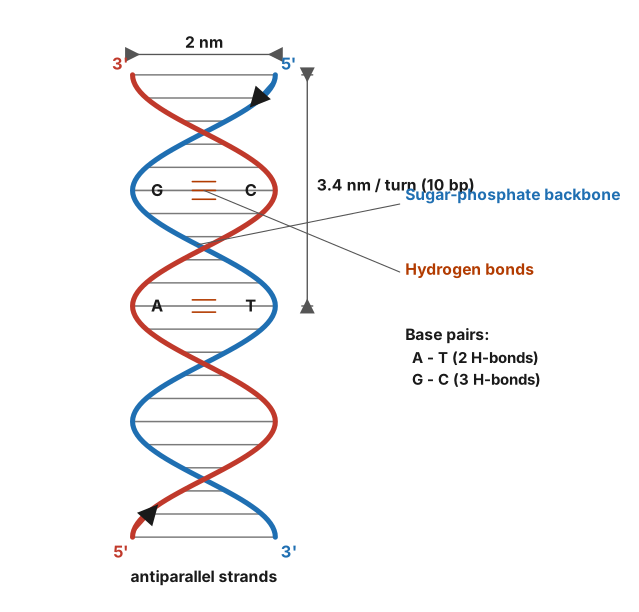
Figure — Labelled DNA double helix (Watson-Crick model). Two ANTIPARALLEL sugar-phosphate backbones coiled RI The Watson-Crick double helix model of DNA: two antiparallel polynucleotide strands wound around a common axis, sugar-phosphate backbone outside, complementary bases paired by hydrogen bonds on the inside.
A labelled diagram of the DNA double helix would show the following key features, described here in place of a drawing:
-
TWO POLYNUCLEOTIDE STRANDS: each strand is a chain of alternating deoxyribose sugar and phosphate units (the sugar-phosphate backbone), drawn as two continuous ribbons running along the outside of the structure.
-
ANTIPARALLEL ORIENTATION: the two strands run in opposite directions - one strand 5' -> 3' from top to bottom, the other 3' -> 5' from top to bottom.
-
RIGHT-HANDED HELIX: the two backbones are coiled around a common central axis in a right-handed spiral (like a twisted ladder).
…
-
- CBSE 2025Set ANNUAL1 markMCQQ.Identify the complementary strand of the DNA primary structure ATGCCGATC.(a) AUGCCGAUC(b) TACGGCJAG(c) UACGGCUAG(d) GATCGGCAT
›Reveal solutionSolution
DNA base pairing is complementary and antiparallel-in-composition: A pairs with T, and G pairs with C; applying this rule base-by-base to the given strand gives the complementary strand.
Given strand: 5'-A T G C C G A T C-3'
Applying Watson-Crick complementary base pairing (A<->T, G<->C) to each base in turn:
A->T, T->A, G->C, C->G, C->G, G->C, A->T, T->A, C->G
Complementary strand: T A C G G C T A G
…
- CBSE 2025Set ANNUAL1 markQ.Read the following paragraph and answer the questions given below: Give full form of DNA and RNA.
›Reveal solutionSolution
DNA and RNA are the two nucleic acids that store and transmit an organism's genetic information.
Nucleic acids are biopolymers of nucleotides (each nucleotide = a nitrogenous base + a pentose sugar + a phosphate group).
- DNA stands for Deoxyribonucleic Acid. It contains the sugar 2-deoxyribose and carries the hereditary information of the organism, transmitted from parents to offspring. …
🎓Unlock everything free for 14 days
- ✓Full step-by-step solutions
- ✓Concept-first explanations
- ✓Methods, shortcuts & mistakes
- ✓PYQ mapping + timed mock tests
Full access for 14 days. No credit card required.