Q.(a) Draw the geometrical isomers of . Which geometrical isomer of is not optically active and why ? (2 + 1)
You're viewing a preview — the full solution, concept, methods & PYQ mapping are locked.
Start your 14-day free trial to unlock the full solution →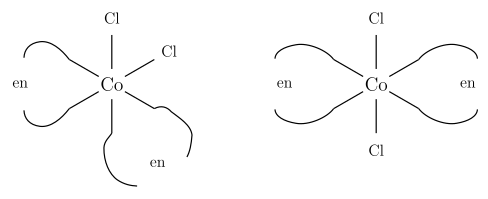
The key idea is that the coordination complex forms an octahedral geometry with two bidentate ethylenediamine (en) ligands and two chloride ligands. It exhibits two geometrical isomers: cis and trans. The trans isomer has a plane of symmetry and is therefore optically inactive (not optically active). For , the Co is in the +3 oxidation state, and with weak-field F⁻ ligands, it undergoes hybridisation with 4 unpaired electrons, making it paramagnetic.
(a) Geometrical isomers of and optical activity
1. Understanding the complex and its geometry
Cobalt in this complex is in the +3 oxidation state (since each en is neutral and each Cl⁻ is -1, the overall charge is +2). Co³⁺ has an electron configuration of . In an octahedral field, with strong-field ligands like en (ethylenediamine), the electrons pair up in the set, giving a low-spin configuration. The complex is octahedral, with the two en ligands each occupying two adjacent positions (they are bidentate, so they must be cis to each other — they cannot span opposite corners of an octahedron).
2. Drawing the isomers
Since en is bidentate, the two en ligands can only be arranged in one way relative to each other: they must be cis to each other (because a single en ligand always occupies two adjacent coordination sites). The two Cl⁻ ligands can then be either:
- cis: both Cl⁻ adjacent to each other (and also adjacent to the en ligands).
- trans: the two Cl⁻ opposite each other.
So the two geometrical isomers are:
- cis-: The two Cl⁻ are at 90° to each other.
- trans-: The two Cl⁻ are at 180° to each other.
3. Optical activity — which isomer is not optically active?
Optical activity requires the molecule to be chiral (no plane of symmetry, no centre of inversion, no improper rotation axis).
- cis isomer: This isomer has no plane of symmetry. The two en ligands form a kind of "propeller" shape, and the molecule exists as a pair of non-superimposable mirror images (enantiomers). Hence, the cis isomer is optically active.
- trans isomer: This isomer has a plane of symmetry that passes through the two Cl⁻ atoms and the Co atom, cutting the two en ligands in half. Because of this symmetry, the molecule is superimposable on its mirror image — it is achiral. Therefore, the trans isomer is not optically active.
A common mistake is to think that because en is bidentate, the complex must be chiral. But the trans arrangement of the two Cl⁻ introduces a plane of symmetry, making the molecule achiral. Always check for symmetry elements before concluding optical activity.
4. Final answer for part (a)
The trans isomer is not optically active because it possesses a plane of symmetry.
(b) Hybridisation and magnetic behaviour of
1. Oxidation state and electron configuration
The complex has a charge of -3. Each F⁻ is -1, so the oxidation state of Co is +3 (since ). Co³⁺ has the configuration .
2. Ligand field strength and spin state …
Unlock everything free for 14 days
- Full step-by-step solutions
- Concept-first explanations
- Methods, shortcuts & mistakes
- PYQ mapping + timed mock tests
Full access for 14 days. No credit card required.