Q.The reactance of a capacitor of capacitance C connected to an ac source of frequency ω is X. If the capacitance of the capacitor is doubled and the frequency of the source is tripled, the reactance will become : (A) 6X (B) 6X (C) 32X (D) 23X
🔒You're viewing a preview — the full solution, concept, methods & PYQ mapping are locked.
🔒 Start your 14-day free trial to unlock the full solution →Concept understanding — Capacitive Reactance
Capacitive Reactance: The AC Resistance of a Capacitor
When you first meet a capacitor in a DC circuit, it behaves like a break in the wire once it's fully charged — no current flows. But in an AC circuit, something entirely different happens. The voltage keeps reversing, so the capacitor never finishes charging. It's constantly being filled, emptied, refilled, and re-emptied. This continuous back-and-forth means current does flow, but the capacitor resists that flow in a frequency-dependent way. That resistance is called capacitive reactance.
The Intuition: Why Frequency Matters
Imagine a water pipe with a flexible rubber membrane stretched across it (a crude capacitor). If you push water slowly from one side, the membrane bulges and eventually stops the flow — that's DC. But if you push and pull the water rapidly (AC), the membrane just vibrates, and water sloshes back and forth through the pipe. The faster you push-pull (higher frequency), the less the membrane impedes the flow. At very high frequencies, it's almost like the membrane isn't there.
In a capacitor, the "membrane" is the electric field between the plates. Higher frequency means the voltage changes faster, so the capacitor has less time to oppose the current. The result: capacitive reactance decreases as frequency increases.
The Precise Statement
Capacitive reactance XC is the opposition a capacitor offers to alternating current. It is measured in ohms (Ω), just like resistance. The formula is:
XC=2πfC1
Where:
- XC = capacitive reactance (ohms)
- f = frequency of the AC signal (hertz)
- C = capacitance (farads)
What the Formula Tells You
Three key relationships jump out:
- Inverse with frequency: Double the frequency, halve the reactance. At DC (f=0), XC becomes infinite — the capacitor blocks DC completely.
- Inverse with capacitance: A larger capacitor (more farads) offers less opposition. It can store more charge per volt, so it "gives way" more easily.
- No power dissipation: Unlike a resistor, a pure capacitor doesn't convert electrical energy to heat. Reactance is a reactive opposition — energy is stored and returned, not lost.
Do not confuse capacitive reactance with resistance. Resistance dissipates energy as heat; reactance stores and releases it. A capacitor in an AC circuit has zero real power loss (in the ideal case).
Phase: The Hidden Twist
There's a critical detail that separates reactance from resistance. In a purely resistive circuit, voltage and current peak at the same time — they are in phase. In a purely capacitive circuit, current leads voltage by 90∘ (or π/2 radians).
Why? Because current is the rate of change of charge: I=CdtdV. When the voltage is at its peak (not changing), the current is zero. When the voltage is crossing zero (changing fastest), the current is maximum. This quarter-cycle shift is baked into the definition of reactance. …
Why this formula?
Capacitive Reactance: Why XC=ωC1?
Let’s build the intuition from the ground up — starting with what a capacitor does in a circuit.
1. The Fundamental Behavior of a Capacitor
A capacitor stores charge. The defining equation is:
Q=CV
where:
- Q = charge on the plates (in coulombs)
- C = capacitance (in farads)
- V = voltage across the plates
But in an AC circuit, voltage changes continuously. So charge must also change — meaning current flows.
2. Relating Current to Voltage
Current is the rate of flow of charge:
I=dtdQ
Substitute Q=CV:
I=dtd(CV)
If C is constant (which it is for a fixed capacitor):
I=CdtdV
Key insight: The current through a capacitor is proportional to the rate of change of voltage, not the voltage itself.
3. Applying a Sinusoidal Voltage
In AC circuits, voltage is typically sinusoidal:
V(t)=V0sin(ωt)
where:
- V0 = peak voltage
- ω=2πf = angular frequency (rad/s)
Now find the current:
I(t)=Cdtd[V0sin(ωt)]=CV0⋅ωcos(ωt)
So:
I(t)=ωCV0cos(ωt)
4. The Phase Shift — Why It Matters
Notice:
- Voltage: sin(ωt)
- Current: cos(ωt)=sin(ωt+90∘)
Current leads voltage by 90∘ in a pure capacitor. This is the opposite of an inductor (where current lags).
5. Extracting the Reactance
Compare the amplitudes:
- Voltage amplitude: V0
- Current amplitude: I0=ωCV0
By Ohm’s law for AC (magnitude only):
Reactance=Current amplitudeVoltage amplitude=ωCV0V0=ωC1
Thus:
XC=ωC1=2πfC1
6. Why "Reactance" and Not "Resistance"?
- Resistance (R) dissipates energy as heat. …
Concept: Capacitive reactance is X=2πνC1 — it is inversely proportional to both frequency and capacitance.
Step 1: Original reactance:
X=2πνC1.
Step 2: New capacitance C′=2C, new frequency ν′=3ν.
Step 3: New reactance: …
Capacitive reactance is X=2πνC1. Doubling C and tripling ν multiplies the denominator by 6, so the new reactance becomes 6X. The correct option is (A).
The key to this problem is understanding what capacitive reactance actually means physically. A capacitor in an AC circuit doesn't "resist" current the way a resistor does — instead, it opposes changes in voltage by storing and releasing charge. The faster the voltage changes (higher frequency) or the larger the capacitor (more charge storage per volt), the easier it is for current to flow. That's why reactance X is inversely proportional to both capacitance C and frequency ν.
Let's work through the change step by step.
- Write the standard formula for capacitive reactance. For a capacitor of capacitance C connected to an AC source of frequency ν, the reactance is:
X=2πνC1
This is a direct relationship — no tricks, just the definition.
-
Identify the new values.
The capacitance is doubled: C′=2C
The frequency is tripled: ν′=3ν
-
Substitute these into the formula for the new reactance X′.
X′=2πν′C′1=2π(3ν)(2C)1
- Simplify the denominator.
X′=2π⋅6⋅νC1=61⋅2πνC1
- Recognize the original reactance in the expression. Since X=2πνC1, we have: X′=6X …
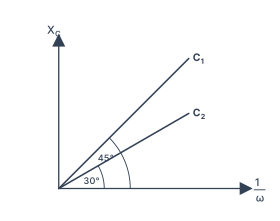
- CBSE 2026Set 55/2/11 markMCQQ.The figure shows the variation of capacitive reactance (XC) of two ideal capacitors of capacitances C1 and C2 with the reciprocal of angular frequency (1/ω) of an ac source. The value of C1/C2 is (A) 21 (B) 2 (C) 3 (D) 31
›Reveal solutionSolution
Figure — CBSE 2026 55/2/1 Q9 Capacitive reactance XC=ωC1 is linear in ω1 with slope C1. Reading the slopes from the angles (tan 45° and tan 30°), we find C2C1=31.
The capacitive reactance of an ideal capacitor is given by
XC=ωC1
Rearranging this as XC=C1⋅ω1, we see that XC is directly proportional to ω1. When we plot XC versus ω1, we get a straight line passing through the origin with slope equal to C1.
The key insight: a steeper line means a larger slope, which means a larger value of C1, which in turn means a smaller capacitance. The graph shows two such lines for capacitors C1 and C2, making angles of 45° and 30° respectively with the horizontal axis.
- Find the slope of line C1: The line makes an angle of 45° with the ω1 axis. The slope is
slopeC1=tan45°=1
Since slope =C11, we have
C11=1⟹C1∝1
- Find the slope of line C2: The line makes an angle of 30° with the ω1 axis. The slope is
slopeC2=tan30°=31
Since slope =C21, we have …
- CBSE 2024Set 55/1/11 markMCQQ.The reactance of a capacitor of capacitance C connected to an ac source of frequency ω is X. If the capacitance of the capacitor is doubled and the frequency of the source is tripled, the reactance will become : (A) 6X (B) 6X (C) 32X (D) 23X
›Reveal solutionSolution
Capacitive reactance is X=2πνC1. Doubling C and tripling ν multiplies the denominator by 6, so the new reactance becomes 6X. The correct option is (A).
The key to this problem is understanding what capacitive reactance actually means physically. A capacitor in an AC circuit doesn't "resist" current the way a resistor does — instead, it opposes changes in voltage by storing and releasing charge. The faster the voltage changes (higher frequency) or the larger the capacitor (more charge storage per volt), the easier it is for current to flow. That's why reactance X is inversely proportional to both capacitance C and frequency ν.
Let's work through the change step by step.
- Write the standard formula for capacitive reactance. For a capacitor of capacitance C connected to an AC source of frequency ν, the reactance is:
X=2πνC1
This is a direct relationship — no tricks, just the definition.
-
Identify the new values.
The capacitance is doubled: C′=2C
The frequency is tripled: ν′=3ν
-
Substitute these into the formula for the new reactance X′.
X′=2πν′C′1=2π(3ν)(2C)1
- Simplify the denominator.
X′=2π⋅6⋅νC1=61⋅2πνC1
- Recognize the original reactance in the expression. Since X=2πνC1, we have: X′=6X …
- CBSE 2023Set 55/3/11 markMCQQ.An inductor, a capacitor and a resistor are connected in series across an ac source of voltage. If the frequency of the source is decreased gradually, the reactance of :(a) both the inductor and the capacitor decreases.(b) inductor decreases and the capacitor increases.(c) both the inductor and the capacitor increases.(d) inductor increases and the capacitor decreases.
›Reveal solutionSolution
The inductive reactance XL=2πfL is directly proportional to frequency, and the capacitive reactance XC=2πfC1 is inversely proportional to frequency. As frequency decreases, XL decreases and XC increases — so option (b) is correct.
The core idea here is simple: reactance is not a fixed property — it depends on frequency. An inductor opposes changes in current, and the faster the current changes (higher frequency), the more it opposes. A capacitor, on the other hand, stores and releases charge; at higher frequencies, it has less time to charge up, so it offers less opposition.
Let’s see exactly how each behaves when frequency is lowered.
- Inductive reactance is given by
XL=2πfL
Here f is the frequency and L is the inductance (a constant for a given inductor). Since XL is directly proportional to f, decreasing f makes XL smaller. So the inductor’s opposition weakens.
- Capacitive reactance is given by
XC=2πfC1
C is the capacitance (constant). Here XC is inversely proportional to f — as f goes down, XC goes up. So the capacitor’s opposition strengthens. …
- CBSE 2021Set A1 markMCQQ.Capacitive reactance is (A) w/c (B) c/w (C) w . c (D) 1/wc
›Reveal solutionSolution
Capacitive reactance X_C = 1/(ωC).
In an AC circuit a capacitor opposes the flow of alternating current; this opposition is the capacitive reactance:
XC=ωC1=2πfC1, …
- CBSE 2020Set ANNUAL1 markQ.How does capacitive reactance vary with frequency?
›Reveal solutionSolution
XC=2πfC1=ωC1; capacitive reactance ∝f1 — it decreases as the frequency increases.
Concept. A capacitor opposes changes in voltage. In an AC circuit this opposition is the capacitive reactance XC.
Why this formula. For a capacitor in AC, XC=ωC1=2πfC1, where f is the supply frequency and C the capacitance. Since f appears in the denominator, higher frequency means the capacitor charges/discharges more rapidly and passes current more easily, so its reactance …
- CBSE 2019Set ANNUAL1 markQ.Find the reactance of a capacitor having a capacitance (π1)μF at 50 Hz.
›Reveal solutionSolution
XC=2πfC1; substituting f=50 Hz and C=π1μF gives XC=104Ω.
The reactance of a capacitor to an AC supply of frequency f is
XC=2πfC1=ωC1
Given C=π1μF=π1×10⁻⁶F and f=50 Hz:
XC=2π(50)(π1×10⁻⁶)1
The π in the numerator (from 2πf) cancels the π in the denominator of C: …
🎓Unlock everything free for 14 days
- ✓Full step-by-step solutions
- ✓Concept-first explanations
- ✓Methods, shortcuts & mistakes
- ✓PYQ mapping + timed mock tests
Full access for 14 days. No credit card required.