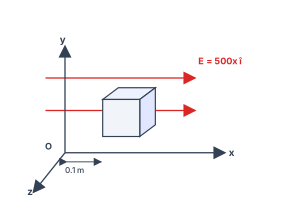
Q.A cube of side is placed, as shown in the figure, in a region where the electric field exists. Here is in metres and in . Calculate :
You're viewing a preview — the full solution, concept, methods & PYQ mapping are locked.
Start your 14-day free trial to unlock the full solution →The electric field is non-uniform (), so the flux through opposite faces does not cancel. Only the two faces perpendicular to the -axis contribute. Net flux , and the enclosed charge .
The key insight here is that Gauss's law relates the net electric flux through a closed surface to the charge enclosed. But when the field is not uniform, you cannot just multiply by area — you must sum the flux through each face separately, paying attention to the direction of the field relative to the outward normal.
The field depends only on . That means on any face of the cube, the field is constant over that face (since is fixed on that face), but it changes from one face to another. This is the classic "non-uniform field through a cube" problem.
Let's work through it systematically.
-
Identify which faces contribute.
The flux through a surface is . Since points purely along , only faces whose area vector has an -component can have non-zero flux. For a cube aligned with the axes, these are the two faces perpendicular to the -axis: the left face (at ) and the right face (at ).
The four faces parallel to the -axis have perpendicular to , so on them. They contribute nothing.
-
Flux through the left face ().
On this face, is constant at , so . The outward normal for the left face points in the direction (out of the cube). So .
The dot product: .
Since is constant over the face, the flux is simply with the sign:
- Flux through the right face (). Here . The outward normal points in , so .
- Net flux through the cube. The other four faces contribute zero, so: …
Unlock everything free for 14 days
- Full step-by-step solutions
- Concept-first explanations
- Methods, shortcuts & mistakes
- PYQ mapping + timed mock tests
Full access for 14 days. No credit card required.