Physics · Ch 9 — Ray Optics and Optical Instruments
Refraction through a Prism
Refraction through a Prism
Refraction Through a Prism
When light passes through a triangular prism, it bends twice — once entering and once leaving. The net effect is a deviation of the ray from its original path. The geometry of the prism and the angles involved lead to a simple relation between the prism angle, the angles of incidence and emergence, and the angle of deviation.
Geometry and Angle Relations
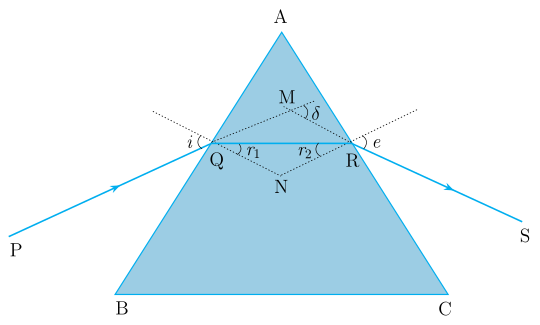
Consider a triangular prism with refracting angle . A ray enters face AB at angle of incidence , refracts inside at angle , then strikes face AC at angle (measured from the normal inside the prism), and emerges at angle (angle of emergence).
In the quadrilateral formed by the prism apex and the two points where the ray meets the faces, two angles are right angles (the normals). The sum of all four angles is , so:
Inside the triangle formed by the ray inside the prism and the two normals, the sum of angles is also :
Comparing these gives the key geometric relation:
This holds for any ray passing through the prism.
Angle of Deviation
The total deviation is the sum of deviations at each face:
- At first face: deviation =
- At second face: deviation =
Thus:
This is the deviation formula. It shows that depends on and , which are symmetric — interchanging and gives the same . This symmetry means that for a given (except at minimum deviation), there are two possible values of .
Minimum Deviation
When the ray inside the prism is parallel to the base, the deviation is minimum, denoted . At this condition:
- (by symmetry)
- (from the geometry)
From , we get:
From , with and :
Refractive Index of the Prism
Using Snell's law at the first face (air to prism):
Substituting and at minimum deviation:
…
Drawn by us to help you understand the concept clearly, and verified to make sure it's accurate. For exams, practice from your NCERT textbook's own diagram.
What the Figure Shows
The diagram depicts a triangular glass prism with vertices labelled A (apex at the top), B, and C. The refracting angle of the prism is the angle at the apex, denoted by A. A ray of light enters the prism through face AB at point P, making an angle of incidence i with the normal at that face. Inside the prism, the ray bends toward the normal and travels to the second face AC, meeting it at point R. The angle of refraction at the first face is r₁, and the angle of incidence (from glass to air) at the second face is r₂. The ray emerges from face AC at point S, making an angle of emergence e with the normal. The incident ray PQ and the emergent ray RS, when extended backward, meet to define the angle of deviation δ — the angle between the original direction of the incident ray and the final direction of the emergent ray. Normals at the two faces are drawn, meeting at point N inside the prism.
Physical Idea
The figure illustrates how a prism bends light by refraction at two inclined surfaces. The key insight is that the total deviation δ depends on the geometry of the prism (angle A) and the angles at which light enters and leaves. The path is reversible: swapping i and e gives the same deviation. At the special condition of minimum deviation (denoted Dₘ), the ray inside the prism runs parallel to the base BC, and the angles of incidence and emergence become equal (i = e), making r₁ = r₂. This symmetric condition is used to measure the refractive index of the prism material.
Key Formulas Derived from the Figure
From the geometry of quadrilateral AQNR (with two right angles at Q and R) and triangle QNR, the textbook obtains:
This relates the two refraction angles inside the prism to the apex angle.
The total deviation is the sum of deviations at the two faces:
which simplifies to:
At minimum deviation (δ = Dₘ, i = e, r₁ = r₂), these become:
Using Snell’s law at the first face (with refractive index of prism relative to air, n₂₁), the formula for refractive index is: …
Drawn by us to help you understand the concept clearly, and verified to make sure it's accurate. For exams, practice from your NCERT textbook's own diagram.
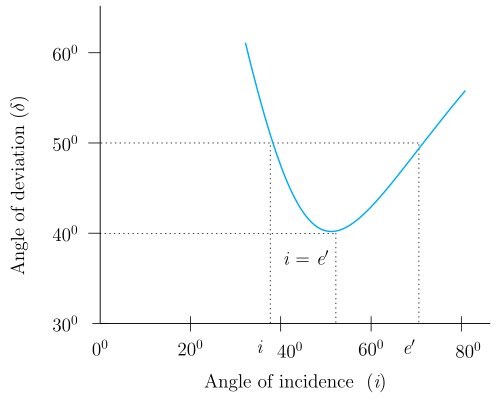
The graph plots the angle of deviation (vertical axis) against the angle of incidence (horizontal axis) for light passing through a triangular prism. The curve is U-shaped: it starts at a relatively high for small , falls steadily to a single lowest point, and then rises again as increases further. This shape shows that the deviation is not constant — it depends strongly on how the light enters the prism.
At the bottom of the U-shaped curve lies the minimum deviation point, labelled . At this point, the incident ray and the emergent ray are symmetric: the angle of incidence equals the angle of emergence , and the refracted ray inside the prism runs parallel to the base of the prism. A horizontal dashed line drawn at any other value of (above ) will intersect the curve at two distinct points — these correspond to two different angles of incidence and that produce the same deviation. This symmetry is expected from the formula , which remains unchanged if and are swapped.
The key physical idea is that for a given prism, there is one unique angle of incidence that minimises the deviation. This minimum deviation is important because it allows a direct measurement of the prism's refractive index.
The textbook derives the following relations using this figure:
- From geometry inside the prism:
where and are the angles of refraction at the first and second faces, and is the prism angle.
- The total deviation:
- At minimum deviation (, , ):
and
- The refractive index of the prism material (relative to the surrounding medium) is then: …