Physics · Ch 9 — Ray Optics and Optical Instruments
Total Internal Reflection
Total Internal Reflection
What is Total Internal Reflection?
When light travels from an optically denser medium (like water or glass) into a rarer medium (like air), it bends away from the normal. This bending is called refraction. At the interface, some light is also reflected back into the denser medium — this is called internal reflection.
As the angle of incidence () increases, the angle of refraction () also increases. For a particular incident ray, the refracted ray bends so much that it just grazes the surface — the angle of refraction becomes . This incident angle is called the critical angle ().
If the angle of incidence is increased beyond the critical angle, refraction is no longer possible. The incident ray is completely reflected back into the denser medium. This phenomenon is total internal reflection.
Key Difference from Ordinary Reflection
In ordinary reflection (even from a smooth mirror), some light is always transmitted or absorbed — the reflected ray is less intense than the incident ray. In total internal reflection, no transmission occurs — the entire incident light is reflected. The reflected ray has the same intensity as the incident ray.
Derivation of the Critical Angle
From Snell’s law (Eq. 9.10), when light travels from medium 1 (denser) to medium 2 (rarer):
At the critical angle (), the angle of refraction is , so . Therefore:
Rearranging gives:
where is the relative refractive index of the rarer medium with respect to the denser medium (always less than 1).
For values of , Snell’s law cannot be satisfied because would exceed 1 — hence no refraction is possible.
The refractive index of the denser medium with respect to the rarer medium is:
Conditions for Total Internal Reflection
- Light must travel from a denser medium to a rarer medium.
- The angle of incidence must be greater than the critical angle for that pair of media.
Critical Angles for Common Media (with respect to air)
| Substance | Refractive index | Critical angle |
|---|---|---|
| Water | 1.33 | |
| Crown glass | 1.52 |
Drawn by us to help you understand the concept clearly, and verified to make sure it's accurate. For exams, practice from your NCERT textbook's own diagram.
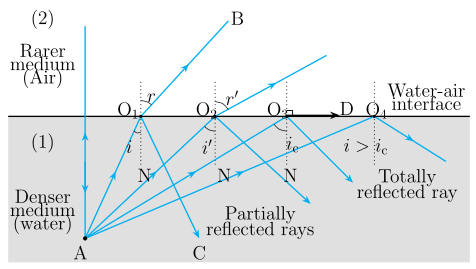
The figure shows a horizontal interface between water (the denser medium, shaded below) and air (the rarer medium, above). A point source A is located in the water. Four rays from A strike the interface at points O₁, O₂, O₃, and O₄, with increasing angles of incidence measured from the dashed normal lines drawn at each point.
- Ray AO₁ (small angle of incidence): Part of the ray refracts into air as O₁B, bending away from the normal (since light travels from denser to rarer medium). The other part reflects internally as O₁C.
- Ray AO₂ (larger angle): The refracted ray bends even more away from the normal; the reflected part remains.
- Ray AO₃ (at the critical angle ): The refracted ray O₃D grazes along the interface — the angle of refraction is exactly 90°.
- Ray AO₄ (angle of incidence > ): No refraction occurs. The ray is totally internally reflected back into the water.
The key physical idea is total internal reflection: when light travels from a denser to a rarer medium, if the angle of incidence exceeds a certain critical angle, all the light is reflected back — no transmission occurs.
The textbook derives the critical angle condition from Snell’s law. For a ray going from medium 1 (denser, refractive index ) to medium 2 (rarer, ), Snell’s law is:
At the critical angle , the angle of refraction (). Thus:
Rearranging gives the formula for the critical angle:
Here:
- = critical angle for the pair of media
- = refractive index of the denser medium (water, )
- = refractive index of the rarer medium (air, ) …
| Substance medium | Refractive index | Critical angle |
|---|---|---|
| Water | 1.33 | 48.75 |
| Crown glass | 1.52 | 41.14 |
Drawn by us to help you understand the concept clearly, and verified to make sure it's accurate. For exams, practice from your NCERT textbook's own diagram.
What the Figure Shows
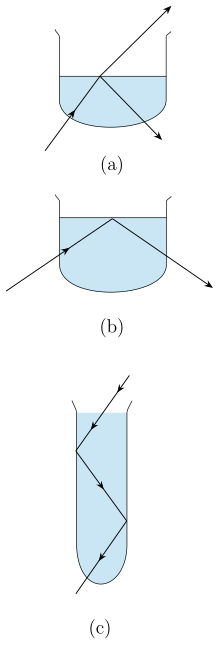
The figure consists of three panels, (a), (b), and (c), that demonstrate total internal reflection using a laser beam in water.
-
Panel (a): A laser beam enters a beaker of slightly turbid water from below. It strikes the upper water–air interface at a small angle of incidence. The beam splits: a partial reflection goes back into the water and hits the table below (visible as a spot), and a partial refraction emerges into the air above, hitting the roof (visible as a spot). The path inside the water glows due to scattering by suspended particles.
-
Panel (b): The laser is directed more obliquely, so the angle of incidence at the upper surface is larger. Now, no beam emerges into the air — the entire incident beam is totally internally reflected back into the water. The refracted spot on the roof disappears.
-
Panel (c): The water is poured into a long test tube. The laser beam is directed from the top at such an angle that it undergoes repeated total internal reflections off the tube walls, bouncing along the length of the tube — exactly like light in an optical fibre.
Physical Idea
The figure illustrates the transition from partial reflection/refraction to total internal reflection as the angle of incidence increases. When light travels from a denser medium (water, refractive index ) to a rarer medium (air, ), it bends away from the normal. For a small angle of incidence , both a reflected and a refracted ray exist. As increases, the angle of refraction also increases. At a specific angle called the critical angle , the refracted ray grazes the surface (). For any , Snell’s law cannot be satisfied — no refraction occurs, and all the light is reflected back into the denser medium. This is total internal reflection, with no transmitted intensity.
Key Formula
The critical angle is derived from Snell’s law:
Thus,
or, defining the relative refractive index of the rarer medium with respect to the denser medium as :
Equivalently, the refractive index of the denser medium with respect to the rarer medium is:
…