Business Economics · Ch 2 — Demand Analysis
The Law of Demand and the Demand Curve
The Law of Demand and the Demand Curve
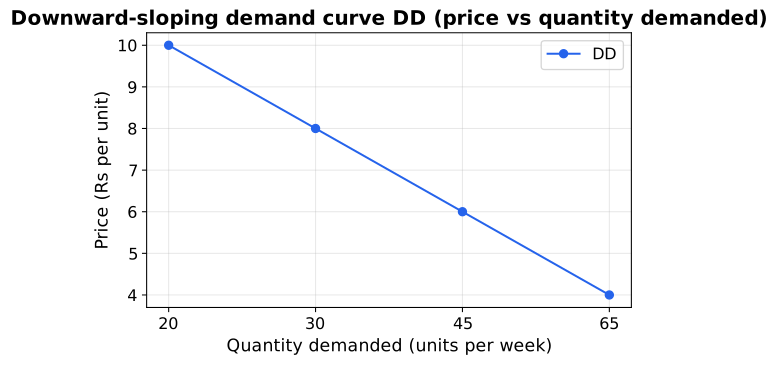
The Law of Demand states that, other things remaining equal, the quantity demanded of a commodity varies inversely with its price — as price falls quantity demanded rises, and as price rises quantity demanded falls. Price and quantity demanded move in opposite directions. The law describes a tendency, not an exact numerical rule; it tells us the direction of change, not its size (that is the job of elasticity, taken up later).
The law can be shown as a schedule and then as a curve:
| Price (₹ per unit) | Quantity demanded (units per week) |
|---|---|
| 10 | 20 |
| 8 | 30 |
| 6 | 45 |
| 4 | 65 |
When these pairs are plotted with price on the vertical (Y) axis and quantity on the horizontal (X) axis, the points trace a demand curve that slopes downward from left to right, confirming the inverse relationship.
Why does the demand curve slope downward? Four reasons are usually given:
- Law of diminishing marginal utility — as a consumer has more units of a good, each extra unit gives less satisfaction, so he will buy more only if the price is lower.
- Income effect — a fall in price raises the consumer's real income (the same money now buys more), enabling him to buy a larger quantity.
- Substitution effect — when a good becomes cheaper relative to its substitutes, buyers switch towards it, raising its quantity demanded.
- New buyers and new uses — a lower price brings in buyers who could not afford the good before and encourages additional uses of it.
Assumptions of the law: there is no change in the consumer's income, in the prices of related goods, in tastes, or in price expectations. If any of these changes, the law may appear not to hold. …
Other things being equal, quantity demanded of a commodity varies inversely w …
A graphical curve showing the quantities of a good demanded at different prices; it slopes downward f …
A strongly inferior good whose demand rises when its price rises, because the income effect outweighs the substitution effect f …