Q.Haloarenes are less reactive than haloalkanes and haloalkenes. Explain.
You're viewing a preview — the full solution, concept, methods & PYQ mapping are locked.
Start your 14-day free trial to unlock the full solution →The lower reactivity of haloarenes compared to haloalkanes and haloalkenes arises from resonance stabilisation of the C–X bond, which gives it partial double-bond character, making nucleophilic substitution difficult. Additionally, the sp² hybridisation of the carbon in haloarenes shortens and strengthens the bond.
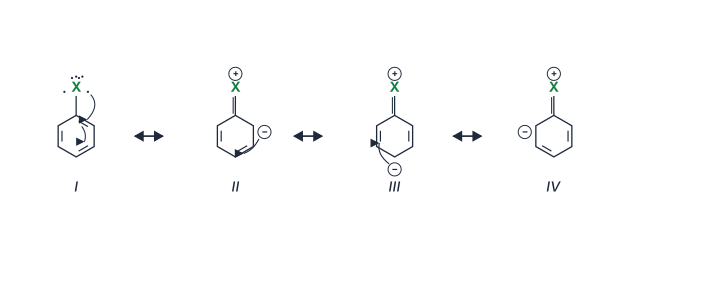
The key to understanding this difference lies in the structure of the carbon–halogen bond. In haloalkanes, the carbon is sp³ hybridised, and the C–X bond is a pure sigma bond. In haloarenes, the halogen is attached to an sp² hybridised carbon of the benzene ring. This sp² carbon has a higher s-character (33%) than an sp³ carbon (25%), which already makes the C–X bond shorter and stronger. But the real game-changer is resonance.
Let’s break it down step by step.
- Resonance in haloarenes gives the C–X bond partial double-bond character. In chlorobenzene, for example, the lone pairs on chlorine can delocalise into the π-electron system of the benzene ring. This creates resonance structures where the C–Cl bond becomes a double bond.
The actual structure is a hybrid, and the C–Cl bond order is greater than 1. This partial double-bond character makes the bond significantly stronger and harder to break. In haloalkanes, no such resonance is possible — the C–X bond remains a pure single bond.
-
The sp² hybridisation of the ring carbon also strengthens the bond.
The carbon in the benzene ring is sp² hybridised, which means the C–Cl sigma bond uses an sp² orbital (33% s-character) rather than an sp³ orbital (25% s-character). Greater s-character means the electrons are held closer to the nucleus, making the bond shorter and stronger. For comparison, the C–Cl bond length in chlorobenzene is about 1.69 Å, while in chloroethane it is about 1.78 Å. A shorter bond is harder to break.
-
Nucleophilic substitution is hindered by the partial double bond.
In a typical Sₙ2 reaction, the nucleophile attacks from the back side, and the C–X bond must break. In haloarenes, the partial double bond means that breaking the C–X bond would require disrupting the aromatic π-system — a high-energy process. Moreover, the sp² carbon is more electronegative than an sp³ carbon, so the carbon is less willing to accept a negative charge in the transition state.
-
Even in haloalkenes, a similar but weaker effect operates.
In vinyl halides (e.g., CH₂=CH–Cl), the halogen is attached to an sp² carbon, and resonance can occur between the lone pair on chlorine and the C=C double bond. This also gives the C–Cl bond partial double-bond character, making vinyl halides less reactive than alkyl halides. However, the effect is less pronounced than in haloarenes because the aromatic ring provides additional stabilisation through its delocalised π-system. …
Unlock everything free for 14 days
- Full step-by-step solutions
- Concept-first explanations
- Methods, shortcuts & mistakes
- PYQ mapping + timed mock tests
Full access for 14 days. No credit card required.