Q.Why are aryl halides less reactive towards nucleophilic substitution reactions than alkyl halides? How can we enhance the reactivity of aryl halides?
You're viewing a preview — the full solution, concept, methods & PYQ mapping are locked.
Start your 14-day free trial to unlock the full solution →Aryl halides are less reactive than alkyl halides in nucleophilic substitution because the lone pair on the halogen is delocalised into the aromatic ring (resonance), giving the C–X bond partial double-bond character. Reactivity can be enhanced by introducing strong electron-withdrawing groups (e.g., –NO₂) at the ortho or para positions, which stabilise the Meisenheimer intermediate in addition–elimination.
1. The core problem: why aryl halides resist nucleophilic attack
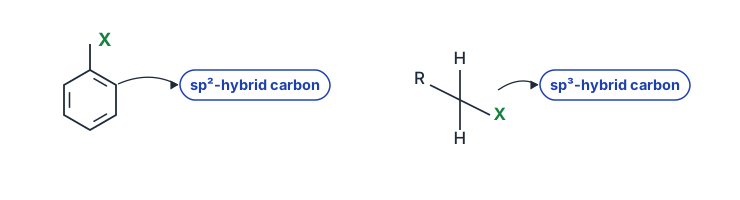
In an alkyl halide, the carbon–halogen bond is a simple σ bond. The carbon is sp³ hybridised, and the halogen’s lone pairs are localised. A nucleophile can approach the carbon from the back side (SN2) or the halogen can leave first (SN1). Both pathways are relatively easy because the C–X bond is polarised and the carbon is electron-deficient.
In an aryl halide, the halogen is attached to an sp² carbon of the benzene ring. That alone makes the bond shorter and stronger (greater s-character). But the real killer is resonance.
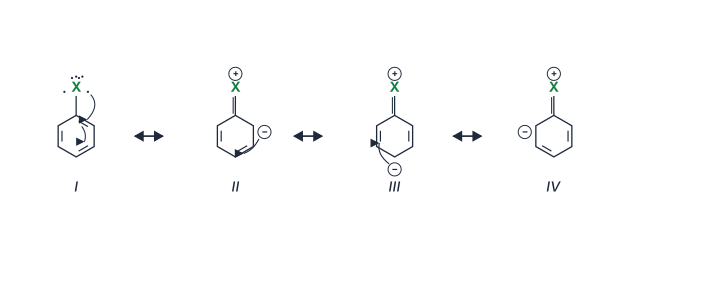
The halogen’s lone pairs participate in resonance with the aromatic ring. This gives the C–X bond partial double-bond character, making it much harder to break.
Draw the resonance structures: the lone pair on chlorine (for chlorobenzene) can delocalise into the ring, placing a negative charge on the ortho and para carbons. This means the C–Cl bond now has a bond order >1. Breaking it requires overcoming this extra stabilisation. Moreover, the ring’s π-electron cloud repels an approaching nucleophile — there’s no empty, accessible orbital on the sp² carbon for backside attack.
Result: SN2 is geometrically impossible (the ring blocks backside approach), and SN1 would require forming a high-energy aryl cation (which is extremely unstable). So the usual substitution mechanisms fail.
2. The mechanism that does work (under harsh conditions)
Aryl halides can undergo nucleophilic substitution, but only via an addition–elimination (SNAr) mechanism, and only under forcing conditions — high temperature, strong base, or a very good nucleophile.
The mechanism:
- The nucleophile attacks the ipso carbon (the one bearing the halogen), forming a Meisenheimer complex — a negatively charged, non-aromatic intermediate.
- The aromaticity is temporarily lost, which costs a lot of energy.
- The halide ion leaves, and aromaticity is restored.
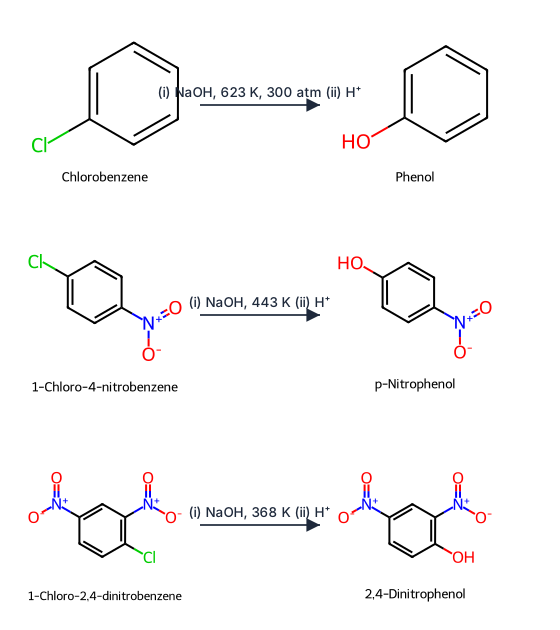
Because the intermediate is high in energy, the activation barrier is large. That’s why chlorobenzene requires temperatures around 300 °C and a strong base like NaOH to give phenol.
3. How to enhance reactivity: the role of electron-withdrawing groups
If you place a strong electron-withdrawing group (EWG) like –NO₂, –CN, or –CHO at the ortho or para position relative to the halogen, the reactivity skyrockets. Here’s why.
The EWG stabilises the negative charge in the Meisenheimer intermediate by delocalising it. This lowers the activation energy dramatically. One –NO₂ group at the ortho or para position can increase the rate by a factor of 10⁵ or more.
Consider 2,4-dinitrochlorobenzene. The two nitro groups pull electron density away from the ring, making the ipso carbon much more electrophilic. When the nucleophile attacks, the negative charge that develops in the intermediate can be spread onto the oxygen atoms of the nitro groups — this is far more stable than having the charge localised on the ring.
The order of activating power: –NO₂ > –CN > –CHO > –COR > –SO₃H. Multiple EWGs at ortho and para positions have a cumulative effect. …
Unlock everything free for 14 days
- Full step-by-step solutions
- Concept-first explanations
- Methods, shortcuts & mistakes
- PYQ mapping + timed mock tests
Full access for 14 days. No credit card required.