Q.Assertion: It is difficult to replace chlorine by –OH in chlorobenzene in comparison to that in chloroethane.
Reason: Chlorine-carbon (C–Cl) bond in chlorobenzene has a partial double bond character due to resonance.
You're viewing a preview — the full solution, concept, methods & PYQ mapping are locked.
Start your 14-day free trial to unlock the full solution →The key idea is that resonance in chlorobenzene gives the C–Cl bond partial double-bond character, making it stronger and harder to break than the single C–Cl bond in chloroethane. Both the assertion and the reason are correct, and the reason correctly explains the assertion.
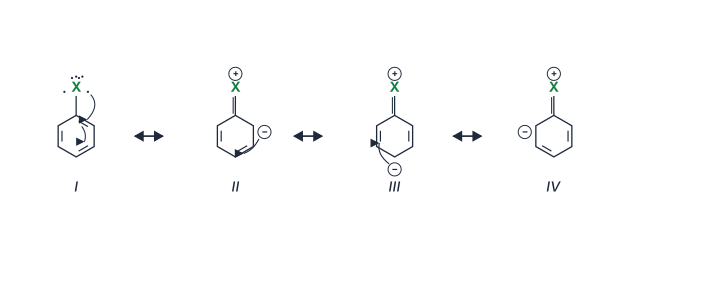
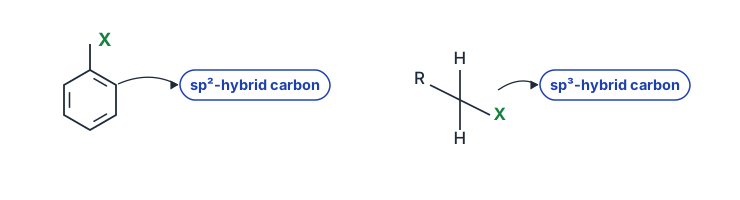
The question tests your understanding of how resonance affects bond strength and reactivity. In chlorobenzene, the chlorine atom donates its lone pairs into the benzene ring, creating resonance structures where the C–Cl bond has double-bond character. This makes the bond stronger and shorter, so replacing chlorine with a nucleophile like –OH becomes difficult. In chloroethane, there is no such resonance — the C–Cl bond is a pure single bond, weaker and more easily broken.
Let’s break it down step by step.
-
Resonance in chlorobenzene
The lone pairs on chlorine can delocalise into the aromatic ring. This gives resonance structures where the carbon attached to chlorine has a partial positive charge and the C–Cl bond is a double bond.
The resonance hybrid shows a C–Cl bond order between 1 and 2, i.e., partial double-bond character.
-
Effect on bond strength
A double bond is stronger and shorter than a single bond. The partial double-bond character in chlorobenzene means the C–Cl bond is harder to break. In chloroethane, the C–Cl bond is a pure single bond — weaker and more reactive toward nucleophilic substitution.
-
Nucleophilic substitution comparison …
Unlock everything free for 14 days
- Full step-by-step solutions
- Concept-first explanations
- Methods, shortcuts & mistakes
- PYQ mapping + timed mock tests
Full access for 14 days. No credit card required.