Q.Chlorobenzene is formed by reaction of chlorine with benzene in the presence of . Which of the following species attacks the benzene ring in this reaction?
You're viewing a preview — the full solution, concept, methods & PYQ mapping are locked.
Start your 14-day free trial to unlock the full solution →In the Friedel–Crafts chlorination of benzene, the attacking electrophile is the chlorine cation , generated by the Lewis acid polarising the bond. The correct option is (ii).
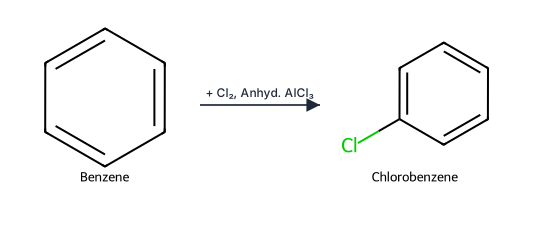
This is a classic electrophilic aromatic substitution (EAS) reaction — the Friedel–Crafts halogenation. Benzene’s π-electron cloud is rich and nucleophilic, but it does not react directly with neutral chlorine gas at room temperature. You need a powerful electrophile to pull electrons away from the ring and form the sigma complex. That’s where the Lewis acid comes in.
The role of is to accept a lone pair from one chlorine atom of , creating a highly polarised complex. This weakens the Cl–Cl bond so much that it effectively breaks heterolytically, generating a ion (or a strongly chlorine in the complex) that can attack the ring.
Let’s walk through the mechanism step by step.
- Generation of the electrophile is electron-deficient (it has only six electrons in its valence shell). It coordinates to a chlorine atom of , forming a complex:
The Al–Cl bond in the complex pulls electron density away from the molecule. This makes one chlorine strongly electrophilic — essentially a equivalent.
- Attack on the benzene ring The π-electrons of benzene attack this electrophilic chlorine, forming a delocalised carbocation intermediate (the arenium ion or sigma complex):
This step is slow and rate-determining. …
Unlock everything free for 14 days
- Full step-by-step solutions
- Concept-first explanations
- Methods, shortcuts & mistakes
- PYQ mapping + timed mock tests
Full access for 14 days. No credit card required.