The Core Intuition: Who Wants to Leave, and Who Can Wait?
Imagine you're at a party where the host (the leaving group) is about to leave. The party (the reaction) happens in two stages. First, the host walks out the door — that's the slow, painful step. Then, a new guest (the nucleophile) rushes in to take the empty spot.
The SN1 reaction works exactly like this: the leaving group leaves first, forming a carbocation intermediate. The nucleophile attacks after the leaving group is gone. This means the rate of the reaction depends only on how easily the leaving group can leave — it does not depend on the nucleophile at all.
So the question becomes: What makes a carbocation form easily? The answer is stability. A carbocation that is more stable will form faster and last longer, making the SN1 reaction faster.
The Precise Statement of SN1 Reactivity Order
SN1 Reactivity Order (for alkyl halides):
Allylic≈Benzyl>3∘>2∘≫1∘≈Methyl
This is the order of how fast the SN1 reaction proceeds. Let's unpack why.
Why This Order? The Stability Ladder
A carbocation is a carbon with only six electrons in its valence shell — it's electron-deficient and positively charged. The more you can spread out (delocalize) that positive charge, the more stable the carbocation becomes.
1. Methyl and 1° Carbocations: The Unstable Ones
A methyl carbocation (CHX3X+) has no alkyl groups attached to the positive carbon. There is zero electron-donating effect to stabilize the charge. It is so unstable that it practically never forms in an SN1 reaction — the reaction simply doesn't happen.
A primary (1°) carbocation has one alkyl group attached. Alkyl groups are weakly electron-donating (through hyperconjugation and inductive effect), so it's slightly more stable than methyl — but still far too unstable to form under normal SN1 conditions.
Watch out
Never say "SN1 happens on a primary carbon" in an exam. It is essentially impossible under standard conditions because the carbocation is too unstable.
2. Secondary (2°) Carbocations: The Borderline Case
A secondary carbocation has two alkyl groups donating electron density. It is moderately stable — stable enough to form, but only under certain conditions (like a good leaving group and a polar protic solvent). SN1 reactions on secondary carbons are possible, but they are slower than on tertiary carbons.
3. Tertiary (3°) Carbocations: The Sweet Spot
Three alkyl groups donate electron density to the positive carbon. This makes the carbocation very stable. Tertiary alkyl halides undergo SN1 reactions readily — they are the classic example.
4. Allylic and Benzylic: The Champions
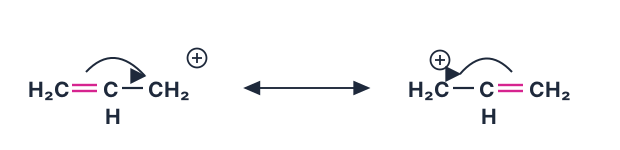
These are special cases. In an allylic carbocation, the positive charge is adjacent to a carbon-carbon double bond. The π electrons of the double bond can delocalize the positive charge onto the second carbon:
CHX2=CH−CHX2X+↔+CHX2−CH=CHX2
Two resonance structures of the allyl carbocation, CH2=CH-CH2+, with the positive charge delocalised between the two terminal carbons (Structure I and Structure II)
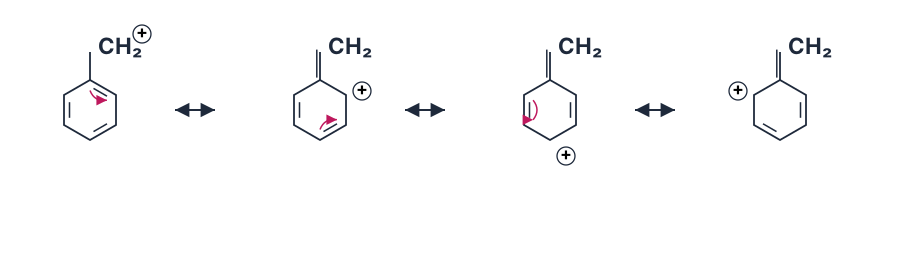
In a benzylic carbocation, the positive charge is adjacent to a benzene ring. The π system of the ring delocalizes the charge across multiple carbons:
CX6HX5−CHX2X+↔(several resonance structures)
Here are those resonance structures — the positive charge cycles from the CH₂ carbon onto the ortho and para positions of the ring:
Four resonance structures of the benzyl carbocation, C6H5-CH2+, with curved electron-pushing arrows showing the positive charge delocalising from the exocyclic CH2 carbon onto the ortho and para ring carbons
This resonance stabilization makes allylic and benzylic carbocations even more stable than tertiary ones. They form the fastest in SN1 reactions.
The Complete Picture in a Table
| Carbocation Type | Stability | SN1 Reactivity | Example |
The SN1 reaction (Substitution Nucleophilic Unimolecular) proceeds via a carbocation intermediate. The reactivity order is determined entirely by the stability of this carbocation — because the rate-determining step is its formation.
The Core Principle
The rate law for SN1 is:
Rate=k[RX]
Only the substrate appears in the rate law — the nucleophile does not participate in the slow step. The slow step is:
RXslowR++X−
Thus, anything that stabilizes the carbocation (R⁺) lowers the activation energy and increases the reaction rate.
The Reactivity Order
For alkyl halides (RX), the SN1 reactivity order is:
This is purely about hyperconjugation and inductive effect.
Tertiary carbocation: Three alkyl groups donate electron density via hyperconjugation (C–H σ bonds overlap with empty p orbital) and +I effect. This spreads the positive charge over more atoms → most stable.
Secondary: Two alkyl groups → less stabilization.
Primary: Only one alkyl group → very little stabilization.
Methyl: No alkyl groups → least stable (only inductive effect from H atoms, which is negligible).
Key formula: The number of α-hydrogens (H on carbons adjacent to the positive carbon) determines hyperconjugation. More α-H → more resonance structures → more stable.
2. Why Allylic and Benzylic Are Even Faster
These carbocations are resonance-stabilized.
Allylic carbocation: The positive charge is delocalized over two carbon atoms via π-bond conjugation:
CH2=CH−CH2+⟷CH2+−CH=CH2
Two resonance structures of the allyl carbocation with the positive charge shared between the two terminal CH2 carbons
Benzylic carbocation: The positive charge is delocalized into the aromatic ring:
C6H5−CH2+⟷several resonance forms involving the ring
Those resonance forms look like this:
Resonance structures of the benzylic carbocation C6H5-CH2+ showing the positive charge delocalised onto the ortho and para carbons of the benzene ring
This resonance stabilization is so powerful that even a primary allylic or benzylic carbocation is more stable than a tertiary alkyl carbocation.
Concept: Density depends on molecular mass and packing. For similar-sized aromatic rings, density increases with the mass of substituents (heavier halogens raise density more).
Reasoning:
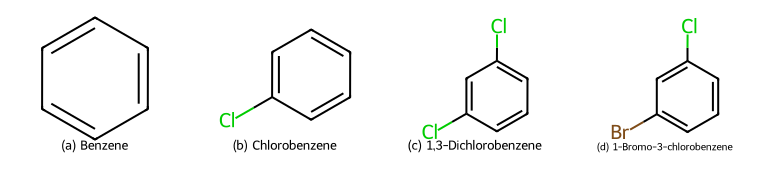
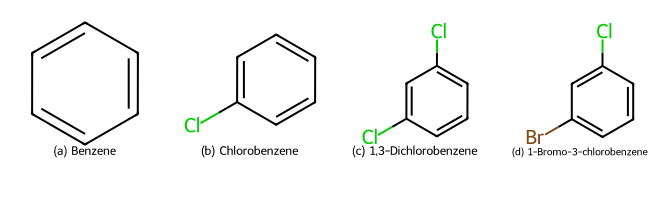
Benzene (a) has the smallest molecular mass (78) and no heavy atoms — lowest density.
Chlorobenzene (b) has one Cl (M≈112.5) — density higher than benzene.
1,3-Dichlorobenzene (c) has two Cl atoms (M≈147) — denser than monochlorobenzene. …
Density in organic liquids is largely governed by molecular mass and packing efficiency. Heavier substituents (Br > Cl) and more halogen atoms increase density. The correct increasing order is benzene < chlorobenzene < 1,3-dichlorobenzene < 1-bromo-3-chlorobenzene, which corresponds to option (i).
The question asks for increasing order of density. For organic liquids at room temperature, density depends on two main factors: molecular mass (heavier molecules generally pack more mass per unit volume) and intermolecular forces (which affect how tightly molecules pack). Halogen atoms are heavy and also polar, so adding them increases density significantly.
Let’s examine each compound.
Benzene (C₆H₆) — molecular mass = 78 g/mol. It is a light hydrocarbon with no heavy atoms. Density ≈ 0.88 g/mL. This will be the lowest.
Chlorobenzene (C₆H₅Cl) — one chlorine atom (atomic mass 35.5) replaces a hydrogen. Molecular mass = 112.5 g/mol. The chlorine adds significant mass and also introduces polarity, leading to better packing. Density ≈ 1.11 g/mL. Clearly denser than benzene.
1,3-Dichlorobenzene (C₆H₄Cl₂) — two chlorine atoms. Molecular mass = 147 g/mol. More mass than chlorobenzene, and the two chlorines increase polarity further. Density ≈ 1.29 g/mL. So it is denser than chlorobenzene. …
Density of organic compounds depends primarily on molecular mass and packing efficiency. For substituted benzenes, heavier halogen atoms (Br > Cl) increase density. More halogen atoms also increase density.
Method: Molecular Mass Comparison
Step 1: Calculate molecular masses
Benzene (C6H6): 6×12+6×1=78 g/mol
Chlorobenzene (C6H5Cl): replace one H of benzene with Cl: 78−1+35.5=112.5 g/mol
1,3-dichlorobenzene (C6H4Cl2): replace two H with two Cl: 78−2+2×35.5=147 g/mol
1-bromo-3-chlorobenzene (C6H4BrCl): replace two H with one Br and one Cl: 78−2+80+35.5=191.5 g/mol
Step 2: Arrange in increasing order of molecular mass
Mistake 1: Assuming meta-substitution reduces packing enough to reorder the trend
The error: Students reason that since 1,3-dichlorobenzene is asymmetric (meta-substituted), its molecules must pack less efficiently than chlorobenzene's, and conclude chlorobenzene should therefore be denser than 1,3-dichlorobenzene — reordering the list to (a)< (c)< (b)< (d).
Why it's wrong: Real densities don't support this: benzene ≈ 0.877 g/mL, chlorobenzene ≈ 1.106 g/mL, 1,3-dichlorobenzene ≈ 1.288 g/mL, 1-bromo-3-chlorobenzene ≈ 1.667 g/mL. Adding a second heavy halogen atom increases mass more than any packing-efficiency loss from losing symmetry can offset — 1,3-dichlorobenzene is genuinely denser than chlorobenzene, not less dense.
How to avoid:
For this class of comparison (aromatic ring + halogen substituents, no big shape change), substituent mass is the dominant factor, not packing symmetry. Don't invent a symmetry-based reversal without checking real values.
Order by cumulative substituent mass: no halogen (78) < one Cl (112.5) < two Cl (147) < one Br + one Cl (191.5).
Mistake 2: Confusing density with molecular weight alone (without checking it actually holds)
The error: Students arrange purely by molar mass without double-checking whether any packing effect could plausibly reverse the order.
Why this is actually fine here: Density = mass/volume, and packing DOES matter in general — but for this specific set of closely related aromatic halides (same ring, no big shape distortion), the extra halogen mass dominates and molar-mass ordering happens to match the real density ordering exactly.
How to avoid:
Use molar mass as your first estimate, then sanity-check: is there a reason (major shape change, hydrogen bonding, drastically different symmetry) the order might flip? Here there isn't — the ordering by mass is correct.
Mistake 3: Forgetting that bromine is much heavier than chlorine
The error: Students treat Br and Cl as similar "heavy atoms" and guess 1-bromo-3-chlorobenzene might be similar in density to 1,3-dichlorobenzene.