Q.Match the reactions given in Column I with the types of reactions given in Column II.
Column I:
(i)
(iii)
Column II:
[!NOTE]
The Exemplar prints Column II as (a), (b), (c), (d),
You're viewing a preview — the full solution, concept, methods & PYQ mapping are locked.
Start your 14-day free trial to unlock the full solution →This problem matches five organic reactions to their correct reaction types. The key is to identify the mechanism based on the substrate, reagent, and product — electrophilic aromatic substitution for chlorobenzene chlorination, electrophilic addition for alkene + HBr, S1 for the benzylic iodide hydrolysis, nucleophilic aromatic substitution for the activated aryl halide, and Saytzeff elimination for the dehydrohalogenation of 2-bromobutane.
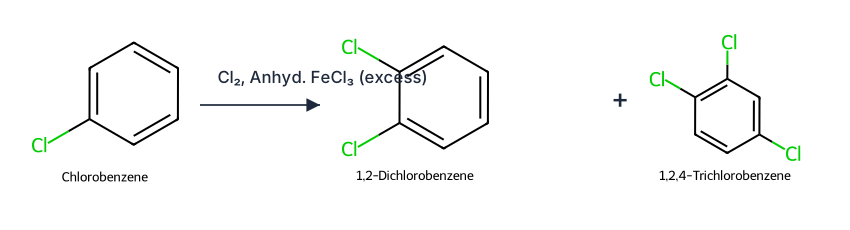
Let’s go through each reaction one by one, understanding why the mechanism is what it is.
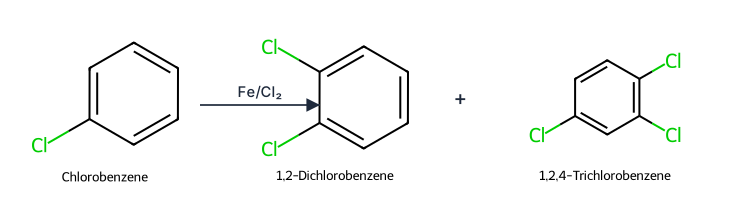
1. (i) 1,2-dichlorobenzene + 1,2,4-trichlorobenzene
Chlorobenzene is an aromatic ring. The reagent is chlorine gas with iron (which generates , a Lewis acid). This is a classic electrophilic aromatic substitution — the electrophile attacks the ring, and the iron catalyst activates the chlorine molecule. The products are ortho-dichlorobenzene and 1,2,4-trichlorobenzene (the chlorine already present is ortho/para-directing). So this matches (b).
Don’t confuse this with nucleophilic aromatic substitution — chlorobenzene does not undergo nucleophilic substitution under normal conditions because the C–Cl bond has partial double-bond character. The Fe/Cl conditions are unmistakably electrophilic.
2. (ii)
Propene reacts with HBr. The double bond is electron-rich and attacks the electrophilic proton of HBr, forming a carbocation. The more stable carbocation (secondary, in this case) forms, and then bromide ion attacks that carbocation. This is electrophilic addition — the alkene is the nucleophile, HBr is the electrophile. The product follows Markovnikov’s rule (Br goes to the more substituted carbon). So this matches (d).
Markovnikov addition: the hydrogen adds to the carbon with more hydrogens already, giving the more stable carbocation intermediate. Here, the secondary carbocation forms, not the primary one.
3. (iii)
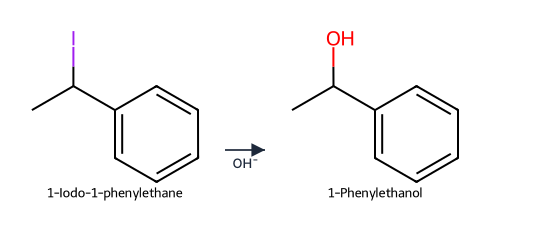
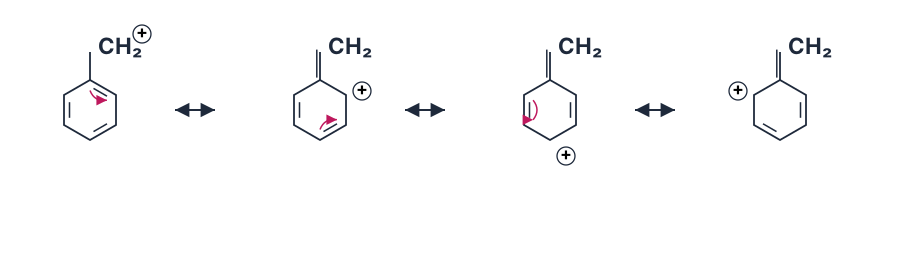
This is 1-iodo-1-phenylethane reacting with hydroxide ion to give 1-phenylethanol. The iodine is on a benzylic carbon — that carbon can form a relatively stable benzylic carbocation. The reaction proceeds via an S1 mechanism: first the C–I bond breaks (slow step) to give a benzylic carbocation, then OH attacks (fast step). The product shows inversion is not required; racemization would occur. So this matches (e).
Benzylic and allylic halides are classic S1 substrates because the carbocation is resonance-stabilized. A primary halide would not do S1, but here the benzylic position makes it possible.
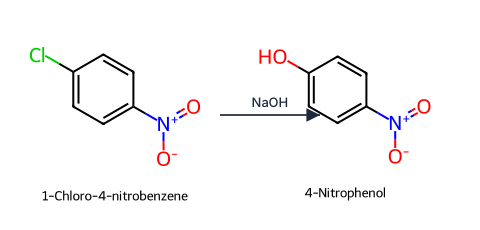
4. (iv) 1-chloro-4-nitrobenzene 4-nitrophenol …
Unlock everything free for 14 days
- Full step-by-step solutions
- Concept-first explanations
- Methods, shortcuts & mistakes
- PYQ mapping + timed mock tests
Full access for 14 days. No credit card required.