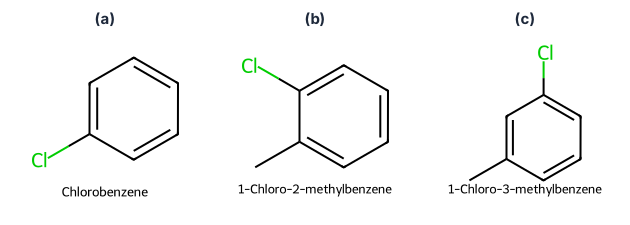
Q.Arrange the compounds in increasing order of rate of reaction towards nucleophilic substitution. (Note printed in the Exemplar for questions 26 to 29.)
You're viewing a preview — the full solution, concept, methods & PYQ mapping are locked.
Start your 14-day free trial to unlock the full solution →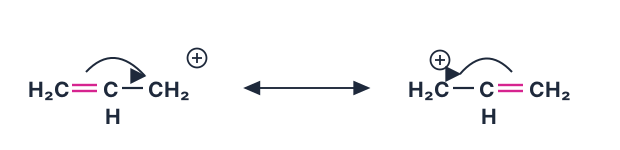
The rate of nucleophilic substitution in aryl halides is governed by the stability of the Meisenheimer complex intermediate. An electron-donating methyl group destabilises this intermediate when placed ortho or para to the leaving group, but has a weaker effect at the meta position. The correct increasing order of reactivity is (b) < (c) < (a), which corresponds to option (iv).
-
The core concept: SNAr mechanism and the Meisenheimer complex
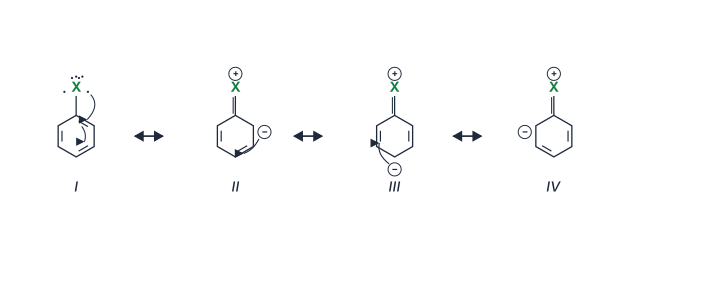
Aryl halides do not undergo typical SN1 or SN2 reactions. Instead, they react via nucleophilic aromatic substitution (SNAr). The rate-determining step is the formation of a negatively charged intermediate called the Meisenheimer complex (or σ-complex). In this intermediate, the negative charge is delocalised onto the ring, especially at the ortho and para positions relative to the leaving group.
Any substituent that stabilises this negative charge will speed up the reaction; any substituent that destabilises it will slow the reaction down.
-
Effect of a methyl group on the Meisenheimer complex
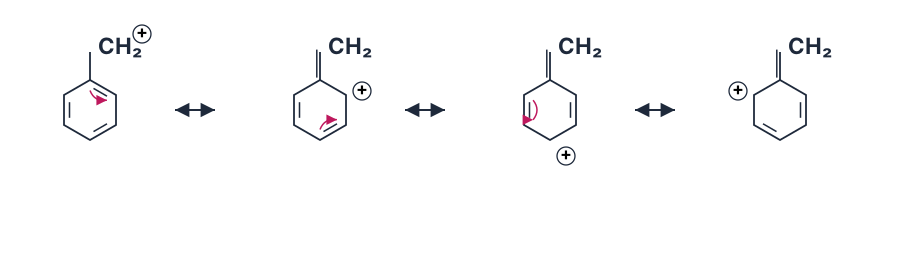
A methyl group is electron-donating by hyperconjugation and induction. When it is placed at the ortho or para position relative to chlorine, it donates electron density directly into the positions that already carry significant negative charge in the intermediate. This destabilises the intermediate (like adding more negative charge where it’s already concentrated) and raises the activation energy.
When the methyl group is meta to chlorine, it does not directly interact with the charge-bearing ortho/para positions. Its electron-donating effect is much weaker and may even be slightly stabilising through inductive effects, but the key point is that the meta-methyl group interferes far less with the intermediate.
-
Comparing the three compounds
- Chlorobenzene (a): No methyl group — the reference compound. The intermediate has no extra destabilisation.
- 1-chloro-3-methylbenzene (c): Methyl is meta to Cl. The destabilising effect is minimal; the rate is slightly slower than chlorobenzene but faster than the ortho isomer. …
Unlock everything free for 14 days
- Full step-by-step solutions
- Concept-first explanations
- Methods, shortcuts & mistakes
- PYQ mapping + timed mock tests
Full access for 14 days. No credit card required.