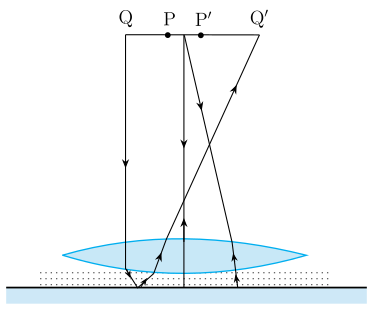
Q.Figure 9.30 shows an equiconvex lens (of refractive index 1.50) in contact with a liquid layer on top of a plane mirror. A small needle with its tip on the principal axis is moved along the axis until its inverted image is found at the position of the needle. The distance of the needle from the lens is measured to be 45.0 cm. The liquid is removed and the experiment is repeated. The new distance is measured to be 30.0 cm. What is the refractive index of the liquid?
🔒You're viewing a preview — the full solution, concept, methods & PYQ mapping are locked.
🔒 Start your 14-day free trial to unlock the full solution →Concept understanding — Lens Maker's Formula
The Intuition: Why a Lens Bends Light
A lens works because light slows down when it enters glass. When a wavefront hits a curved surface at an angle, different parts of it slow down at different moments, and the wavefront bends. The stronger the curvature, the more it bends.
A lens has two surfaces. Each surface bends light by an amount that depends on its radius of curvature R and the refractive index n of the glass. The net bending — the focal length f — is the combined effect of both surfaces.
If you had a single spherical surface separating air from glass, its contribution to bending power is Rn−1. A lens has two such surfaces: light goes from air into glass at the first surface, then from glass back into air at the second. Because the two surfaces face opposite directions relative to the travelling light, their radii typically carry opposite signs.
This uses the New Cartesian Sign Convention (the one used in NCERT and CBSE): all distances are measured from the optical centre, and the direction the incident light travels in is taken as positive. So R is positive if the centre of curvature lies on the side the light is travelling towards (the outgoing side), and negative if it lies on the side the light is travelling from (the incident side).
The Precise Statement
For a thin lens (thickness negligible compared to the radii), the Lens Maker's Formula is:
f1=(n−1)(R11−R21)
where:
- f is the focal length of the lens (positive for converging, negative for diverging)
- n is the refractive index of the lens material relative to the surrounding medium (usually air)
- R1 is the radius of curvature of the first surface (the one light reaches first)
- R2 is the radius of curvature of the second surface
f1=(n−1)(R11−R21)
How to Apply It: A Worked Example
Take a biconvex lens made of glass (n=1.5) with both surfaces having the same radius of curvature magnitude, 20 cm.
Light travels left to right. The first surface bulges toward the incoming light, so its centre of curvature lies to the right of the surface — on the side the light is travelling towards. By the rule above, R1=+20 cm.
The second surface also bulges outward (away from the lens), so its centre of curvature lies to the left of that surface — on the side the light is travelling from. So R2=−20 cm.
Plug in:
f1=(1.5−1)(201−−201)=0.5×(201+201)=0.5×202=201
So f=+20 cm. Positive means converging — correct for a biconvex lens.
The most common mistake is getting the sign of R2 wrong. For a biconvex lens, R1 is positive and R2 is negative. For a biconcave lens, it's the reverse: R1 negative, R2 positive. Always sketch the lens and mark where each surface's centre of curvature actually sits.
Why the Formula Works (Brief Derivation) …
When the inverted image coincides with the needle (autocollimation), the needle is at the focus of the mirror–lens system, so each measured distance equals a system focal length:
- Lens + liquid: F=45.0 cm
- Glass lens alone: f1=30.0 cm
Radius of the equiconvex lens (ng=1.50, radii +R and −R):
f11=(1.50−1)(R1−−R1)=R1⇒R=30 cm
Focal length of the liquid (plano-concave) lens, in contact with the glass lens:
f21=F1−f11=451−301=−901⇒f2=−90 cm …
Autocollimation makes each needle distance a focal length: glass lens f1=30 cm, lens + liquid F=45 cm. These give a liquid lens f2=−90 cm and a liquid refractive index n=34≈1.33.
Principle — why the coincidence gives a focal length
With a plane mirror below the lens, rays that leave the needle, pass through the lens, reflect off the mirror, and return retrace their path only when they strike the mirror normally — that is, when they travel parallel between lens and mirror. This happens when the needle sits at the focus of the lens system, so the measured needle distance equals the focal length.
Step 1 — Focal lengths from the two measurements
- Glass lens + liquid layer together: F=45.0 cm
- Glass lens alone (liquid removed): f1=30.0 cm
Step 2 — Radius of the equiconvex glass lens
With ng=1.50 and surface radii +R and −R, the lens maker's formula gives
f11=(1.50−1)(R1−−R1)=0.5×R2=R1
so R=f1=30.0 cm.
Step 3 — Focal length of the liquid lens
The liquid fills the gap between the convex glass lens and the plane mirror, forming a plano-concave lens in contact with the glass lens. For thin lenses in contact, …
Method: Optical Autocollimation with a Liquid Lens on a Mirror
This method solves "needle experiment" problems where a lens (or a lens plus a liquid layer) rests on a plane mirror, and a needle's own inverted image coinciding with itself is used to extract a focal length.
Steps
Step 1: Recognise WHY coincidence gives a focal length
Light leaving the needle, passing through the lens system, reflecting off the plane mirror, and retracing its own path back to the needle can only happen if the rays strike the mirror travelling parallel to the axis — which happens only when the needle sits exactly at the focus of the whole lens(+liquid) system. So each measured needle-to-lens distance IS a system focal length, no further optics needed to establish that.
Step 2: Use the lens maker's formula on the part of the system you already know
f1=(n−1)(R11−R21)
Apply this to the glass lens alone (its shape and index are given) to pin down any unknown radius of curvature.
Step 3: Isolate the unknown component's focal length using the thin-lens combination rule
For two thin elements in contact, …
- JKBOSE Class 12 Annual Regular Examination 2026Set SZ5 marksQ.What is Lens Maker's formula? Derive an expression for Lens Maker's formula for a convex lens. OR State Huygen's Principle. Derive laws of reflection from Huygen's Principle.
›Reveal solutionSolution
The Lens Maker's formula, f1=(μ−1)(R11−R21), is derived by applying single-surface refraction twice, once at each face of the lens. (OR alternative: Huygens' Principle constructs wavefronts from secondary wavelets, and can be used to derive the laws of reflection geometrically.)
Part 1: Lens Maker's Formula
What it is. The Lens Maker's formula relates a lens's focal length f to the refractive index μ of its material (relative to the surrounding medium) and the radii of curvature R1, R2 of its two spherical surfaces — it tells a lens manufacturer what curvatures are needed to grind a lens of a desired focal length.
Derivation for a thin convex lens. Consider a thin lens with two refracting surfaces of radii R1 (first surface, light hits this first) and R2 (second surface), made of material of refractive index μ, surrounded by air (index 1). Let a point object O on the principal axis form an image after refraction at each surface in turn.
Step 1 — Refraction at the first surface (radius R1), treating it alone (ignoring the second surface for now), forming a virtual intermediate image I1 at distance v1:
v1μ−u1=R1μ−1
Step 2 — Refraction at the second surface (radius R2): the image I1 from step 1 now acts as the object for this second refraction (light going from the denser lens medium μ back into air, index 1), forming the final image I at distance v:
v1−v1μ=R21−μ
Step 3 — Add the two equations (the μ/v1 terms cancel):
v1−u1=(μ−1)(R11−R21)
Step 4 — Apply the lens definition. When the object is at infinity (u→∞), the image forms at the focus (v=f), so v1−u1→f1. Substituting:
f1=(μ−1)(R11−R21)
This is the Lens Maker's formula, and it also leads to the general thin lens formula v1−u1=f1.
OR: Huygens' Principle and the Laws of Reflection
Huygens' Principle. Every point on a given wavefront (a surface of constant phase) acts as a source of new secondary wavelets, which spread out in all directions with the speed of the wave in that medium. The new wavefront at any later time is given by the forward "envelope" (common tangent surface) of all these secondary wavelets.
Deriving the laws of reflection. Consider a plane wavefront AB incident on a reflecting surface MN at angle of incidence i, with A striking the surface first while B is still travelling. …
- JKBOSE Class 12 Annual Regular Examination 2023Set ANNUAL5 marksQ.Stating the assumptions made and convention of signs used, derive the lens maker's formula in case of a double convex lens. OR Define fringe width. Derive an expression for fringe width in Young's double slit experiment of interference of light.
›Reveal solutionSolution
The lens maker's formula, 1/f = (n21-1)(1/R1 - 1/R2), is derived by applying refraction at each of the two spherical surfaces of a thin lens in turn. (OR: Fringe width beta = lambdaD/d is derived from the path-difference condition for constructive/destructive interference in Young's double-slit experiment.)
Derivation of Lens Maker's Formula (for a thin double convex lens):
Assumptions: (i) The lens is thin, so the two refracting surfaces are close enough that the lateral displacement of the ray inside the lens can be neglected. (ii) Only paraxial rays (making small angles with the principal axis) are considered. (iii) The medium on both sides of the lens is the same (say, refractive index n1), and the lens material has refractive index n2.
Sign convention: All distances are measured from the pole/optical centre of the surface; distances measured in the direction of the incident light are taken positive, against it negative. For a double convex lens, the first surface (facing the incident light) is convex towards the object, so its radius R1 is positive; the second surface curves the other way, so its radius R2 is negative.
Consider a point object O on the principal axis. Let the first surface (radius R1) refract the light from the object; treating this surface alone, the image I1 formed (a virtual, intermediate image) obeys the single-surface refraction formula:
n2/v1 - n1/u = (n2 - n1)/R1 ... (i)
where u is the object distance and v1 is the image distance for the first surface alone.
This intermediate image I1 now acts as a virtual object for the second surface (radius R2), which refracts the ray back into the surrounding medium n1, forming the final real image I at distance v:
n1/v - n2/v1 = (n1 - n2)/R2 ... (ii)
Adding equations (i) and (ii), the n2/v1 and -n2/v1 terms cancel:
n1/v - n1/u = (n2-n1)/R1 + (n1-n2)/R2 = (n2-n1)*(1/R1 - 1/R2).
Dividing throughout by n1:
1/v - 1/u = (n2/n1 - 1)(1/R1 - 1/R2) = (n21 - 1)(1/R1 - 1/R2), where n21 = n2/n1 is the refractive index of the lens material relative to the surrounding medium.
Now, if the object is placed at infinity (u tends to infinity), the rays refracted by the lens converge (for a convex lens) to the principal focus, so v = f (the focal length). Putting u = infinity, 1/u = 0:
1/f = (n21 - 1)*(1/R1 - 1/R2).
This is the Lens Maker's Formula. It relates the focal length f of a thin lens to the refractive index of its material (relative to the surrounding medium) and the radii of curvature of its two surfaces, and is used by lens manufacturers to design a lens of a required focal length. For a double convex lens (R1 positive, R2 negative), (1/R1 - 1/R2) is positive, so f comes out positive - confirming it is a converging lens.
…
- JKBOSE Class 12 Annual Regular Examination 2021Set SZ5 marksQ.Derive Lens-Maker's formula for convex lens. Write the necessary sign convention used. OR State Huygen's wave principles. Use them to prove laws of refraction of light.
›Reveal solutionSolution
The lens-maker's formula relates a thin lens's focal length to its refractive index and the radii of curvature of its two surfaces, derived by applying single-surface refraction twice.
Sign convention (Cartesian, as used in NCERT): All distances are measured from the optical centre of the lens. Distances measured in the direction of the incident light are taken as positive; distances measured against the direction of incident light are taken as negative. Heights measured upward from the principal axis are positive, downward are negative. For a convex lens, if the centre of curvature of a surface lies on the outgoing-light side, its radius R is positive; if on the incoming-light side, R is negative.
Derivation of lens-maker's formula:
Consider a thin convex lens of refractive index n2 placed in a medium of refractive index n1, with surfaces of radii R1 and R2. Let an object be at O on the principal axis.
Refraction at the first surface (radius R1) forms an image at I1 (treating the second surface as absent), using the single spherical refracting surface formula:
v1n2−un1=R1n2−n1
Refraction at the second surface (radius R2): the image I1 from the first surface now acts as a virtual object for the second surface, forming the final image at I (at distance v):
vn1−v1n2=R2n1−n2
Adding these two equations (the n2/v1 terms cancel):
vn1−un1=(n2−n1)(R11−R21)
Dividing throughout by n1:
v1−u1=(n1n2−1)(R11−R21)=(n21−1)(R11−R21)
When the object is at infinity (u→∞), the image forms at the focus, v=f, giving the general lens formula v1−u1=f1, so:
f1=(n21−1)(R11−R21)
where n21=n2/n1 is the refractive index of the lens material relative to the surrounding medium.
OR — Huygens' principle and laws of refraction:
Huygens' wave principle: Every point on a given wavefront (locus of points vibrating in phase) acts as a source of new secondary wavelets, which spread out in all directions with the speed of the wave in that medium. The new (secondary) wavefront at any later instant is the surface tangent (envelope) to all these secondary wavelets.
Derivation of Snell's law using Huygens' construction:
…
🎓Unlock everything free for 14 days
- ✓Full step-by-step solutions
- ✓Concept-first explanations
- ✓Methods, shortcuts & mistakes
- ✓PYQ mapping + timed mock tests
Full access for 14 days. No credit card required.