Chemistry · Ch 3 — Thermodynamics
Extensive and Intensive Properties
Extensive and Intensive Properties
Extensive and Intensive Properties
In thermodynamics, properties of a system are classified into two fundamental categories.
Extensive properties depend on the quantity or size of matter present in the system. If you double the amount of substance, the property doubles. Examples include mass, volume, internal energy (), enthalpy (), and heat capacity ().
Intensive properties do not depend on the quantity or size of matter present. They are the same regardless of how much substance you have. Examples include temperature, density, and pressure.
A molar property, denoted , is the value of an extensive property of the system for one mole of the substance. If is the amount of matter, then:
Molar properties are intensive because they are independent of the amount of substance. Examples include molar volume () and molar heat capacity (). …
Drawn by us to help you understand the concept clearly, and verified to make sure it's accurate. For exams, practice from your textbook's own diagram.
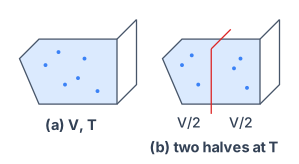
Fig. 5.6 is a simple two-panel sketch that makes the extensive-vs-intensive distinction concrete. Panel (a) shows a rectangular box containing a gas, labelled with its volume and temperature . Panel (b) shows the same box with a thin partition inserted down the middle: each compartment now holds half the gas, labelled .
The point of the comparison is what changes and what does not. Inserting the partition halves the volume of each portion — volume depends on the amount of matter considered, so it is an extensive property. But each half is still at the same temperature — temperature does not care how much gas you look at, so it is an intensive property.
Run the same thought experiment on any property to classify it. Mass, internal energy, enthalpy, and heat capacity all halve with the partition — extensive. Temperature, pressure, and density stay the same — intensive.
The same device explains why molar quantities are intensive: a molar property divides one extensive quantity by another (the amount of substance ), and the dependence on the amount cancels. Molar volume and molar heat capacity are the standard examples. …