Q.In the presence of a catalyst, the heat evolved or absorbed during the reaction ___________.
Concept understanding — Average Rate Of Reaction
Reaction Rate Stoichiometry – From Intuition to Precision
Imagine you are watching a simple reaction:
2NO2→2NO+O2
As NO₂ disappears, NO appears twice as fast as O₂ appears. Why? Because the balanced equation says: for every 2 molecules of NO₂ that break apart, you get 2 molecules of NO and 1 molecule of O₂. The numbers in front of the species — the stoichiometric coefficients — tell you the relative speeds at which reactants vanish and products appear.
That is the core idea: reaction rate stoichiometry is the relationship between the rates of change of different species in a chemical reaction, dictated by their coefficients in the balanced equation.
The Intuitive Picture
Think of a factory assembly line. The balanced equation is like a recipe:
- 2 units of raw material A → 2 units of product B + 1 unit of byproduct C
If the line runs steadily, every time 2 units of A are consumed, 2 units of B are produced and 1 unit of C is produced. So the rate at which A disappears must be twice the rate at which C appears. The rate at which B appears equals the rate at which A disappears (both have coefficient 2).
The stoichiometric coefficients are not speeds themselves — they are scaling factors that connect the speeds of different species.
The Precise Statement
For a general reaction:
aA+bB→cC+dD
The rate of reaction (often called the rate of the process, r) is defined as:
r=−a1dtd[A]=−b1dtd[B]=c1dtd[C]=d1dtd[D]
Here:
- dtd[X] is the instantaneous rate of change of concentration of species X (in mol L⁻¹ s⁻¹).
- The minus sign is used for reactants (their concentration decreases with time).
- The plus sign is used for products (their concentration increases with time).
- Dividing by the coefficient normalises the rate — so r is the same number for every species.
r=−a1dtd[A]=c1dtd[C]
This single value r is the intrinsic rate of the reaction, independent of which species you measure.
How to Use It (Step by Step)
Suppose you are given:
2H2+O2→2H2O
And you measure that dtd[H2]=−0.040 M/s (negative because H₂ is being consumed).
Step 1: Write the rate relation:
r=−21dtd[H2]=−11dtd[O2]=21dtd[H2O]
Step 2: Plug in the known value:
r=−21(−0.040)=+0.020 M/s
Step 3: Find the rate for O₂:
−dtd[O2]=r⇒dtd[O2]=−0.020 M/s
Step 4: Find the rate for H₂O:
21dtd[H2O]=r⇒dtd[H2O]=2r=0.040 M/s
A quick check: the coefficients tell you the relative rates. Here, H₂ disappears twice as fast as O₂, and H₂O appears at the same rate as H₂ disappears (both coefficient 2). Always verify your numbers match the coefficient ratios.
Common Pitfall to Avoid
Do not write dtd[reactant] as a positive number and then forget the minus sign. The rate of change of a reactant is negative (concentration falls). The minus sign in the definition flips it to a positive r. If you skip the sign, you will get the wrong magnitude for other species.
Why This Matters
In exams (JEE, NEET, etc.), you will often be given the rate for one species and asked to find the rate for another. The stoichiometric relation is the only tool you need — no extra formulas. It also appears in more advanced topics like the rate law (where the exponents are not the coefficients) — but that is a separate concept. Reaction rate stoichiometry is purely about the definition of the reaction rate itself.
Final takeaway: The coefficients in the balanced equation are the conversion factors between the rates of different species. Always normalise by dividing by the coefficient to get the universal reaction rate r.
Average rate of reaction is one of the first ideas introduced in the NCERT/CBSE Class 12 Chemistry Chemical Kinetics chapter, and ‘average rate of reaction formula’ or ‘average vs instantaneous rate’ are common important-question topics in board exams and JEE Main chemistry. A solid grasp of this basic definition is also assumed in nearly every subsequent kinetics numerical asked in NEET and state CETs.
Why this formula?
Average Rate of Reaction — Why the Formula Holds
Let’s build this from the ground up. The goal is to understand why the average rate formula looks the way it does — not just memorise it.
1. What does "rate of reaction" mean physically?
A chemical reaction changes the concentration of reactants (decreasing) and products (increasing) over time.
- Rate = how fast this change happens.
- If you measure the change over a finite time interval, you get the average rate.
2. The core idea: change per unit time
For any quantity X that changes from X1 to X2 over time t1 to t2:
Average rate of change of X=ΔtΔX=t2−t1X2−X1
This is just the slope of the straight line connecting the two points on a concentration vs. time graph.
3. Applying this to a reaction
Consider a simple reaction:
A→B
- Reactant A is consumed: [A] decreases.
- Product B is formed: [B] increases.
For reactant A (disappearing):
Average rate=−ΔtΔ[A]
Why the minus sign?
Because Δ[A]=[A]2−[A]1 is negative (concentration drops). The rate itself must be positive (speed is never negative). So we multiply by −1.
For product B (appearing):
Average rate=+ΔtΔ[B]
Here Δ[B] is positive, so no minus sign needed.
4. The general formula for any reaction
For a balanced reaction:
aA+bB→cC+dD
The average rate is defined per mole of reaction — so it’s the same number regardless of which species you track.
We divide each ΔtΔ[species] by its stoichiometric coefficient:
Average rate=−a1ΔtΔ[A]=−b1ΔtΔ[B]=+c1ΔtΔ[C]=+d1ΔtΔ[D]
Why divide by the coefficient?
If 2 moles of A disappear for every 1 mole of C formed, then ΔtΔ[A] is twice as large as ΔtΔ[C]. Dividing by the coefficient normalises them to the same "per mole of reaction" rate.
5. Key exam point: the formula in one line
For any species X with stoichiometric coefficient νX (negative for reactants, positive for products):
Average rate=νX1ΔtΔ[X]
- νX is negative for reactants → the minus sign is already built in.
- νX is positive for products.
6. Why this is the average rate (not instantaneous)
- Average rate uses a finite Δt — it’s the slope of the chord between two points.
- Instantaneous rate uses Δt→0 — it’s the slope of the tangent at a single point.
The average rate formula is just the discrete version of the derivative:
Instantaneous rate=νX1dtd[X]
Summary — the "why" in one sentence
The average rate formula holds because it measures change in concentration per unit time, uses a minus sign to keep rates positive for reactants, and divides by stoichiometric coefficients to give a single, comparable value for the whole reaction.
Always remember:
- Δ[reactant] is negative → minus sign makes it positive.
- Δ[product] is positive → no minus sign.
- Divide by coefficient → normalise to "per mole of reaction".
The key idea is that a catalyst lowers the activation energy but does not affect the thermodynamic quantities of the reaction.
- The heat evolved or absorbed during a reaction is the enthalpy change (ΔH), which depends only on the initial and final states of the reactants and products.
- A catalyst provides an alternative reaction pathway with a lower activation energy, but it does not change the initial or final states.
- Therefore, ΔH remains the same whether a catalyst is present or not.
The heat evolved or absorbed remains unchanged.
A catalyst speeds up a reaction by lowering the activation energy, but it does not change the overall enthalpy change (ΔH) of the reaction. The heat evolved or absorbed remains unchanged.
The key idea here is simple but often misunderstood: a catalyst affects the path of a reaction, not its destination. Let’s unpack why.
The Concept: What a Catalyst Actually Does
A catalyst provides an alternative reaction pathway with a lower activation energy. This means more reactant molecules have enough energy to cross the energy barrier per unit time, so the reaction rate increases.
But here’s the crucial point: the initial and final states of the reaction — the reactants and products — are exactly the same with or without the catalyst. The catalyst is not consumed and does not appear in the overall balanced equation.
The heat evolved or absorbed in a reaction is the enthalpy change, ΔH=Hproducts−Hreactants. Since the reactants and products are identical in both the catalysed and uncatalysed reactions, ΔH must be the same.
A common mistake is to think that because a catalyst lowers the activation energy, it also changes the heat released or absorbed. That’s false — activation energy and enthalpy change are completely different quantities. Activation energy is the barrier height; enthalpy change is the net energy difference between start and finish.
Step-by-Step Reasoning
-
Identify what the question asks
The “heat evolved or absorbed” is the enthalpy change of the reaction, ΔH. This is a thermodynamic property, not a kinetic one.
-
Recall the role of a catalyst
A catalyst speeds up the reaction by lowering the activation energy (Ea) for both the forward and reverse reactions equally. It does not alter the energies of the reactants or products themselves.
-
Visualise the energy profile
Draw an energy diagram: the reactants are at some energy level, the products at another. The catalyst lowers the peak (the transition state) but leaves the two flat ends exactly where they were. The vertical drop (or rise) from reactants to products — that’s ΔH — stays the same.
-
Apply the principle
Since ΔH depends only on the initial and final states, and those are unchanged, the heat evolved or absorbed remains unchanged.
Think of a catalyst as a tunnel through a mountain instead of a path over the top. The tunnel is faster, but you start and end at the same two towns — the altitude difference between the towns hasn’t changed.
The heat evolved or absorbed during the reaction remains unchanged. The correct option is (iii).
Concept: Effect of Catalyst on Reaction Enthalpy
A catalyst provides an alternative reaction pathway with a lower activation energy, but it does not change the initial and final energy states of the reactants and products.
Method: First Law of Thermodynamics / Hess’s Law Approach
Step 1: Recall the definition of enthalpy change (ΔH)
ΔH=Hproducts−Hreactants
It depends only on the initial and final states, not on the path taken.
Step 2: Recognize the role of a catalyst
A catalyst speeds up the reaction by lowering the activation energy barrier — it participates in the reaction mechanism but is regenerated unchanged at the end.
Step 3: Apply the principle
Since the catalyst does not alter the identity or energy of reactants or products, the difference Hproducts−Hreactants remains the same.
Step 4: Conclude
Therefore, the heat evolved or absorbed (ΔH) remains unchanged.
Final Answer:
(iii) remains unchanged.
Here is the breakdown of the common mistakes students make on this concept, along with how to avoid them.
The Core Concept
A catalyst provides an alternative pathway (mechanism) for the reaction. This new pathway has a lower activation energy (Ea), which is why the reaction speeds up.
Crucially, a catalyst does not change the initial and final states of the reactants and products. Since the enthalpy change (ΔH) depends only on the difference in energy between these initial and final states (Hess's Law), the catalyst cannot change ΔH.
Therefore, the correct answer is (iii) remains unchanged.
Common Mistake #1: Confusing Rate with Energy Change
- The Mistake: Students think that because a catalyst makes a reaction happen faster, it must also change how much heat is released or absorbed. They assume "faster" means "more" or "less" heat.
- Why it happens: The word "catalyst" is often associated with "speed" in everyday language. Students fail to separate the kinetics (how fast) from the thermodynamics (how much energy).
- How to Avoid:
- Draw the Energy Profile Diagram: Always sketch the reaction coordinate diagram. Draw the curve for the uncatalyzed reaction (high peak) and the catalyzed reaction (lower peak). Notice that the starting point (reactants) and ending point (products) are at the exact same energy levels on both curves.
- Remember the Definition: ΔH=Hproducts−Hreactants. The catalyst does not change Hproducts or Hreactants.
- Key Phrase: "A catalyst affects the path, not the destination."
Common Mistake #2: Thinking a Catalyst Absorbs or Releases Heat
- The Mistake: Students believe the catalyst itself participates in the reaction by absorbing heat (making it "less exothermic") or releasing heat (making it "more exothermic").
- Why it happens: Some students know that catalysts can be involved in the reaction mechanism (e.g., forming an intermediate) and assume this involvement changes the overall energy balance.
- How to Avoid:
- The "Regeneration" Rule: A catalyst is chemically unchanged at the end of the reaction. If it were to absorb or release a net amount of heat, its own chemical structure or energy state would have to change permanently. Since it is regenerated, its net energy contribution to the system is zero.
- Think of a "Middleman": A catalyst is like a middleman who helps two people trade goods. The middleman facilitates the trade but doesn't keep any of the goods or money. The net value of the trade is the same whether the middleman is there or not.
Common Mistake #3: Confusing Catalyst with an "Initiator" or "Igniter"
- The Mistake: Students think a catalyst "starts" a reaction that otherwise wouldn't happen, and therefore must supply the initial energy (heat) to get it going.
- Why it happens: This is a confusion between a catalyst and an initiator (like a spark plug or a match). An initiator provides the initial activation energy and is consumed in the process.
- How to Avoid:
- Compare and Contrast:
- Initiator: Provides energy, gets consumed, changes ΔH of the overall process (e.g., burning a match to start a fire adds the match's energy to the system).
- Catalyst: Lowers the energy barrier, is not consumed, does not change ΔH.
- The "Free Pass" Analogy: A catalyst is like a "free pass" that lowers the entrance fee to a concert. It doesn't change the price of the ticket (the ΔH), it just makes it easier to get in (lowers Ea).
- Compare and Contrast:
- KCET 2025Set D-41 markMCQQ.In the given graph:
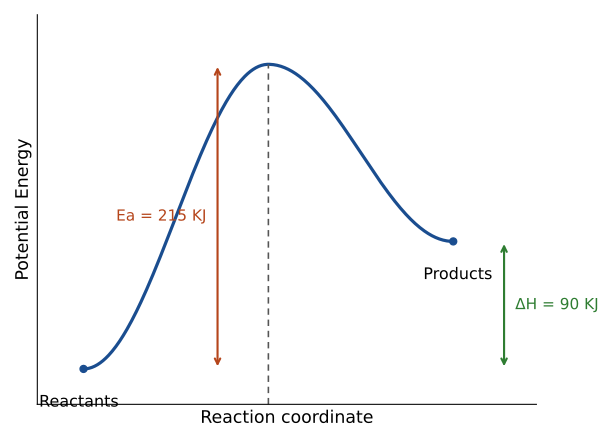 Ea for the reverse reaction will be
(A) 125 KJ
(B) 215 KJ
(C) 90 KJ
(D) 305 KJ
Ea for the reverse reaction will be
(A) 125 KJ
(B) 215 KJ
(C) 90 KJ
(D) 305 KJ›Reveal solutionSolution
On an energy profile the forward and backward barriers are both measured to the same peak, so Ea(reverse)=Ea(forward)−ΔH=215−90=125 kJ.
Step 1 — Read the graph.
From the described energy profile:
- The reactants sit at the lower level.
- The curve rises to a peak (the activated complex / transition state).
- The products sit at a higher level than the reactants — so the reaction is endothermic.
- Ea(forward)=215 kJ — measured from reactants up to the peak.
- ΔH=+90 kJ — measured from reactants up to products.
Step 2 — Set an energy scale.
Put the reactants at zero:
E(reactants)=0 kJ
E(peak)=0+Ea(f)=215 kJ
E(products)=0+ΔH=90 kJ
Step 3 — The reverse activation energy.
Running the reaction backwards, the molecules start at the products and must climb to the same peak (the transition state is common to both directions — this is the principle of microscopic reversibility):
Ea(reverse)=E(peak)−E(products)=215−90=125 kJ
Step 4 — Verify with the general relation.
For any reaction,
ΔH=Ea(forward)−Ea(reverse)
⇒ Ea(reverse)=Ea(forward)−ΔH=215−90=125 kJ ✓
Consistency check: the reaction is endothermic (ΔH>0), so we expect the reverse (exothermic) barrier to be the smaller of the two — and indeed 125<215. Option (D) 305 kJ is the trap for a student who adds instead of subtracting; option (B) 215 kJ merely repeats the forward barrier; option (C) 90 kJ repeats ΔH.
✓Final answerThe correct option is (A) — 125 KJ.
ANSWER: A
- COMEDK 2024Set 2024-A1 markMCQQ.For the reaction, A+3 B→2C+D, the concentration of A changes from 0.0150 to 0.0125 in 1 minute. The rate of formation of C in mol L−1 s−1 is: (A) 6.32×10⁻⁵ (B) 8.32×10⁻⁵ (C) 3.26×10⁻⁵ (D) 2.5×10⁻⁵
›Reveal solutionSolution
Rate of reaction =4.17×10⁻⁵, and rate of formation of C is twice this =8.32×10⁻⁵ mol L−1s−1. Official key: (B).
Working
For A+3B→2C+D, the rate of reaction is
Rate=−dtd[A]=+21dtd[C]
The change in [A] over 1 minute (=60 s):
−ΔtΔ[A]=600.0150−0.0125=600.0025=4.17×10⁻⁵ mol L−1s−1
Since C has a stoichiometric coefficient of 2, its rate of formation is twice the rate of reaction:
dtd[C]=2(−ΔtΔ[A])=2×4.17×10−5=8.33×10⁻⁵≈8.32×10⁻⁵ mol L−1s−1
✓Final answer(B) 8.32×10⁻⁵ mol L−1s−1 — rate of formation of C.
- COMEDK 2024Set 2024-A1 markMCQQ.The rate of appearance of bromine is related to the disappearance of bromide ion in the equation given below is: BrO3−(aq) +5Br−(aq) +6H+→3Br2(l)+3H2O(l) (A) dtd[Br2]=35dtd[Br−] (B) dtd[Br2]=−51dtd[Br−] (C) dtd[Br2]=53dtd[Br−] (D) dtd[Br2]=−53dtd[Br−]
›Reveal solutionSolution
The rate of appearance of a product and the rate of disappearance of a reactant are linked by stoichiometric coefficients, with opposite signs. For the given reaction, the correct relation is dtd[Br2]=−53dtd[Br−], which corresponds to option (D).
The key idea is that for a chemical reaction, the rate can be expressed in terms of any reactant or product, but we must account for stoichiometry and sign conventions. The rate of disappearance of a reactant is negative (its concentration decreases), while the rate of appearance of a product is positive (its concentration increases). To relate them, we divide each rate by its stoichiometric coefficient and set them equal in magnitude, then adjust signs.
Let’s work through it step by step.
- Write the general rate expression. For a reaction aA+bB→cC+dD, the rate is defined as:
Rate=−a1dtd[A]=−b1dtd[B]=c1dtd[C]=d1dtd[D]
The negative signs for reactants ensure the rate is positive (since dtd[reactant] is negative).
- Identify the species and coefficients. In the given reaction:
BrO3−+5Br−+6H+→3Br2+3H2O
We care about Br− (reactant, coefficient 5) and Br2 (product, coefficient 3).
- Set up the equality from the general rate. Using the definition:
−51dtd[Br−]=31dtd[Br2]
The left side has a negative sign because Br− is a reactant; the right side has no negative sign because Br2 is a product.
- Solve for the desired relation. Multiply both sides by 3:
dtd[Br2]=−53dtd[Br−]
This shows that the rate of appearance of bromine is −53 times the rate of disappearance of bromide ion. The negative sign simply indicates that as bromide disappears (negative rate), bromine appears (positive rate).
Watch outA common mistake is to forget the sign or invert the fraction. For example, option (C) dtd[Br2]=53dtd[Br−] is wrong because it omits the negative sign — it would imply both concentrations increase together, which is impossible for a reactant and product.
TipYou can also think: for every 5 moles of Br− that disappear, 3 moles of Br2 appear. So the magnitude ratio is 3/5, and the sign is opposite. That directly gives −53.
✓Final answerThe correct option is (D).
ANSWER: D
- COMEDK 2024Set 2024-E1 markMCQQ.For a reaction 5X+Y→3Z, the rate of formation of Z is 2.4×10⁻⁵ mol L−1 s−1 Calculate the average rate of disappearance of X. (A) 4.8×10⁻⁷ mol L−1 s−1 (B) 13.33×10⁻⁶ mol L−1 s−1 (C) 4.0×10⁻⁵ mol L−1 s−1 (D) 12.0×10⁻⁵ mol L−1 s−1
›Reveal solutionSolution
The key idea is that reaction rates for different species are linked by stoichiometric coefficients. For the reaction 5X+Y→3Z, the rate of disappearance of X is 35 times the rate of formation of Z, giving 4.0×10⁻⁵mol L−1s−1.
The core concept here is stoichiometric rate relationships. In a chemical reaction, the rate at which reactants disappear and products appear are not independent — they are tied together by the coefficients in the balanced equation. This is because for every 5 molecules of X that react, 3 molecules of Z are formed. So the rate of change of concentration for each species must be scaled by its coefficient to give the same "overall reaction rate."
Why this works:
If we define the rate of reaction as r=−51dtd[X]=−11dtd[Y]=31dtd[Z], then knowing any one of these rates lets us find the others by simple multiplication or division by the appropriate coefficient ratio.
- Write the general rate relationship For the reaction 5X+Y→3Z, the rate of reaction r is:
r=−51dtd[X]=31dtd[Z]
The negative sign indicates disappearance (decrease in concentration), while positive indicates formation.
- Identify what we know We are given the rate of formation of Z:
dtd[Z]=2.4×10⁻⁵mol L−1s−1
- Relate the rate of disappearance of X to the rate of formation of Z From the equality above:
−51dtd[X]=31dtd[Z]
Multiply both sides by −5:
dtd[X]=−35dtd[Z]
The negative sign here just reminds us that X is disappearing; the rate of disappearance (a positive quantity) is:
Rate of disappearance of X=35×dtd[Z]
- Plug in the numbers
Rate=35×(2.4×10−5)=312.0×10−5=4.0×10⁻⁵mol L−1s−1
TipA quick shortcut: the ratio of coefficients (X:Z = 5:3) directly gives the factor. Since X disappears faster than Z forms (more X used per Z made), multiply the given rate by 5/3.
Watch outA common mistake is to invert the ratio — using 3/5 instead of 5/3. Always check: if more moles of a reactant are consumed per mole of product formed, its disappearance rate must be larger than the product's formation rate.
✓Final answerThe correct option is (C).
ANSWER: C
- COMEDK 2021Set 2021-B1 markMCQQ.The equation showing the decomposition of Dinitrogen pentoxide is as follows : N2O5(g) -> N2O4(g) + 1/2 O2(g) If the initial pressure is 250 mm and after half an hour of the reaction the total pressure of the gaseous mixture is 296 mm, what is the average rate of the reaction ? (A) 4.04 * 10^-3 atm min^-1 (B) -2.02 * 10^-3 atm min^-1 (C) 2.19 * 10^-2 atm min^-1 (D) 1.09 * 10^-2 atm min^-1
›Reveal solutionSolution
The pressure rise fixes the N2O5 consumed at 92 mm; converting to atm over 30 min gives 4.04×10⁻³ atm min−1.
Pressure bookkeeping (N2O5→N2O4+21O2), let x = mm of N2O5 reacted:
Ptotal=(250−x)+x+2x=250+2x
250+2x=296⇒x=92 mm
Average rate (=−ΔPN2O5/Δt), converting mm → atm (÷760):
rate=30 min92/760 atm=300.121=4.04×10⁻³ atm min−1
✓Final answerThe correct option is (A) — 4.04×10⁻³ atm min−1
- KCET 2020Set A-11 markMCQQ.The rate constant of a reaction is given by k=PZe−Ea/RT under standard notation. In order to speed up the reaction, which of the following factors has to be decreased ? (A) T (B) Z (C) Both Z and T (D) Ea
›Reveal solutionSolution
The rate constant k increases when the activation energy Ea is decreased, because k depends exponentially on −Ea/RT; the correct answer is (D).
The Arrhenius equation k=Ae−Ea/RT (where A=PZ in the given notation) tells us exactly how temperature and activation energy control reaction speed. The exponential term e−Ea/RT is the key: it represents the fraction of molecules that have enough energy to overcome the activation barrier. To speed up a reaction, we want k to be larger — so we need that exponential term to be as large as possible.
Since the exponent is negative, making Ea smaller makes the exponent less negative, which increases e−Ea/RT. Making T larger also makes the exponent less negative (because RT is in the denominator), so increasing temperature speeds up the reaction. But the question asks which factor has to be decreased to speed up the reaction.
Let’s check each option carefully.
-
Option (A): T — Temperature appears in the denominator of the exponent. Decreasing T makes Ea/RT larger, so the exponent becomes more negative, and k gets smaller. That slows the reaction down, not speeds it up. So this is wrong.
-
Option (B): Z — Z is the collision frequency factor (part of the pre-exponential term PZ). It multiplies the exponential directly: k=(PZ)e−Ea/RT. Decreasing Z reduces the pre-factor, which reduces k. That also slows the reaction. So this is wrong too.
-
Option (C): Both Z and T — Since decreasing either one slows the reaction, decreasing both certainly won’t speed it up. This is incorrect.
-
Option (D): Ea — Activation energy appears in the numerator of the exponent. Decreasing Ea makes Ea/RT smaller, so the exponent becomes less negative, and e−Ea/RT increases. This directly increases k and speeds up the reaction. This is the only factor among the choices that, when decreased, actually accelerates the reaction.
Watch outA common mistake is to think that decreasing temperature speeds up a reaction because "higher temperature makes molecules move faster." That’s true — but the question asks which factor must be decreased. Raising temperature speeds up reactions; lowering temperature slows them down. Don’t confuse the direction of change.
TipA quick way to check: write k=Ae−Ea/RT. For k to increase, the exponent −Ea/RT must become less negative. That happens when Ea decreases or T increases. Only Ea is listed as something to decrease.
✓Final answerThe correct option is (D) — decreasing the activation energy Ea speeds up the reaction.
-
- KCET 2018Set A-11 markMCQQ.VERSION: 14-A 34. The temperature coefficient of a reaction is 2. When the temperature is increased from 30∘C to 90∘C, the rate of reaction is increased by (A) 150 times (B) 410 times (C) 72 times (D) 64 times
›Reveal solutionSolution
Rate ratio =(temperature coefficient)ΔT/10=260/10=26=64.
Step 1 — Meaning of the temperature coefficient.
The temperature coefficient μ of a reaction is defined as the ratio of the rate constants for a 10∘C rise:
μ=kTkT+10
For most reactions μ≈2–3 (the familiar 'rate roughly doubles for every 10∘C rise' rule). Here μ=2.
Step 2 — Count the 10∘ intervals.
ΔT=90∘C−30∘C=60∘C
n=10ΔT=1060=6
Step 3 — Compound the factor.
The effect is multiplicative, not additive — each successive 10∘ step multiplies the rate by 2 again:
k30k90=μn=26=64
Step 4 — Conclude.
The rate of reaction increases by 64 times.
Common mistake: adding instead of multiplying (2×6=12) or mis-counting the intervals as 260 — the exponent is the number of 10∘ steps, not the temperature rise itself.
✓Final answerThe correct option is (D) — 64 times.
ANSWER: D
🎓Unlock everything free for 14 days
- ✓Full step-by-step solutions
- ✓Concept-first explanations
- ✓Methods, shortcuts & mistakes
- ✓PYQ mapping + timed mock tests
Full access for 14 days. No credit card required.