Q.Consider a first order gas phase decomposition reaction given below:
A(g)→B(g)+C(g)
The initial pressure of the system before decomposition of A was pi. After lapse of time t, total pressure of the system increased by x units and became pt. The rate constant k for the reaction is given as _________.
🔒You're viewing a preview — the full solution, concept, methods & PYQ mapping are locked.
🔒 Start your 14-day free trial to unlock the full solution →Concept understanding — Average Rate Of Reaction
Reaction Rate Stoichiometry – From Intuition to Precision
Imagine you are watching a simple reaction:
2NO2→2NO+O2
As NO₂ disappears, NO appears twice as fast as O₂ appears. Why? Because the balanced equation says: for every 2 molecules of NO₂ that break apart, you get 2 molecules of NO and 1 molecule of O₂. The numbers in front of the species — the stoichiometric coefficients — tell you the relative speeds at which reactants vanish and products appear.
That is the core idea: reaction rate stoichiometry is the relationship between the rates of change of different species in a chemical reaction, dictated by their coefficients in the balanced equation.
The Intuitive Picture
Think of a factory assembly line. The balanced equation is like a recipe:
- 2 units of raw material A → 2 units of product B + 1 unit of byproduct C
If the line runs steadily, every time 2 units of A are consumed, 2 units of B are produced and 1 unit of C is produced. So the rate at which A disappears must be twice the rate at which C appears. The rate at which B appears equals the rate at which A disappears (both have coefficient 2).
The stoichiometric coefficients are not speeds themselves — they are scaling factors that connect the speeds of different species.
The Precise Statement
For a general reaction:
aA+bB→cC+dD
The rate of reaction (often called the rate of the process, r) is defined as:
r=−a1dtd[A]=−b1dtd[B]=c1dtd[C]=d1dtd[D]
Here:
- dtd[X] is the instantaneous rate of change of concentration of species X (in mol L⁻¹ s⁻¹).
- The minus sign is used for reactants (their concentration decreases with time).
- The plus sign is used for products (their concentration increases with time).
- Dividing by the coefficient normalises the rate — so r is the same number for every species.
r=−a1dtd[A]=c1dtd[C]
This single value r is the intrinsic rate of the reaction, independent of which species you measure.
How to Use It (Step by Step)
Suppose you are given:
2H2+O2→2H2O
And you measure that dtd[H2]=−0.040 M/s (negative because H₂ is being consumed).
Step 1: Write the rate relation:
r=−21dtd[H2]=−11dtd[O2]=21dtd[H2O]
Step 2: Plug in the known value:
r=−21(−0.040)=+0.020 M/s
Step 3: Find the rate for O₂:
−dtd[O2]=r⇒dtd[O2]=−0.020 M/s
Step 4: Find the rate for H₂O:
21dtd[H2O]=r⇒dtd[H2O]=2r=0.040 M/s
A quick check: the coefficients tell you the relative rates. Here, H₂ disappears twice as fast as O₂, and H₂O appears at the same rate as H₂ disappears (both coefficient 2). Always verify your numbers match the coefficient ratios.
--- …
Why this formula?
Average Rate of Reaction — Why the Formula Holds
Let’s build this from the ground up. The goal is to understand why the average rate formula looks the way it does — not just memorise it.
1. What does "rate of reaction" mean physically?
A chemical reaction changes the concentration of reactants (decreasing) and products (increasing) over time.
- Rate = how fast this change happens.
- If you measure the change over a finite time interval, you get the average rate.
2. The core idea: change per unit time
For any quantity X that changes from X1 to X2 over time t1 to t2:
Average rate of change of X=ΔtΔX=t2−t1X2−X1
This is just the slope of the straight line connecting the two points on a concentration vs. time graph.
3. Applying this to a reaction
Consider a simple reaction:
A→B
- Reactant A is consumed: [A] decreases.
- Product B is formed: [B] increases.
For reactant A (disappearing):
Average rate=−ΔtΔ[A]
Why the minus sign?
Because Δ[A]=[A]2−[A]1 is negative (concentration drops). The rate itself must be positive (speed is never negative). So we multiply by −1.
For product B (appearing):
Average rate=+ΔtΔ[B]
Here Δ[B] is positive, so no minus sign needed.
4. The general formula for any reaction
For a balanced reaction:
aA+bB→cC+dD
The average rate is defined per mole of reaction — so it’s the same number regardless of which species you track.
We divide each ΔtΔ[species] by its stoichiometric coefficient:
Average rate=−a1ΔtΔ[A]=−b1ΔtΔ[B]=+c1ΔtΔ[C]=+d1ΔtΔ[D]
Why divide by the coefficient?
If 2 moles of A disappear for every 1 mole of C formed, then ΔtΔ[A] is twice as large as ΔtΔ[C]. Dividing by the coefficient normalises them to the same "per mole of reaction" rate.
5. Key exam point: the formula in one line
For any species X with stoichiometric coefficient νX (negative for reactants, positive for products):
Average rate=νX1ΔtΔ[X] …
Concept: Average Rate Of Reaction — For a first-order gas-phase reaction, the rate constant is derived from pressure changes because partial pressures are proportional to concentration.
Reasoning:
-
The reaction: A(g)→B(g)+C(g).
Initial pressure: pi (only A). At time t, let pressure of A decrease by y. Then pA=pi−y, pB=y, pC=y.
-
Total pressure at time t:
pt=(pi−y)+y+y=pi+y.
So y=pt−pi.
-
Express the remaining pressure of A in terms of the measured pressures pi and pt: …
For a first-order gas-phase reaction, the pressure increases because each mole of reactant produces two moles of products. The key is to relate the partial pressure of A remaining to the total pressure, then substitute into the first-order rate law. The correct expression is k=t2.303log2pi−ptpi.
The average rate of a reaction tells us how fast reactants are consumed or products are formed. For a first-order reaction, the rate depends linearly on the concentration (or, for gases, the partial pressure) of the reactant. The integrated rate law is:
k=t2.303log[A]t[A]0
For gases at constant temperature and volume, partial pressure is proportional to concentration (from PV=nRT). So we can use pressures directly — but we must be careful: the total pressure changes because the number of moles changes.
Here, one mole of A decomposes into one mole of B and one mole of C. So for every mole of A that reacts, the total number of moles increases by 1. This means the total pressure increases as the reaction proceeds.
Let’s work through it step by step.
-
Set up the initial condition.
Initially, only A is present at pressure pi. So the initial partial pressure of A is pi, and the initial total pressure is also pi.
-
Define the change.
Let the decrease in pressure of A at time t be y units. Since the stoichiometry is 1:1:1, when y pressure of A decomposes, y pressure of B and y pressure of C are formed. So at time t:
- Partial pressure of A remaining: pA=pi−y
- Partial pressure of B: pB=y
- Partial pressure of C: pC=y
-
Relate total pressure to the change.
The total pressure at time t is:
pt=pA+pB+pC=(pi−y)+y+y=pi+y
So y=pt−pi.
The problem also says the total pressure increased by x units, so x=pt−pi. That means y=x. We’ll keep using y for clarity.
- Express the remaining pressure of A. From step 2:
pA=pi−y=pi−(pt−pi)=2pi−pt
This is the key relation: the partial pressure of A at time t is 2pi−pt. …
Method: First-Order Integrated Rate Law Using Partial Pressures
Concept
For a first-order gas-phase reaction, the rate constant is given by:
k=t2.303log[A]t[A]0
In terms of pressure, concentration is proportional to partial pressure of A.
Step-by-step
Step 1: Write the reaction and initial conditions
A(g)→B(g)+C(g)
- Initial pressure of A = pi
- B and C are initially absent.
Step 2: Express pressure changes
Let p = pressure of A that has decomposed at time t.
| Species | Initial pressure | Pressure at time t |
|---|---|---|
| A | pi | pi−p |
| B | 0 | p |
| C | 0 | p |
Step 3: Relate total pressure pt to p
pt=(pi−p)+p+p=pi+p
Given that total pressure increased by x units:
pt=pi+x⇒p=x=pt−pi
Step 4: Find partial pressure of A at time t, expressed via the measured quantities pi and pt
pA=pi−p=pi−(pt−pi)=2pi−pt
Step 5: Apply first-order rate law
k=t2.303logpApi=t2.303log2pi−ptpi …
Common Mistakes & How to Avoid Them
Mistake 1: Confusing "increase by x units" with "final pressure pt"
The error:
Students often treat x and pt as unrelated or incorrectly assume pt=pi+x without checking the stoichiometry.
Why it happens:
The problem says "total pressure increased by x units and became pt". This means:
pt=pi+x
But many students forget this simple relation and try to derive k using x and pi directly without linking to pt.
How to avoid:
Always write the given relation explicitly:
x=pt−pi
Then use pt in the formula, not x alone. The correct expression must involve pt (or pi and x together).
Mistake 2: Forgetting stoichiometric pressure changes
The error:
Students assume that if initial pressure of A is pi, then after time t, pressure of A is simply pi−x.
Why it happens:
They think the increase in total pressure equals the decrease in pressure of A. But the reaction is:
A(g)→B(g)+C(g)
- 1 mole of A produces 2 moles of gas.
- So if pA decreases by y, total pressure increases by y (from B) + y (from C) = 2y.
Correct relation:
Let pA at time t be pi−y. Then:
- pB=y, pC=y
- Total pressure: pt=(pi−y)+y+y=pi+y
So y=pt−pi=x.
Thus pressure of A at time t is:
pA=pi−x=2pi−pt
How to avoid:
Always set up a pressure table:
| Species | Initial | At time t |
|---|---|---|
| A | pi | pi−y |
| B | 0 | y |
| C | 0 | y |
| Total | pi | pi+y |
Then pt=pi+y⇒y=pt−pi.
Mistake 3: Using wrong expression for k in the formula
The error:
Students plug pA=pi−x directly into:
k=t2.303logpApi
and get option (i) or (iv).
Why it happens:
They don't convert x to pt or forget that pA=2pi−pt.
Correct derivation:
k=t2.303logpApi=t2.303logpi−ypi
Since y=pt−pi:
pi−y=pi−(pt−pi)=2pi−pt
Thus:
k=t2.303log2pi−ptpi
This matches option (ii).
How to avoid:
Always express pA in terms of pi and pt (not x alone) before substituting into the first-order formula.
--- …
- KCET 2025Set D-41 markMCQQ.In the given graph:
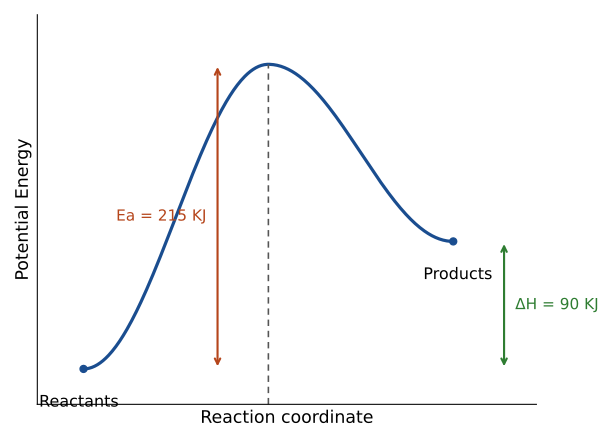 Ea for the reverse reaction will be
(A) 125 KJ
(B) 215 KJ
(C) 90 KJ
(D) 305 KJ
Ea for the reverse reaction will be
(A) 125 KJ
(B) 215 KJ
(C) 90 KJ
(D) 305 KJ›Reveal solutionSolution
On an energy profile the forward and backward barriers are both measured to the same peak, so Ea(reverse)=Ea(forward)−ΔH=215−90=125 kJ.
Step 1 — Read the graph.
From the described energy profile:
- The reactants sit at the lower level.
- The curve rises to a peak (the activated complex / transition state).
- The products sit at a higher level than the reactants — so the reaction is endothermic.
- Ea(forward)=215 kJ — measured from reactants up to the peak.
- ΔH=+90 kJ — measured from reactants up to products.
Step 2 — Set an energy scale.
Put the reactants at zero:
E(reactants)=0 kJ
E(peak)=0+Ea(f)=215 kJ
E(products)=0+ΔH=90 kJ
Step 3 — The reverse activation energy.
Running the reaction backwards, the molecules start at the products and must climb to the same peak (the transition state is common to both directions — this is the principle of microscopic reversibility):
Ea(reverse)=E(peak)−E(products)=215−90=125 kJ
Step 4 — Verify with the general relation.
For any reaction, …
- COMEDK 2024Set 2024-A1 markMCQQ.For the reaction, A+3 B→2C+D, the concentration of A changes from 0.0150 to 0.0125 in 1 minute. The rate of formation of C in mol L−1 s−1 is: (A) 6.32×10⁻⁵ (B) 8.32×10⁻⁵ (C) 3.26×10⁻⁵ (D) 2.5×10⁻⁵
›Reveal solutionSolution
Rate of reaction =4.17×10⁻⁵, and rate of formation of C is twice this =8.32×10⁻⁵ mol L−1s−1. Official key: (B).
Working
For A+3B→2C+D, the rate of reaction is
Rate=−dtd[A]=+21dtd[C]
The change in [A] over 1 minute (=60 s):
−ΔtΔ[A]=600.0150−0.0125=600.0025=4.17×10⁻⁵ mol L−1s−1
Since C has a stoichiometric coefficient of 2, its rate of formation is twice the rate of reaction: …
- COMEDK 2024Set 2024-A1 markMCQQ.The rate of appearance of bromine is related to the disappearance of bromide ion in the equation given below is: BrO3−(aq) +5Br−(aq) +6H+→3Br2(l)+3H2O(l) (A) dtd[Br2]=35dtd[Br−] (B) dtd[Br2]=−51dtd[Br−] (C) dtd[Br2]=53dtd[Br−] (D) dtd[Br2]=−53dtd[Br−]
›Reveal solutionSolution
The rate of appearance of a product and the rate of disappearance of a reactant are linked by stoichiometric coefficients, with opposite signs. For the given reaction, the correct relation is dtd[Br2]=−53dtd[Br−], which corresponds to option (D).
The key idea is that for a chemical reaction, the rate can be expressed in terms of any reactant or product, but we must account for stoichiometry and sign conventions. The rate of disappearance of a reactant is negative (its concentration decreases), while the rate of appearance of a product is positive (its concentration increases). To relate them, we divide each rate by its stoichiometric coefficient and set them equal in magnitude, then adjust signs.
Let’s work through it step by step.
- Write the general rate expression. For a reaction aA+bB→cC+dD, the rate is defined as:
Rate=−a1dtd[A]=−b1dtd[B]=c1dtd[C]=d1dtd[D]
The negative signs for reactants ensure the rate is positive (since dtd[reactant] is negative).
- Identify the species and coefficients. In the given reaction:
BrO3−+5Br−+6H+→3Br2+3H2O
We care about Br− (reactant, coefficient 5) and Br2 (product, coefficient 3).
- Set up the equality from the general rate. Using the definition:
−51dtd[Br−]=31dtd[Br2]
The left side has a negative sign because Br− is a reactant; the right side has no negative sign because Br2 is a product.
- Solve for the desired relation. Multiply both sides by 3:
- COMEDK 2024Set 2024-E1 markMCQQ.For a reaction 5X+Y→3Z, the rate of formation of Z is 2.4×10⁻⁵ mol L−1 s−1 Calculate the average rate of disappearance of X. (A) 4.8×10⁻⁷ mol L−1 s−1 (B) 13.33×10⁻⁶ mol L−1 s−1 (C) 4.0×10⁻⁵ mol L−1 s−1 (D) 12.0×10⁻⁵ mol L−1 s−1
›Reveal solutionSolution
The key idea is that reaction rates for different species are linked by stoichiometric coefficients. For the reaction 5X+Y→3Z, the rate of disappearance of X is 35 times the rate of formation of Z, giving 4.0×10⁻⁵mol L−1s−1.
The core concept here is stoichiometric rate relationships. In a chemical reaction, the rate at which reactants disappear and products appear are not independent — they are tied together by the coefficients in the balanced equation. This is because for every 5 molecules of X that react, 3 molecules of Z are formed. So the rate of change of concentration for each species must be scaled by its coefficient to give the same "overall reaction rate."
Why this works:
If we define the rate of reaction as r=−51dtd[X]=−11dtd[Y]=31dtd[Z], then knowing any one of these rates lets us find the others by simple multiplication or division by the appropriate coefficient ratio.
- Write the general rate relationship For the reaction 5X+Y→3Z, the rate of reaction r is:
r=−51dtd[X]=31dtd[Z]
The negative sign indicates disappearance (decrease in concentration), while positive indicates formation.
- Identify what we know We are given the rate of formation of Z:
dtd[Z]=2.4×10⁻⁵mol L−1s−1
- Relate the rate of disappearance of X to the rate of formation of Z From the equality above:
−51dtd[X]=31dtd[Z]
Multiply both sides by −5:
dtd[X]=−35dtd[Z] …
- COMEDK 2021Set 2021-B1 markMCQQ.The equation showing the decomposition of Dinitrogen pentoxide is as follows : N2O5(g) -> N2O4(g) + 1/2 O2(g) If the initial pressure is 250 mm and after half an hour of the reaction the total pressure of the gaseous mixture is 296 mm, what is the average rate of the reaction ? (A) 4.04 * 10^-3 atm min^-1 (B) -2.02 * 10^-3 atm min^-1 (C) 2.19 * 10^-2 atm min^-1 (D) 1.09 * 10^-2 atm min^-1
›Reveal solutionSolution
The pressure rise fixes the N2O5 consumed at 92 mm; converting to atm over 30 min gives 4.04×10⁻³ atm min−1.
Pressure bookkeeping (N2O5→N2O4+21O2), let x = mm of N2O5 reacted:
Ptotal=(250−x)+x+2x=250+2x
250+2x=296⇒x=92 mm …
- KCET 2020Set A-11 markMCQQ.The rate constant of a reaction is given by k=PZe−Ea/RT under standard notation. In order to speed up the reaction, which of the following factors has to be decreased ? (A) T (B) Z (C) Both Z and T (D) Ea
›Reveal solutionSolution
The rate constant k increases when the activation energy Ea is decreased, because k depends exponentially on −Ea/RT; the correct answer is (D).
The Arrhenius equation k=Ae−Ea/RT (where A=PZ in the given notation) tells us exactly how temperature and activation energy control reaction speed. The exponential term e−Ea/RT is the key: it represents the fraction of molecules that have enough energy to overcome the activation barrier. To speed up a reaction, we want k to be larger — so we need that exponential term to be as large as possible.
Since the exponent is negative, making Ea smaller makes the exponent less negative, which increases e−Ea/RT. Making T larger also makes the exponent less negative (because RT is in the denominator), so increasing temperature speeds up the reaction. But the question asks which factor has to be decreased to speed up the reaction.
Let’s check each option carefully.
-
Option (A): T — Temperature appears in the denominator of the exponent. Decreasing T makes Ea/RT larger, so the exponent becomes more negative, and k gets smaller. That slows the reaction down, not speeds it up. So this is wrong.
-
Option (B): Z — Z is the collision frequency factor (part of the pre-exponential term PZ). It multiplies the exponential directly: k=(PZ)e−Ea/RT. Decreasing Z reduces the pre-factor, which reduces k. That also slows the reaction. So this is wrong too.
-
Option (C): Both Z and T — Since decreasing either one slows the reaction, decreasing both certainly won’t speed it up. This is incorrect. …
-
- KCET 2018Set A-11 markMCQQ.VERSION: 14-A 34. The temperature coefficient of a reaction is 2. When the temperature is increased from 30∘C to 90∘C, the rate of reaction is increased by (A) 150 times (B) 410 times (C) 72 times (D) 64 times
›Reveal solutionSolution
Rate ratio =(temperature coefficient)ΔT/10=260/10=26=64.
Step 1 — Meaning of the temperature coefficient.
The temperature coefficient μ of a reaction is defined as the ratio of the rate constants for a 10∘C rise:
μ=kTkT+10
For most reactions μ≈2–3 (the familiar 'rate roughly doubles for every 10∘C rise' rule). Here μ=2.
Step 2 — Count the 10∘ intervals.
ΔT=90∘C−30∘C=60∘C
n=10ΔT=1060=6
Step 3 — Compound the factor.
The effect is multiplicative, not additive — each successive 10∘ step multiplies the rate by 2 again: …
🎓Unlock everything free for 14 days
- ✓Full step-by-step solutions
- ✓Concept-first explanations
- ✓Methods, shortcuts & mistakes
- ✓PYQ mapping + timed mock tests
Full access for 14 days. No credit card required.