Q.Explain why [Fe(H2O)6]3+ has magnetic moment value of 5.92 BM whereas [Fe(CN)6]3− has a value of only 1.74 BM.
🔒You're viewing a preview — the full solution, concept, methods & PYQ mapping are locked.
🔒 Start your 14-day free trial to unlock the full solution →Concept understanding — Magnetic Moment Calculation
From a Paperclip to a Magnet: The Intuition
You already know that a magnet can pick up iron nails. But what is actually happening inside that nail when it gets near the magnet? And why does a plastic comb, rubbed on hair, pick up tiny bits of paper — but never iron filings?
The answer lies in magnetization — the process by which a material becomes magnetic.
Think of a piece of iron as a chaotic crowd of tiny compass needles. Each needle is an atomic magnetic moment (a tiny magnet, arising from the spin of electrons). In unmagnetized iron, these needles point in random directions. Their magnetic effects cancel out, so the iron as a whole shows no net magnetism.
Now bring a strong magnet close. Its magnetic field acts like a command: "Line up!" The tiny compass needles inside the iron start rotating, aligning themselves with the external field. The more they align, the stronger the iron's own magnetic field becomes. This alignment is magnetization.
Magnetization is not the same as inducing a current. It is a purely magnetic reorientation of atomic dipoles inside a material.
The Precise Definition
Magnetization (M) is the net magnetic dipole moment per unit volume of a material. It tells you how strongly a material is magnetized — how many tiny atomic magnets are aligned, and in which direction.
If a material has N atoms per unit volume, each with an average magnetic moment μavg, then:
M=Nμavg
The SI unit of M is amperes per metre (A/m). Why? Because a magnetic dipole moment has units of A·m², and dividing by volume (m³) gives A/m.
M=volumetotal magnetic dipole moment
How Magnetization Connects to the Magnetic Field
When a material gets magnetized, it produces its own magnetic field. The total magnetic field B inside the material is the sum of:
- The external applied field H (caused by free currents, like the current in a solenoid)
- The material's response — the magnetization M
The fundamental relation is:
B=μ0(H+M)
where μ0=4π×10−7T⋅m/A is the permeability of free space.
Do not confuse H (magnetic field intensity, or "magnetizing field") with B (magnetic flux density). H is what you apply; M is what the material does; B is the total field you measure.
The Three Kinds of Magnetic Materials
Not all materials respond the same way to an external field. The magnetization M is proportional to H for most materials (at least for small fields):
M=χmH
where χm is the magnetic susceptibility — a dimensionless number that tells you how easily a material magnetizes.
| Material Type | χm | Behaviour | Example |
|---|---|---|---|
| Diamagnetic | Small and negative (≈−10−5) | Weakly repelled by a magnet; M opposes H | Water, copper, bismuth |
| Paramagnetic | Small and positive (≈10−5 to 10−3) | Weakly attracted; M aligns with H | Aluminium, oxygen gas |
| Ferromagnetic | Large and positive (≫1) | Strongly attracted; M can be huge and persists even after H is removed | Iron, nickel, cobalt |
Why this formula?
Magnetic Moment Calculation: Why the Formula Holds
Let's build this from first principles — understanding the why before the formula.
1. What is Magnetic Moment?
A magnetic moment (μ) is a measure of the strength and orientation of a magnet or current loop. It tells us how strongly an object will interact with an external magnetic field.
The core idea: any moving charge creates a magnetic field. A loop of current is like a tiny bar magnet — its magnetic moment quantifies this.
2. The Fundamental Formula: Current Loop
The Setup
Consider a planar loop of wire carrying a steady current I, enclosing an area A.
Why μ=IA?
Step 1: Force on a moving charge
A charge q moving with velocity v in a magnetic field B experiences:
F=q(v×B)
Step 2: Torque on a current loop
For a rectangular loop of sides a and b (A=ab), placed in a uniform B:
- Current I means charge flows. On side of length a, the force magnitude is F=IaB (since I=tq and v=ta).
- These forces on opposite sides form a couple (equal, opposite, not collinear).
- Torque τ=force×perpendicular distance=(IaB)×(bsinθ)
Step 3: Recognize the pattern
τ=I(ab)Bsinθ=IABsinθ
This looks exactly like:
τ=μBsinθ
Comparing, we identify:
μ=IA
Why this works: The torque on a current loop is proportional to the current and the area — this product naturally defines the magnetic moment.
3. For a Single Moving Charge (Orbital Magnetic Moment)
The Setup
An electron of charge −e moves in a circular orbit of radius r with speed v.
Why μ=2evr?
Step 1: Treat orbit as a current loop
- Time for one revolution: T=v2πr
- Current (charge per unit time): I=Te=2πrev
Step 2: Apply μ=IA
- Area of orbit: A=πr2
- So: μ=(2πrev)(πr2)=2evr
Step 3: Express in terms of angular momentum
- Orbital angular momentum: L=mvr
- Therefore: μ=2meL
Why this matters: The magnetic moment is directly proportional to angular momentum. The factor 2me is called the gyromagnetic ratio — it links mechanics to magnetism.
4. For a Solenoid (Many Turns)
The Setup
A solenoid of N turns, length l, carrying current I, cross-sectional area A.
Why μ=NIA? …
The key idea is that the magnetic moment depends on the number of unpaired electrons, which is determined by the ligand field strength and the resulting high-spin vs. low-spin configuration.
Step 1: Determine the oxidation state and d-electron count.
In [Fe(H2O)6]3+, Fe is in +3 state (3d5). In [Fe(CN)6]3−, Fe is also +3 (3d5). Both have the same d5 configuration.
Step 2: Identify the ligand field and spin state.
H2O is a weak field ligand, causing a small crystal field splitting (Δo). For d5, electrons fill all five d-orbitals singly before pairing (Hund's rule), giving a high-spin configuration: t2g3eg2 — 5 unpaired electrons.
CN− is a strong field ligand, causing a large Δo. For d5, pairing occurs, giving a low-spin configuration: t2g5eg0 — only 1 unpaired electron.
Step 3: Calculate the magnetic moment. …
The difference in magnetic moments arises from the different ligand field strengths of H2O and CN−. H2O is a weak field ligand, leaving Fe3+ in a high-spin d5 configuration with 5 unpaired electrons (μ=5.92 BM). CN− is a strong field ligand, causing pairing and giving a low-spin d5 configuration with only 1 unpaired electron (μ=1.74 BM).
The magnetic moment of a transition metal complex tells us how many unpaired electrons are present. The formula μ=n(n+2) BM (where n is the number of unpaired electrons) connects the experimental value directly to the electronic configuration. So when you see 5.92 BM and 1.74 BM, you're really being asked: why does the same metal ion, Fe3+, have a different number of unpaired electrons in these two complexes?
The answer lies in the crystal field theory and the nature of the ligands.
-
Identify the metal ion and its d-electron count.
Iron in both complexes is in the +3 oxidation state. Atomic number of Fe is 26. Fe3+ means we remove 3 electrons: [Ar]3d5. So in both cases, we have a d5 system.
-
Recall the crystal field splitting in an octahedral field.
In an octahedral complex, the five d-orbitals split into two sets: the lower-energy t2g set (three orbitals) and the higher-energy eg set (two orbitals). The energy gap between them is called Δo (or 10Dq).
-
The key: how do electrons fill these orbitals?
For a d5 ion, there are two possible arrangements:
- High-spin: Electrons fill all five orbitals singly first (Hund's rule), giving 5 unpaired electrons. This happens when Δo is small — it costs less energy to put an electron in a higher eg orbital than to pair up in a t2g orbital.
- Low-spin: Electrons pair up in the t2g set first, giving only 1 unpaired electron. This happens when Δo is large — pairing energy is less than the energy needed to promote an electron to eg.
-
Now, the ligands decide Δo.
Ligands are arranged in the spectrochemical series in order of increasing field strength:
I−<Br−<Cl−<F−<OH−<H2O<NH3<en<NO2−<CN−<CO
- H2O is a weak field ligand. It produces a small Δo.
- CN− is a strong field ligand. It produces a large Δo.
-
Apply to [Fe(H2O)6]3+:
Weak field → small Δo → high-spin configuration.
The five electrons occupy all five orbitals singly: t2g3eg2.
Number of unpaired electrons, n=5.
Magnetic moment: μ=5(5+2)=35≈5.92 BM.
This matches the given value exactly. …
Method: Crystal Field Theory (CFT) – Spin-Only Magnetic Moment Calculation
This method uses the spin-only formula to predict magnetic moment (μ) based on the number of unpaired electrons (n):
μ=n(n+2) BM
Step-by-step reasoning for both complexes
Step 1: Determine the oxidation state and electron configuration of Fe
- Fe atomic number = 26
- Ground state: [Ar]3d64s2
For [Fe(H2O)6]3+:
- Ligand charge: H2O is neutral → overall +3 charge comes from Fe
- Fe is in +3 oxidation state → Fe3+
- Electron configuration of Fe3+: [Ar]3d5
For [Fe(CN)6]3−:
- Ligand charge: CN− is −1 each → total −6 from ligands
- Overall charge −3 → Fe must be +3 to balance: Fe3+
- Same 3d5 configuration
Step 2: Identify ligand field strength and predict pairing
| Complex | Ligand | Field strength | Effect on 3d5 |
|---|---|---|---|
| [Fe(H2O)6]3+ | H2O | Weak field | No pairing → High spin |
| [Fe(CN)6]3− | CN− | Strong field | Forces pairing → Low spin |
Step 3: Write the d-orbital filling (octahedral splitting)
High spin Fe3+ (weak field):
- t2g: ↑ ↑ ↑ (3 electrons)
- eg: ↑ ↑ (2 electrons)
- Unpaired electrons = 5
Low spin Fe3+ (strong field):
- t2g: ↑↓ ↑ ↑ (5 electrons, all paired except 1 unpaired)
- eg: empty
- Unpaired electrons = 1
Step 4: Apply spin-only formula
For [Fe(H2O)6]3+ (n=5): …
Here is a breakdown of the common mistakes students make on this exact question, and how to avoid them.
The Core Concept (Why the difference?)
The magnetic moment (μ) depends on the number of unpaired electrons (n). The formula is:
μ=n(n+2) BM
- [Fe(H2O)6]3+: Fe3+ has 5 electrons in the 3d orbital. H2O is a weak field ligand. It does not force pairing. The electrons remain unpaired (high spin). n=5.
μ=5(5+2)=35≈5.92 BM
- [Fe(CN)6]3−: Fe3+ still has 5 electrons. CN− is a strong field ligand. It forces pairing. The electrons pair up, leaving only 1 unpaired electron (low spin). n=1.
μ=1(1+2)=3≈1.74 BM
Common Mistakes & How to Avoid Them
Mistake 1: Forgetting to find the oxidation state of the metal first.
- The Error: Students directly count electrons from the neutral atom (e.g., Fe has 8 electrons in 3d and 4s) without adjusting for the charge on the complex.
- Example of Error: Saying Fe in [Fe(CN)6]3− has 8 d-electrons.
- How to Avoid:
- Always calculate the oxidation state first.
- For [Fe(CN)6]3−: Let x be the oxidation state of Fe. CN− has a -1 charge. So: x+6(−1)=−3⟹x−6=−3⟹x=+3.
- Fe3+ has lost 3 electrons. The electronic configuration of Fe is [Ar]3d64s2. For Fe3+, remove the 4s electrons first, then one 3d electron: [Ar]3d5.
- Result: You always start with 5 d-electrons for Fe3+.
Mistake 2: Confusing strong and weak field ligands.
- The Error: Thinking H2O is a strong field ligand or CN− is a weak field ligand.
- Example of Error: Predicting [Fe(H2O)6]3+ will have paired electrons.
- How to Avoid:
- Memorize the Spectrochemical Series (partial list is enough):
- Strong field (low spin): CN−>CO>en>NH3
- Weak field (high spin): H2O>F−>Cl−>Br−>I−
- Rule of thumb: CN− and CO are almost always strong. H2O is borderline but usually weak for 3d metals. Halides are always weak.
- Memorize the Spectrochemical Series (partial list is enough):
Mistake 3: Forgetting the "Hund's Rule" logic for d5 configuration.
- The Error: Students correctly identify 5 electrons but then pair them incorrectly, leading to a wrong n value.
- Example of Error: For Fe3+ (d5), placing 2 electrons in one orbital and 3 in others, giving 3 unpaired electrons.
- How to Avoid:
- Draw the d-orbital splitting diagram.
- For weak field (H2O): The energy gap (Δo) is small. Electrons fill all 5 orbitals singly first (Hund's rule). Result: 5 unpaired electrons.
- For strong field (CN−): The energy gap (Δo) is large. Electrons pair up in the lower energy t2g orbitals before going to the higher eg orbitals. For d5: 3 electrons fill t2g singly, then the next 2 pair up. Result: 1 unpaired electron.
Mistake 4: Using the wrong formula or miscalculating the square root.
- The Error: Using μ=n(n+1) (which is for orbital angular momentum) or making arithmetic errors.
- Example of Error: For n=5, calculating 5×7=35≈5.91 (correct), but then writing 5.92 without checking. Or for n=1, calculating 1×3=3≈1.73 (correct), but writing 1.74.
- How to Avoid:
- Use the spin-only formula: μ=n(n+2).
- Memorize the common values:
- n=1⟹μ=3≈1.73 BM
- n=2⟹μ=8≈2.83 BM …
Showing the 12 most recent of 14 on this concept.
- COMEDK 2026Set 2026-M1 markMCQQ.The ion that has a spin only magnetic moment of 5.9 BM is: (A) Fe3+ (B) Mn3+ (C) Ni2+ (D) Co3+
›Reveal solutionSolution
The spin-only magnetic moment is given by μ=n(n+2) BM, where n is the number of unpaired electrons. A value of 5.9 BM corresponds to n=5 unpaired electrons. Among the options, only Fe3+ has 5 unpaired electrons, so the correct option is (A).
The key concept here is the spin-only magnetic moment formula:
μ=n(n+2) BM
where n is the number of unpaired electrons. This formula works well for first-row transition metal ions because orbital angular momentum is often "quenched" by the crystal field. The experimental value 5.9 BM is very close to the theoretical value for n=5, which is 5×7=35≈5.92 BM. So we need to find which ion has exactly 5 unpaired electrons in its ground state.
Let’s check each option step by step:
-
Determine the electronic configuration of each ion
- Fe3+: Atomic number of Fe = 26. Neutral Fe: [Ar]3d64s2. Removing three electrons (first from 4s, then from 3d) gives [Ar]3d5.
- Mn3+: Atomic number of Mn = 25. Neutral Mn: [Ar]3d54s2. Removing three electrons gives [Ar]3d4.
- Ni2+: Atomic number of Ni = 28. Neutral Ni: [Ar]3d84s2. Removing two electrons gives [Ar]3d8.
- Co3+: Atomic number of Co = 27. Neutral Co: [Ar]3d74s2. Removing three electrons gives [Ar]3d6.
-
Count unpaired electrons using Hund’s rule
- For Fe3+ (3d5): All five d-orbitals are half-filled, each with one electron → 5 unpaired electrons.
- For Mn3+ (3d4): Four electrons occupy four orbitals singly (Hund’s rule) → 4 unpaired electrons.
- For Ni2+ (3d8): The d-orbitals fill as: ↑↓ ↑↓ ↑ ↑ ↑ (two paired, two singly, one singly) → 2 unpaired electrons. …
-
- KCET 2026Set D31 markMCQQ.The calculated spin only magnetic moment of Cr2+ ion is (A) 3.87 BM (B) 4.90 BM (C) 5.92 BM (D) 2.84 BM
›Reveal solutionSolution
The spin-only magnetic moment depends on the number of unpaired electrons in the ion's d-configuration.
Step 1 — Electron configuration of Cr²⁺
Neutral Cr (Z = 24) is [Ar]3d54s1. Forming Cr2+ removes the single 4s electron first, then one 3d electron, giving Cr2+=[Ar]3d4.
Step 2 — Counting unpaired electrons …
- COMEDK 2025Set 2025-A1 markMCQQ.Which is the correct order of increasing number of unpaired electrons in the following ions? A=Cr2+(Z=24)B=Cu2+(Z=29)C=Ni2+(Z=28)D=Fe3+(Z=26) (A) B<C<A<D (B) D<C<A<B (C) B<C<D<A (D) C<B<D<A
›Reveal solutionSolution
The number of unpaired electrons depends on the electronic configuration of each ion, considering the d-orbital filling and Hund's rule. The correct order is B (Cu²⁺, 1 unpaired) < C (Ni²⁺, 2 unpaired) < A (Cr²⁺, 4 unpaired) < D (Fe³⁺, 5 unpaired), which corresponds to option (A).
Concept & Intuition
The key is to write the ground-state electron configurations for each ion, focusing on the d-electrons. Transition metal ions lose s-electrons first, then d-electrons if needed. Unpaired electrons arise from half-filled or partially filled d-orbitals following Hund's rule (each orbital gets one electron before pairing). The more unpaired electrons, the higher the magnetic moment. Here, we count them directly.
Step-by-step reasoning
-
Cr²⁺ (Z = 24)
- Neutral Cr: [Ar] 4s¹ 3d⁵ (exception: half-filled d gives stability).
- Remove two electrons: first from 4s, then from 3d → Cr²⁺: [Ar] 3d⁴.
- Hund's rule: four d-orbitals each get one electron, one orbital empty → 4 unpaired electrons.
-
Cu²⁺ (Z = 29)
- Neutral Cu: [Ar] 4s¹ 3d¹⁰ (exception: fully filled d).
- Remove two electrons: one from 4s, one from 3d → Cu²⁺: [Ar] 3d⁹.
- One d-orbital has a single electron (the rest are paired) → 1 unpaired electron.
-
Ni²⁺ (Z = 28)
- Neutral Ni: [Ar] 4s² 3d⁸.
- Remove two 4s electrons → Ni²⁺: [Ar] 3d⁸.
- Filling: five orbitals get 2, 2, 2, 1, 1 (two unpaired) → 2 unpaired electrons.
-
Fe³⁺ (Z = 26)
- Neutral Fe: [Ar] 4s² 3d⁶. …
-
- COMEDK 2025Set 2025-A1 markMCQQ.The correct order of spin only magnetic moments among the following is: [Given: Atomic numbers: Mn=25,Fe=26,Co=27 ] (A) [Fe(CN)6]4−>[MnCl4]2−>[CoCl4]2− (B) [MnCl4]2−>[CoCl4]2−>[Fe(CN)6]4− (C) [Fe(CN)6]4−>[CoCl4]2−>[MnCl4]2− (D) [MnCl4]2−>[Fe(CN)6]4−>[CoCl4]2−
›Reveal solutionSolution
The spin-only magnetic moment depends on the number of unpaired electrons, which is determined by the metal’s oxidation state and the ligand field (strong-field CN⁻ vs. weak-field Cl⁻). The correct order is [MnCl4]2−>[CoCl4]2−>[Fe(CN)6]4−, corresponding to option (B).
Concept & Intuition
The spin-only magnetic moment is given by μ=n(n+2) Bohr magnetons, where n is the number of unpaired electrons. So the problem reduces to finding n for each complex. The key twist: ligands like CN⁻ are strong-field (low-spin), causing maximum pairing, while Cl⁻ is weak-field (high-spin), favoring unpaired electrons. Also, geometry matters — here all complexes are either octahedral or tetrahedral, which affects the d-orbital splitting and thus the electron configuration.
Step-by-step reasoning
-
Determine oxidation states and d-electron counts
- [Fe(CN)6]4−: CN⁻ is −1 each, so Fe must be +2 (since 6×(−1) + x = −4 → x = +2). Fe (Z=26): [Ar]3d⁶. Fe²⁺: 3d⁶.
- [MnCl4]2−: Cl⁻ is −1 each, so Mn is +2 (4×(−1) + x = −2 → x = +2). Mn (Z=25): [Ar]3d⁵. Mn²⁺: 3d⁵.
- [CoCl4]2−: Cl⁻ is −1 each, so Co is +2 (4×(−1) + x = −2 → x = +2). Co (Z=27): [Ar]3d⁷. Co²⁺: 3d⁷.
-
Analyze [Fe(CN)6]4− — octahedral, strong-field
CN⁻ is a strong-field ligand, causing large splitting. For Fe²⁺ (d⁶) in an octahedral field, strong-field means low-spin: all electrons pair in the t2g set first. Configuration: t2g6eg0. All 6 electrons are paired → 0 unpaired electrons.
μ=0(0+2)=0 BM.
-
Analyze [MnCl4]2− — tetrahedral, weak-field
Cl⁻ is a weak-field ligand. Tetrahedral splitting is smaller than octahedral, so always high-spin. Mn²⁺ is d⁵. In tetrahedral geometry, the e set is lower in energy than t2. High-spin d⁵: each of the five d-orbitals gets one electron (Hund’s rule) → 5 unpaired electrons.
μ=5(5+2)=35≈5.92 BM.
-
Analyze [CoCl4]2− — tetrahedral, weak-field …
-
- COMEDK 2025Set 2025-E1 markMCQQ.Arrange the complex ions in the increasing order of their magnetic moments A. [Fe(H2O)6]2+ B. [Fe(CN)6]4− C. [Fe(CN)6]3− D. [FeF6]3− (A) D<A<B<C (B) B<C<A<D (C) D<C<B<A (D) A<D<C<B
›Reveal solutionSolution
The magnetic moment depends on the number of unpaired electrons, which is determined by the metal’s oxidation state, ligand field strength (weak vs. strong field), and the resulting high-spin or low-spin configuration. The correct increasing order is B < C < A < D, corresponding to option (B).
Concept & Intuition
Magnetic moment (μ) for a transition metal complex is given by the spin-only formula:
μ=n(n+2) BM
where n is the number of unpaired electrons. So the order of magnetic moments is simply the order of number of unpaired electrons.
To find n, we need:
- The oxidation state of iron in each complex.
- Whether the ligand is weak-field (high-spin) or strong-field (low-spin).
- The d-electron count and how electrons fill the t2g and eg orbitals.
Let’s work through each complex step by step.
1. Determine oxidation states and d-electron counts
- A: [Fe(H2O)6]2+ — Water is neutral, so Fe is +2. Fe²⁺ has electron configuration [Ar] 3d⁶.
- B: [Fe(CN)6]4− — CN⁻ is -1 each, total −6 from ligands, so Fe must be +2 to give overall −4. Again, Fe²⁺, 3d⁶.
- C: [Fe(CN)6]3− — CN⁻ gives −6, so Fe is +3. Fe³⁺ is 3d⁵.
- D: [FeF6]3− — F⁻ is -1 each, total −6, so Fe is +3. Also 3d⁵.
So we have two Fe²⁺ (d⁶) and two Fe³⁺ (d⁵) complexes.
2. Identify ligand field strength
- H₂O is a weak-field ligand (causes small splitting).
- F⁻ is also a weak-field ligand.
- CN⁻ is a strong-field ligand (causes large splitting).
For weak-field ligands, electrons fill according to Hund’s rule (high-spin). For strong-field ligands, pairing occurs before occupying higher orbitals (low-spin).
3. Determine unpaired electrons for each
-
A: Fe²⁺ (d⁶), weak field (H₂O) → high-spin.
In an octahedral field: t2g4eg2 → 4 unpaired electrons.
n=4.
-
B: Fe²⁺ (d⁶), strong field (CN⁻) → low-spin.
All 6 electrons pair in t2g: t2g6eg0 → 0 unpaired electrons.
n=0.
-
C: Fe³⁺ (d⁵), strong field (CN⁻) → low-spin. …
- COMEDK 2025Set 2025-M1 markMCQQ.Match the coordination compounds in Column I having the given type of hybridisation of Mn+ ion and magnetic moment as given in Column II. .tg {border-collapse:collapse;border-spacing:0;} .tg td{border-color:black;border-style:solid;border-width:1px;font-family:Arial, sans-serif;font-size:14px; overflow:hidden;padding:10px 5px;word-break:normal;} .tg th{border-color:black;border-style:solid;border-width:1px;font-family:Arial, sans-serif;font-size:14px; font-weight:normal;overflow:hidden;padding:10px 5px;word-break:normal;} .tg .tg-baqh{text-align:center;vertical-align:top} .tg .tg-0lax{text-align:left;vertical-align:top} Coordination compounds Hybridisation & Magnetic nature A. Ni(CO)4 P. sp3,μ=5.92BM B. [Ni(CN)4]2− Q. sp3,μ=2.84BM C. [Ni(Cl)4]2− R. sp3,μ=0 D. [MnBr4]2− S. dsp2,μ=0 (A) A=RB=SC=QD=P (B) A=SB=RC=PD=Q (C) A=SB=PC=RD=Q (D) A=QB=PC=SD=R
›Reveal solutionSolution
The key is to determine the oxidation state, geometry, and number of unpaired electrons for each complex, then match the hybridisation and magnetic moment. The correct matches are A→R, B→S, C→Q, D→P, so option (A) is correct.
We need to match each coordination compound with its hybridisation and magnetic moment. The magnetic moment (in Bohr magnetons, BM) is given by μ=n(n+2) where n is the number of unpaired electrons. Let’s analyse each complex step by step.
-
Complex A: Ni(CO)4
- Nickel is in zero oxidation state (CO is neutral).
- CO is a strong field ligand, causing pairing of electrons.
- Ni(0) has atomic number 28: [Ar]3d84s2. In the presence of strong field CO, the 4s electrons are used for bonding, and the 3d electrons pair up.
- The complex is tetrahedral (4 ligands), so hybridisation is sp3.
- All electrons are paired → μ=0 BM.
- So A matches R (sp3,μ=0).
-
Complex B: [Ni(CN)4]2−
- CN⁻ is a strong field ligand.
- Oxidation state: Ni + 4(−1) = −2 → Ni is +2.
- Ni²⁺: [Ar]3d8. Strong field CN⁻ causes pairing of 3d electrons, leaving one d-orbital empty.
- Geometry is square planar (4 ligands), hybridisation is dsp2.
- All electrons paired → μ=0 BM.
- So B matches S (dsp2,μ=0).
-
Complex C: [Ni(Cl)4]2−
- Cl⁻ is a weak field ligand.
- Ni is again +2 (same as B).
- Weak field → no pairing; Ni²⁺ has 8 d-electrons, which in a tetrahedral field give 2 unpaired electrons (since t2 orbitals are higher energy, electrons occupy them singly first).
- Geometry is tetrahedral → hybridisation sp3.
- μ=2(2+2)=8≈2.84 BM.
- So C matches Q (sp3,μ=2.84 BM).
-
Complex D: [MnBr4]2−
- Br⁻ is a weak field ligand. …
-
- COMEDK 2025Set 2025-M1 markMCQQ.What is the spin only magnetic moment of the metal ion in P and the oxidation number of Sulphur in the oxidised product Z ? (A) μ=0 Oxidation number =+4 (B) μ=5.00BM Oxidation number =0 (C) μ=5.92BM Oxidation number =+2 (D) μ=1.732BM Oxidation number =+6
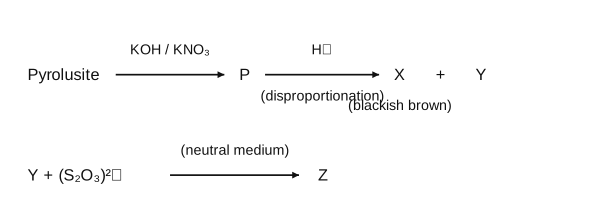
›Reveal solutionSolution
Pyrolusite (MnO2) fused with KOH and KNO3 gives the manganate(VI) ion in P=K2MnO4. The metal ion Mn6+ is d1, so μ=1(1+2)=1.732 BM. Permanganate then oxidises thiosulphate in neutral medium to sulphate, in which sulphur is +6. The correct option is (D).
Concept
In an oxidising alkaline fusion, Mn(IV) in pyrolusite is raised to Mn(VI), giving the green manganate ion MnO42−. The spin-only magnetic moment depends only on the number of unpaired electrons through μ=n(n+2) BM. Separately, the oxidation number of an atom is read from the formula of the species it ends up in.
Solution
- Identify P. MnO2+2KOH+KNO3→K2MnO4+KNO2+H2O. So P=K2MnO4 and the metal ion is Mn6+.
- Magnetic moment of Mn6+. Configuration [Ar]3d1 gives n=1, so μ=1(1+2)=3=1.732 BM.
- Fate in acid. 3MnO42−+4H+→2MnO4−+MnO2+2H2O (disproportionation), giving permanganate and MnO2. …
- KCET 2024Set B-21 markMCQQ.Match the following: I. Zn2+ II. Cu2+ III. Ni2+ i. d8 configuration ii. colourless iii. μ=1.73BM I II III (A) i ii iii (B) ii iii i (C) ii i iii (D) i iii ii
›Reveal solutionSolution
Write the dn configuration of each ion, then read off colour (needs a partly-filled d shell) and magnetic moment from the spin-only formula.
Step 1 — Get the d-configurations.
For a transition-metal cation, remove the 4s electrons first, then the 3d electrons.
Ion Atomic no. Neutral atom M2+ configuration Zn2+ 30 [Ar]3d104s2 [Ar]3d10 Cu2+ 29 [Ar]3d104s1 [Ar]3d9 Ni2+ 28 [Ar]3d84s2 [Ar]3d8 Step 2 — Match III: Ni2+ → (i) d8.
Read straight off the table above. This is the most direct match, and it already eliminates options (A) and (C), which both send d8 to Zn2+.
Step 3 — Match I: Zn2+ → (ii) colourless.
Colour in transition-metal ions arises from d–d electronic transitions: an electron absorbs visible light and is promoted from the lower (t2g) to the higher (eg) set. This demands a partially filled d subshell. Zn2+ is d10 — completely full, no vacancy to promote into — so no d–d transition is possible and the ion is colourless.
Step 4 — Match II: Cu2+ → (iii) μ=1.73 BM.
Use the spin-only formula, where n = number of unpaired electrons: …
- COMEDK 2024Set 2024-A1 markMCQQ.The metallic ions that have almost same spin only magnetic moment are :(i) Co2+(ii) Mn2+(iii) Cr2+(iv) Cr3+ (A) $$ \text {(iii) and(iv) } (B) \text {(i) and(ii) } (C) \text {(i) and(iv) } (D) \text {(i) and(iii) } $$
›Reveal solutionSolution
Counting unpaired electrons: Co2+ (d7) = 3, Mn2+ (d5) = 5, Cr2+ (d4) = 4, Cr3+ (d3) = 3. Co2+ and Cr3+ share n=3, hence the same μ=3.87 BM → (i) and (iv).
Spin-only moment μ=n(n+2) BM, where n = number of unpaired electrons:
- (i) Co2+: 3d7 → 3 unpaired → μ=15=3.87 BM
- (ii) Mn2+: 3d5 → 5 unpaired → μ=35=5.92 BM …
- COMEDK 2024Set 2024-E1 markMCQQ.Based on Valence Bond Theory, match the complexes listed in Column I with the number of unpaired electrons on the central metal ion, given in Column II .tg {border-collapse:collapse;border-spacing:0;} .tg td{border-color:black;border-style:solid;border-width:1px;font-family:Arial, sans-serif;font-size:14px; overflow:hidden;padding:10px 5px;word-break:normal;} .tg th{border-color:black;border-style:solid;border-width:1px;font-family:Arial, sans-serif;font-size:14px; font-weight:normal;overflow:hidden;padding:10px 5px;word-break:normal;} .tg .tg-c3ow{border-color:inherit;text-align:center;vertical-align:top} .tg .tg-7btt{border-color:inherit;font-weight:bold;text-align:center;vertical-align:top} .tg .tg-0pky{border-color:inherit;text-align:left;vertical-align:top} No. Complex ions No. Number of unpaired electrons (A) [FeF6]3− (P) 0 (B) [Fe(CN)6]4− (P) 1 (C) [Fe(H2O)6]2+ (R) 5 (D) [Fe(CN)6]3− (S) 4 (A) A=SB=QC=RD=P (B) A=SB=QC=PD=R (C) A=RB=PC=SD=Q (D) A=RB=SC=QD=P
›Reveal solutionSolution
[!TLDR]
Using d-electron counts and strong/weak-field ligands, the unpaired electrons are 5, 0, 4, 1 for A-D, matching option (C).
Concept
In Valence Bond Theory a strong-field ligand (like CN-) forces electron pairing, giving a low-spin inner-orbital complex, while a weak-field ligand (F-, H2O) leaves the electrons unpaired (high spin). Always count the d-electrons on the metal ion first (CBSE/NCERT Class 12, Coordination Compounds).
Solution
- (A) [FeF6]3−: Fe3+ is 3d5; F− is weak-field ⇒ high spin ⇒ 5 unpaired ⇒ R.
- (B) [Fe(CN)6]4−: Fe2+ is 3d6; CN− strong-field ⇒ low spin (t2g6) ⇒ 0 unpaired ⇒ P. …
- COMEDK 2024Set 2024-M1 markMCQQ.A d - block metal X(Z=26) forms a compound [X(CN)2(CO)4]+. Calculate its spin magnetic moment value. (A) 2.83 BM (B) 1.73 BM (C) 3.87 BM (D) 5.92 BM
›Reveal solutionSolution
The metal is iron (Z=26); in [Fe(CN)2(CO)4]+ it is Fe3+ (d5), and since CN− and CO are both strong-field ligands, the complex is low-spin with 1 unpaired electron, giving μ=1.73 BM — option (B).
Step-by-step reasoning
-
Identify the metal. Z=26 is iron (Fe).
-
Find the oxidation state.
CN− contributes −1 each (×2), CO is neutral (×4), overall complex charge =+1:
x+2(−1)+4(0)=+1⇒x=+3
So Fe is in the +3 state.
-
Find the d-electron count.
Neutral Fe is [Ar]3d64s2; Fe3+ is [Ar]3d5.
-
Apply the ligand field. …
-
- COMEDK 2024Set 2024-M1 markMCQQ.The permanganate ion in acid medium acts as an oxidant and gets converted to its lower oxidation state. What would be the spin only magnetic moment of such reduced manganese ion? (A) 2.84 BM (B) 4.90 BM (C) 3.87 BM (D) 5.92 BM
›Reveal solutionSolution
In acidic medium, permanganate (MnO4−) is reduced to Mn2+, which has five unpaired 3d electrons; the spin-only magnetic moment is 5(5+2)=35≈5.92 BM, so the correct option is (D).
The key concept here is the relationship between oxidation state, electronic configuration, and magnetic moment. The permanganate ion (MnO4−) contains manganese in the +7 oxidation state. In acidic medium, it is a powerful oxidant and gets reduced to a lower oxidation state — specifically, to the manganous ion (Mn2+). The question asks for the spin-only magnetic moment of this reduced ion. The spin-only formula is μ=n(n+2) BM, where n is the number of unpaired electrons. So we need to find n for Mn2+.
-
Determine the electronic configuration of the reduced manganese ion.
Manganese (atomic number 25) has the ground-state configuration [Ar]3d54s2.
In the Mn2+ ion, two electrons are removed — first from the 4s orbital (as is standard for transition metals), giving [Ar]3d5.
-
Find the number of unpaired electrons in Mn2+.
The 3d subshell has five orbitals. For a d5 configuration, Hund’s rule tells us that electrons occupy all five orbitals singly with parallel spins before any pairing occurs. Thus, all five 3d electrons are unpaired.
So n=5.
-
Apply the spin-only magnetic moment formula.
The formula is:
μ=n(n+2) BM
Substituting n=5:
μ=5×7=35 BM …
-
🎓Unlock everything free for 14 days
- ✓Full step-by-step solutions
- ✓Concept-first explanations
- ✓Methods, shortcuts & mistakes
- ✓PYQ mapping + timed mock tests
Full access for 14 days. No credit card required.