Q.Draw figure to show the splitting of d orbitals in an octahedral crystal field.
🔒You're viewing a preview — the full solution, concept, methods & PYQ mapping are locked.
🔒 Start your 14-day free trial to unlock the full solution →Concept understanding — Crystal Field Splitting
Crystal Field Splitting: From Intuition to Precision
Imagine you are a negatively charged electron sitting on a metal ion. All around you, the space is perfectly spherical — every direction feels the same. Your energy depends only on how far you are from the nucleus, not on which way you face.
Now imagine that six negative ions (or the negative ends of polar molecules) march in from the x, y, and z axes and stop close to you. Suddenly, the space around you is no longer uniform. If you try to move straight toward one of these approaching ions, you feel a strong repulsion — that path costs extra energy. If you move between the axes (say, along a diagonal), you feel less repulsion because you are farther from the incoming charges.
This is the core intuition: when ligands approach a metal ion, they break the spherical symmetry of the space around the metal. Different directions in space are no longer equivalent. Electrons in orbitals that point directly at the ligands get pushed up in energy; electrons in orbitals that point between the ligands stay lower.
The Precise Statement
Crystal Field Splitting is the splitting of degenerate d orbitals of a transition metal ion into two or more sets of different energies, caused by the electrostatic repulsion between the metal's d electrons and the negative charge (or dipole) of surrounding ligands.
For the most common geometry — octahedral — here is what happens:
- Six ligands sit at the corners of an octahedron, along the +x, −x, +y, −y, +z, −z axes.
- The dx2−y2 and dz2 orbitals point their lobes directly along these axes. These are the eg set. They feel maximum repulsion → higher energy.
- The dxy, dxz, and dyz orbitals point their lobes between the axes (into the octahedral faces). These are the t2g set. They feel less repulsion → lower energy.
The energy gap between these two sets is denoted by Δo (or 10Dq). The t2g set drops by 0.4Δo and the eg set rises by 0.6Δo, keeping the average energy unchanged (the "barycentre" rule).
The labels eg and t2g come from group theory — they describe how the orbitals transform under the symmetry operations of an octahedron. You do not need to memorise the derivation, but the notation is standard in every exam.
Why This Matters
Crystal field splitting explains three things you will see repeatedly:
- Colour — electrons can jump from t2g to eg by absorbing visible light. The gap Δo determines the colour you see.
- Magnetism — if Δo is large, electrons pair up in the lower t2g set (low spin). If Δo is small, electrons spread out (high spin). This changes the number of unpaired electrons. …
Why this formula?
Crystal Field Splitting: Why the Energy Splitting Occurs
Crystal Field Theory (CFT) explains how the d-orbitals of a transition metal ion split in energy when placed in an electrostatic field created by surrounding ligands (anions or polar molecules). The key result is that five degenerate d-orbitals split into two or more sets with different energies. Let's understand why this happens.
1. The Starting Point: Degenerate d-Orbitals
In a free transition metal ion (no ligands), all five d-orbitals have the same energy (degenerate). Their shapes are:
- dxy, dxz, dyz — lobes lie between the x, y, z axes (called t2g set in octahedral symmetry)
- dx2−y2, dz2 — lobes point directly along the x, y, z axes (called eg set)
Key idea: The spatial orientation of each orbital determines how it interacts with approaching ligands.
2. The Octahedral Case: Why eg Orbitals Are Higher in Energy
Imagine six ligands approaching along the +x, –x, +y, –y, +z, –z axes (octahedral geometry).
What happens to dx2−y2 and dz2?
- Their lobes point directly at the ligands.
- The negatively charged ligands repel the electron density in these orbitals.
- This repulsion raises the energy of these orbitals — they become less stable (higher energy).
What happens to dxy, dxz, dyz?
- Their lobes point between the axes (e.g., dxy lobes lie in the xy-plane but at 45° to x and y).
- They avoid the ligands — less repulsion.
- Their energy is lower than the eg set.
The Splitting Pattern
Δoct=E(eg)−E(t2g)
Where:
- E(eg) = energy of dx2−y2 and dz2 (higher)
- E(t2g) = energy of dxy, dxz, dyz (lower)
- Δoct is called the crystal field splitting energy (CFSE)
Why the name? The eg orbitals are "doubly degenerate" (2 orbitals), t2g are "triply degenerate" (3 orbitals). The letters come from group theory symmetry labels.
3. The Energy Conservation Rule
The total energy of all five d-orbitals must remain constant (no energy is created or destroyed). So:
- The center of gravity (average energy) of the split set equals the original degenerate energy.
- For octahedral splitting:
- 2 eg orbitals go up by +0.6Δoct each
- 3 t2g orbitals go down by −0.4Δoct each
Check:
2×(+0.6Δ)+3×(−0.4Δ)=1.2Δ−1.2Δ=0
This conservation of energy is a fundamental constraint — the splitting is not arbitrary.
4. The Tetrahedral Case: Why It's Opposite and Smaller
In a tetrahedral complex, four ligands approach from alternate corners of a cube. The axes are different:
- The dxy, dxz, dyz orbitals now point closer to the ligands (more repulsion).
- The dx2−y2 and dz2 orbitals point away from ligands (less repulsion).
Result:
- e set ( dx2−y2, dz2 ) — lower energy
- t2 set ( dxy, dxz, dyz ) — higher energy
The splitting is inverted compared to octahedral.
Magnitude:
Δtet≈94Δoct
Why smaller?
- Only 4 ligands (vs. 6) → less total repulsion.
- Ligands are not directly along axes → weaker interaction. …
Concept: Crystal Field Splitting – In an octahedral field, the five degenerate d orbitals split into two sets: the higher-energy eg (dx2−y2,dz2) and the lower-energy t2g (dxy,dyz,dzx).
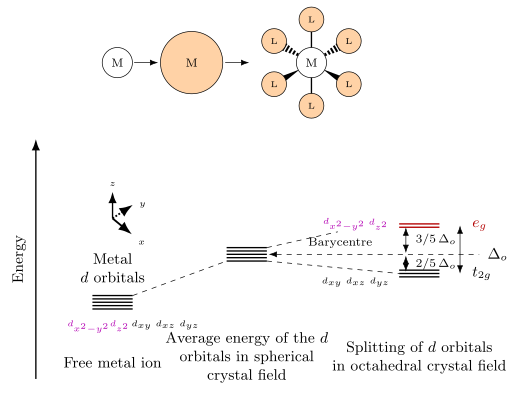
Reasoning:
- In an octahedral complex, six ligands approach along the x, y, and z axes.
- Orbitals with lobes pointing directly along these axes (eg) experience strong repulsion, raising their energy.
- Orbitals with lobes directed between the axes (t2g) experience less repulsion, so they remain lower in energy.
- The energy gap between the two sets is denoted Δo (or 10Dq).
Figure: …
In an octahedral crystal field, the five degenerate d‑orbitals split into two sets: the lower‑energy t2g set (dxy,dyz,dzx) and the higher‑energy eg set (dz2,dx2−y2). The splitting arises because the eg orbitals point directly at the ligands and experience greater repulsion.
The core idea: why does splitting happen?
Imagine placing a central metal ion inside an octahedron of six negative charges (ligands). The d‑orbitals are not all shaped the same — some lobes point directly toward the ligands, others point between them. An electron in an orbital that points straight at a ligand feels a strong electrostatic repulsion, raising its energy. An electron in an orbital that points between ligands feels less repulsion, so its energy stays lower.
This difference in repulsion is the entire origin of crystal field splitting. The five originally equal‑energy d‑orbitals break into two groups.
Step‑by‑step reasoning
-
Identify the orbital shapes relative to the axes
In an octahedral complex, the ligands lie along the +x, −x, +y, −y, +z, and −z axes.
- dz2 has a lobe along the z‑axis (plus a doughnut in the xy‑plane).
- dx2−y2 has lobes along the x and y axes.
- dxy, dyz, dzx have lobes that lie between the axes — in the planes at 45∘ to the axes.
-
Which orbitals point directly at the ligands?
The dz2 and dx2−y2 orbitals have their lobes aimed straight at the ligands on the axes. These are the eg set (two orbitals).
The dxy, dyz, dzx orbitals point between the axes, so they avoid the ligands. These are the t2g set (three orbitals).
-
Energy consequence
Because the eg orbitals experience direct repulsion from the ligand charges, their energy rises. The t2g orbitals, pointing into empty space between ligands, stay at a lower energy. The energy gap between the two sets is called Δo (or 10Dq).
-
The splitting diagram
On the left, the five d-orbitals of the free ion sit together at one (degenerate) energy level. On the right, in the octahedral field, they split into two groups: the eg pair (dz2,dx2−y2) raised above that level, and the t2g trio (dxy,dyz,dzx) lowered below it, separated by the gap Δo.
In its simplest form:
     e_g (higher energy)
     ↑
     |  Δ_o
     ↓
     t_{2g} (lower energy)
``` …
Crystal Field Splitting in an Octahedral Field
Method: Crystal Field Theory (CFT) — Electrostatic Repulsion Model
Core Concept
In an octahedral complex, the five d orbitals are not degenerate (equal in energy) because they experience different electrostatic repulsion from the six ligands placed along the x, y, and z axes.
Steps to Draw the Splitting Diagram
Step 1: Draw the energy axis
- Draw a vertical line (energy increasing upward).
- Mark a horizontal line labeled "Barycenter" or "Average energy of d orbitals in spherical field" — this is the energy the d orbitals would have if the field were spherically symmetric.
Step 2: Place the two groups of orbitals
- Above the barycenter, draw two degenerate (same energy) orbitals: dx2−y2 and dz2 — these are the eg set.
- Below the barycenter, draw three degenerate orbitals: dxy, dxz, dyz — these are the t2g set.
Step 3: Label the energy gap
- Draw a double-headed arrow between the t2g and eg sets.
- Label this gap as Δo (or 10Dq).
Step 4: Add orbital shapes (optional but helpful)
- Beside each orbital label, sketch the shape:
- dx2−y2: four lobes along x and y axes
- dz2: two lobes along z + a donut in xy plane
- dxy, dxz, dyz: four lobes between the axes
Why This Splitting Occurs
| Orbital Set | Orientation | Repulsion from ligands | Energy |
|---|---|---|---|
| eg (dx2−y2, dz2) | Point directly at ligands along axes | Maximum repulsion | Higher (+0.6Δo each) |
Common Mistakes in Drawing Octahedral Crystal Field Splitting
Mistake 1: Wrong Orbital Labels or Orientation
The error: Students often mislabel the dx2−y2 and dz2 orbitals, or draw them with incorrect spatial orientation.
How to avoid:
- Remember: dx2−y2 has lobes along the x and y axes (pointing directly at ligands in octahedral geometry)
- dz2 has a unique "doughnut" shape — a lobe along z-axis with a ring in xy-plane
- The three t2g orbitals (dxy,dxz,dyz) point between the axes
Key insight: In an octahedral field, ligands approach along x, y, and z axes. Orbitals pointing at axes (eg) experience more repulsion than those pointing between axes (t2g).
Mistake 2: Incorrect Energy Order
The error: Drawing t2g above eg, or placing them at the same energy level.
How to avoid:
- eg orbitals (dx2−y2,dz2) are higher in energy — they point directly at ligands
- t2g orbitals (dxy,dxz,dyz) are lower in energy — they point between ligands
- The energy gap is denoted as Δo (or 10Dq)
The eg set (dx2−y2,dz2) sits at the higher energy level, separated by the gap Δo from the t2g set (dxy,dxz,dyz) at the lower energy level.
Mistake 3: Forgetting the Barycenter
The error: Drawing the split levels without showing the average energy (barycenter) or misplacing it.
How to avoid:
- The barycenter (average energy of all five d-orbitals) must remain constant
- In octahedral field: eg orbitals go up by +0.6Δo, t2g go down by −0.4Δo
- Check: 2(+0.6)+3(−0.4)=1.2−1.2=0 ✓
Mistake 4: Unequal Spacing or Wrong Gap Size
The error: Drawing the eg and t2g levels with unequal spacing from the barycenter.
How to avoid:
- The eg level is farther from barycenter than t2g level
- Ratio: eg shift : t2g shift = 3:2 (because 2 orbitals × 3 parts = 3 orbitals × 2 parts)
- Draw the gap from t2g to barycenter as 2 units, and from barycenter to eg as 3 units
--- …
Showing the 12 most recent of 17 on this concept.
- KCET 2026Set D31 markMCQQ.Match List-I with List-IIChoose the correct answer from the options given below. (A) a - ii, b – iii, c – iv, d - i (B) a - ii, b - i, c - iii, d – iv (C) a – iii, b – ii, c – iv, d - i (D) a – i, b – iii, c – iv, d – ii
List-I (Complex) List-II (Geometry) a. [Co(NH3)6]3+ i. Trigonal bipyramidal b. [NiCl4]2− ii. Octahedral c. [Ni(CN)4]2− iii. Tetrahedral d. [Fe(CO)5] iv. Square planar ›Reveal solutionSolution
Each complex's geometry is fixed by its coordination number together with the metal's oxidation state/d-electron count and the field strength of its ligands.
Step 1 — [Co(NH3)6]3+
Cobalt here is Co3+ (d6), six-coordinate with NH3, a moderately strong-field ligand. Six-coordinate complexes of this type adopt octahedral geometry, matching item ii.
Step 2 — [NiCl4]2−
Nickel here is Ni2+ (d8), four-coordinate with Cl−, a weak-field ligand. A weak field is unable to pair up the d8 electrons into a low-spin arrangement, so the complex uses sp3 hybridization and adopts tetrahedral geometry, matching item iii.
Step 3 — [Ni(CN)4]2− …
- KCET 2025Set D-41 markMCQQ.In the following pairs, the one in which both transition metal ions are colourless is (A) ScX3+,ZnX2+ (B) VX2+,TiX3+ (C) ZnX2+,MnX2+ (D) TiX4+,CuX2+
›Reveal solutionSolution
Colour in transition-metal ions comes from d–d transitions, which require a partially filled d-subshell; so find the pair where both ions are d0 or d10.
Step 1 — The concept: why transition-metal ions are coloured
In a complex (or in aqueous solution, where water acts as the ligand), the five degenerate d-orbitals are split by the ligand field into a lower set and an upper set, separated by the crystal-field splitting energy Δ.
ΔE=Δ=hν=λhc
For most first-row transition-metal complexes Δ happens to correspond to a photon in the visible range. An electron in the lower set absorbs that photon and jumps to the upper set — a d–d transition — and the complementary colour of the absorbed light is what we see.
The essential requirement: the d-subshell must be partially filled, i.e. d1 to d9.
- If the ion is d0 — there is no electron to promote.
- If the ion is d10 — the upper set is completely full, so there is no vacancy to promote into.
Either way, no d–d transition ⇒ colourless.
Step 2 — Work out the d-configuration of every ion offered
Recall that for a transition metal we remove the ns electrons first, then the (n−1)d electrons.
Ion Atomic no. Neutral atom d-config of ion Coloured? ScX3+ 21 [Ar]3d14s2 3d0 Colourless ZnX2+ 30 [Ar]3d104s2 3d10 Colourless VX2+ 23 [Ar]3d34s2 3d3 Coloured (violet) TiX3+ 22 [Ar]3d24s2 3d1 Coloured (purple) MnX2+ 25 [Ar]3d54s2 3d5 Coloured (pale pink) TiX4+ 22 [Ar]3d24s2 3d0 Colourless - COMEDK 2025Set 2025-A1 markMCQQ.A transition metal M forms 4 homoleptic octahedral coordination compounds, A,B,C and D of the type [MX6]z− with monodentate ligands a, b, c and d respectively. These compounds absorb red. blue. yellow and blue-green light respectively. Which one of the options shows the correct order of decreasing ligand strength? (A) B>D>C>A (B) D>C>B>A (C) A>C>D>B (D) A>B>C>D
›Reveal solutionSolution
The colour absorbed by a complex is complementary to the colour we see; the energy of absorbed light (and thus the crystal field splitting Δₒ) increases from red to blue, so the ligand that causes the largest Δₒ is the strongest. The correct order of decreasing ligand strength is B > D > C > A, which corresponds to option (A).
The key idea is the spectrochemical series: ligands are ranked by how strongly they split the d‑orbitals in an octahedral field. The stronger the ligand, the larger the crystal field splitting energy Δₒ. The colour we see is the complement of the colour absorbed — so the absorbed colour tells us the energy of the transition, and hence the relative Δₒ.
Here, the complexes absorb:
- A: red light
- B: blue light
- C: yellow light
- D: blue‑green light
We need to rank the ligands a, b, c, d from strongest to weakest.
- Recall the relationship between absorbed colour and energy. In the visible spectrum, red light has the longest wavelength (lowest energy), and blue/violet light has the shortest wavelength (highest energy). The order of increasing energy for the absorbed colours is:
red<yellow<blue‑green<blue
(Blue‑green is intermediate between green and blue, so it is higher in energy than yellow but lower than pure blue.)
-
Connect absorbed energy to Δₒ.
For an octahedral d‑complex, the energy of the d‑d transition (typically from t2g to eg) is approximately equal to Δₒ. So a complex that absorbs higher‑energy light has a larger Δₒ, meaning its ligand is stronger in the spectrochemical series.
-
Rank the complexes by Δₒ from largest to smallest.
- B absorbs blue → highest energy → largest Δₒ → strongest ligand (b).
- D absorbs blue‑green → next highest energy → next largest Δₒ.
- C absorbs yellow → lower energy than blue‑green → smaller Δₒ. …
- COMEDK 2025Set 2025-E1 markMCQQ.Which of the following compounds has electrons symmetrically distributed in both t2 g and eg orbitals? (A) [CoF6]3− (B) [Mn(CN)6]4− (C) [Cr(NH3)6]3+ (D) [FeCl6]3−
›Reveal solutionSolution
"Symmetric distribution in both t2g and eg" requires each set to be half-filled (or full). Among the options only high-spin d5, i.e. [FeCl6]3− with t2g3eg2, satisfies this. The correct option is (D).
Concept
In an octahedral field the five d orbitals split into the lower t2g (dxy,dxz,dyz) and the higher eg (dz2,dx2−y2). Electrons are symmetrically distributed in a set when every orbital of that set holds the same number of electrons — one each (half-filled) or two each (full). For both sets to be symmetric with electrons present, the classic case is high-spin d5: t2g3eg2, one electron in each of the five orbitals.
Solution
- Oxidation states and dn.
- (A) [CoF6]3−: Co3+=d6.
- (B) [Mn(CN)6]4−: Mn2+=d5.
- (C) [Cr(NH3)6]3+: Cr3+=d3.
- (D) [FeCl6]3−: Fe3+=d5.
- Field strength and filling.
- F− weak ⇒ Co3+ high-spin t2g4eg2 — t2g uneven. …
- Oxidation states and dn.
- KCET 2024Set B-21 markMCQQ.Which of the following statements are true about [CoF6]3− ion? I. The complex has octahedral geometry. II. Coordination number of Co is 3 and oxidation state is +6. III. The complex is sp3d2 hybridised. IV. It is a high spin complex. (A) I, II and IV (B) I, III and IV (C) II and IV (D) II, III and IV
›Reveal solutionSolution
F− is a weak-field ligand, so [CoF6]3− is an outer-orbital, high-spin, octahedral sp3d2 complex — statements I, III and IV are true; only statement II (about CN and oxidation state) is false.
1. Oxidation state and coordination number
Let the oxidation state of Co be x. Each fluoride ligand is F−, and the overall charge is −3:
x+6(−1)=−3⟹x=+3
There are six ligands directly bonded to the metal, so the coordination number is 6.
Co: oxidation state =+3,coordination number =6
Statement II says "coordination number of Co is 3 and oxidation state is +6" — this has the two numbers exactly swapped. II is FALSE. ✗
This single deduction is enough to eliminate options (A) [I, II, IV], (C) [II and IV] and (D) [II, III, IV] — all of them include statement II. Only (B) survives. Let us confirm each of I, III, IV independently.
2. Statement I — geometry
A coordination number of 6 in Werner-type complexes means an octahedral arrangement (the six ligands at the vertices of a regular octahedron, minimising repulsion). I is TRUE. ✓
3. The electronic configuration of Co3+
Co (Z=27):[Ar]3d74s2⟹Co3+:[Ar]3d6
4. Statement IV — high spin or low spin?
The deciding factor is the crystal-field splitting energy Δo versus the pairing energy P:
- If Δo>P (strong-field ligand, e.g. CN−, NH3, CO) ⇒ electrons pair up in t2g ⇒ low spin.
- If Δo<P (weak-field ligand) ⇒ electrons spread out and stay unpaired ⇒ high spin.
In the spectrochemical series,
I−<Br−<Cl−<F−<H2O<NH3<en<CN−<CO
F− sits firmly on the weak-field end. Hence Δo<P and the d6 electrons occupy the orbitals with maximum multiplicity:
t2g4 eg2⇒4 unpaired electrons — HIGH SPIN (paramagnetic)
μ=n(n+2)=4×6=24≈4.9 BM …
- COMEDK 2024Set 2024-A1 markMCQQ.On the basis of crystal field theory, electronic configuration of a low spin d4 complex is: (A) t2g1eg3 (B) t2g4eg (C) t2g3eg1 (D) t2g2eg2
›Reveal solutionSolution
A low-spin d4 octahedral complex places all four electrons in t2g: t2g4eg0.
In crystal field theory for an octahedral complex, the d orbitals split into lower t2g (three orbitals) and higher eg (two orbitals). In a low-spin (strong-field) case the pairing energy is less than Δo, so electrons pair up in t2g before occupying eg. For d4 …
- COMEDK 2024Set 2024-E1 markMCQQ.Based on Crystal Field theory, match the Complex ions listed in Column I with the electronic configuration in the d orbitals of the central metal ion listed in Column II. .tg {border-collapse:collapse;border-spacing:0;} .tg td{border-color:black;border-style:solid;border-width:1px;font-family:Arial, sans-serif;font-size:14px; overflow:hidden;padding:10px 5px;word-break:normal;} .tg th{border-color:black;border-style:solid;border-width:1px;font-family:Arial, sans-serif;font-size:14px; font-weight:normal;overflow:hidden;padding:10px 5px;word-break:normal;} .tg .tg-c3ow{border-color:inherit;text-align:center;vertical-align:top} .tg .tg-7btt{border-color:inherit;font-weight:bold;text-align:center;vertical-align:top} .tg .tg-0pky{border-color:inherit;text-align:left;vertical-align:top} No. Complexion No. d orbital configuration of central metal ion. (A) [Mn(CN)6]4− (P) eg2t2g3 (B) [Co(H2O)6]2+ (Q) t2g4eg2 (C) [Fe(H2O)6]2+ (R) t2g5 (D) [MnCl4]2− (S) t2g5eg2 (A) A=SB=RC=PD=Q (B) A=RB=SC=QD=P (C) A=QB=SC=PD=R (D) A=RB=SC=PD=Q
›Reveal solutionSolution
A=R, B=S, C=Q, D=P.
Work out each central-ion d-configuration:
- A [Mn(CN)6]4−: Mn2+ is d5; CN− is strong-field ⇒ low spin octahedral ⇒t2g5eg0=t2g5 = R.
- B [Co(H2O)6]2+: Co2+ is d7; H2O weak-field ⇒ high spin ⇒t2g5eg2 = S.
- C [Fe(H2O)6]2+: Fe2+ is d6; high spin ⇒t2g4eg2 = Q. …
- KCET 2023Set D-21 markMCQQ.Match the column A (type of crystalline solid) with the column B (example for each type): A P. Molecular Solid Q. Ionic Solid R. Metallic Solid S. Network Solid B i. SiC ii. Mg iii. H2O iv. MgO (A) P-iii, Q-i, R-ii, S-iv (B) P-iv, Q-iii, R-ii, S-i (C) P-ii, Q-iv, R-iii, S-i (D) P-iii, Q-iv, R-ii, S-i
›Reveal solutionSolution
The question asks you to match each type of crystalline solid (molecular, ionic, metallic, network) with its correct example. The key is to identify the bonding and structure of each substance: HX2O is a molecular solid, MgO is ionic, Mg is metallic, and SiC is a network covalent solid. The correct match is P-iii, Q-iv, R-ii, S-i, which corresponds to option (D).
The concept here is classification of crystalline solids based on the nature of the bonding forces between their constituent particles. Each type has a distinct set of properties that you can use to identify examples.
-
Molecular solids are held together by weak intermolecular forces (van der Waals, hydrogen bonding). They consist of discrete molecules. Water (HX2O) is a classic example — it forms ice crystals where individual HX2O molecules are linked by hydrogen bonds. So P matches with iii.
-
Ionic solids are composed of positive and negative ions held together by strong electrostatic (ionic) bonds. Magnesium oxide (MgO) is an ionic compound: MgX2+ and OX2− ions arranged in a lattice. So Q matches with iv.
-
Metallic solids consist of metal atoms held together by metallic bonding — a "sea" of delocalized electrons around positive ions. Magnesium (Mg) is a metal, so R matches with ii.
-
Network solids (also called covalent network solids) are giant molecules where atoms are bonded together by a continuous network of covalent bonds. Silicon carbide (SiC) has a structure similar to diamond, with each Si atom covalently bonded to four C atoms. So S matches with i. …
-
- KCET 2023Set D-21 markMCQQ.Which of the following system in an octahedral complex has maximum unpaired electrons? (A) d9 (high spin) (B) d6 (low spin) (C) d4 (low spin) (D) d7 (high spin)
›Reveal solutionSolution
Fill the t2g/eg levels for each configuration using the correct spin state and simply count the unpaired electrons.
Step 1 — The concept: high spin vs low spin
In an octahedral complex the five d orbitals split into a lower t2g set (3 orbitals) and an upper eg set (2 orbitals), separated by the crystal-field splitting energy Δo.
- High spin (Δo<P, the pairing energy): electrons obey Hund's rule as far as possible — they occupy eg singly before pairing in t2g. Maximum unpaired electrons.
- Low spin (Δo>P): electrons pair up in t2g before entering eg. Minimum unpaired electrons.
Step 2 — Fill each configuration
(A) d9 (high spin): t2g6eg3. Six paired in t2g; in eg one orbital is doubled and one is singly filled.
unpaired=1
(Note that d9 has only one unpaired electron in either spin state — hence the Jahn–Teller distortion of Cu2+.)
(B) d6 (low spin): all six electrons pair into the three t2g orbitals: t2g6eg0.
unpaired=0(diamagnetic, e.g. [Co(NH3)6]3+) …
- KCET 2023Set D-21 markMCQQ.If a didentate ligand ethane-1,2-diamine is progressively added in the molar ratio en : Ni :: 1 : 1, 2 : 1, 3 : 1 to [Ni(H2O)6]2+ aq solution, following co-ordination entities are formed. I. [Ni(H2O)4en](aq)2+ – pale blue II. [Ni(H2O)2(en)2](aq)2+ – blue/purple III. [Ni(en)3](aq)2+ – violet The wavelength in nm of light absorbed in case of I and III are respectively (A) 475 nm and 310 nm (B) 300 nm and 475 nm (C) 310 nm and 500 nm (D) 600 nm and 535 nm
›Reveal solutionSolution
The colour of a coordination complex is the complement of the colour it absorbs. As the ligand field strength increases (en replaces H₂O), the crystal field splitting Δ₀ increases, so the absorbed light shifts to shorter wavelengths (blue-shift). For [Ni(H₂O)₆]²⁺ (green), the absorbed wavelength is around 600–650 nm; replacing water with the stronger-field en shifts absorption to shorter wavelengths. The pale blue complex I absorbs in the orange-red (~600 nm), and the violet complex III absorbs in the yellow-green (~535 nm). The correct option is (D).
The question is about the relationship between the colour we see and the wavelength of light absorbed. A complex appears coloured because it absorbs a specific portion of visible light; the colour we see is the complement of the absorbed colour. The key variable here is the crystal field splitting energy Δo, which determines which wavelength gets absorbed.
Ethane-1,2-diamine (en) is a stronger field ligand than water. As you replace H₂O with en, Δo increases. A larger Δo means the energy gap between the t2g and eg orbitals is bigger, so the absorbed photon must have higher energy — that is, a shorter wavelength. So the sequence from I to III should show a progressive shift of the absorption band toward shorter wavelengths.
Now, what do the observed colours tell us?
-
Complex I — pale blue.
Pale blue is the complementary colour of orange/red. A pale blue complex absorbs light in the orange-red region, roughly 600–650 nm. Since en is a stronger ligand than water, the absorption for I should be at a slightly shorter wavelength than for the original [Ni(H₂O)₆]²⁺ (which is green and absorbs around 650–700 nm). So ~600 nm is reasonable.
-
Complex III — violet.
Violet is the complementary colour of yellow-green. A violet complex absorbs light in the yellow-green region, roughly 530–560 nm. With three en ligands, the field is strongest, so the absorption is at the shortest wavelength among the three — around 535 nm fits perfectly.
-
Complex II — blue/purple (intermediate).
This falls between I and III, absorbing at an intermediate wavelength (~570–580 nm), consistent with two en ligands. …
-
- KCET 2022Set B-31 markMCQQ.Crystal Field Splitting Energy (CFSE) for [CoCl_4]^{2-} is 18000 cm^{-1}. The Crystal Field Splitting Energy (CFSE) for [CoCl_4]^{2-} will be (A) 8000 cm^{-1} (B) 10,000 cm^{-1} (C) 18,000 cm^{-1} (D) 16,000 cm^{-1}
›Reveal solutionSolution
Apply the standard crystal-field relation Δt=94Δo for the same metal ion and the same ligands.
Step 1 — Read the question correctly.
The two complexes are [CoCl6]4− (octahedral, six chloride ligands, Δo=18000 cm−1) and [CoCl4]2− (tetrahedral, four chloride ligands). Both contain Co2+ with the same ligand, Cl− — only the geometry changes. (The stem as reproduced repeats the formula, but the accompanying data statement makes the intent explicit: the 18000 cm−1 value belongs to the octahedral hexachloro complex.)
Step 2 — Why tetrahedral splitting is smaller.
In crystal field theory the d-orbitals split because the ligand lone pairs repel the d-electrons. Two things weaken that repulsion in a tetrahedral field:
- Fewer ligands — only 4 instead of 6, so about 64=32 of the repulsive interaction;
- Poorer orbital alignment — in an octahedron the ligands point straight at the eg orbitals (dz2, dx2−y2); in a tetrahedron no ligand points directly at any d-orbital. The t2 set is merely the less badly oriented one, giving a further factor of about 32.
Multiplying the two effects:
Δt≈32×32Δo=94Δo≈0.45Δo. …
- KCET 2021Set B-21 markMCQQ.Which of the following does not represent property stated against it? (A) CO+2 < Fe+2 < Mn+2 – Ionic size (B) Ti < V < Mn – Number of oxidation states (C) Cr+2 < Mn+2 < Fe+2 – Paramagnetic behaviour (D) Sc > Cr > Fe – Density
›Reveal solutionSolution
Mn²⁺ (3d⁵, half-filled) has the maximum unpaired electrons in this part of the series — Cr²⁺ and Fe²⁺ both have 4, so a strictly increasing order across all three is wrong.
Electron configurations (3d series, +2 ions):
- Cr2+: [Ar] 3d⁴ → 4 unpaired electrons
- Mn2+: [Ar] 3d⁵ → 5 unpaired electrons (half-filled — the classic maximum-stability, maximum-paramagnetism case)
- Fe2+: [Ar] 3d⁶ → 4 unpaired electrons (one pair forms once past the half-filled point) …
🎓Unlock everything free for 14 days
- ✓Full step-by-step solutions
- ✓Concept-first explanations
- ✓Methods, shortcuts & mistakes
- ✓PYQ mapping + timed mock tests
Full access for 14 days. No credit card required.