Q.Amongst the following, the most stable complex is
🔒You're viewing a preview — the full solution, concept, methods & PYQ mapping are locked.
🔒 Start your 14-day free trial to unlock the full solution →Concept understanding — Crystal Field Stabilization Energy
Crystal Field Splitting: From Intuition to Precision
Imagine you are a negatively charged electron sitting on a metal ion. All around you, the space is perfectly spherical — every direction feels the same. Your energy depends only on how far you are from the nucleus, not on which way you face.
Now imagine that six negative ions (or the negative ends of polar molecules) march in from the x, y, and z axes and stop close to you. Suddenly, the space around you is no longer uniform. If you try to move straight toward one of these approaching ions, you feel a strong repulsion — that path costs extra energy. If you move between the axes (say, along a diagonal), you feel less repulsion because you are farther from the incoming charges.
This is the core intuition: when ligands approach a metal ion, they break the spherical symmetry of the space around the metal. Different directions in space are no longer equivalent. Electrons in orbitals that point directly at the ligands get pushed up in energy; electrons in orbitals that point between the ligands stay lower.
The Precise Statement
Crystal Field Splitting is the splitting of degenerate d orbitals of a transition metal ion into two or more sets of different energies, caused by the electrostatic repulsion between the metal's d electrons and the negative charge (or dipole) of surrounding ligands.
For the most common geometry — octahedral — here is what happens:
- Six ligands sit at the corners of an octahedron, along the +x, −x, +y, −y, +z, −z axes.
- The dx2−y2 and dz2 orbitals point their lobes directly along these axes. These are the eg set. They feel maximum repulsion → higher energy.
- The dxy, dxz, and dyz orbitals point their lobes between the axes (into the octahedral faces). These are the t2g set. They feel less repulsion → lower energy.
The energy gap between these two sets is denoted by Δo (or 10Dq). The t2g set drops by 0.4Δo and the eg set rises by 0.6Δo, keeping the average energy unchanged (the "barycentre" rule).
The labels eg and t2g come from group theory — they describe how the orbitals transform under the symmetry operations of an octahedron. You do not need to memorise the derivation, but the notation is standard in every exam.
Why This Matters
Crystal field splitting explains three things you will see repeatedly:
- Colour — electrons can jump from t2g to eg by absorbing visible light. The gap Δo determines the colour you see.
- Magnetism — if Δo is large, electrons pair up in the lower t2g set (low spin). If Δo is small, electrons spread out (high spin). This changes the number of unpaired electrons. …
Why this formula?
Crystal Field Stabilization Energy (CFSE): Why the Formula Holds
Let's build this from first principles — not just memorizing numbers, but understanding why the energy changes happen.
1. The Core Idea: d-Orbitals Are Not All Equal in an Octahedral Field
In a free metal ion, all five d-orbitals have the same energy (degenerate). But when you place the ion inside an octahedral ligand field, something changes:
- Ligands (negative point charges or dipoles) approach along the x, y, and z axes.
- Some d-orbitals point directly at the ligands → high repulsion → higher energy.
- Other d-orbitals point between the ligands → less repulsion → lower energy.
Which orbitals point where?
| Orbital | Lobes point toward | Repulsion with ligands? |
|---|---|---|
| dx2−y2 | Along x and y axes | High (directly at ligands) |
| dz2 | Along z axis (with a ring in xy plane) | High (directly at ligands) |
| dxy | Between x and y axes | Low (between ligands) |
| dxz | Between x and z axes | Low |
| dyz | Between y and z axes | Low |
So the five d-orbitals split into two groups:
- eg set (higher energy): dx2−y2, dz2
- t2g set (lower energy): dxy, dxz, dyz
2. The Energy Splitting: Why Δo and the "Barycenter" Rule
The total energy of all five d-orbitals must be conserved — it's the same as in the free ion. This is the barycenter (center of gravity) rule.
Let:
- Energy of t2g orbitals = −x (below barycenter)
- Energy of eg orbitals = +y (above barycenter)
- The splitting energy between them = Δo (called 10Dq in older texts)
So:
y−(−x)=Δo⇒x+y=Δo
Conservation of energy:
- There are 3 t2g orbitals and 2 eg orbitals.
- Total energy shift = 3(−x)+2(+y)=0
From this:
−3x+2y=0⇒2y=3x⇒y=23x
Substitute into x+y=Δo:
x+23x=Δo⇒25x=Δo⇒x=52Δo
Then:
y=23⋅52Δo=53Δo
Key result:
- Each t2g electron is stabilized by −52Δo
- Each eg electron is destabilized by +53Δo
3. The CFSE Formula for Octahedral Complexes
Let:
- nt2g = number of electrons in t2g orbitals
- neg = number of electrons in eg orbitals
Then:
CFSE=−52Δo⋅nt2g+53Δo⋅neg
Why this is the stabilization energy:
- The negative sign means energy is lowered (stabilization).
- The positive term means energy is raised (destabilization).
- Net CFSE = how much more stable the complex is compared to the free ion.
4. The "Why" Behind Pairing Energy and High/Low Spin
When you add electrons beyond d3, you face a choice:
Example: d4 configuration
Option A (High spin):
- Put 4th electron in eg (higher energy)
- Cost: +53Δo (destabilization)
- Benefit: No pairing energy (P)
Option B (Low spin):
- Pair the 4th electron in t2g
- Cost: Pairing energy P (electrostatic repulsion between two electrons in same orbital)
- Benefit: Avoid +53Δo destabilization
The decision rule:
- If Δo>P → Low spin (pairing is cheaper than going to eg)
- If Δo<P → High spin (going to eg is cheaper than pairing)
CFSE for low-spin d4:
4×(−52Δo)+0×(+53Δo)+P=−58Δo+P
CFSE for high-spin d4: …
The key idea is the chelate effect, not Crystal Field Stabilization Energy — all four complexes are octahedral Fe3+ (d5), and for Fe3+ even a comparatively strong field ligand like oxalate does not force pairing, so CFSE is essentially the same (approximately 0) for all four.
- Fe3+ (26−3=23 electrons) is d5 in every complex here. H2O, NH3, and Cl− are all monodentate ligands and, for d5Fe3+, all give a high-spin t2g3eg2 configuration (CFSE approximately 0) - none of them is strong enough to force pairing. …
[Fe(C2O4)3]3− is the most stable because oxalate is a bidentate (chelating) ligand forming three stable five-membered rings - the chelate effect gives it by far the largest formation constant. Correct option: (iii).
All four are Fe(III) (d5) octahedral complexes. Among the ligands, H2O, NH3 and Cl− are monodentate, whereas oxalate C2O42− is bidentate. A bidentate ligand clamps the metal into a chelate ring, and the accompanying entropy gain (the chelate effect) makes chelate complexes far more stable than comparable monodentate complexes. Three oxalate rings therefore make [Fe(C2O4)3]3− …
Method: Chelate-Effect Stability Comparison
We compare the four Fe3+ (d5) complexes by ligand denticity, not by assuming a stronger-field ligand automatically wins on CFSE.
Step 1: Identify the metal ion and its d-electron count
- Iron in all four complexes is Fe3+ (oxidation state +3).
- Fe atomic number = 26, so Fe3+ has 26−3=23 electrons, i.e. [Ar]3d5.
Step 2: Check whether any ligand is strong enough to force low spin
- H2O, NH3, Cl− - monodentate, weak-to-intermediate field. For d5Fe3+, all give high spin (t2g3eg2), CFSE approximately 0.
- C2O42− (oxalate) - although higher than H2O in the general spectrochemical series, it is still not strong enough to pair Fe3+'s d5 electrons. [Fe(C2O4)3]3− is experimentally high spin (μ≈5.9 BM, 5 unpaired electrons) - so CFSE does not distinguish it from the other three.
Step 3: Identify the ligand that can chelate
- H2O, NH3, Cl− are monodentate - one donor atom each, no ring formed.
- C2O42− is bidentate - it binds through two oxygen atoms, forming a stable 5-membered ring with the metal. Three oxalate ions give three such chelate rings.
Step 4: Apply the chelate effect (entropy argument) …
Common Mistakes in Comparing Stability of Fe3+ Complexes
Mistake 1: Ignoring the Metal's d5 Configuration
The error: Students assume all complexes have the same CFSE because they all contain Fe3+, without checking whether any ligand is actually strong enough to force pairing.
How to avoid: Always write the d-electron count first. Fe3+ = 26−3=23 electrons, i.e. d5 configuration.
Mistake 2: Wrongly Assuming Oxalate Forces Low Spin (the key trap in this question)
The error: Students see oxalate placed above H2O/NH3 in the spectrochemical series and conclude it must force a low-spin d5 configuration with a large CFSE, making [Fe(C2O4)3]3− 'win' on CFSE grounds.
Why it's wrong: For Fe3+ (d5), the pairing energy is unusually high (a half-filled t2g3eg2 arrangement is already favourable), so even oxalate is not strong enough to force pairing. [Fe(C2O4)3]3− is experimentally high-spin (μ≈5.9 BM) - the same spin state as the other three complexes.
How to avoid: Don't assume higher-in-the-spectrochemical-series automatically means low spin here - for a half-filled d5 ion, only very strong ligands like CN− can force low spin. Check the experimental magnetic moment when in doubt.
Mistake 3: Missing the Chelate Effect
The error: Students compare only CFSE values and, once they see (correctly or not) that CFSE is similar for all four, conclude the complexes should be similarly stable.
How to avoid: Always check ligand denticity. Oxalate (C2O42−) is bidentate - it forms a 5-membered chelate ring with the metal. Replacing monodentate ligands with a chelating one is entropically favourable (more free particles released), which is the real reason [Fe(C2O4)3]3− is far more stable - this is the chelate effect, an entropy-driven effect, not a CFSE effect.
Mistake 4: Misplacing Ligands in the Spectrochemical Series
The error: Students rank NH3 as weaker than H2O, or Cl- as stronger than H2O.
Correct order (increasing field strength):
I−<Br−<Cl−<F−<H2O<NH3<en<NO2−<CN−
--- …
- COMEDK 2026Set 2026-A1 markMCQQ.Identify the complex which exhibits all 3 characteristics; paramagnetic; high spin configuration; octahedral geometry (A) [Co(NH3)5Cl]Cl2 (B) [Ni(H2O)2(C2O4)2]2− (C) [CO(NH3)(Cl)(en)2]2+ (D) [Ni(CO)4]
›Reveal solutionSolution
The key is to find a complex that is paramagnetic (has unpaired electrons), has a high-spin configuration (weak-field ligand environment), and is octahedral. Only option (B) satisfies all three: it is octahedral, has a weak-field ligand set (water and oxalate), and Ni²⁺ in a high-spin d⁸ configuration gives two unpaired electrons, making it paramagnetic.
Concept and Intuition
We need to check three properties for each complex:
- Paramagnetic: has unpaired electrons (check electron configuration).
- High-spin: occurs when ligands are weak-field (small Δ), so electrons fill orbitals singly before pairing.
- Octahedral geometry: coordination number 6, with ligands at 90° angles.
We’ll determine the oxidation state, d-electron count, ligand field strength, and geometry for each option.
-
Option (A): [Co(NH3)5Cl]Cl2
- The complex ion is [Co(NH3)5Cl]2+.
- Oxidation state: NH₃ is neutral, Cl⁻ is –1, so Co + 0×5 + (–1) = +2 → Co²⁺.
- Co²⁺ has electron configuration [Ar] 3d⁷.
- Ligands: NH₃ (moderate field) and Cl⁻ (weak field). However, NH₃ is strong enough to cause pairing in Co³⁺ but for Co²⁺ it often gives low-spin? Actually, NH₃ is borderline; for Co²⁺, it typically gives low-spin d⁷ (one unpaired electron) because Δ is large enough. But here we have one Cl⁻, which is weak, but overall the field is still moderate. In practice, [Co(NH3)5Cl]2+ is low-spin (one unpaired electron) — paramagnetic, but not high-spin. So fails the high-spin condition.
-
Option (B): [Ni(H2O)2(C2O4)2]2−
- The complex ion is [Ni(H2O)2(C2O4)2]2−.
- Oxidation state: H₂O neutral, oxalate (C₂O₄²⁻) each –2, so Ni + 0×2 + (–2)×2 = –2 → Ni – (–4) = +2? Wait: total charge –2, so Ni + 0 + (–4) = –2 → Ni = +2. Yes, Ni²⁺.
- Ni²⁺ has [Ar] 3d⁸.
- Ligands: H₂O (weak field) and oxalate (weak to moderate, but generally weak). Both are weak-field ligands, so Δ is small → high-spin configuration.
- For d⁸ in octahedral field: high-spin means t₂g⁶ e_g² (two unpaired electrons in e_g) → paramagnetic.
- Geometry: coordination number 6 (two water + two bidentate oxalates = 2 + 4 = 6) → octahedral.
- So (B) satisfies all three.
-
Option (C): [CO(NH3)(Cl)(en)2]2+
- Note: "CO" is likely a typo for "Co". The complex is [Co(NH3)(Cl)(en)2]2+.
- Oxidation state: NH₃ neutral, Cl⁻ –1, en (ethylenediamine) neutral, so Co + 0 + (–1) + 0 = +2 → Co²⁺ again. …
- COMEDK 2026Set 2026-M1 markMCQQ.The Crystal Field Stabilisation energy of(i) [CoF6]3− and(ii) [Fe(H2O)6]3+ are ⋯and ⋯⋯ respectively. (A)(i) −2.8Δ0(ii) −2.4Δ0 (B)(i) 2.8Δ0(ii) 2.4Δ0 (C)(i) −0.6Δ0(ii) 0.4Δ0 (D)(i) −0.4Δ0 ii) 0Δ0
›Reveal solutionSolution
CFSE depends on the metal’s d-electron count, the ligand field strength (weak vs. strong), and the resulting high-spin or low-spin configuration. For (i) [CoFX6]X3− (Co³⁺, d⁶, weak field) CFSE = −0.4Δo; for (ii) [Fe(HX2O)X6]X3+ (Fe³⁺, d⁵, weak field) CFSE = 0Δo. The correct option is (D).
Concept & Intuition
Crystal Field Stabilisation Energy (CFSE) measures the net energy gained (or lost) when d-electrons occupy the split t2g and eg orbitals in an octahedral field. The key is knowing:
- The metal ion’s d-electron count.
- Whether the ligand is weak-field (high-spin) or strong-field (low-spin).
- For weak-field ligands, electrons fill all five d-orbitals singly before pairing (Hund’s rule), minimising pairing energy. For strong-field ligands, electrons pair in the lower t2g set first.
Here, both FX− and HX2O are weak-field ligands (F⁻ is a weak-field halide; H₂O is intermediate but for Fe³⁺ it gives high-spin). So both complexes are high-spin.
Step-by-step reasoning
-
Determine the metal ion and d-electron count
- (i) [CoFX6]X3−: Co in +3 oxidation state. Co atomic number = 27, Co³⁺ = 27 – 3 = 24 electrons. Argon core = 18, so d-electrons = 24 – 18 = 6 (d⁶).
- (ii) [Fe(HX2O)X6]X3+: Fe in +3 state. Fe atomic number = 26, Fe³⁺ = 26 – 3 = 23 electrons. Argon core = 18, so d-electrons = 23 – 18 = 5 (d⁵).
-
Identify spin state from ligand field strength
- F⁻ is a weak-field ligand → small Δo → high-spin.
- H₂O is a weak-to-intermediate field ligand; for Fe³⁺ (d⁵), it gives high-spin (all five electrons unpaired). So both are high-spin.
-
Fill the d-orbitals for high-spin d⁶ and d⁵
- For high-spin d⁶: t2g: ↑ ↑ ↑ (three electrons) eg: ↑ ↑ (two electrons) Then the sixth electron goes into t2g pairing: t2g: ↑↓ ↑ ↑ → total t2g4eg2.
- For high-spin d⁵: t2g: ↑ ↑ ↑ (three) eg: ↑ ↑ (two) → t2g3eg2 (all unpaired).
-
Calculate CFSE
CFSE formula: (number of t2g electrons)×(−0.4Δo)+(number of eg electrons)×(+0.6Δo). …
- KCET 2026Set D31 markMCQQ.Which of the following is the most stable complex? (A) [Fe(CO)5] (B) [Fe(CN)6]4− (C) [Fe(C2O4)3]3− (D) [Fe(H2O)6]3+
›Reveal solutionSolution
Stability of a coordination complex is governed largely by ligand field strength — strong-field ligands like CN− give large crystal field stabilization energy (CFSE) and very stable complexes.
Step 1 — Ligand field strength
In the spectrochemical series, CN− is one of the strongest field ligands, far stronger than CO acting on Fe(0), C2O42− (oxalate, a moderately weak-field chelating ligand), or H2O (a weak-field ligand).
Step 2 — Effect on Fe(II)
With Fe2+ (d6), the strong field of six CN− ligands forces a low-spin t2g6eg0 configuration, giving the maximum possible CFSE for a d6 ion and a very high formation constant for [Fe(CN)6]4−.
Step 3 — Comparing the others …
- COMEDK 2024Set 2024-E1 markMCQQ.Given below are 4 statements. Two of these are correct statements. Identify them. A. Co2+ is easily oxidised to Co3+ in the presence of a strong ligand like CN− B. [Fe(CN)6]4− is an octahedral complex ion which is paramagnetic in nature. C. Removal of H2O molecules from [Ti(H2O)6]Cl3 on strong heating converts it to a colourless compound. D. Crystal Field splitting in Octahedral and Tetrahedral complexes is given by the equation Δ0=4/9Δt (A) A & C (B) A & D (C) B & D (D) C & B
›Reveal solutionSolution
The key idea is to evaluate each statement using coordination chemistry principles: ligand field strength, magnetic properties, hydration effects, and crystal field splitting. The correct statements are A and C, so the answer is option (A).
Let’s break down each statement carefully.
-
Statement A: Co²⁺ is easily oxidised to Co³⁺ in the presence of a strong ligand like CN⁻.
- Co²⁺ has a d7 configuration. In the presence of a strong field ligand like CN⁻, the crystal field splitting is large, causing electrons to pair up in the lower-energy t2g orbitals. For Co²⁺ in an octahedral field, this gives t2g6eg1.
- Co³⁺ has a d6 configuration. With strong ligands, it becomes low-spin t2g6, which is very stable (like the inert [Co(CN)₆]³⁻).
- The oxidation of Co²⁺ to Co³⁺ is thus favoured because the resulting low-spin d6 complex gains extra stabilisation (large CFSE). So this statement is correct.
-
Statement B: [Fe(CN)₆]⁴⁻ is an octahedral complex ion which is paramagnetic.
- Fe²⁺ in [Fe(CN)₆]⁴⁻ has a d6 configuration. CN⁻ is a strong field ligand, causing large splitting. The six electrons all pair up in the t2g set: t2g6.
- With all electrons paired, the complex is diamagnetic, not paramagnetic. So this statement is false.
-
Statement C: Removal of H₂O molecules from [Ti(H₂O)₆]Cl₃ on strong heating converts it to a colourless compound.
- [Ti(H₂O)₆]Cl₃ contains Ti³⁺, which has a d1 configuration. The complex is coloured (typically violet) due to d-d transitions.
- On strong heating, water molecules are lost, and the compound decomposes to TiCl₃ (or further to TiCl₄ and other products). In the absence of water ligands, the d-d transitions are no longer possible in the same way, and the resulting anhydrous compound (e.g., TiCl₃) is often colourless or pale.
- More precisely, removal of water destroys the octahedral aqua complex, and the resulting solid does not show the characteristic d-d absorption. So the statement is correct. …
-
- COMEDK 2024Set 2024-M1 markMCQQ.Arrange the following ions in the increasing order of their ΔH(hydration) values. Cr2+,Co2+,Mn2+,Ni2+ (A) Co2+<Ni2+<Cr2+<Mn2+ (B) Cr2+<Mn2+<Co2+<Ni2+ (C) Ni2+<Co2+<Mn2+<Cr2+ (D) Mn2+<Cr2+<Co2+<Ni2+
›Reveal solutionSolution
Hydration enthalpy for divalent first-row transition-metal ions generally increases across the series due to decreasing ionic radius, but the irregularity at Mn2+ (half-filled d5 configuration, lower CFSE) makes it the least exothermic; the correct order is Mn2+<Cr2+<Co2+<Ni2+, which corresponds to option (D).
Concept & Intuition
Hydration enthalpy (ΔHhyd) is the energy released when gaseous ions are surrounded by water molecules. For a given charge, the key factors are:
- Ionic radius: smaller ion → stronger ion-dipole attraction → more exothermic (more negative) ΔHhyd.
- Crystal field stabilization energy (CFSE): In octahedral hydration complexes, d-electrons in lower-energy t2g orbitals provide extra stabilization, making hydration more exothermic. Ions with higher CFSE (more electrons in t2g) have more negative ΔHhyd.
For Cr2+, Mn2+, Co2+, Ni2+, the ionic radii decrease from left to right across the period (due to increasing nuclear charge), so we expect ΔHhyd to become more negative. However, Mn2+ (d5, high-spin) has zero CFSE in a weak-field octahedral environment, making its hydration less exothermic than expected from size alone. This creates a "dip" in the trend.
Step-by-step reasoning
-
Identify electronic configurations and CFSE
All these ions are high-spin in aqueous solution (water is a weak-field ligand).
- Cr2+: d4 → t2g3eg1 → CFSE = 3×(−0.4Δo)+1×(0.6Δo)=−0.6Δo
- Mn2+: d5 → t2g3eg2 → CFSE = 3×(−0.4Δo)+2×(0.6Δo)=0
- Co2+: d7 → t2g5eg2 → CFSE = 5×(−0.4Δo)+2×(0.6Δo)=−0.8Δo
- Ni2+: d8 → t2g6eg2 → CFSE = 6×(−0.4Δo)+2×(0.6Δo)=−1.2Δo
TipCFSE is negative (stabilizing) except for d0, d5 (high-spin), and d10, where it is zero. The more negative the CFSE, the more exothermic the hydration.
-
Consider ionic radii
Across the series Cr2+→Mn2+→Co2+→Ni2+, ionic radii decrease (due to increasing effective nuclear charge). Smaller radius → stronger ion-water attraction → more negative ΔHhyd. So, based on size alone, the order would be:
Cr2+>Mn2+>Co2+>Ni2+ in radius, meaning ΔHhyd becomes more negative from Cr2+ to Ni2+. …
- KCET 2023Set D-21 markMCQQ.Among the following : I.
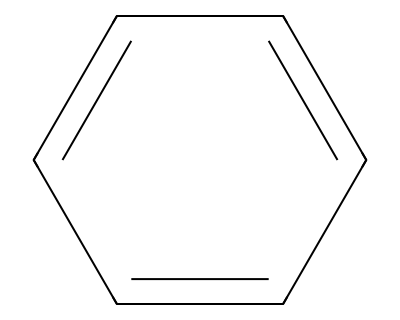 II.
II. 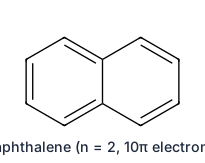 III.
III. 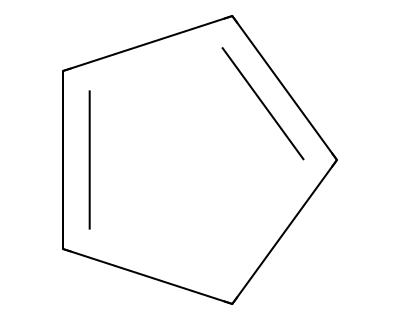 IV.
IV. 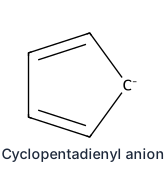 V.
V. 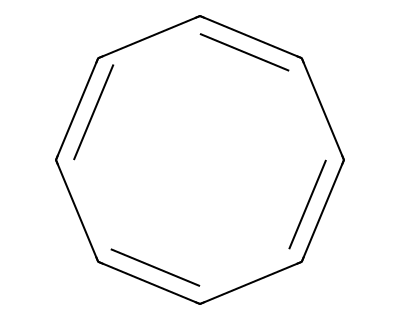 The set which represents aromatic species is
(A) I, II and III
(B) III, IV and V
(C) II and III
(D) I, II and IV
The set which represents aromatic species is
(A) I, II and III
(B) III, IV and V
(C) II and III
(D) I, II and IV›Reveal solutionSolution
Test each structure against Hückel's rule — cyclic, planar, completely conjugated, with (4n+2) π-electrons — and only benzene, naphthalene and the cyclopentadienyl anion pass.
Step 1 — State the criteria for aromaticity.
A species is aromatic only if all four hold:
- It is cyclic.
- It is planar.
- It is completely conjugated — every ring atom must be sp2 (or carry a lone pair in a p orbital), so the p orbitals form an unbroken loop. A single sp3 centre breaks the ring of overlap.
- It obeys Hückel's rule: the delocalised π system contains (4n+2) π-electrons, n=0,1,2,… (i.e. 2, 6, 10, 14 …).
Step 2 — I: Benzene.
Six-membered ring, three alternating C=C ⇒ all six carbons sp2, planar, 6 π electrons =4(1)+2. Aromatic ✓ (the archetype).
Step 3 — II: Naphthalene.
Two fused six-membered rings, fully conjugated and planar, with 5 double bonds ⇒10 π electrons =4(2)+2 with n=2. Aromatic ✓ (a polynuclear/benzenoid aromatic hydrocarbon).
Step 4 — III: Cyclopentadiene.
The five-membered ring has two C=C and one CH2 carbon, which is sp3. That saturated carbon has no p orbital, so the conjugation loop is broken — criterion 3 fails. (Its π count is only 4 anyway.) Not aromatic ✗
Step 5 — IV: Cyclopentadienyl anion.
Removing the H+ from that CH2 leaves a carbanion whose lone pair sits in a p orbital, so that carbon becomes sp2 and the ring is now fully conjugated and planar. π-electron count:
2 C=C×2 π each+2 (the lone pair)=6 π=4(1)+2. …
- COMEDK 2023Set 2023-M1 markMCQQ.Which among the following is diamagnetic? (A) [Ni(CN)4]2− (B) [Co(F6)]3− (C) [NiCl4]2− (D) [Fe(CN)6]3−
›Reveal solutionSolution
[Ni(CN)4]2− has Ni2+ (d8) with the strong-field CN− forcing a square-planar dsp2 arrangement in which all d electrons are paired — diamagnetic. The other complexes retain unpaired electrons and are paramagnetic.
Analyse each:
- (A) [Ni(CN)4]2−: Ni2+=d8; CN− is a strong-field ligand ⇒ electrons pair up, square-planar (dsp2), 0 unpaired ⇒ diamagnetic.
- (B) [CoF6]3−: Co3+=d6; F− weak-field ⇒ high-spin, 4 unpaired ⇒ paramagnetic. …
- KCET 2022Set B-31 markMCQQ.Which can adsorb larger of hydrogen gas? (A) Finely divided platinum (B) Colloidal Fe(OH)3 (C) Finely divided nickel (D) Colloidal solution of palladium
›Reveal solutionSolution
The key idea is that adsorption of hydrogen gas is a surface phenomenon, and colloidal solutions offer an enormous surface area per unit mass. Among the given options, a colloidal solution of palladium adsorbs the largest volume of hydrogen because palladium metal has a unique ability to occlude hydrogen (up to 900 times its own volume). The correct option is (D).
The question is about adsorption — the adhesion of atoms, ions, or molecules from a gas, liquid, or dissolved solid to a surface. Hydrogen gas is a small, diatomic molecule that can be adsorbed onto the surface of certain solids. The amount of gas adsorbed depends critically on the surface area available and the nature of the adsorbent.
Colloidal particles are extremely small (1–100 nm in diameter), so a given mass of a colloidal substance has an enormous total surface area compared to the same mass in bulk form. This is why colloidal solutions are often excellent adsorbents. However, not all colloidal particles are equally good at adsorbing hydrogen — the chemical affinity between the adsorbent and hydrogen matters just as much.
-
Finely divided platinum (Option A) and finely divided nickel (Option C) are both good catalysts for hydrogenation reactions because they adsorb hydrogen. But "finely divided" means a powder, not a colloid. While the surface area is large, it is still far smaller than that of a true colloidal solution. For example, 1 gram of finely divided platinum might have a surface area of a few square meters, whereas 1 gram of a colloidal metal can have hundreds of square meters.
-
Colloidal Fe(OH)3 (Option B) is a common colloid, but iron(III) hydroxide does not have a strong affinity for hydrogen gas. Its surface is polar and hydrated, and hydrogen is nonpolar — so adsorption is weak. This option is a distractor. …
-
- KCET 2020Set A-11 markMCQQ.The co-ordination number of Fe and Co in the complex ions, [Fe(C2O4)3]3− and [Co(SCN)4]2− are respectively : (A) 6 and 4 (B) 3 and 4 (C) 6 and 8 (D) 4 and 6
›Reveal solutionSolution
The coordination number is the number of ligand donor atoms directly bonded to the central metal ion. Oxalate (C2O42−) is a bidentate ligand (each binds through 2 O atoms), so 3 oxalate ligands give a coordination number of 6. Thiocyanate (SCN−) is a monodentate ligand (binds through S or N), so 4 thiocyanate ligands give a coordination number of 4. The answer is (A).
The coordination number of a metal in a complex ion is not simply the number of ligand molecules or ions attached — it is the number of donor atoms from the ligands that are directly bonded to the central metal. This is a crucial distinction.
A ligand may be monodentate (one donor atom, like SCN−) or polydentate (multiple donor atoms, like C2O42−). Counting the number of ligands alone can mislead you; you must count the number of bonds each ligand forms.
Let’s examine each complex separately.
-
Complex [Fe(C2O4)3]3−
The ligand here is the oxalate ion, C2O42−. Each oxalate ion has two negatively charged oxygen atoms that can each donate a lone pair to the metal. So each oxalate ligand is bidentate — it forms two coordinate bonds with the central Fe3+ ion.
With three such ligands, the total number of donor atoms (and hence coordinate bonds) is 3×2=6.
Therefore, the coordination number of Fe in this complex is 6.
-
Complex [Co(SCN)4]2−
The ligand here is the thiocyanate ion, SCN−. Thiocyanate is monodentate — it binds through either the sulfur atom or the nitrogen atom, but only one atom per ligand coordinates to the metal.
There are four such ligands, each contributing one donor atom. So the total number of coordinate bonds is 4×1=4. …
-
- KCET 2019Set A-11 markMCQQ.The compound having longest C−Cl bond is (A) Chlorobenzene
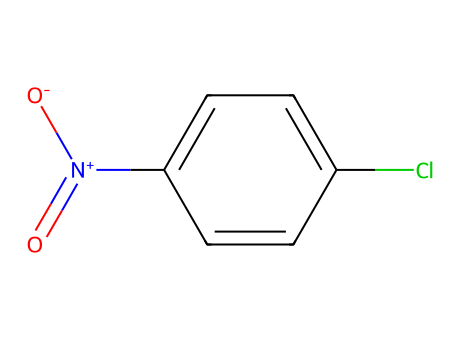
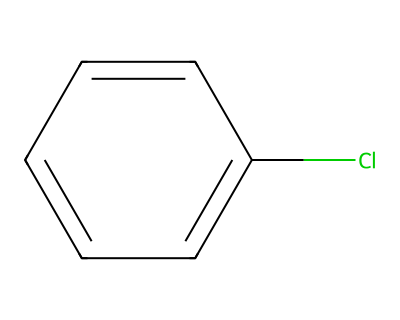 (B) 1-chloro-4-nitrobenzene
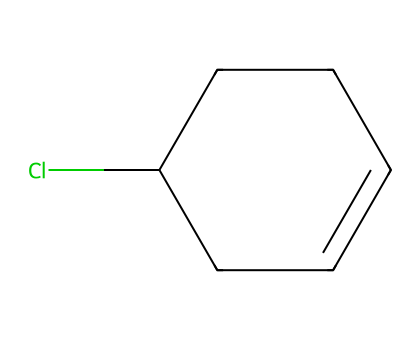
 (C) 4-chlorocyclohex-1-ene
 (D) CH2=CH−Cl
›Reveal solutionSolution
Resonance (partial double-bond character) and higher s-character both shorten a C–Cl bond; only option (C) has Cl on a non-conjugated sp3 carbon, so it has neither shortening effect and therefore the longest C–Cl bond.
Step 1 — The two things that control C–Cl bond length.
- Resonance / partial double-bond character. If the chlorine is attached to an sp2 carbon that is part of a π system (a benzene ring or a C=C), the Cl lone pair is delocalised:
CH2=CH−C¨l⟷−CH2−CH=C+l
The C–Cl bond thereby gains partial double-bond character ⇒ it becomes shorter and stronger.
- Hybridisation / s-character. An sp2 carbon (33% s) holds its bonding electrons closer to the nucleus than an sp3 carbon (25% s), so an sp2C–Cl bond is shorter than an sp3C–Cl bond.
Both effects push the same way: sp3, non-conjugated C–Cl = longest.
Step 2 — Examine each option.
- (A) Chlorobenzene: Cl on an sp2 ring carbon, lone pair delocalised into the ring ⇒ strong resonance, short C–Cl (≈1.69 Å).
- (B) 1-Chloro-4-nitrobenzene: same as (A), and the para −NO2 withdraws electron density, increasing the C–Cl double-bond character further ⇒ even shorter C–Cl. …
- KCET 2018Set A-11 markMCQQ.In F.C.C. the unit cell is shared equally by how many unit cells? (A) 10 (B) 8 (C) 6 (D) 2
›Reveal solutionSolution
As KEA phrased it, this question is read as asking how many neighbouring unit cells an FCC cell is shared with via its face-centred atoms — 6, one per face of the cube.
Why this reads differently from the standard NCERT question. The more common textbook question specifies "a corner atom" (shared by 8 unit cells) or "a face-centred atom" (shared by 2). This question's own printed wording is looser — "the unit cell is shared equally by how many unit cel …
🎓Unlock everything free for 14 days
- ✓Full step-by-step solutions
- ✓Concept-first explanations
- ✓Methods, shortcuts & mistakes
- ✓PYQ mapping + timed mock tests
Full access for 14 days. No credit card required.