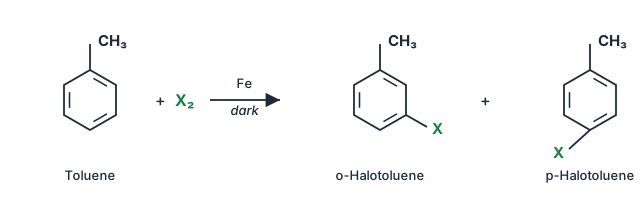
Q.Write the structures and names of the compounds formed when compound ‘A’ with molecular formula, C7H8 is treated with Cl2 in the presence of FeCl3.
Carboxylic Acid Halogenation: The Hell–Volhard–Zelinsky Reaction
Imagine you have a carboxylic acid — say, propanoic acid (CH3CH2COOH). You want to replace one of the hydrogen atoms on the carbon chain with a halogen (like bromine or chlorine). But here's the catch: the carboxylic acid group (−COOH) is already quite reactive. If you just add bromine directly, nothing useful happens — the α-carbon (the carbon right next to the −COOH group) is not reactive enough to attack bromine on its own.
The trick is to activate the α-carbon first. This is exactly what the Hell–Volhard–Zelinsky (HVZ) reaction does.
The Intuition
The −COOH group is electron-withdrawing. That makes the α-carbon slightly positive (electrophilic), but not enough to react with a halogen directly. To make it work, we convert the acid into an acyl halide (like RCOBr) using PBr3 or PCl3. The acyl halide is even more electron-withdrawing, which makes the α-hydrogen more acidic — it can be removed by a base (like a catalytic amount of PBr3 or Br2 itself) to form an enol or enolate intermediate. This enol then attacks a halogen molecule, giving an α-haloacyl halide. Finally, water hydrolyses it back to the α-halo carboxylic acid.
In short: activate → enolize → halogenate → hydrolyse.
The Precise Statement
RCH2COOH2.H2O1.Br2,PBr3RCHBrCOOH
The reaction is regioselective: halogenation occurs exclusively at the α-carbon (the carbon adjacent to the −COOH group). No other position on the chain is halogenated.
Step-by-Step Mechanism
Formation of acyl bromide
The carboxylic acid reacts with PBr3 (or PCl3) to form an acyl bromide:
RCH2COOH+PBr3→RCH2COBr+H3PO3
Enolization
A catalytic amount of PBr3 or Br2 acts as a Lewis acid, making the α-hydrogen more acidic. A base (often Br− from the reaction) abstracts this hydrogen, forming an enol:
RCH2COBr⇌RCH=C(OH)Br
Halogenation
The enol attacks a Br2 molecule, giving the α-bromoacyl bromide:
RCH=C(OH)Br+Br2→RCHBrCOBr+HBr
Hydrolysis
Water hydrolyses the acyl bromide back to the carboxylic acid:
RCHBrCOBr+H2O→RCHBrCOOH+HBr
Note
The PBr3 is catalytic — it is regenerated in the hydrolysis step. Only a small amount is needed.
Why This Matters
The α-halo carboxylic acid is a versatile intermediate. You can:
Substitute the halogen with OH to get α-hydroxy acids (like lactic acid).
Substitute with NH3 to get α-amino acids (the building blocks of proteins). …
Why this formula?
Carboxylic Acid Halogenation — The Hell-Volhard-Zelinsky (HVZ) Reaction
Let's start with the core reaction and then unpack why it works the way it does.
The Reaction in a Nutshell
Carboxylic acids undergo α-halogenation (replacement of an α-hydrogen with a halogen) only under specific conditions:
R−CHX2−COOH+BrX2PBrX3(cat⋅)R−CHBr−COOH+HBr
The key reagents: Br₂ (or Cl₂) + a catalytic amount of PBr₃ (or PCl₃). The product is an α-halo carboxylic acid.
Why Does This Happen? The Step-by-Step Reasoning
1. The Problem: Carboxylic Acids Are Not Enolizable Directly
A carboxylic acid has a carbonyl group (C=O), but the α-hydrogen is not acidic enough to be removed by a base like OHX−.
Why? The conjugate base (carboxylate ion, RCOOX−) is more stable than an enolate. So enolate formation is disfavoured.
Key insight: We need to activate the carbonyl first.
2. The Solution: Convert to an Acyl Halide (More Electrophilic)
PBr₃ reacts with the carboxylic acid to form an acyl bromide:
3R−COOH+PBrX33R−COBr+HX3POX3
The acyl bromide has a better leaving group (Br⁻ vs OH⁻) and a more electrophilic carbonyl carbon. This makes enolization easier.
3. Enolization of the Acyl Halide
A small amount of HBr (from the reaction) or Br₂ itself can act as a Lewis acid to polarize the carbonyl.
The α-hydrogen is now removable by a weak base (like Br⁻ or the enol itself), forming an enol:
Concept: Electrophilic Aromatic Substitution (Toluene Chlorination) — The reaction is electrophilic aromatic substitution (chlorination) on the methylbenzene ring.
Reasoning:
C7H8 is toluene (methylbenzene). The methyl group is an ortho/para director.
Cl2 in the presence of FeCl3 generates a strong electrophile (Cl+), which attacks the aromatic ring. …
The key idea is that C7H8 with Cl2/FeCl3 undergoes electrophilic aromatic substitution (chlorination) on the benzene ring, not free-radical side-chain chlorination. The compound is toluene (C6H5CH3), and the reaction gives a mixture of ortho- and para-chlorotoluene as the major products, with a minor amount of meta-chlorotoluene.
Electrophilic halogenation of toluene
Concept and Intuition: Why This Reaction Works
The molecular formula C7H8 is a classic giveaway — it fits toluene (methylbenzene). The reagent Cl2 in the presence of FeCl3 is the standard condition for electrophilic aromatic chlorination. Here, FeCl3 acts as a Lewis acid catalyst, generating the active electrophile Cl+ (or a polarized Cl2–FeCl3 complex).
Why does this matter? Because the methyl group (−CH3) on toluene is an activating and ortho/para-directing group. It donates electron density into the benzene ring via hyperconjugation and inductive effect, making the ortho and para positions more nucleophilic. So when the Cl+ attacks, it preferentially goes to those positions.
A common pitfall: students often confuse this with free-radical chlorination (using Cl2/light or heat), which would attack the side-chain methyl group. But here, the presence of FeCl3 ensures electrophilic substitution on the ring, not radical substitution.
Watch out
Do not use free-radical conditions here. FeCl3 is a Lewis acid catalyst for electrophilic substitution, not a radical initiator. The side-chain chlorination (to give benzyl chloride) requires UV light or high temperature, not FeCl3.
Step-by-Step Solution
1. Identify the starting compound ‘A’.
The formula C7H8 has a degree of unsaturation:
DU=22×7+2−8=28=4
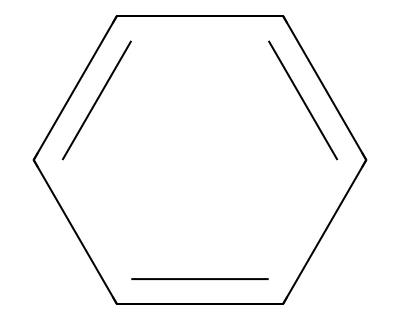
Four degrees of unsaturation strongly suggest a benzene ring (which accounts for 4 DU) plus one extra carbon. The only common aromatic compound with C7H8 is toluene (C6H5CH3). So compound A is toluene.
2. Recognize the reaction type.
Cl2/FeCl3 is the classic electrophilic aromatic chlorination system. The FeCl3 polarizes the chlorine molecule:
Cl2+FeCl3→Cl++FeCl4−
The Cl+ (or the polarized complex) acts as the electrophile.
3. Predict the directing effect of the methyl group.
The −CH3 group is an ortho/para director because it stabilizes the intermediate carbocation (arenium ion) formed during attack at ortho and para positions. Attack at meta position gives a less stable intermediate.
Concept: Electrophilic Aromatic Substitution (EAS) – specifically, chlorination of toluene
Method: Electrophilic aromatic halogenation (chlorination) of an activated ring
(Note: although a Lewis-acid catalyst is used, ring halogenation is not a Friedel–Crafts reaction — that name is reserved for alkylation and acylation.)
Why this method?
Compound ‘A’ with formula C7H8 is toluene (methylbenzene). The methyl group (−CH3) is an activating and ortho/para-directing group. In the presence of FeCl3 (a Lewis acid catalyst), Cl2 generates an electrophile (Cl+), which substitutes a hydrogen on the benzene ring.
Steps:
Identify the substrate
Molecular formula C7H8 → toluene:
C6H5CH3
Recognize directing effect
The −CH3 group activates the ring and directs incoming Cl to ortho and para positions.
Write the reaction
Toluene + Cl2 + FeCl3 → mixture of ortho-chlorotoluene and para-chlorotoluene (major products).
Minor meta product is negligible due to activation.
Here are the common mistakes students make when tackling this specific electrophilic aromatic substitution problem, along with how to avoid each.
1. Mistake: Forgetting to Identify Compound ‘A’ First
The Error: Students jump straight to writing the chlorination products without first identifying what C7H8 is. They might treat it as an alkane or an unknown cyclic compound.
Why It Happens: The molecular formula C7H8 is not immediately obvious. Students often fail to calculate the Degree of Unsaturation (DU) .
How to Avoid:
Always calculate DU first. For C7H8:
DU=22C+2−H=22(7)+2−8=28=4
- A DU of 4 strongly suggests an aromatic ring (benzene ring has DU = 4). The only common aromatic compound with $\mathrm{C_7H_8}$ is **toluene** (methylbenzene).
- **Key Insight:** If you don't identify the starting material correctly, every subsequent product will be wrong.
2. Mistake: Confusing the Reagent System (Cl2/FeCl3)
The Error: Students treat Cl2/FeCl3 as a free-radical halogenation reagent (like Cl2/light or heat) and attack the side chain (methyl group) instead of the ring.
Why It Happens: They memorize "chlorine + catalyst = substitution" but forget where the substitution occurs. FeCl3 is a Lewis acid that polarizes Cl2, making it an electrophilic aromatic substitution reagent.
How to Avoid:
Remember the rule:Cl2/FeCl3 (or Br2/FeBr3) always substitutes on the aromatic ring (electrophilic substitution).
Side-chain substitution (free-radical) requires Cl2/light or heat (no FeCl3).
Mnemonic: "Catalyst = Ring; Light = Side-chain."
3. Mistake: Ignoring the Directing Effect of the Methyl Group
The Error: Students write only one product (e.g., just ortho or just para) or write all three possible monochlorinated products (ortho, meta, para) without realizing that the methyl group is an ortho/para director.
Why It Happens: They forget that substituents already on the ring influence where the next substituent goes.
How to Avoid:
Recall the activating/directing groups: Alkyl groups (like −CH3) are activating and ortho/para directing.
Therefore, the major products are:
ortho-chlorotoluene (1-chloro-2-methylbenzene)
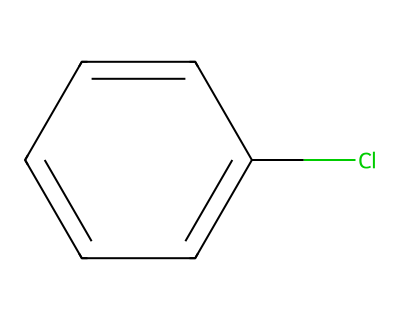
para-chlorotoluene (1-chloro-4-methylbenzene)
Meta product is a minor (negligible) product and is usually not listed in exam answers unless specifically asked.
4. Mistake: Writing Incorrect IUPAC Names or Structures
The Error: Students write the correct skeleton but misnumber the carbons or use wrong locants (e.g., writing 2-chloro-1-methylbenzene instead of 1-chloro-2-methylbenzene).
Why It Happens: Confusion about which substituent gets the lower number in IUPAC naming.
Same / Similar Concept — real previous-year questions on the same or a closely similar concept, not this exact question.
Showing the 12 most recent of 14 on this concept.
COMEDK 2026Set 2026-M1 markMCQ
Q.Identify the name of the reaction involved in conversion of A→B and name the compound B. CH3CNH+H2OA−Cl2/ Red Phosphorous H+/H2OB
(A) Kolbe's reaction, Ethanoic acid
(B) Esterification, methyl ethanoate
(C) Hell-Volhard-Zelinsky reaction, 2-chloro-ethanoic acid
(D) Riemer-Tiemann reaction, 1-chloro-ethanoic acid
›Reveal solutionSolution
The reaction sequence starts with hydrolysis of acetonitrile to ethanoic acid, followed by α‑chlorination via the Hell‑Volhard‑Zelinsky reaction, giving 2‑chloroethanoic acid. The correct option is (C).
Concept & Intuition
The problem asks you to identify two things: the name of the reaction that converts intermediate A into final product B, and the structure/name of B. The first step is a simple acid‑catalysed hydrolysis of a nitrile (CH₃CN) to a carboxylic acid (ethanoic acid, A). The second step uses Cl₂ in the presence of red phosphorus and water under acidic conditions — this is the classic setup for the Hell‑Volhard‑Zelinsky (HVZ) reaction, which selectively halogenates the α‑carbon of a carboxylic acid. The product is therefore an α‑chloro acid.
Step‑by‑step reasoning
First step: hydrolysis of acetonitrile
CH3CNH+H2OCH3COOH
Nitriles are hydrolysed by hot aqueous acid to give carboxylic acids. Here, acetonitrile (CH₃CN) becomes ethanoic acid (acetic acid). So compound A is ethanoic acid.
Second step: the reaction conditions
The reagents are Cl2/Red Phosphorus in the presence of H+/H2O. Red phosphorus reacts with chlorine to form PCl₃ in situ, which converts the carboxylic acid into an acyl chloride. The acyl chloride then enolises and is chlorinated at the α‑position. Water present hydrolyses the acyl chloride back to the carboxylic acid. This is the Hell‑Volhard‑Zelinsky (HVZ) reaction.
Applying HVZ to ethanoic acid
Ethanoic acid has the structure CH3COOH. The α‑carbon is the carbon adjacent to the carboxyl group — that is, the methyl carbon. Chlorination replaces one hydrogen on that carbon:
CH3COOHCl2/P,H+/H2OClCH2COOH
The product is 2‑chloroethanoic acid (also called chloroacetic acid). The “2‑” indicates the chlorine is on the carbon next to the carboxyl group.
Q.Ethyl alcohol is heated with concentrated sulphuric acid at 413 K. The major product
(A) C2H5–O–C2H5
(B) CH3–O–C3H7
(C) CH2 = CH2
(D) CH3COOC2H5
›Reveal solutionSolution
Ethanol + conc. H2SO4 is temperature-controlled: 413 K gives bimolecular dehydration (ether); 443 K gives intramolecular dehydration (alkene). The question specifies 413 K.
Step 1 — The competing pathways.
Concentrated H2SO4 protonates the –OH of ethanol, converting it into −O+H2 — an excellent leaving group (water). What happens next depends on whether a nucleophile or elimination takes over, and temperature is the switch:
At 413K (=413−273=140∘C), a second, un-protonated ethanol molecule — still abundant in the mixture — acts as the nucleophile and attacks the carbon of the protonated ethanol via SN2, displacing water:
C2H5−O+H2+HO−C2H5⟶C2H5−O+(H)−C2H5+H2O
Loss of H+ from that oxonium ion then gives diethyl ether. This is called bimolecular dehydration because two alcohol molecules combine, losing one molecule of water between them. This is in fact the industrial route to diethyl ether.
Q.Which of the following halides cannot be hydrolysed?
(A) CCl4
(B) SiCl4
(C) GeCl4
(D) SnCl4
›Reveal solutionSolution
Hydrolysis needs the central atom to expand its octet using vacant d-orbitals; carbon has none, so CCl4 alone resists water.
Step 1 — The mechanism of tetrahalide hydrolysis
For MCl4 (M = Si, Ge, Sn), water attacks the central atom:
SiCl4+4H2O⟶Si(OH)4+4HCl
The first step is nucleophilic attack by the oxygen lone pair of H2O on M, giving a five- (or six-) coordinate intermediate/transition state. To accept that extra bond pair the central atom must expand its octet — which requires energetically accessible vacant d-orbitals in its valence shell.
Step 2 — Which elements have those d-orbitals?
Halide
Central atom
Period
Valence shell
Vacant d available?
Hydrolyses?
CCl4
C
2
2s2p
No — there is no 2d subshell
No
SiCl4
Si
3
3s3p3d
Yes (3d)
Yes
GeCl4
Ge
4
4s4p4d
Yes (4d)
Yes
SnCl4
Sn
5
5s5p5d
Yes (5d)
Yes
Carbon's valence shell (n=2) simply has no d subshell, so its maximum covalency is 4. It cannot form the five-coordinate transition state, and the alternative route — spontaneous ionisation of C−Cl — is far too endothermic.
Q.The first chlorinated organic insecticide prepared is:
(A) Gammexane
(B) Chloroform
(C) COCl2
(D) DDT
›Reveal solutionSolution
DDT is the historically first chlorinated organic insecticide; the other options are either a later one or not insecticides.
Step 1 — Recall the history
DDT — p,p'-dichlorodiphenyltrichloroethane — was first synthesised in 1873, but its insecticidal property was discovered by Paul Hermann Müller in 1939 (for which he received the 1948 Nobel Prize in Physiology or Medicine). From the 1940s it was used worldwide against malarial mosquitoes and agricultural pests. It is universally cited as the first chlorinated organic insecticide.
Structure: two chlorobenzene rings joined to a −CH−CCl3 bridge, i.e. a heavily chlorinated hydrocarbon.
Step 2 — Screen the other options
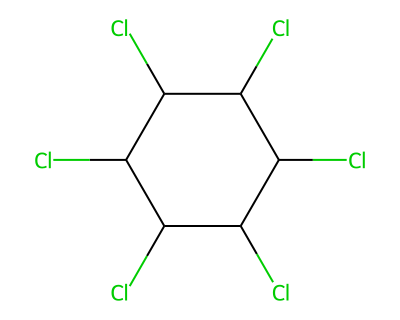
(A) Gammexane — this is the γ-isomer of benzene hexachloride (C6H6Cl6, BHC/lindane). It is a chlorinated organic insecticide, but it came into use after DDT, so it is not the first. This is the intended distractor. ✗
(B) Chloroform (CHCl3) — a chlorinated organic compound, but it is a solvent/anaesthetic, not an insecticide. ✗ …
Q.An organic compound with molecular formula C3H5N on hydrolysis gives compound 'X' which on treatment with Cl2/P gives compound 'Y'. Compound 'Y' on reaction with NH3 gives 'Z'. The compound 'Z' is :
(A) 2-aminopropanoic acid
(B) 2-nitropropane
(C) 1-hydroxypropane
(D) 1-chloropropane
›Reveal solutionSolution
Propanenitrile hydrolyses to propanoic acid, then HVZ gives α-chloro acid, and ammonolysis gives 2-aminopropanoic acid (alanine). Official key: (A).
Working
The formula C3H5N is that of propanenitrile, CH3CH2C≡N.
Step 1 — Hydrolysis of the nitrile gives the carboxylic acid X:
CH3CH2CNH3O+X: propanoic acidCH3CH2COOH
Step 2 — Hell–Volhard–Zelinsky (Cl2/P) chlorinates the α-carbon, giving Y:
Q.Which one of the following gases converts haemoglobin into carboxy haemoglobin?
(A) CO
(B) O2
(C) NO
(D) CO2
›Reveal solutionSolution
Carbon monoxide co-ordinates to the haem iron far more strongly than dioxygen does, converting haemoglobin into carboxyhaemoglobin (HbCO).
1. How haemoglobin normally works
Haemoglobin (Hb) carries a haem group with an Fe2+ centre. Molecular oxygen binds reversibly to this iron:
Hb+O2⇌HbO2(oxyhaemoglobin)
The reversibility is essential — O2 must be released in the tissues.
2. What CO does
CO is a strong σ-donor / π-acceptor ligand. Its back-bonding with Fe2+ makes the Fe–CO bond far stronger than the Fe–O2 bond (affinity roughly 200–300× greater):
Hb+CO⟶HbCO(carboxyhaemoglobin)
Because the binding is essentially irreversible on a physiological timescale, those haem sites are permanently blocked. The blood's oxygen-carrying capacity collapses, causing hypoxia — the classic symptom of CO poisoning from incomplete combustion.
Q.During the electrolysis of brine, by using inert electrodes,
(A) O2 liberates at anode
(B) H2 liberates at anode
(C) Na deposits on cathode
(D) Cl2 liberates at anode
›Reveal solutionSolution
In the electrolysis of brine (concentrated NaCl solution) with inert electrodes, the key is to compare the standard reduction potentials of the competing ions. Chloride ions are preferentially oxidized over water at the anode, producing chlorine gas, while water is reduced at the cathode to give hydrogen gas. The correct answer is (D).
The electrolysis of brine is a classic industrial process (the chlor-alkali process). The confusion usually arises because students remember that in the electrolysis of dilute NaCl or of water itself, oxygen is produced at the anode. But brine is concentrated sodium chloride. The concentration of chloride ions is high, and this shifts the competition in their favor.
At the anode, two oxidation reactions are possible:
2Cl−→Cl2+2e− (standard potential E∘=−1.36 V)
2H2O→O2+4H++4e− (standard potential E∘=−1.23 V)
The reaction with the less negative (or more positive) potential is thermodynamically easier. On paper, water oxidation (−1.23 V) looks easier than chloride oxidation (−1.36 V). However, the oxidation of water has a large overpotential at inert electrodes like platinum or graphite — it needs extra voltage to get going. In concentrated chloride solution, the actual potential required to evolve oxygen is higher than that for chlorine. So chlorine is liberated at the anode.
At the cathode, the competition is between:
Na++e−→Na (E∘=−2.71 V)
2H2O+2e−→H2+2OH− (E∘=−0.83 V)
Reduction of water to hydrogen is far easier (much less negative potential) than depositing sodium metal. Sodium would immediately react with water anyway. So hydrogen gas is liberated at the cathode, and the solution becomes alkaline (NaOH forms).
Let's go through the options step by step.
Option (A): O2 liberates at anode
This is true only for very dilute NaCl or for electrolysis of pure water. In concentrated brine, the overpotential for oxygen evolution makes chlorine the preferred product. So (A) is false for brine.
Option (B): H2 liberates at anode
Hydrogen is produced at the cathode, not the anode. Anodes are where oxidation happens. This is completely wrong.
Q.Ethanoic acid undergoes Hell-Volhard Zelinsky reaction but Methanoic acid does not, because of
(A) absence of α-H atom in ethanoic acid
(B) higher acidic strength of ethanoic acid than methanoic acid
(C) presence of α-H atom in methanoic acid
(D) presence of α-H atom in ethanoic acid
›Reveal solutionSolution
HVZ halogenation proceeds through an enol of the acyl halide, which can only form if the acid carries an α-hydrogen — ethanoic acid has three, methanoic acid has none.
1. What the HVZ reaction actually does
Carboxylic acids with an α-H react with Cl2/Br2 in the presence of a small amount of red phosphorus to give the α-halo acid:
R–CH2–COOH(i)X2/red P(ii)H2OR–CHX–COOH
2. Why an α-H is mandatory
The mechanism is:
Red P + X2 generates PX3, which converts the acid into the acyl halideR–CH2–COX.
The acyl halide tautomerises to its enol: R–CH=C(OH)X. This step consumes an α-hydrogen.
The nucleophilic enol double bond attacks X2, putting the halogen on the α-carbon.
Hydrolysis / exchange regenerates the α-halo acid.
Without an α-H there is no enolisable position, step 2 fails, and the whole sequence stops.
6Cl2 (excess) Anhydrous AlCl3dark, cold X + 6HCl
(A)
(B)
(C)
(D)
›Reveal solutionSolution
AlCl3 + dark/cold ⇒ electrophilic substitution; six Cl2 and six HCl liberated ⇒ all six ring H's replaced ⇒ hexachlorobenzene.
Step 1 — Read the reagent and the conditions.
Benzene reacts with chlorine along two completely different routes:
Cl2 / anhydrous AlCl3 (or FeCl3), dark, cold→electrophilic substitution. The Lewis acid polarises Cl−Cl to generate Cl+, which attacks the π cloud; the ring's aromaticity is restored by loss of H+, which appears as HCl.
Cl2 / UV light, sunlight, no Lewis acid→free-radical addition of three Cl2 across the three π bonds giving benzene hexachloride (BHC / gammexane), C6H6Cl6, with a saturated ring and no HCl formed.
Here the conditions are anhydrous AlCl3, dark and cold ⇒ substitution.
Step 2 — Use the stoichiometry as the clincher.
C6H6+6Cl2anhyd. AlCl3,dark, coldC6Cl6+6HCl
Six molecules of HCl are released, i.e. six ring hydrogens have been replaced. An addition reaction produces noHCl at all. So X must have all six H's swapped for Cl while the aromatic ring survives.
Hinsberg's reagent is benzenesulfonyl chloride (C65SO2Cl), used to distinguish primary, secondary, and tertiary amines via sulfonamide formation.
The question tests a classic name reaction in organic chemistry — the Hinsberg test. This test is a practical way to tell apart the three classes of amines based on their reactivity with a sulfonyl chloride. The key idea is that the reagent must have a reactive sulfonyl chloride group (−SO2Cl) that can attack the nitrogen of an amine. Let's see why only one option fits.
What Hinsberg's reagent does
It reacts with amines to form sulfonamides. A primary amine gives a sulfonamide that is soluble in alkali (because it has an acidic N–H hydrogen). A secondary amine gives a sulfonamide that is insoluble in alkali (no acidic hydrogen). A tertiary amine does not react at all under the test conditions — it may form a salt but no stable sulfonamide. The reagent must therefore be a sulfonyl chloride, not an acyl chloride or an amide.
Check each option
(A)CH3COCl / pyridine — This is acetyl chloride in pyridine. It's an acylating agent, used for acetylation (like in the Schotten–Baumann reaction), not for the Hinsberg test. It would give amides, not sulfonamides.
(B)(CH3CO)2O / pyridine — Acetic anhydride, again an acylating agent. Same reason: not a sulfonyl chloride.
(C)C6H5SO2Cl — Benzenesulfonyl chloride. This is exactly the compound: it has the −SO2Cl group attached to a benzene ring. This is the classic Hinsberg reagent.
(D)C6H5SO2NH2 — Benzenesulfonamide. This is already a sulfonamide — it has no reactive chloride to attack an amine. It cannot act as a reagent for the test.
Q.Propanoic acid undergoes HVZ reaction to give chloropropanoic acid. The product obtained is
(A) stronger acid than propanoic acid
(B) weaker acid than propanoic acid
(C) as stronger as propanoic acid
(D) stronger than dichloropropanoic acid
›Reveal solutionSolution
The HVZ reaction replaces an α-hydrogen with chlorine, and the electron-withdrawing inductive effect of chlorine makes the resulting α-chloropropanoic acid a stronger acid than propanoic acid. The correct option is (A).
The key here is understanding how substituents affect acid strength in carboxylic acids. The acidity of a carboxylic acid depends on the stability of its conjugate base — the carboxylate anion. Any group that pulls electron density away from the carboxylate ion (an electron-withdrawing group) stabilizes the negative charge and makes the acid stronger. Conversely, electron-donating groups destabilize the anion and weaken the acid.
In the HVZ (Hell–Volhard–Zelinsky) reaction, propanoic acid is treated with bromine (or chlorine) in the presence of a catalytic amount of PBr3 or PCl3. This selectively replaces one α-hydrogen (the hydrogen on the carbon adjacent to the carboxyl group) with a halogen atom. So propanoic acid (CH3CH2COOH) becomes 2-chloropropanoic acid (CH3CHClCOOH).
Now, chlorine is highly electronegative. It pulls electron density toward itself through the sigma bonds — this is the inductive effect. In 2-chloropropanoic acid, the chlorine is attached to the α-carbon, which is directly next to the carboxyl group. This means the electron-withdrawing effect is transmitted very effectively to the carboxylate group, stabilizing the conjugate base.
Let’s walk through the reasoning step by step.
Identify the change caused by the HVZ reaction.
Propanoic acid: CH3CH2COOH
After HVZ with chlorine: CH3CHClCOOH (2-chloropropanoic acid)
One α-hydrogen is replaced by a chlorine atom.
Recall the inductive effect on acidity.
The carboxylate anion (RCOO−) is stabilized by any group that pulls electron density away from the negative charge. Chlorine is strongly electron-withdrawing (−I effect). The closer the chlorine is to the carboxyl group, the stronger its effect. Here it is on the α-carbon — the closest possible position without being directly on the carboxyl carbon.
Compare the acid strengths.
Propanoic acid has no electron-withdrawing substituent on the α-carbon. Its pKa is about 4.87.
2-Chloropropanoic acid has a chlorine on the α-carbon. Its pKa is about 2.86.
A lower pKa means a stronger acid. So 2-chloropropanoic acid is significantly stronger than propanoic acid. …
Q.Which of the following compounds undergoes haloform reaction?
(A) CH3COCH3
(B) HCHO
(C) CH3CH2Br
(D) CH3−O−CH3
›Reveal solutionSolution
Haloform requires a methyl ketone (CH3−CO−R) or a methyl carbinol; only acetone qualifies.
Step 1 — The structural requirement.
The haloform reaction proceeds when a compound carries the group
CH3−∥C−(a methyl ketone, CH3COR)
or a CH3−CH(OH)− group (a methyl carbinol, which the reagent first oxidises to the methyl ketone). Ethanol and acetaldehyde also work for the same reason.
Step 2 — Why that group.
The three hydrogens on the methyl adjacent to C=O are acidic. In base they are removed one by one and replaced by halogen, giving CX3CO−. The strongly electron-withdrawing CX3 makes CX3− a good leaving group, so OH− attacks the carbonyl and expels CHX3 (the haloform):
 (B)
(B)  (C)
(C) 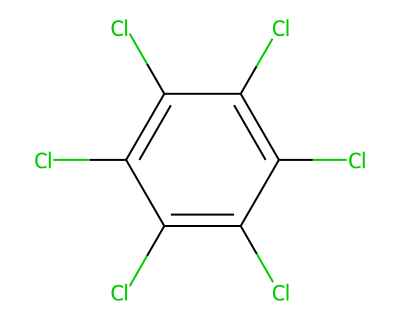 (D)
(D)