Q.Some alkylhalides undergo substitution whereas some undergo elimination reaction on treatment with bases. Discuss the structural features of alkyl halides with the help of examples which are responsible for this difference.
🔒You're viewing a preview — the full solution, concept, methods & PYQ mapping are locked.
🔒 Start your 14-day free trial to unlock the full solution →Concept understanding — SN1 Reactivity
The Core Intuition: Who Wants to Leave, and Who Can Wait?
Imagine you're at a party where the host (the leaving group) is about to leave. The party (the reaction) happens in two stages. First, the host walks out the door — that's the slow, painful step. Then, a new guest (the nucleophile) rushes in to take the empty spot.
The SN1 reaction works exactly like this: the leaving group leaves first, forming a carbocation intermediate. The nucleophile attacks after the leaving group is gone. This means the rate of the reaction depends only on how easily the leaving group can leave — it does not depend on the nucleophile at all.
So the question becomes: What makes a carbocation form easily? The answer is stability. A carbocation that is more stable will form faster and last longer, making the SN1 reaction faster.
The Precise Statement of SN1 Reactivity Order
SN1 Reactivity Order (for alkyl halides):
Allylic≈Benzyl>3∘>2∘≫1∘≈Methyl
This is the order of how fast the SN1 reaction proceeds. Let's unpack why.
Why This Order? The Stability Ladder
A carbocation is a carbon with only six electrons in its valence shell — it's electron-deficient and positively charged. The more you can spread out (delocalize) that positive charge, the more stable the carbocation becomes.
1. Methyl and 1° Carbocations: The Unstable Ones
A methyl carbocation (CHX3X+) has no alkyl groups attached to the positive carbon. There is zero electron-donating effect to stabilize the charge. It is so unstable that it practically never forms in an SN1 reaction — the reaction simply doesn't happen.
A primary (1°) carbocation has one alkyl group attached. Alkyl groups are weakly electron-donating (through hyperconjugation and inductive effect), so it's slightly more stable than methyl — but still far too unstable to form under normal SN1 conditions.
Never say "SN1 happens on a primary carbon" in an exam. It is essentially impossible under standard conditions because the carbocation is too unstable.
2. Secondary (2°) Carbocations: The Borderline Case
A secondary carbocation has two alkyl groups donating electron density. It is moderately stable — stable enough to form, but only under certain conditions (like a good leaving group and a polar protic solvent). SN1 reactions on secondary carbons are possible, but they are slower than on tertiary carbons.
3. Tertiary (3°) Carbocations: The Sweet Spot
Three alkyl groups donate electron density to the positive carbon. This makes the carbocation very stable. Tertiary alkyl halides undergo SN1 reactions readily — they are the classic example.
4. Allylic and Benzylic: The Champions
These are special cases. In an allylic carbocation, the positive charge is adjacent to a carbon-carbon double bond. The π electrons of the double bond can delocalize the positive charge onto the second carbon:
CHX2=CH−CHX2X+↔+CHX2−CH=CHX2
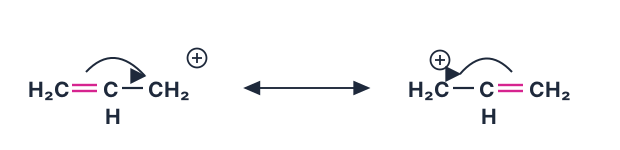
In a benzylic carbocation, the positive charge is adjacent to a benzene ring. The π system of the ring delocalizes the charge across multiple carbons:
CX6HX5−CHX2X+↔(several resonance structures)
Here are those resonance structures — the positive charge cycles from the CH₂ carbon onto the ortho and para positions of the ring:
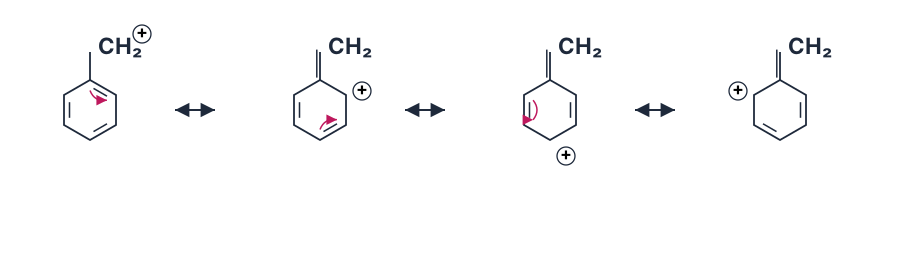
This resonance stabilization makes allylic and benzylic carbocations even more stable than tertiary ones. They form the fastest in SN1 reactions.
The Complete Picture in a Table
| Carbocation Type | Stability | SN1 Reactivity | Example |
|---|---|---|---|
| Methyl | Extremely unstable | Does not occur | CHX3Br |
Why this formula?
SN1 Reactivity: Why the Rate Law and Mechanism Hold
The Core Idea: A Two-Step, Carbocation-Mediated Process
SN1 stands for Substitution, Nucleophilic, Unimolecular. The "unimolecular" part is the key — the rate-determining step involves only one molecule (the substrate). This is fundamentally different from SN2, where both substrate and nucleophile collide.
The reaction proceeds in two distinct steps:
- Slow step: The leaving group departs, forming a carbocation intermediate.
- Fast step: The nucleophile attacks the carbocation.
Why the Rate Law is First-Order
Step 1: The Rate-Determining Step
The slow step is the heterolytic cleavage of the C–LG bond:
R–LGslowR++LG−
Since this step involves only one molecule of substrate, the rate depends only on its concentration:
Rate=k1[R–LG]
Step 2: The Fast Step
The nucleophile then attacks the carbocation:
R++Nu−fastR–Nu
Because this step is fast, it does not affect the overall rate. The nucleophile concentration does not appear in the rate law.
The Resulting Rate Law
Rate=k[R–LG]
This is first-order in substrate and zero-order in nucleophile — a hallmark of SN1.
The classic example — hydrolysis of 2-bromo-2-methylpropane — shows both steps:
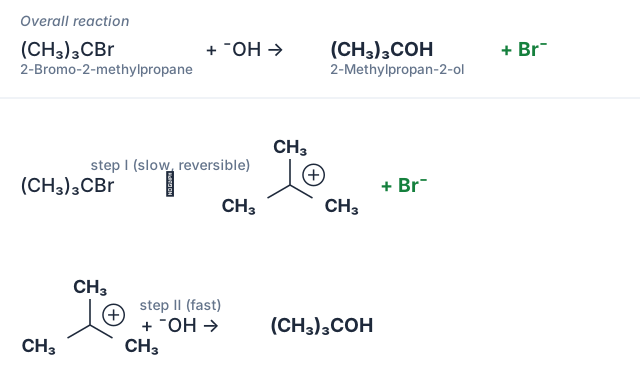
Why the Carbocation Stability Dictates Reactivity
The slow step involves breaking a bond without any help from the nucleophile. This creates a high-energy carbocation intermediate. The activation energy for this step depends entirely on how stable that carbocation is.
Carbocation Stability Order
Methyl<Primary<Secondary<Tertiary<Allylic/Benzylic
Why this order? Three factors stabilize carbocations:
- Hyperconjugation: Adjacent C–H or C–C bonds donate electron density into the empty p-orbital.
- Inductive effect: Alkyl groups are electron-donating, spreading the positive charge.
- Resonance: Allylic and benzylic carbocations delocalize the charge across multiple atoms.
For the benzylic case, that delocalisation looks like this:
The Reactivity Consequence
- Tertiary substrates form relatively stable carbocations → fast SN1.
- Primary substrates form highly unstable carbocations → SN1 is essentially impossible (the activation energy is too high).
- Methyl substrates never undergo SN1 — the carbocation is too unstable.
Why the Leaving Group Must Be Good
The slow step requires the leaving group to depart with its bonding electrons. A good leaving group:
- Is weakly basic (stable as an anion)
- Can stabilize negative charge (large, polarizable, or resonance-stabilized)
Examples: I−, Br−, Cl−, OTs−, H2O
Poor leaving groups: OH−, OR−, NH2− — these are strong bases and will not leave easily.
Why the Solvent Matters (Polar Protic Solvents)
SN1 reactions are faster in polar protic solvents (e.g., water, methanol, ethanol). Why? …
The key idea is that the structure of the alkyl halide determines whether substitution or elimination dominates, based on steric hindrance and the stability of the carbocation (for SN1/E1) or the accessibility of the β-hydrogen (for E2).
Reasoning:
- Primary alkyl halides (e.g., 1-bromopropane) have a low steric hindrance at the α-carbon and no stable carbocation. They favour SN2 substitution with strong nucleophiles (e.g., OH⁻). Elimination (E2) is minor unless a strong, bulky base (e.g., t-BuO⁻) is used.
- Secondary alkyl halides (e.g., 2-bromobutane) can undergo both SN2 and E2. The outcome depends on the base: a strong, small nucleophile (e.g., CH₃O⁻) favours SN2; a strong, bulky base (e.g., t-BuO⁻) favours E2 by abstracting a β-hydrogen. …
The outcome of a base/alkyl halide reaction (substitution vs. elimination) is governed by the structure of the alkyl halide — specifically the degree of substitution at the carbon bearing the halogen. Primary halides favour substitution (SN2), tertiary halides favour elimination (E2), and secondary halides give mixtures, with strong bulky bases pushing elimination.
The key idea is that the same base can trigger two completely different reaction pathways — substitution (replacing the halogen) or elimination (removing H and X to form a double bond). Which one wins depends on how accessible the carbon is and how stable the potential alkene would be.
Let’s break down the structural features that decide the fate.
1. The carbon’s substitution pattern — primary vs. secondary vs. tertiary
The most important structural feature is the number of alkyl groups attached to the carbon that holds the halogen (the α-carbon).
-
Primary alkyl halide (e.g., CH3CH2Br): The α-carbon is bonded to only one other carbon. This carbon is sterically unhindered — a nucleophile/base can easily approach from the back side. The SN2 mechanism is fast here. Elimination (E2) is possible but requires a strong, bulky base to abstract a β-hydrogen; with a small base like OH−, substitution dominates.
-
Tertiary alkyl halide (e.g., (CH3)3CBr): The α-carbon is crowded by three alkyl groups. Back-side attack is blocked, so SN2 is impossible. However, the β-hydrogens are numerous and the alkene product (e.g., 2-methylpropene) is highly substituted and stable. The base easily abstracts a β-hydrogen, and the bulky halide leaves — E2 elimination is strongly favoured.
-
Secondary alkyl halide (e.g., CH3CHBrCH3): Intermediate case. Both SN2 and E2 are possible. The outcome depends on the base’s strength and size. A small, strong base like OH− gives a mixture; a bulky strong base like t−BuO− forces elimination.
A common mistake is to think that “strong base always gives elimination”. A strong but small base (like OH−) can still give SN2 with primary halides because it can squeeze in for back-side attack. Bulky bases are the elimination specialists.
2. The nature of the β-hydrogens
Elimination requires at least one hydrogen on a carbon adjacent to the α-carbon (a β-hydrogen). The number and accessibility of these β-hydrogens matter.
- In a primary halide like CH3CH2Br, there are three β-hydrogens on the CH3 group. They are available, but the SN2 pathway is so fast that elimination is minor unless a bulky base is used.
- In a tertiary halide like (CH3)3CBr, there are nine β-hydrogens — plenty of targets for the base. Moreover, the alkene formed (tetrasubstituted or trisubstituted) is highly stable due to hyperconjugation and alkyl group donation.
The Saytzeff rule applies here: the more substituted alkene (more alkyl groups on the double bond) is more stable. Tertiary halides give the most substituted alkene, which is a thermodynamic bonus for elimination.
3. The leaving group ability
While the halogen (Cl, Br, I) is a good leaving group in both reactions, the structure of the alkyl group affects how easily it leaves. In tertiary halides, the carbocation-like transition state for E2 is stabilised by the three alkyl groups (inductive effect and hyperconjugation), making the C–X bond more polarised and easier to break. In primary halides, no such stabilisation exists — the SN2 transition state is favoured because it avoids charge buildup.
4. Base strength and bulk — the external factor tied to structure
The structural features of the alkyl halide dictate which base will favour which pathway.
| Alkyl halide | Favoured with small strong base (e.g., OH−) | Favoured with bulky strong base (e.g., t−BuO−) |
|--------------|----------------------------------------------------------|------------------------------------------------------------| …
Concept: Competing Substitution (SN1/SN2) vs. Elimination (E1/E2) in Alkyl Halides
The key structural feature that decides whether an alkyl halide undergoes substitution or elimination is the nature of the carbon attached to the halogen (the α-carbon), specifically its degree of substitution (primary, secondary, tertiary) and the steric hindrance around it.
Method: Substrate Structure Analysis
Step 1: Identify the α-carbon (the carbon bonded to the halogen)
Count how many carbon atoms are directly attached to this α-carbon.
| Type of α-carbon | Number of C–C bonds | Example |
|---|---|---|
| Primary (1°) | 1 | CH₃–CH₂–Br |
| Secondary (2°) | 2 | CH₃–CH(Br)–CH₃ |
| Tertiary (3°) | 3 | (CH₃)₃C–Br |
Step 2: Predict the dominant pathway based on substitution
Primary alkyl halides → SN2 substitution (almost always)
- Why: The α-carbon is sterically unhindered — the backside attack by the nucleophile is easy.
- Elimination (E2) is possible only if a strong, bulky base (like tert-butoxide) is used.
- Example:
- CH₃–CH₂–Br + NaOH (aq) → CH₃–CH₂–OH (substitution, SN2)
- With bulky base: CH₃–CH₂–Br + (CH₃)₃CO⁻K⁺ → CH₂=CH₂ (elimination, E2)
Secondary alkyl halides → Both SN2 and E2 compete
- Why: Moderate steric hindrance. The outcome depends on:
- Base/nucleophile strength (stronger → more E2)
- Basicity vs. nucleophilicity (bulky bases favour E2)
- Example:
- CH₃–CH(Br)–CH₃ + CH₃O⁻Na⁺ → mixture of substitution (CH₃–CH(OCH₃)–CH₃) and elimination (CH₃–CH=CH₂)
Tertiary alkyl halides → Elimination (E2 or E1) dominates
- Why: The α-carbon is too crowded for SN2. Substitution, if it occurs, goes via SN1 (requires a good leaving group and a weak nucleophile/solvent).
- Example:
- (CH₃)₃C–Br + strong base (OH⁻) → (CH₃)₂C=CH₂ (E2, major)
- (CH₃)₃C–Br + H₂O/ethanol (weak base, heat) → (CH₃)₂C=CH₂ (E1, major) + minor substitution product
Step 3: Consider the leaving group and base strength …
Here’s a breakdown of the common mistakes students make when analyzing why some alkyl halides undergo substitution (SN1/SN2) and others undergo elimination (E1/E2) with bases, along with how to avoid each.
Mistake 1: Forgetting that the Base is Also a Nucleophile
The Mistake:
Students treat the base as only a “proton remover” for elimination, ignoring that a strong base is also a strong nucleophile. This leads to confusion when a reaction gives both substitution and elimination products.
How to Avoid:
Always check the nature of the base:
- Strong base + strong nucleophile (e.g., OH−, RO−) → can do both E2 and SN2.
- Bulkier base (e.g., t-BuO−) → favours elimination (E2) because steric hindrance blocks SN2.
- Weak base/nucleophile (e.g., H2O, ROH) → favours SN1/E1 (via carbocation).
Example:
CH3CH2Br+OH− gives mostly SN2 (substitution).
CH3CH2Br+t-BuO− gives mostly E2 (elimination).
Mistake 2: Ignoring the Role of Alkyl Group Structure (Primary vs Tertiary)
The Mistake:
Students assume all alkyl halides behave the same way. They miss that primary halides favour SN2, tertiary favour E1/SN1, and secondary can go either way depending on conditions.
How to Avoid:
Memorise the structural preference:
| Alkyl halide | Favoured mechanism | Reason |
|---|---|---|
| Primary (1∘) | SN2 (substitution) | Low steric hindrance; strong nucleophile attacks backside. E2 possible only with strong, bulky base. |
| Secondary (2∘) | Both SN2/E2 possible | Moderate steric hindrance; competition depends on base strength and temperature. |
| Tertiary (3∘) | E1 or SN1 (elimination/substitution via carbocation) | Too crowded for SN2; weak base favours SN1/E1; strong base favours E2. |
Example:
- 1-bromopropane (primary) + OH− → substitution (propan-1-ol).
- 2-bromo-2-methylpropane (tertiary) + OH− → elimination (2-methylpropene).
Mistake 3: Overlooking the Effect of Heat (Temperature)
The Mistake:
Students think the reaction path is fixed by the alkyl halide structure alone. They forget that higher temperature favours elimination (E1/E2) over substitution (SN1/SN2) because elimination has a higher activation energy and is entropically favoured.
How to Avoid:
Always note the reaction conditions in the question:
- Room temperature / cold → substitution favoured.
- Heat (Δ) → elimination favoured (especially E2 with strong base).
Example:
CH3CH2Br+OH− at 25∘C → ethanol (SN2).
Same reactants at 80∘C → ethene (E2).
Mistake 4: Confusing the Role of the Leaving Group
The Mistake:
Students think a good leaving group (like Br−) always favours substitution. In reality, a good leaving group favours both substitution and elimination — the deciding factor is the base/nucleophile and alkyl structure.
How to Avoid:
Treat the leaving group as a necessary but not sufficient condition. Focus on:
- Leaving group ability (I > Br > Cl > F) — affects rate of both SN1/E1 and SN2/E2.
- Substitution vs elimination is decided by base strength, sterics, and temperature.
Example:
Both CH3CH2Br and CH3CH2I can undergo SN2 or E2 — the leaving group only changes the speed, not the path.
Mistake 5: Forgetting That Elimination Requires a β-Hydrogen
The Mistake:
Students try to apply elimination to alkyl halides that have no β-hydrogen (e.g., methyl halides, neopentyl halides). This is impossible for E2 and E1.
How to Avoid:
Check the β-carbon (carbon adjacent to the carbon bearing the leaving group): …
Showing the 12 most recent of 13 on this concept.
- COMEDK 2026Set 2026-A1 markMCQQ.With reference to the two statements Assertion and Reason, choose the correct option. Assertion: The order of reactivity towards SN1 reaction is: C6H5−CH2Br>(CH3)3−C−Br>(CH3)2−CH−Br. Reason: Among the given 3 compounds, the Benzyl carbocation formed is the most stable while Isopropyl carbocation is the least stable one. (A) Reason is correct but Assertion is wrong (B) Both Assertion and Reason are correct and Reason is the correct explanation of Assertion (C) Both Assertion and Reason are correct but Reason is not the correct explanation of Assertion (D) Assertion is correct but Reason is wrong
›Reveal solutionSolution
The assertion correctly orders SN1 reactivity by carbocation stability (benzyl > tert-butyl > isopropyl), and the reason correctly identifies that stability order, so both are true and the reason explains the assertion. The correct option is (B).
Concept & Intuition
SN1 reactions proceed via a carbocation intermediate. The rate of an SN1 reaction depends on how easily the leaving group departs and, crucially, on the stability of the carbocation formed. More stable carbocations form faster and lead to higher reactivity. Here, we compare three carbocations: benzyl (from CX6HX5CHX2Br), tert-butyl (from (CHX3)X3CBr), and isopropyl (from (CHX3)X2CHBr). Benzyl carbocation is exceptionally stable due to resonance delocalization of the positive charge into the aromatic ring. Tert-butyl carbocation is stabilized by hyperconjugation from nine C–H bonds. Isopropyl carbocation has only six hyperconjugative C–H bonds, making it the least stable of the three. Thus the reactivity order given in the assertion matches the stability order given in the reason.
Step-by-step reasoning
-
Identify the reaction type
The question concerns SN1 reactivity. In an SN1 reaction, the rate-determining step is the formation of a carbocation after the leaving group departs. Therefore, the relative rates depend directly on the relative stabilities of the carbocation intermediates.
-
Analyze the three carbocations
- Benzyl carbocation (CX6HX5CHX2X+): The positive charge on the CHX2 group is delocalized into the benzene ring via resonance. This gives it exceptional stability — comparable to or even greater than a tertiary carbocation.
- tert-Butyl carbocation ((CHX3)X3CX+): A tertiary carbocation stabilized by hyperconjugation from nine α C–H bonds. It is very stable, but not as stable as a resonance-stabilized benzyl carbocation.
- Isopropyl carbocation ((CHX3)X2CHX+): A secondary carbocation with only six hyperconjugative C–H bonds. It is less stable than a tertiary carbocation.
-
Order the carbocation stabilities
Benzyl > tert-butyl > isopropyl. This is a well-established order in organic chemistry.
-
Relate stability to SN1 reactivity …
-
- COMEDK 2026Set 2026-M1 markMCQQ.Identify the wrong statement from the following (A) SN1 reaction of Alkyl halides is favoured by the presence of bulky substituents, protic solvents and the reaction products are a racemic mixture (B) Vinyl halides do not undergo nucleophilic substitution reaction easily c. (C) The product formed when (-)-2-Methylbutan-1-OI is heated with Conc. HCl is (+)-1-Chloro-2-methylbutane with Retention of configuration (D) SN2 reaction of optically active halides are accompanied by Retention of configuration
›Reveal solutionSolution
The question asks to identify the wrong statement among four about organic reaction mechanisms. The key is that SN2 reactions invert configuration, not retain it, so statement (D) is false. The correct answer is (D).
Let’s examine each statement carefully, using the principles of nucleophilic substitution and stereochemistry.
-
Statement (A): “SN1 reaction of Alkyl halides is favoured by the presence of bulky substituents, protic solvents and the reaction products are a racemic mixture.”
- Reasoning: SN1 reactions proceed via a carbocation intermediate. Bulky substituents stabilize the carbocation (by hyperconjugation and inductive effects) and also hinder the backside attack needed for SN2, favoring SN1. Protic solvents stabilize the carbocation and the leaving group through solvation. The planar carbocation allows attack from either side, giving a racemic mixture (though sometimes with slight inversion due to ion-pairing). This statement is correct.
-
Statement (B): “Vinyl halides do not undergo nucleophilic substitution reaction easily.”
- Reasoning: In vinyl halides (e.g., CH₂=CH–Cl), the carbon–halogen bond has partial double-bond character due to resonance, making it stronger. Also, the SN2 transition state would require a planar backside attack that is geometrically unfavorable, and SN1 would form an unstable vinyl carbocation. Thus, they are indeed resistant to nucleophilic substitution. This statement is correct.
-
Statement (C): “The product formed when (-)-2-Methylbutan-1-Ol is heated with Conc. HCl is (+)-1-Chloro-2-methylbutane with Retention of configuration.” …
-
- COMEDK 2026Set 2026-M1 markMCQQ.Two statements, Assertion and Reason are given. With reference to them, choose the correct option. Assertion: Hydrolysis of 2-Bromo-2-methylpropane follows SN1 mechanism which involves 2 steps and the first step is: Reason: The energy required to cleave C−Br is taken from the energy released due to Inductive effect and hyper-conjugative effect. (A) Assertion is correct but Reason is wrong (B) Reason is correct but Assertion is wrong (C) Both Assertion and Reason are correct but Reason is not the correct explanation of Assertion (D) Both Assertion and Reason are correct and Reason is the correct explanation of Assertion
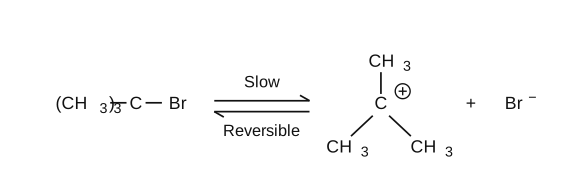
›Reveal solutionSolution
The Assertion correctly describes the two-step SN1 hydrolysis of 2‑bromo‑2‑methylpropane, but the Reason misidentifies the source of activation energy — it is not supplied by inductive or hyperconjugative effects, which only stabilize the carbocation after it forms. Hence the Assertion is correct, the Reason is wrong.
Concept and intuition
The SN1 mechanism proceeds via a rate‑determining ionization of the C–Br bond to form a carbocation. The energy needed to break this bond comes from thermal collisions (heat) in the solvent, not from internal electronic effects. Inductive and hyperconjugative effects stabilize the resulting carbocation, lowering the activation energy for its formation, but they do not release energy that directly cleaves the bond. The Reason confuses stabilization of a product with the source of activation energy.
Step‑by‑step reasoning
-
Identify the mechanism
The substrate is 2‑bromo‑2‑methylpropane, a tertiary alkyl halide. Tertiary halides favor SN1 over SN2 because of steric hindrance and the stability of the tertiary carbocation. The Assertion correctly states that hydrolysis follows SN1, which occurs in two steps:
- Step 1 (slow, rate‑determining): ionization to a tert‑butyl carbocation and bromide ion.
- Step 2 (fast): nucleophilic attack by water on the carbocation, followed by deprotonation.
-
Examine the first step shown in the figure
The figure shows the equilibrium:
(CH3)3C–Br⇌(CH3)3C++Br−
labelled “Slow” and “Reversible”. This is exactly the correct depiction of the rate‑determining ionization. So the Assertion is factually correct.
-
Analyze the Reason
The Reason claims: “The energy required to cleave C–Br is taken from the energy released due to Inductive effect and hyper‑conjugative effect.”
- Inductive and hyperconjugative effects are stabilizing interactions that occur after the carbocation forms. They lower the potential energy of the carbocation relative to the transition state, thereby reducing the activation energy (Ea).
- However, the actual energy to break the C–Br bond comes from the kinetic energy of molecular collisions (thermal energy from the surroundings). No “energy release” from these electronic effects directly supplies the bond‑breaking energy; rather, they make the transition state easier to reach by stabilizing the developing positive charge.
-
Distinguish between stabilization and energy source …
-
- COMEDK 2025Set 2025-A1 markMCQQ.Identify the incorrect statement. (A) When (一)-2-bromooctane is reacted with aqueous KOH , the substitution follows SN2 mechanism and product formed is (一) -Octan-2-ol. (B) Benzylic halides show higher reactivity towards SN1 reaction. (C) The reaction of C6H5CH2−CHCl−C6H5 with alc. KOH on heating yields two products. (D) Optically active (-)-2-Methylbutan-1-ol on reaction with HCl yields a product (+)-1-Chloro-2-methylbutane.
›Reveal solutionSolution
The key is to analyze each statement for stereochemical and mechanistic consistency. Only statement (A) is incorrect because the SN2 reaction of (−)-2-bromooctane with aqueous KOH inverts configuration, giving (+)-octan-2-ol, not (−)-octan-2-ol.
Concept and Intuition
This question tests your understanding of substitution mechanisms (SN1 vs SN2), stereochemistry (inversion vs racemization), and the special reactivity of benzylic and allylic halides. Each statement must be checked against known principles:
- SN2 proceeds with inversion of configuration.
- SN1 proceeds with racemization (or partial retention if the carbocation is asymmetric).
- Benzylic halides stabilize carbocations, favoring SN1.
- Alcoholic KOH promotes elimination (E2), not substitution.
- The reaction of an optically active alcohol with HCl involves an SN1 mechanism via a carbocation, leading to racemization or inversion depending on the structure.
Let’s examine each statement step by step.
-
Statement (A):
(−)-2-Bromooctane is a secondary alkyl halide. Aqueous KOH is a strong nucleophile and a weak base, favoring SN2 over E2 for secondary halides. In SN2, the nucleophile attacks from the back, inverting the stereochemistry.
- Starting material: (−)-2-bromooctane (specific rotation negative).
- Product: octan-2-ol. If the reaction is pure SN2, the product should have the opposite configuration, i.e., (+)-octan-2-ol.
- The statement claims the product is (−)-octan-2-ol, which would require retention — impossible for SN2. Conclusion: Statement (A) is incorrect.
-
Statement (B):
Benzylic halides (e.g., C6H5CH2Cl) form a resonance-stabilized benzylic carbocation in SN1 reactions. This stabilization lowers the activation energy, making them much more reactive than primary or secondary alkyl halides in SN1.
Conclusion: Statement (B) is correct.
-
Statement (C):
The compound C6H5CH2−CHCl−C6H5 is 1,2-diphenyl-1-chloroethane. Alcoholic KOH is a strong base in a protic solvent, favoring E2 elimination. The β-hydrogens are on both sides of the chlorine, leading to two possible alkenes:
- Elimination toward the CH2C6H5 side gives C6H5CH=CH−C6H5 (stilbene, cis/trans possible).
- Elimination toward the C6H5 side gives C6H5CH2−C(C6H5)=CH2 (1,1-diphenylethene). So indeed two products form. Conclusion: Statement (C) is correct.
-
Statement (D):
(−)-2-Methylbutan-1-ol is a primary alcohol. Reaction with HCl proceeds via protonation of the OH, loss of water to form a primary carbocation, which then rearranges (via a 1,2-hydride shift) to a more stable secondary carbocation. The chloride ion attacks this secondary carbocation, giving 1-chloro-2-methylbutane. …
- COMEDK 2025Set 2025-M1 markMCQQ.Which one of the following is a true statement with reference to reaction between 2- Bromo-2-methylpropane and aqueous KOH ? (A) The rate of reaction depends on the concentration of the haloalkane and the nucleophile OH− (B) The reaction occurs at a fast rate since the substrate is a tertiary alkyl halide and follows SN1 mechanism. (C) The reaction is not favoured by the presence of polar protic solvent. (D) The reaction occurs at a slow rate since it follows SN2 mechanism.
›Reveal solutionSolution
The reaction of 2‑bromo‑2‑methylpropane with aqueous KOH follows an S_N1 mechanism because it is a tertiary alkyl halide; the rate depends only on the haloalkane concentration, not on the nucleophile, and the polar protic solvent actually favours the reaction. The true statement is (B).
The key here is to recognise the substrate: 2‑bromo‑2‑methylpropane is a tertiary alkyl halide. Tertiary halides are too sterically hindered for a back‑side attack (S_N2), so they react via an S_N1 mechanism. In S_N1, the rate‑determining step is the loss of the leaving group to form a carbocation — this step involves only the haloalkane, not the nucleophile. Therefore the rate is independent of the nucleophile concentration. Aqueous KOH provides both a polar protic solvent (water) and a strong nucleophile (OH⁻), but the nucleophile only attacks the carbocation in a fast second step.
Let’s examine each option carefully.
-
Option (A): “The rate depends on the concentration of the haloalkane and the nucleophile OH⁻.”
This would be true for an S_N2 reaction, where both the alkyl halide and the nucleophile appear in the rate law. But for a tertiary halide, the mechanism is S_N1, and the rate law is first order in the haloalkane only. So (A) is false.
-
Option (B): “The reaction occurs at a fast rate since the substrate is a tertiary alkyl halide and follows S_N1 mechanism.”
Tertiary carbocations are relatively stable (due to hyperconjugation and inductive effects from three alkyl groups), so the S_N1 reaction proceeds at a moderate to fast rate under typical conditions. The statement correctly identifies both the mechanism and the reason for the rate. This looks correct.
-
Option (C): “The reaction is not favoured by the presence of polar protic solvent.” …
-
- KCET 2024Set B-21 markMCQQ.In the following scheme of reaction, C2H5ClXC2H5FC2H5ClYCH2=CH2C2H5ClZC4H10 X, Y and Z respectively are : (A) AgF, alcoholic KOH and benzene (B) HF, aqueous KOH and Na in dry ether (C) Hg2F2, alcoholic KOH and Na in dry ether (D) CoF2, aqueous KOH and benzene
›Reveal solutionSolution
Identify the three named reactions — Swarts (metal fluoride), dehydrohalogenation (alcoholic KOH) and Wurtz (Na/dry ether) — and only one option gets all three right.
1. Reaction X: C2H5Cl⟶C2H5F (halogen exchange)
This is the Swarts reaction: an alkyl chloride/bromide is heated with a metallic fluoride, and the halogen is swapped:
C2H5Cl+Hg2F2⟶C2H5F+Hg2Cl2
The reagents that work are AgF, Hg2F2, CoF2, SbF3. Note that HF (option B) does not do this — a hydrogen halide cannot displace a halide from an alkyl halide, so (B) is out on step X alone.
2. Reaction Y: C2H5Cl⟶CH2=CH2 (elimination)
Making an alkene from an alkyl halide means removing HCl — β-elimination (E2), i.e. dehydrohalogenation. The decisive rule:
- Alcoholic KOH ⇒ the base is the ethoxide ion C2H5O−, a strong, bulky base ⇒ it abstracts the β-hydrogen ⇒ elimination ⇒ alkene.
- Aqueous KOH ⇒ OH− is well-solvated and acts as a nucleophile ⇒ substitution ⇒ ethanol, not ethene.
CH3CH2Clalc. KOH, ΔCH2=CH2+KCl+H2O
So (B) and (D), which both say aqueous KOH, are wrong here.
3. Reaction Z: C2H5Cl⟶C4H10 (chain doubling)
The product C4H10 (n-butane) has twice the carbon count of the C2 starting material — two alkyl fragments have been coupled. That is the Wurtz reaction: an alkyl halide with sodium metal in dry ether:
2C2H5Cl+2Nadry etherCH3CH2−CH2CH3+2NaCl …
- COMEDK 2024Set 2024-E1 markMCQQ.Arrange the compounds A,B,C and D in the increasing order of their reactivity towards SN1 reaction. A=C6H5CH2ClB=C6H5ClC=CH2=CH−ClD=CH3−CH2−Cl (A) D<B<A<C (B) D<C<B<A (C) B<D<C<A (D) C<A<D<B
›Reveal solutionSolution
SN1 rate tracks carbocation stability: chlorobenzene gives the least stable cation and benzyl the most, giving the increasing order B<D<C<A - option (C).
In an SN1 reaction the slow step is loss of Cl− to form a carbocation, so reactivity follows carbocation stability.
- A, C6H5CH2Cl → a benzyl cation, strongly resonance-stabilised by the ring ⇒ most reactive.
- B, C6H5Cl → the C-Cl bond has partial double-bond (resonance) character and a phenyl cation is extremely unstable ⇒ least reactive.
- D, CH3CH2Cl → an ordinary primary sp3 C-Cl bond. …
- COMEDK 2024Set 2024-M1 markMCQQ.Arrange the following compounds in the decreasing order of reactivity towards SN1 reaction. (A) A > D > B > C (B) D > B > A > C (C) C > A > B > D (D) B > A > C > D
![Four skeletal (zig-zag) chloroalkane structures drawn side by side, labelled [A], [B], [C]](/figures/comedk/2024-M-chemistry-q28.svg)
›Reveal solutionSolution
S_N1 reactivity follows carbocation stability: tertiary > secondary > primary. Compound [C] (tertiary) is most reactive, [A] (secondary) next, and the two primary halides [B] and [D] are least reactive, with the less hindered straight-chain [B] slightly ahead of the branched [D]. The order is C > A > B > D, which is option (C).
The key concept is that S_N1 reactions proceed through a carbocation intermediate. The rate-determining step is the departure of the leaving group (Cl⁻) to form that carbocation, so anything that stabilizes it — more alkyl groups supplying electron density through hyperconjugation and induction — speeds up the reaction. The more substituted the carbon bearing chlorine, the more stable the carbocation and the faster the S_N1 reaction.
Let's analyze each compound:
-
Identify the substitution level of the carbon attached to Cl:
- [C]: chlorine on a carbon bonded to three other carbons → tertiary (3°), giving a highly stabilized tertiary carbocation.
- [A]: chlorine on a carbon bonded to two other carbons → secondary (2°), less stable than tertiary but more stable than primary.
- [B]: chlorine on a terminal carbon of a straight chain → primary (1°), an unstable primary carbocation.
- [D]: chlorine on a terminal carbon of a branched chain → also primary (1°), an unstable primary carbocation.
-
Compare the two primary compounds [B] and [D]: …
-
- COMEDK 2024Set 2024-M1 markMCQQ.Match the compounds given in column I with the corresponding most stable Carbocations formed by each, as given in Column II, when they undergo acidic dehydration in presence of Conc. H2SO4. .tg {border-collapse:collapse;border-spacing:0;} .tg td{border-color:black;border-style:solid;border-width:1px;font-family:Arial, sans-serif;font-size:14px; overflow:hidden;padding:10px 5px;word-break:normal;} .tg th{border-color:black;border-style:solid;border-width:1px;font-family:Arial, sans-serif;font-size:14px; font-weight:normal;overflow:hidden;padding:10px 5px;word-break:normal;} .tg .tg-c3ow{border-color:inherit;text-align:center;vertical-align:top} .tg .tg-7btt{border-color:inherit;font-weight:bold;text-align:center;vertical-align:top} .tg .tg-0pky{border-color:inherit;text-align:left;vertical-align:top} No. Column I No. Column II A 2-Methylbutan-1-ol P (CH3)2C+−CH(CH3)2 B Butan-2-ol Q CH3−CH2−CH2−C+H2 C 3, 3-Dimethylbutan-2-ol R (CH3)2C+−CH2−CH3 D Butan-1-ol S CH3−C+H−CH2−CH3 (A) A=SB=RC=QD=P (B) A=QB=RC=SD=P (C) A=RB=SC=PD=Q (D) A=QB=SC=PD=R
›Reveal solutionSolution
The key is to identify the most stable carbocation formed during acidic dehydration of each alcohol, considering carbocation rearrangements (hydride/methyl shifts) that lead to the most substituted, most stable intermediate. The correct matches are A→R, B→S, C→P, D→Q, which corresponds to option (C).
Concept & Intuition
When an alcohol is heated with concentrated H2SO4, it undergoes dehydration via an E1 mechanism: protonation of the –OH group, loss of water to form a carbocation, then loss of a proton to give an alkene. The key intermediate is the carbocation. However, carbocations can rearrange via 1,2-hydride or 1,2-alkyl shifts to form a more stable (more substituted) carbocation. The question asks for the most stable carbocation formed, not necessarily the first one. So we must trace possible rearrangements for each alcohol.
Step-by-step reasoning
-
Compound A: 2-Methylbutan-1-ol
- Structure: CH3CH2CH(CH3)CH2OH (primary alcohol).
- Protonation and loss of water gives a primary carbocation: CH3CH2CH(CH3)CH2+ (1°).
- A 1,2-hydride shift from the adjacent carbon (the one bearing the methyl group) yields a more stable secondary carbocation: CH3CH2C+(CH3)CH3.
- This is exactly (CH3)2C+CH2CH3, which is R.
- No further shift gives a tertiary carbocation here because the adjacent carbons are either primary or secondary; a methyl shift would not improve stability. So the most stable is R.
-
Compound B: Butan-2-ol
- Structure: CH3CH2CH(OH)CH3 (secondary alcohol).
- Direct loss of water gives a secondary carbocation: CH3CH2C+HCH3 (2°).
- This is already quite stable. Could it rearrange? A 1,2-hydride shift from the terminal methyl group would give a primary carbocation (less stable), so no. A methyl shift from the ethyl group would also give a primary carbocation. So no rearrangement improves stability.
- The carbocation is CH3C+HCH2CH3, which is S.
-
Compound C: 3,3-Dimethylbutan-2-ol
- Structure: (CH3)3CCH(OH)CH3 (secondary alcohol).
- Loss of water gives a secondary carbocation: (CH3)3CCH+CH3 (2°).
- Notice the adjacent carbon is a quaternary carbon (tert-butyl group). A 1,2-methyl shift from that tert-butyl group can occur: the methyl group moves to the carbocation center, and the positive charge moves to the former quaternary carbon.
- Result: (CH3)2C+CH(CH3)2 — a tertiary carbocation (3°).
- This is exactly P: (CH3)2C+CH(CH3)2.
- This is the most stable possible.
-
Compound D: Butan-1-ol
- Structure: CH3CH2CH2CH2OH (primary alcohol).
- Loss of water gives a primary carbocation: CH3CH2CH2CH2+ (1°).
- A 1,2-hydride shift from the adjacent carbon gives a secondary carbocation: CH3CH2C+HCH3 (2°).
- This is S again? Wait, but S is already used for B. Let's check: S is CH3C+HCH2CH3, which is exactly the same as the secondary carbocation from butan-1-ol. However, we must see if a further shift is possible. A 1,2-hydride shift from the other side would give a primary carbocation again, so no. A methyl shift would give a primary carbocation. So the most stable is the secondary carbocation.
- But note: The secondary carbocation from butan-1-ol is identical to that from butan-2-ol? Actually, careful: Butan-1-ol gives CH3CH2C+HCH3 (the positive charge is on C2). Butan-2-ol gives CH3CH2C+HCH3 as well (same structure). So both B and D would give the same carbocation? That can't be, because the options list different matches. Let's re-examine:
- Butan-2-ol: direct loss gives CH3CH2C+HCH3 (2°).
- Butan-1-ol: after one hydride shift gives CH3CH2C+HCH3 (2°).
- So indeed both give the same secondary carbocation. But the question expects different matches. This suggests that for butan-1-ol, a further rearrangement might occur? Let's check: The secondary carbocation from butan-1-ol has a methyl group on the adjacent carbon (C1) and an ethyl group on the other side (C3). A 1,2-methyl shift from the ethyl group would give a tertiary carbocation? No, moving a methyl from the ethyl group would give CH3C+(CH3)CH2CH3? Actually, if we take CH3CH2C+HCH3 and shift a methyl from the ethyl group (C3) to C2, we get CH3C+(CH3)CH2CH3 which is the same as R? Wait, R is (CH3)2C+CH2CH3. That is exactly CH3C+(CH3)CH2CH3. So a methyl shift from the ethyl group gives a tertiary carbocation!
- Is that possible? Yes, because the ethyl group has a methyl that can undergo a 1,2-shift. So the secondary carbocation can rearrange to a tertiary carbocation via a methyl shift.
- Therefore, the most stable carbocation from butan-1-ol is actually the tertiary one: R.
- But then B and D would both give R? That can't be. Let's check butan-2-ol again: The secondary carbocation from butan-2-ol is CH3CH2C+HCH3. Can it undergo a methyl shift? The adjacent carbons are C1 (methyl) and C3 (methylene of ethyl). A methyl shift from C3 would give the same tertiary carbocation R. So butan-2-ol can also rearrange to R.
- This is a problem: both B and D could give R. However, the question asks for the most stable carbocation formed. For butan-2-ol, the secondary carbocation is already quite stable, and a methyl shift would require breaking a C-C bond, which has a higher activation energy than a hydride shift. Typically, in acidic dehydration, secondary carbocations do not always rearrange to tertiary if the shift is a methyl shift (slower). But it is possible.
- Let's look at the given options: In option (C), B is matched with S (secondary) and D with Q (primary). That suggests that for butan-1-ol, the most stable carbocation is actually primary? That seems wrong.
- Wait, Q is CH3CH2CH2C+H2 — a primary carbocation. That would be the direct product from butan-1-ol without rearrangement. But that is less stable than the secondary. So why would they match D with Q?
- Perhaps the question means the first-formed carbocation? No, it says "most stable Carbocations formed".
- Let's re-read the column II: P: (CH3)2C+CH(CH3)2 (tertiary) Q: CH3CH2CH2C+H2 (primary) R: (CH3)2C+CH2CH3 (tertiary) S: CH3C+HCH2CH3 (secondary)
- For butan-1-ol, the most stable carbocation after all possible rearrangements is tertiary (R). But then butan-2-ol also gives tertiary (R). That would make both B and D map to R, which is not an option.
- So perhaps the intended interpretation is that we consider only the direct carbocation from loss of water, without rearrangement? But then A (primary) would give Q, not R. That doesn't match either.
- Let's check the typical textbook knowledge:
- 2-Methylbutan-1-ol: dehydration gives mainly 2-methyl-2-butene via a tertiary carbocation after a hydride shift? Actually, the most stable carbocation is tertiary: (CH3)2C+CH2CH3 (R).
- Butan-2-ol: dehydration gives mainly 2-butene via the secondary carbocation (S). Rearrangement to tertiary is not common because it would require a methyl shift.
- 3,3-Dimethylbutan-2-ol: undergoes a methyl shift to give tertiary carbocation (P).
- Butan-1-ol: dehydration gives mainly 1-butene? Actually, butan-1-ol gives a mixture, but the carbocation rearranges via hydride shift to secondary (S), and then possibly to tertiary? In practice, butan-1-ol gives 1-butene and 2-butene, with 2-butene being major. The secondary carbocation is the key intermediate. So the most stable carbocation is secondary (S).
- So the matches are: A→R, B→S, C→P, D→S? But D cannot be S because S is already used for B. In the options, D is matched with Q in (C) and with P in (D).
- Let's look at option (C): A=R, B=S, C=P, D=Q. That means D (butan-1-ol) gives a primary carbocation? That seems unlikely.
- Option (D): A=Q, B=S, C=P, D=R. That means A gives primary? No.
- Let's systematically check each option:
- (A) A=S, B=R, C=Q, D=P → A secondary, B tertiary, C primary, D tertiary.
- (B) A=Q, B=R, C=S, D=P → A primary, B tertiary, C secondary, D tertiary.
- (C) A=R, B=S, C=P, D=Q → A tertiary, B secondary, C tertiary, D primary.
- (D) A=Q, B=S, C=P, D=R → A primary, B secondary, C tertiary, D tertiary.
- The most plausible based on typical carbocation stability:
- A (2-methylbutan-1-ol) → tertiary (R) after hydride shift.
- B (butan-2-ol) → secondary (S) (no rearrangement needed).
- C (3,3-dimethylbutan-2-ol) → tertiary (P) after methyl shift.
- D (butan-1-ol) → secondary (S) after hydride shift, but S is taken. However, note that butan-1-ol's secondary carbocation is the same as butan-2-ol's. So if the question expects distinct matches, perhaps they consider that butan-1-ol does not rearrange? That would give primary (Q). But that contradicts the fact that hydride shifts are very fast. …
-
- COMEDK 2023Set 2023-E1 markMCQQ.Which one of the following will undergo Nucleophilic substitution, by SN1 mechanism, fastest? (A) Br−CH2−CH=CH2 (B) C6H5Br (C) CH3−CH=CHBr (D) C6H11Br
›Reveal solutionSolution
SN1 is fastest for the substrate forming the most stable carbocation. Allyl bromide gives a resonance-stabilised allylic cation, so it reacts fastest; aryl/vinyl halides don't ionise (sp²-C–X, partial double-bond character), and cyclohexyl bromide is only an ordinary secondary halide.
SN1 proceeds through a carbocation, so its rate tracks carbocation stability:
- (A) BrCH2CH=CH2 (allyl): ionises to the allylic carbocation CH2=CH-CH2+↔+CH2-CH=CH2, resonance-stabilised ⇒ fastest SN1. …
- COMEDK 2023Set 2023-M1 markMCQQ.t-butyl chloride preferably undergo hydrolysis by (A) SN1 mechanism (B) SN2 mechanism (C) any of(a) and(b) (D) None of the above
›Reveal solutionSolution
t-butyl chloride is a tertiary halide. On ionisation it gives a highly stabilised tertiary carbocation, so hydrolysis proceeds through the unimolecular SN1 pathway.
The mechanism of nucleophilic substitution depends on the substrate:
- Tertiary halides favour SN1 because (i) the 3∘ carbocation intermediate is strongly stabilised by hyperconjugation and inductive effects, and (ii) the three bulky methyl groups sterically hinder the backside attack required for SN2.
- SN2 is favoured by primary (and methyl) halides where the carbon is accessible. …
- KCET 2022Set B-31 markMCQQ.The major product obtained when ethanol is heated with excess of conc. H_2SO_4 at 443K is (A) ethane (B) methane (C) ethene (D) ethyne
›Reveal solutionSolution
Excess conc. H2SO4 at 443 K dehydrates ethanol intramolecularly to the alkene, ethene.
Step 1 — Recognise the conditions.
The two classic reactions of ethanol with conc. sulphuric acid are distinguished only by temperature and stoichiometry — this is exactly what the question tests:
Conditions Reaction Product 443 K (170 °C), excess conc. H2SO4 intramolecular dehydration (elimination) ethene, CH2=CH2 413 K (140 °C), excess ethanol intermolecular dehydration (condensation) diethyl ether, C2H5OC2H5 The stem says excess acid and 443 K → the elimination branch.
Step 2 — The mechanism (E1), and why acid is needed.
−OH is a terrible leaving group. The acid's job is to convert it into a good one:
- Protonation of the alcohol:
CH3CH2−OH+H+⇌CH3CH2−O+H2
The −OH has become −OH2+, i.e. water — an excellent leaving group.
- Loss of water (slow, rate-determining) to give the carbocation:
CH3C+H2+H2O
- Loss of a β-proton to a base (HSO4− or H2O), forming the π bond:
CH3C+H2⟶CH2=CH2+H+
Net:
CH3CH2OHconc. H2SO4443 KCH2=CH2+H2O …
🎓Unlock everything free for 14 days
- ✓Full step-by-step solutions
- ✓Concept-first explanations
- ✓Methods, shortcuts & mistakes
- ✓PYQ mapping + timed mock tests
Full access for 14 days. No credit card required.