Q.Arrange the following compounds in increasing order of their boiling points.
🔒You're viewing a preview — the full solution, concept, methods & PYQ mapping are locked.
🔒 Start your 14-day free trial to unlock the full solution →Concept understanding — Boiling Point Trends
Boiling Point Trends (Organic Compounds)
A substance's boiling point is set by how much energy is needed to overcome the attractive forces HOLDING its molecules together in the liquid — the stronger those intermolecular forces, the higher the boiling point.
The Forces, Weakest to Strongest
- Van der Waals (London dispersion) forces — present in every molecule, and they grow stronger as the molecule gets bigger (more electrons, larger surface area of contact between neighbouring molecules) and more polarisable.
- Dipole–dipole forces — present in polar molecules, add an extra attraction on top of dispersion forces.
- Hydrogen bonding — present when H is bonded directly to N, O, or F; much stronger than ordinary dipole–dipole attraction, and it raises the boiling point sharply compared to a similarly-sized molecule without it.
Trend 1: Down a Series of Halogens (Same Alkyl Group)
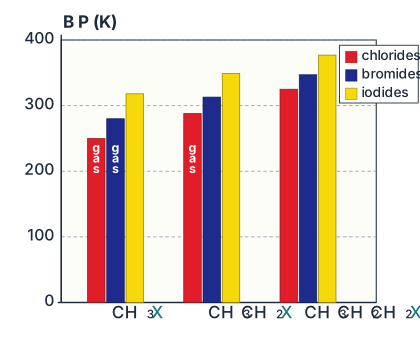
For a fixed R group, boiling point rises as the halogen gets heavier: R−I>R−Br>R−Cl>R−F. This looks surprising at first, since electronegativity (and so bond polarity/dipole moment) actually DECREASES down the group — but boiling point here is dominated by the growing size and polarisability of the halogen atom (stronger dispersion forces), which outweighs the shrinking dipole contribution.
The measured values for the methyl, ethyl and propyl halides show this rise clearly:
Trend 2: Chain Length and Branching
- Longer chains (more carbons) have more surface area for van der Waals contact between neighbouring molecules, so boiling point rises with chain length within a homologous series.
- Branching LOWERS boiling point compared to a straight-chain isomer of the same molecular formula — a more compact, spherical shape has less surface-to-surface contact with neighbouring molecules, weakening the dispersion forces. (E.g. neopentane boils well below n-pentane.)
Trend 3: Hydrogen Bonding Beats Molecular Mass …
Why this formula?
Boiling Point Trends: Why They Happen
Boiling point is the temperature at which a liquid's vapor pressure equals the external atmospheric pressure. To understand why boiling points follow certain trends, we must first understand what determines vapor pressure.
The Core Idea: Intermolecular Forces
A liquid boils when its molecules have enough kinetic energy to overcome the intermolecular forces (IMFs) holding them together in the liquid phase. Stronger IMFs → harder to escape → lower vapor pressure at a given temperature → higher boiling point.
There is no single "formula" for boiling point, but the relationship is captured by the Clausius–Clapeyron equation, which links vapor pressure (P) to temperature (T) and the enthalpy of vaporization (ΔHvap):
lnP=−RΔHvap⋅T1+C
Where:
- P = vapor pressure
- ΔHvap = enthalpy of vaporization (energy needed to vaporize 1 mole)
- R = gas constant
- T = absolute temperature (Kelvin)
- C = constant (depends on substance)
Why this formula makes sense
- ΔHvap is large when IMFs are strong — more energy is needed to separate molecules.
- At boiling point, P=Patm (usually 1 atm). So a substance with larger ΔHvap needs a higher T to reach that pressure.
Thus, boiling point ∝ strength of intermolecular forces.
The Four Key Trends (with Reasoning)
1. Trend across a period (e.g., Period 2: CH₄ → NH₃ → H₂O → HF)
| Molecule | IMFs present | Boiling point (°C) |
|---|---|---|
| CH₄ | London dispersion only | -161 |
| NH₃ | Dispersion + H-bonding | -33 |
| H₂O | Dispersion + H-bonding (2 per molecule) | 100 |
| HF | Dispersion + H-bonding | 19 |
Why?
- CH₄ is nonpolar — only weak London dispersion forces.
- NH₃, H₂O, HF have hydrogen bonding (strongest IMF).
- H₂O forms two H-bonds per molecule (donor + acceptor), while NH₃ forms one and HF forms one — hence H₂O has the highest boiling point.
Key insight: Hydrogen bonding dominates over molecular mass in small molecules.
2. Trend down a group (e.g., Halogens: F₂ → Cl₂ → Br₂ → I₂)
| Molecule | Molar mass (g/mol) | Boiling point (°C) |
|---|---|---|
| F₂ | 38 | -188 |
| Cl₂ | 71 | -34 |
| Br₂ | 160 | 59 |
| I₂ | 254 | 184 |
Why?
- All are nonpolar — only London dispersion forces.
- Dispersion force strength increases with number of electrons (larger molar mass → more polarizable electron cloud → stronger temporary dipoles).
- So boiling point increases down the group.
Key insight: For nonpolar molecules, molar mass (electron count) is the primary factor.
3. Branching in alkanes (e.g., C₅H₁₂ isomers)
| Isomer | Boiling point (°C) |
|---|---|
| n-pentane (straight chain) | 36 |
| 2-methylbutane (branched) | 28 |
| 2,2-dimethylpropane (highly branched) | 10 |
Why?
- All have same molecular formula — same molar mass. …
Concept: Boiling Point Trends — For isomeric alkyl halides, boiling point depends on the surface area and branching. More branching → more compact shape → weaker London forces → lower boiling point.
Reasoning:
- All three are isomers of C4H9Br, so molecular weight is identical.
- Boiling point is governed by van der Waals forces, which increase with molecular surface area.
- Branching reduces surface area:
- (b) 1-bromobutane is straight-chain → largest surface area → highest boiling point. …
Boiling points of alkyl halides depend on molecular weight and branching. More branching lowers boiling point due to reduced surface area. The correct order is (c) < (a) < (b), which corresponds to option (iii).
Boiling point trends in organic compounds are governed by two main factors: molecular mass and intermolecular forces. For isomeric alkyl halides like these three C₄H₉Br compounds, the molecular weight is identical (137 g/mol), so the deciding factor is the strength of van der Waals forces — specifically, how well the molecules can pack together.
The key insight: more branching means a more compact, spherical molecule. A compact molecule has less surface area available for intermolecular contact, so the van der Waals forces are weaker, and the boiling point is lower. A straight-chain molecule, by contrast, is long and flexible, allowing many points of contact between neighbouring molecules.
Let’s examine each compound:
-
Compound (c): 2-bromo-2-methylpropane — This is the most branched. The central carbon is bonded to three methyl groups and one bromine. The molecule is nearly spherical. Very little surface area for neighbouring molecules to “grip” each other. This will have the lowest boiling point.
-
Compound (a): 1-bromo-2-methylpropane — Here the longest chain is only three carbons (a propane backbone) with a methyl branch on the middle carbon and the bromine on C-1: (CH3)2CHCH2Br. The single branch makes the molecule less elongated than the straight chain, yet it is still not as compact as (c). Its surface area is intermediate, so its boiling point falls in the middle. …
Concept: Boiling Point Trends in Alkyl Halides
The boiling point of alkyl halides depends on molecular mass and branching. For isomers (same molecular formula), more branching → lower boiling point because branching reduces the surface area for intermolecular forces (van der Waals forces).
Method: Branching Effect on Boiling Points
Steps:
-
Identify molecular formula
All three compounds are isomers of C4H9Br — same molecular mass.
-
Analyze branching
- (b) 1-bromobutane — straight chain (no branching)
- (a) 1-bromo-2-methylpropane — one methyl branch …
Let’s break this down step-by-step — first the concept, then the common mistakes, and finally how to avoid each.
Core Concept: Boiling Points of Alkyl Halides
Boiling points of organic compounds depend on:
- Molecular mass (larger mass → higher boiling point, generally)
- Surface area (more linear → more surface contact → stronger London dispersion forces → higher boiling point)
- Branching (more branching → more compact shape → less surface area → lower boiling point)
All three compounds here are isomers (same molecular formula C4H9Br), so molecular mass is identical.
Thus, branching decides the order.
Correct Order
- Least branched = 1-bromobutane (b) → highest boiling point
- Moderately branched = 1-bromo-2-methylpropane (a)
- Most branched = 2-bromo-2-methylpropane (c) → lowest boiling point
Increasing order:
(c)<(a)<(b)
So the correct option is (iii).
Common Mistakes & How to Avoid Them
✗ Mistake 1: Assuming higher branching increases boiling point
Why it happens: Students confuse branching with stronger intermolecular forces.
Reality: Branching decreases surface area → weaker London forces → lower boiling point.
✓ How to avoid:
Visualise the molecules — draw them out. A straight chain has more contact points with neighbours than a compact, branched one.
✗ Mistake 2: Ignoring that all are isomers
Why it happens: Students see different names and assume different molecular masses.
Reality: All three have formula C4H9Br — same mass.
✓ How to avoid:
Always check molecular formula first. If they are isomers, mass is not the deciding factor — shape is.
✗ Mistake 3: Confusing boiling point with melting point trends
Why it happens: Melting point trends for branched alkanes can be different (symmetry helps packing). …
- COMEDK 2026Set 2026-A1 markMCQQ.Arrange the given alkanes in increasing order of their boiling points. (A) 2, 2-dimethylpropane (B) 2-methylbutane (C) n-pentane (D) n-butane (A) D<A<B<C (B) C<A<B<D (C) D<C<B<A (D) A<B<C<D
›Reveal solutionSolution
Boiling point rises with chain length and falls with branching; the increasing order is n-butane < 2,2-dimethylpropane < 2-methylbutane < n-pentane, i.e. D<A<B<C — option (A).
Concept
Alkanes are held together by London dispersion forces, which strengthen with (i) more electrons — longer chains — and (ii) larger surface contact — straighter chains. So for a fixed carbon count, more branching lowers the boiling point because the molecule becomes more compact.
Solution
Identify each compound:
- D — n-butane: C4, straight; fewest electrons ⇒ lowest boiling point overall (≈−0.5∘C).
- A — 2,2-dimethylpropane (neopentane): C5, most branched ⇒ lowest among the C5's (≈9.5∘C).
- B — 2-methylbutane (isopentane): C5, one branch (≈28∘C). …
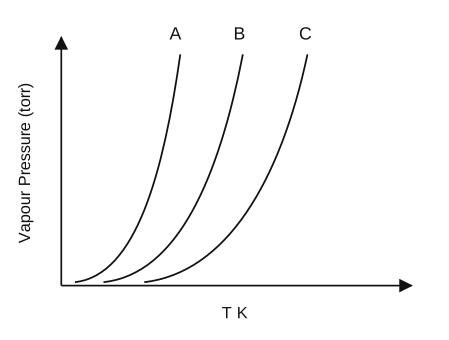
- COMEDK 2024Set 2024-M1 markMCQQ.Above figure represents Vapour pressure versus Temperature graphs of 2 pure volatile liquids and a solution formed by the 2 liquids.(i) Which curve represents the solution?(ii) Which curve represents the liquid with the strongest intermolecular forces of attraction? (A)(i) B(ii) C (B)(i) A(ii) C (C)(i) C(ii) A (D)(i) B(ii) A
›Reveal solutionSolution
The solution’s vapour-pressure curve lies between those of the pure liquids, so it is curve B. The liquid with the strongest intermolecular forces has the lowest vapour pressure at a given temperature, so it is curve C. Hence the answer is option (A).
Concept and intuition
Vapour pressure is a measure of how readily molecules escape from the liquid into the gas phase. For a pure liquid, stronger intermolecular forces (like hydrogen bonding or dipole-dipole interactions) mean molecules are held more tightly, so fewer escape — giving a lower vapour pressure at any given temperature. For a solution of two volatile liquids, Raoult’s law tells us that the total vapour pressure is a weighted average of the pure vapour pressures (assuming ideal behaviour). Therefore, the solution’s vapour-pressure curve must lie between the curves of the two pure components. In the graph, the three curves are ordered from highest vapour pressure (curve A) to lowest (curve C) at any fixed temperature. So:
- Curve A: highest vapour pressure → weakest intermolecular forces.
- Curve C: lowest vapour pressure → strongest intermolecular forces.
- Curve B: intermediate → must be the solution.
Now let’s confirm step by step.
- Identify which curve is the solution For an ideal solution of two volatile liquids, the total vapour pressure at a given temperature is
Psoln=χAPA∗+χBPB∗
where PA∗ and PB∗ are the vapour pressures of the pure liquids and χ are mole fractions (which sum to 1). Since Psoln is a weighted average, it always lies between PA∗ and PB∗. Therefore, on the graph, the solution’s curve must be the one that sits between the other two at every temperature. The curves are labelled A (leftmost, highest vapour pressure), B (middle), and C (rightmost, lowest vapour pressure). So curve B is the solution.
- Identify which pure liquid has the strongest intermolecular forces …
- KCET 2020Set A-11 markMCQQ.Which of the following polymer has strongest intermolecular forces of attraction ? (A) Polystyrene (B) Neoprene (C) Terylene (D) Polythene
›Reveal solutionSolution
Fibres have the strongest intermolecular forces of all polymer classes, and Terylene (a polyester) is the only fibre among the four.
Step 1 — Classify polymers by intermolecular force (the concept).
The molecular-force classification explains a polymer's entire mechanical behaviour:
Class Intermolecular forces Behaviour Examples Elastomers Weakest — chains coiled, held by only a few crosslinks highly elastic, stretch and snap back rubber, neoprene, buna-S Plastics Intermediate mouldable on heating polythene, polystyrene, PVC Fibres Strongest — H-bonding / strong dipole–dipole; chains pack closely and crystallise high tensile strength, thread-forming nylon-6,6, Terylene (Dacron), silk Step 2 — Why Terylene sits at the top.
Terylene is a polyester made from ethylene glycol and terephthalic acid. Its backbone carries repeating polar ester groups (−COO−), whose C=O dipoles set up strong dipole–dipole attractions (and hydrogen-bonding-type interactions) between neighbouring chains. These forces let the chains pack into a close, crystalline arrangement — giving the high tensile strength, high melting point and thread-forming ability that define a fibre.
Step 3 — Why the other three are weaker. …
- KCET 2018Set A-11 markMCQQ.Phenol can be distinguished from ethanol by the reagent (A) Bromine water (B) Sodium metal (C) Iron metal (D) Chlorine water
›Reveal solutionSolution
Phenol reacts with bromine water to give a white precipitate of 2,4,6-tribromophenol, while ethanol does not — this makes bromine water the correct distinguishing reagent.
The key here is that both phenol and ethanol have an —OH group, so they share some reactions (like with sodium metal). But phenol is an aromatic alcohol — the —OH is attached directly to a benzene ring. That changes its chemistry dramatically. The ring activates the ortho and para positions toward electrophilic substitution, which ethanol, being aliphatic, cannot do.
Bromine water is a classic test for phenols because it exploits this difference. Let's see why each option works or fails.
- Bromine water (Option A) — This is the correct choice. Phenol reacts instantly with bromine water at room temperature to form a white precipitate of 2,4,6-tribromophenol. The reaction is:
C6H5OH+3Br2→C6H2Br3OH↓+3HBr
Ethanol does not react with bromine water under these conditions — no decolourisation, no precipitate. So you get a clear visual distinction.
- Sodium metal (Option B) — Both phenol and ethanol react with sodium metal to liberate hydrogen gas:
2C6H5OH+2Na→2C6H5ONa+H2↑
2C2H5OH+2Na→2C2H5ONa+H2↑
This test cannot distinguish between them — both give the same observation.
- Iron metal (Option C) — Iron does not react with either phenol or ethanol under ordinary conditions. No useful test here. …
🎓Unlock everything free for 14 days
- ✓Full step-by-step solutions
- ✓Concept-first explanations
- ✓Methods, shortcuts & mistakes
- ✓PYQ mapping + timed mock tests
Full access for 14 days. No credit card required.