Q.Match the reactions given in Column I with the names given in Column II.
Column I:
(i)
Column II:
🔒You're viewing a preview — the full solution, concept, methods & PYQ mapping are locked.
🔒 Start your 14-day free trial to unlock the full solution →Concept understanding — Markovnikov Addition
The Intuition First
Imagine you have an alkene — a carbon-carbon double bond. That double bond is like a crowded room with two doors. When a molecule like HBr comes along, it wants to break that double bond and add across it. The question is: which carbon gets the hydrogen, and which gets the bromine?
You might think it doesn't matter — after all, the two carbons look similar. But they aren't. One carbon usually has more alkyl groups (methyl, ethyl, etc.) attached to it than the other. That carbon is more "electron-rich" — it has more friends pushing electrons toward it.
The hydrogen, being small and positively charged, is picky. It goes to the carbon that already has more hydrogens. Why? Because that carbon is less crowded and can stabilise the positive charge that forms temporarily during the reaction. The bromine, being large and negatively charged, goes to the other carbon — the one with more alkyl groups.
That's the intuition: the rich get richer. The carbon with more hydrogens gets another hydrogen. The carbon with more alkyl groups gets the halogen.
The Precise Statement
Markovnikov's Rule: When an unsymmetrical reagent (like HX, H₂O, etc.) adds to an unsymmetrical alkene, the hydrogen atom attaches to the carbon of the double bond that already has the greater number of hydrogen atoms.
In other words, for an alkene like CH3CH=CH2 (propene) reacting with HBr:
- Carbon 1 (the CH₂ end) has 2 hydrogens.
- Carbon 2 (the CH end) has 1 hydrogen.
- The H goes to carbon 1 (more hydrogens).
- The Br goes to carbon 2 (fewer hydrogens).
So the product is CH3CHBrCH3 (2-bromopropane), not CH3CH2CH2Br (1-bromopropane).
Why Does This Happen? The Real Chemistry
The reaction proceeds through a carbocation intermediate. When the H⁺ attacks the double bond, it can form one of two possible carbocations:
- A primary carbocation (if H⁺ goes to the more substituted carbon) — unstable.
- A secondary carbocation (if H⁺ goes to the less substituted carbon) — more stable.
The reaction chooses the path that gives the more stable carbocation. Alkyl groups stabilise carbocations through hyperconjugation and inductive effect — they donate electron density to the positively charged carbon.
The stability order of carbocations is: tertiary > secondary > primary > methyl. Markovnikov addition always proceeds through the most stable carbocation possible.
A Common Misconception
Many students think Markovnikov's rule means "hydrogen goes to the carbon with more hydrogens" because that carbon already has more hydrogens. That's backwards. The hydrogen goes there because that path leads to a more stable carbocation — the number of hydrogens is just a convenient way to predict the outcome, not the cause.
The One Big Exception …
Why this formula?
Markovnikov Addition: Why the Rule Holds
Markovnikov's rule is not a formula in the algebraic sense — it's a predictive principle for electrophilic addition to unsymmetrical alkenes. The "why" comes from carbocation stability and reaction mechanism.
The Rule in Words
When H–X adds to an unsymmetrical alkene, the hydrogen attaches to the carbon with more hydrogen atoms already attached, and the halogen (or X group) attaches to the carbon with fewer hydrogen atoms.
Example:
Propene (CHX3−CH=CHX2) + HBr → 2-bromopropane (major product), not 1-bromopropane.
Why This Happens: The Step-by-Step Reasoning
1. The Mechanism (Electrophilic Addition)
The reaction proceeds in two steps:
- Slow step (rate-determining): The alkene's π bond attacks the electrophilic HX+ from H–X, forming a carbocation intermediate.
- Fast step: The carbocation is attacked by the nucleophilic XX−.
2. The Key: Carbocation Stability
The more stable carbocation intermediate forms faster and determines the major product.
| Carbocation Type | Stability Order | Reason |
|---|---|---|
| Tertiary (3∘) | Most stable | +3 alkyl groups donate electron density via hyperconjugation and inductive effect |
| Secondary (2∘) | Intermediate | +2 alkyl groups |
| Primary (1∘) | Least stable | +1 alkyl group |
| Methyl (CHX3X+) | Unstable | No alkyl stabilization |
3. Applying to Propene + HBr
Propene: CHX3−CH=CHX2
Two possible protonation sites:
- Path A (Markovnikov): HX+ adds to CHX2 (terminal carbon) → forms secondary carbocation:
CHX3−CHX+−CHX3(2∘)
- Path B (Anti-Markovnikov): HX+ adds to CH (middle carbon) → forms primary carbocation:
CHX3−CHX2−CHX2X+(1∘)
Result: The secondary carbocation is more stable (by ~25–30 kJ/mol), so Path A is faster. The BrX− then attacks the positively charged carbon, giving 2-bromopropane.
The "Formula" — A Stability-Based Prediction
There is no algebraic formula, but a decision rule:
Major product=Product from the more stable carbocation
For alkenes with alkyl substituents, the stability order is:
Tertiary>Secondary>Primary>Methyl …
Concept: These are name reactions from organic chemistry — each is a standard method for forming carbon–carbon bonds or substituting halogens.
Reasoning:
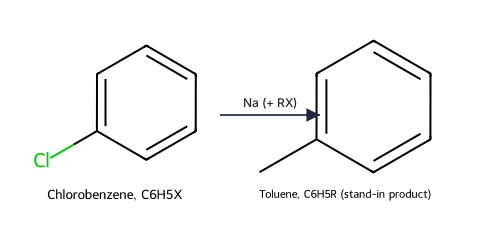
- (i) Aryl halide + alkyl halide + Na gives an alkylarene. This is the Wurtz–Fittig reaction (cross-coupling of two different halides). → matches (b).
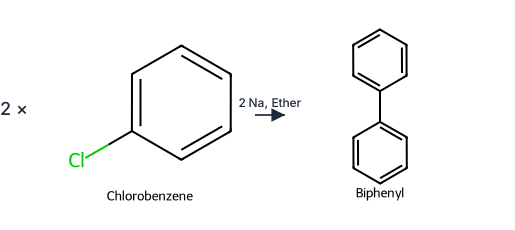
- (ii) Two aryl halides + Na in ether gives a biaryl. This is the Fittig reaction (homocoupling of aryl halides). → matches (a). …
This is a matching problem linking four organic reactions to their standard name. The correct mapping is (i)→ (b), (ii)→ (a), (iii)→ (d), (iv)→ (c).
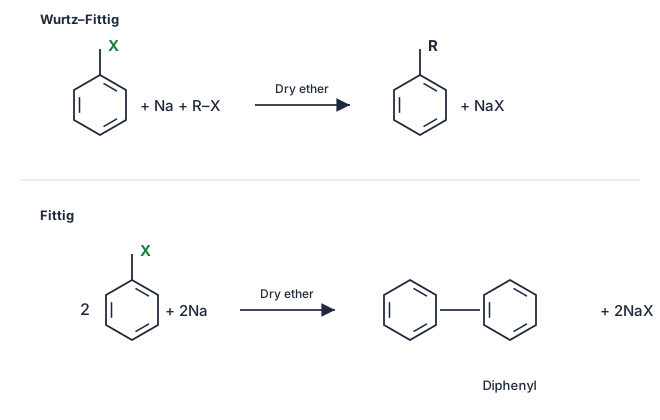
The key to solving this is recognising the reagent pattern and the product structure — each reaction has a classic signature that tells you which name it belongs to. Let’s walk through them one by one.
-
Reaction (i): C6H5X+RXNaC6H5R
An aryl halide and an alkyl halide react with sodium metal to give an alkylbenzene. This is a cross-coupling between an aromatic and an aliphatic halide.
That’s the hallmark of the Wurtz–Fittig reaction — it’s a variant of the Wurtz reaction where one partner is aromatic.
→ Matches with (b).
-
Reaction (ii): 2C6H5X+2NaEtherC6H5−C6H5+2NaX
Two aryl halides couple in the presence of sodium to form a biaryl (diphenyl). No alkyl halide is involved.
This is the Fittig reaction (sometimes called the Wurtz–Fittig reaction when alkyl halides are also present, but here it’s purely aromatic).
→ Matches with (a).
-
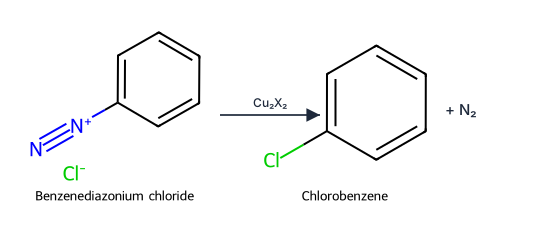
Reaction (iii): C6H5N2+X−Cu2X2C6H5X+N2
A diazonium salt is decomposed by cuprous halide (Cu2X2) to replace the diazonium group with a halogen. Nitrogen gas is evolved.
This is the classic Sandmeyer reaction — the copper(I) halide catalyses the substitution.
→ Matches with (d).
-
Reaction (iv): C2H5Cl+NaIdry acetoneC2H5I+NaCl …
Concept: Named Reactions in Organic Chemistry (Aryl and Alkyl Halides)
This is a matching question based on recognising the reagent, conditions, and product pattern of standard named reactions.
Method: Pattern Recognition by Reagent & Product Type
Steps:
- Identify the substrate — is it an alkyl halide, aryl halide, or diazonium salt?
- Identify the reagent and conditions — Na/ether, Cu₂X₂, NaI/acetone, etc.
- Match the transformation to the standard reaction definition.
Step-by-step matching:
(i) C6H5X+RXNaC6H5R
- Substrate: Aryl halide + Alkyl halide
- Reagent: Sodium metal
- Product: Alkyl benzene
- Pattern: Combination of Wurtz reaction (alkyl-alkyl) and Fittig reaction (aryl-aryl) → Wurtz-Fittig reaction
- Match: (b)
(ii) 2C6H5X+2NaEtherC6H5−C6H5+2NaX
- Substrate: Two aryl halides
- Reagent: Sodium in dry ether
- Product: Biphenyl (diaryl)
- Pattern: Coupling of two aryl halides → Fittig reaction
- Match: (a)
(iii) C6H5N2+X−Cu2X2C6H5X+N2
- Substrate: Diazonium salt
- Reagent: Cuprous halide (Cu₂X₂)
- Product: Aryl halide + N₂ gas
- Pattern: Replacement of diazonium group by halogen using copper catalyst → Sandmeyer reaction
- Match: (d)
(iv) C2H5Cl+NaIdry acetoneC2H5I+NaCl
- Substrate: Alkyl chloride
- Reagent: NaI in dry acetone …
Here are the common mistakes students make when matching these reactions, along with how to avoid each.
Mistake 1: Confusing the Wurtz-Fittig and Fittig Reactions
- The Mistake: Students often mix up reaction (i) and (ii). They see sodium (Na) and an aryl halide in both and assume they are the same type of reaction. Specifically, they might label (i) as the Fittig reaction or (ii) as the Wurtz-Fittig reaction.
- Why it happens: Both reactions use sodium metal and involve aryl halides. The key difference is the number of different halides used.
- How to Avoid:
- Focus on the reactants.
- Wurtz-Fittig (i): Involves two different halides: one aryl (C6H5X) and one alkyl (RX). The product is an alkylbenzene (C6H5R).
- Fittig (ii): Involves only one type of halide: an aryl halide (C6H5X). The product is a biphenyl (C6H5−C6H5).
- Memory Trick: "Wurtz-Fittig" has W and F — think "With Friends" (two different partners: alkyl + aryl). "Fittig" is just F — think "Family" (same type: aryl + aryl).
- Focus on the reactants.
Mistake 2: Forgetting the Catalyst in the Sandmeyer Reaction
- The Mistake: Students match reaction (iii) with the Sandmeyer reaction but forget the crucial role of the copper(I) halide (Cu2X2). They might think any diazonium salt decomposition is a Sandmeyer reaction.
- Why it happens: The reaction looks simple: a diazonium salt (C6H5N2+X−) is converted to an aryl halide (C6H5X). Students memorize the "diazonium to halide" part but miss the specific reagent.
- How to Avoid:
- Memorize the specific reagent. The Sandmeyer reaction is defined by the use of a cuprous halide (Cu2X2 or CuX) as a catalyst.
- Compare with similar reactions:
- Sandmeyer: C6H5N2+Cl−Cu2Cl2/HClC6H5Cl
- Gattermann reaction: C6H5N2+Cl−Cu/HClC6H5Cl (uses copper metal, not its salt).
- Simple substitution (without catalyst): C6H5N2+Cl−H2OC6H5OH (gives phenol, not halide).
- Exam Tip: If you see Cu2X2 or CuX with a diazonium salt, the answer is Sandmeyer.
Mistake 3: Misidentifying the Finkelstein Reaction
- The Mistake: Students fail to recognize reaction (iv) as the Finkelstein reaction because they don't immediately see the "iodide for chloride" swap. …
Showing the 12 most recent of 17 on this concept.
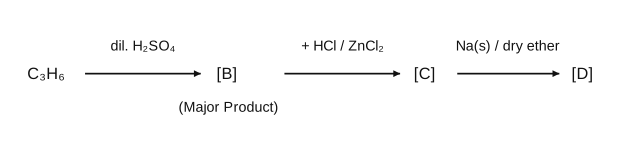
- COMEDK 2026Set 2026-A1 markMCQQ.An unsaturated organic compound (C3H6), undergoes the following series of reactions: Identify compound [D] (A) Cyclohexane (B) 2,3-dimethylbutane (C) Hexane (D) 2-methyl pentane
›Reveal solutionSolution
The reaction sequence is propene → isopropyl alcohol (via acid-catalysed hydration) → isopropyl chloride (via Lucas reagent) → 2,3-dimethylbutane (via Wurtz coupling). The final product [D] is 2,3-dimethylbutane, which corresponds to option (B).
The key to this problem is recognising that each step is a classic organic reaction with a well-known regioselectivity. The starting material is an unsaturated hydrocarbon with formula C₃H₆ — that is propene (CH₃–CH=CH₂). The sequence uses dilute H₂SO₄ (hydration), then Lucas reagent (HCl/ZnCl₂, a test for alcohols), then sodium in dry ether (Wurtz reaction). Let’s walk through each transformation.
- Step 1: Hydration of propene with dilute H₂SO₄ Propene reacts with dilute sulphuric acid via electrophilic addition. According to Markovnikov’s rule, the hydrogen adds to the less substituted carbon of the double bond, and the –OH group adds to the more substituted carbon.
CH3–CH=CH2+H2Odil. H2SO4CH3–CH(OH)–CH3
The product is propan-2-ol (isopropyl alcohol). This is the major product because the carbocation intermediate (secondary) is more stable than the primary one. So compound [B] is isopropyl alcohol.
- Step 2: Reaction with Lucas reagent (HCl/ZnCl₂) Lucas reagent converts alcohols to alkyl chlorides. The reaction works best for tertiary alcohols (immediate cloudiness), secondary alcohols (slow), and primary alcohols (very slow). Isopropyl alcohol is a secondary alcohol; it reacts to give isopropyl chloride.
CH3–CH(OH)–CH3+HClZnCl2CH3–CH(Cl)–CH3+H2O
So compound [C] is 2-chloropropane (isopropyl chloride).
- Step 3: Wurtz reaction with sodium in dry ether The Wurtz reaction couples two alkyl halides in the presence of sodium metal to form a higher alkane. Here, two molecules of isopropyl chloride react: 2CH3–CH(Cl)–CH3+2Nadry etherCH3–CH(CH3)–CH(CH3)–CH3+2NaCl …
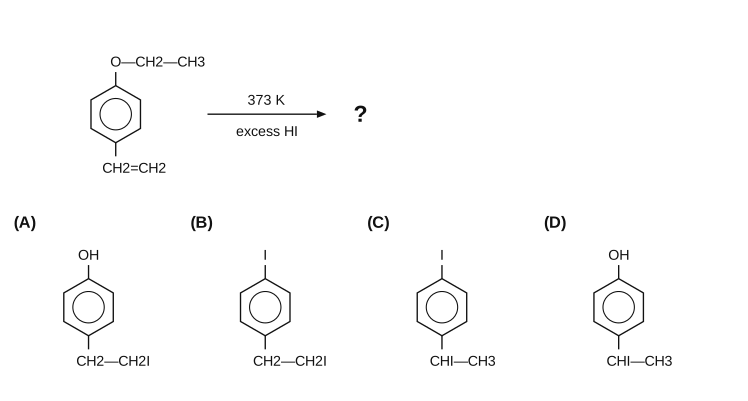
- COMEDK 2025Set 2025-A1 markMCQQ.Which one of the following is the major product formed when the given reaction occurs? (A) (B) (C) (D)
›Reveal solutionSolution
The reaction of a para-ethoxy styrene with excess HI at 373 K leads to cleavage of the ether (forming phenol) and Markovnikov addition of HI to the vinyl group, giving the product with an OH group and a –CHI–CH₃ side chain. The correct option is (D).
The key here is to recognize that two independent reactions occur on the same molecule under the given conditions: an aromatic ether cleavage and an electrophilic addition to an alkene. The challenge is to predict the outcome of each correctly and then combine them.
Concept & Intuition:
HI is a strong acid and a source of iodide, a good nucleophile. At 373 K (about 100 °C), it does two things:
- Cleaves aryl alkyl ethers (like –OCH₂CH₃) via an Sₙ2 or Sₙ1 mechanism, yielding a phenol and an alkyl iodide. The aromatic C–O bond is strong, so the alkyl–O bond breaks instead.
- Adds to alkenes following Markovnikov’s rule: the proton adds to the less substituted carbon of the double bond, and iodide adds to the more substituted carbon.
The molecule has both an ethoxy group and a vinyl group on opposite sides of the benzene ring. They react independently because they are separated by the aromatic ring.
Step-by-step reasoning:
-
Ether cleavage:
The ethoxy group (–O–CH₂–CH₃) is an aryl alkyl ether. With excess HI at high temperature, the alkyl–oxygen bond is cleaved. The mechanism: protonation of the ether oxygen, then nucleophilic attack by I⁻ on the ethyl carbon (Sₙ2), giving ethanol (which further reacts to ethyl iodide) and leaving a phenol group (–OH) on the ring.
Result: The top substituent becomes –OH.
-
Addition to the vinyl group:
The vinyl group (–CH=CH₂) is an alkene. HI adds across the double bond. According to Markovnikov’s rule, the hydrogen (H⁺) attaches to the terminal carbon (CH₂) because it is less substituted, forming a more stable carbocation (secondary benzylic) on the carbon attached to the ring. Then I⁻ attacks that carbocation. …
- COMEDK 2025Set 2025-E1 markMCQQ.Identify the Carbonyl compound which will not be formed when hydration of Alkynes is carried out with dil. H2SO4/Hg2+ at 333 K . Acetone, Butanal, Ethanal, Butanone. (A) Acetone (B) Butanone (C) Butanal (D) Ethanal
›Reveal solutionSolution
Hydration of alkynes with dil. H₂SO₄/Hg²⁺ follows Markovnikov’s rule, so terminal alkynes give methyl ketones and internal alkynes give a mixture; butanal, an aldehyde, cannot be formed because it would require anti-Markovnikov addition.
The key concept here is Markovnikov’s rule applied to the hydration of alkynes. The Hg²⁺-catalyzed addition of water across a triple bond proceeds via a vinyl carbocation intermediate, and the more stable carbocation (with more alkyl substituents) determines the product. This means the oxygen ends up on the more substituted carbon, yielding ketones (except for ethyne, which gives ethanal). An aldehyde like butanal would require the –OH to attach to a terminal carbon, which is the less substituted position — that’s anti-Markovnikov and does not happen under these conditions.
Let’s check each option:
-
Acetone (propanone) – Formed from hydration of propyne (CH₃–C≡CH). The triple bond is terminal; water adds so that the –OH goes to the internal carbon (more substituted), giving an enol that tautomerizes to acetone. ✓ Possible.
-
Butanone – Formed from hydration of 1-butyne (CH₃CH₂–C≡CH) or 2-butyne (CH₃–C≡C–CH₃). For 1-butyne, Markovnikov addition gives butanone; for 2-butyne, symmetrical addition also gives butanone. ✓ Possible. …
-
- COMEDK 2025Set 2025-M1 markMCQQ.Both reactions(i) and(ii) give the same compound X as the major product. Identify X (i). 3-Methylbut-1-ene +HCl→X (ii). Neopentyl alcohol +HCl( anh. ZnCl2)→X (A) (CH3)2−CH−CHCl−CH3 (B) (CH3)2−CCl−CH2−CH3 (C) CH3−CH2−CH(CH3)−CH2Cl (D) (CH3)2−CH−CH2−CH2Cl
›Reveal solutionSolution
Both reactions proceed through the same tertiary carbocation intermediate, leading to the same major product: 2-chloro-2-methylbutane. The correct option is (B).
Concept & Intuition
The key here is that two different starting materials—an alkene and an alcohol—can funnel into the same carbocation intermediate under acidic conditions. Markovnikov addition to the alkene gives the more stable carbocation, while the alcohol (neopentyl alcohol) undergoes a carbocation rearrangement (a 1,2-methyl shift) to escape the instability of a primary carbocation. Both paths converge on the same tertiary carbocation, which then captures chloride to form the major product.
Step-by-step reasoning
-
Reaction (i): 3-Methylbut-1-ene + HCl
- The alkene is unsymmetrical: CHX2=CH−CH(CHX3)X2.
- According to Markovnikov’s rule, the proton adds to the less substituted carbon (the terminal CHX2), placing the positive charge on the more substituted carbon (the internal one).
- This gives a secondary carbocation: (CHX3)X2CH−CHX+ −CHX3.
- However, this secondary carbocation can undergo a 1,2-hydride shift to form a more stable tertiary carbocation: (CHX3)X2CX+ −CHX2−CHX3 (2-methylbutan-2-ylium).
- Chloride ion then attacks this tertiary carbocation to yield 2-chloro-2-methylbutane: (CHX3)X2CCl−CHX2−CHX3.
-
Reaction (ii): Neopentyl alcohol + HCl (anh. ZnCl2)
- Neopentyl alcohol is (CHX3)X3C−CHX2OH.
- Under acidic conditions (Lucas reagent, ZnClX2/HCl), the −OH group is protonated and leaves as water, generating a primary carbocation: (CHX3)X3C−CHX2X+. …
-
- COMEDK 2024Set 2024-E1 markMCQQ.Identify the product [C] formed at the end of the reaction below 1,1,2,2- Tetrabromopropane + 2 Zn(S) / Ethanol → [B] [B] + 2 moles of HBr→[C] (A) 2, 2-Dibromopropane (B) 1, 1- Dibromopropane (C) 1,3-Dibromopropane (D) 1, 2-Dibromopropane
›Reveal solutionSolution
The reaction proceeds via debromination to an alkyne (propyne), followed by double hydrobromination that adds two HBr molecules in Markovnikov fashion, yielding 2,2-dibromopropane. The correct option is (A).
Concept & Intuition
The starting material is 1,1,2,2-tetrabromopropane — a propane chain with four bromines on the first two carbons. The first step uses zinc dust in ethanol, a classic reagent for dehalogenation: two vicinal bromines are removed to form a carbon–carbon bond of higher order. With four bromines and two Zn, both pairs are removed to give a triple bond (an alkyne). Then two moles of HBr add across the triple bond. HBr adds to alkynes in a Markovnikov fashion, and the addition happens twice, placing both bromines on the more substituted carbon.
Step-by-step reasoning
- Structure of the starting compound. 1,1,2,2-Tetrabromopropane:
CH3–CBr2–CHBr2
(C1 has two Br, C2 has two Br, C3 is a methyl group.)
- First reaction: debromination with Zn/ethanol. Zinc removes vicinal bromine atoms; with four bromines and two Zn, both C1–C2 bromine pairs are eliminated, converting the linkage into a triple bond. The product [B] is
CH3–C≡C–H
that is propyne (methylacetylene).
TipThe reaction of a vicinal tetrahalide with Zn is a standard way to make alkynes — each Zn removes two adjacent halogen atoms.
- Second reaction: addition of 2 moles of HBr to [B]. Propyne has a terminal triple bond. The first HBr adds by Markovnikov's rule — H to the terminal carbon, Br to the internal carbon: CH3–CBr=CH2 …
- COMEDK 2024Set 2024-E1 markMCQQ.Given below are 4 reactions. Two of these reactions will give product which is an equimolar mixture of the d and 1 forms. Identify these 2 reactions. [A] 2- Methylpropene + HI→ --------- [B] But-1-ene + HBr→ ----------- [C] 3-Methylbut-1-ene + HI→ ----------- [D] 3- Phenylpropene + HBr (Peroxide) → ----------- (A) C & A (B) D & B (C) B & C (D) A & D
›Reveal solutionSolution
[!TLDR]
Only the reactions that generate a new chiral carbon via a planar carbocation give the racemic (d/l) mixture; these are B (but-1-ene + HBr) and C (3-methylbut-1-ene + HI), so option (C).
Concept
From CBSE Class 12 (Haloalkanes / Stereochemistry): Markovnikov addition of HX proceeds through a planar carbocation. If the carbon bearing the halogen ends up attached to four different groups, it is a stereocentre; attack of X− from both faces of the planar cation gives equal amounts of the two enantiomers (a racemic, optically inactive d/l mixture).
Solution
[A] 2-Methylpropene + HI: (CH3)2C=CH2+HI→(CH3)3C−I (tert-butyl iodide). The carbon holding I bears three identical methyls – not chiral, no d/l pair.
[B] But-1-ene + HBr (Markovnikov): CH3CH2CH=CH2+HBr→CH3CH2BrCHCH3 (2-bromobutane). C-2 carries H,Br,CH3,C2H5 – four different groups → chiral → racemic. ✓ …
- KCET 2023Set D-21 markMCQQ.Compounds P and R in the following reaction are CH3CHO (1) CH3MgBr P conc. H2SO4,heat Q (i) B2H6 R (ii) H3O+ (ii) H2O2,OH− (A) Position isomers (B) Functional isomers (C) Metamers (D) Identical
›Reveal solutionSolution
Track the three steps: Grignard → propan-2-ol, dehydration → propene, hydroboration–oxidation (anti-Markovnikov) → propan-1-ol; the two alcohols differ only in where the –OH sits.
Step 1 — Grignard addition gives P
A Grignard reagent's carbanion-like carbon attacks the carbonyl carbon; acid work-up then gives an alcohol. Acetaldehyde (an aldehyde other than formaldehyde) yields a secondary alcohol:
CH3CHO CH3MgBr H3O+ CH3−∣COHH−CH3
P=propan-2-ol (CH3CH(OH)CH3)
Step 2 — Acid dehydration gives Q
Concentrated H2SO4 with heat dehydrates the alcohol (E1, via a carbocation) to the alkene:
CH3CH(OH)CH3conc. H2SO4, ΔCH3−CH=CH2+H2O
Q=propene
(Propene is the only alkene possible here — the molecule is symmetric about C-2, so Saytzeff offers no choice.)
Step 3 — Hydroboration–oxidation gives R
B2H6 adds across the double bond with the boron attaching to the less substituted (terminal) carbon — partly steric, partly because the addition is syn and concerted with Bδ+−Hδ−. Alkaline H2O2 then replaces the C–B bond by C–OH with retention. The net result is anti-Markovnikov hydration:
CH3CH=CH2 B2H6 (CH3CH2CH2)3B H2O2,OH− CH3CH2CH2OH
R=propan-1-ol …
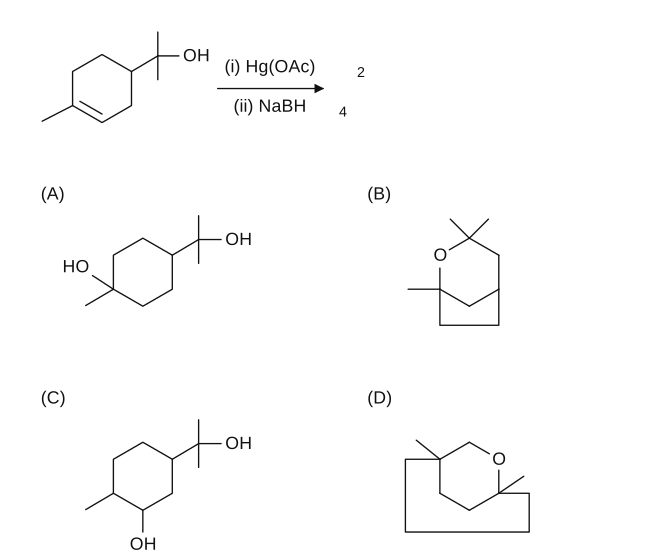
- COMEDK 2023Set 2023-M1 markMCQQ.Product of the following reaction is (A) (B) (C) (D)
›Reveal solutionSolution
[!TLDR]
Intramolecular oxymercuration-demercuration lets the existing tertiary hydroxyl attack the mercurinium ion, giving a Markovnikov bridged bicyclic ether with the gem-dimethyl group intact.
Concept
Oxymercuration (Hg(OAc)2/H2O, then NaBH4) adds -H and -OH across a C=C by a mercurinium-ion mechanism: Markovnikov orientation, no carbocation rearrangement. When a suitably placed hydroxyl exists inside the same molecule, that oxygen acts as the nucleophile instead of water, so a cyclic ether is formed intramolecularly (alkoxymercuration).
Solution
- The mercurinium ion forms on the ring double bond.
- The tertiary −C(CH3)2OH oxygen is positioned across the ring and reaches the more-substituted (Markovnikov) alkene carbon, opening the mercurinium ring intramolecularly. …
- KCET 2021Set B-21 markMCQQ.Peroxide effect is observed with the addition of HBr but not with the addition of HI to unsymmetrical alkene because (A) H-I bond is strong that H-Br and is not cleaved by the free radical (B) H-I bond is weaker than H-Br bond so that iodine free radicals combine to form iodine molecules (C) Bond strength of HI and HBr are same but free radicals are formed in HBr (D) All of these.
›Reveal solutionSolution
The peroxide effect requires a self-sustaining radical chain; with HI the weak H–I bond gives I∙ radicals that prefer to dimerise to I2 rather than add to the alkene, so the chain never propagates.
1. The mechanism the peroxide effect depends on
In the presence of a peroxide, addition of HX to an unsymmetrical alkene switches from ionic (Markovnikov) to a free-radical chain (anti-Markovnikov, Kharasch effect):
Initiation
R−O−O−R Δ 2RO∙RO∙+H−X⟶RO−H+X∙
Propagation
X∙+CH2=CH−R⟶X−CH2−C∙H−R(i)
X−CH2−C∙H−R+H−X⟶X−CH2−CH2−R+X∙(ii)
The chain survives only if both (i) and (ii) are exothermic. That is a thermodynamic tug-of-war set by the H–X and C–X bond strengths.
2. Why HBr works
- H–Br (≈366 kJmol−1) is weak enough that RO∙ abstracts H readily ⇒ Br∙ is generated.
- Br∙ adds to the double bond exothermically (step i) and the resulting carbon radical abstracts H from HBr exothermically (step ii).
Both propagation steps are downhill ⇒ the chain runs ⇒ peroxide effect is observed.
3. Why HI fails
The H–I bond is the weakest of the hydrogen halides (≈297 kJmol−1), so I∙ radicals are formed very easily. But the C–I bond that step (i) would create is also very weak, which makes the addition of I∙ to the alkene endothermic — it simply does not go. The iodine radicals therefore accumulate and take the only path open to them, recombination:
I∙+I∙⟶I2 …
- KCET 2021Set B-21 markMCQQ.The major product of the following reaction is CH2=CH−CH2−OHHBr (excess) product (A) CH3−CHBr−CH2Br (B) CH2=CH−CH2Br (C) CH3−CHBr−CH2−OH (D) CH3−CHOH−CH2OH
›Reveal solutionSolution
With excess HBr, allyl alcohol undergoes both substitution of the −OH and Markovnikov addition across the double bond, giving 1,2-dibromopropane.
1. Identify the two reactive sites
C3CH2=C2CH−C1CH2−OH(prop-2-en-1-ol, allyl alcohol)
- an alcohol −OH (reacts with HBr by substitution),
- a C=C double bond (reacts with HBr by electrophilic addition).
The word "excess" in the question is the signal that both must be consumed — a single equivalent would only do one.
2. Step 1 — Substitution of the –OH
−OH is a poor leaving group, so HBr first protonates it to −O+H2 (an excellent leaving group, water), and bromide then displaces it:
CH2=CH−CH2−OH H+ CH2=CH−CH2−O+H2 Br− CH2=CH−CH2Br+H2O
(The allylic position makes this substitution especially easy — the allyl cation is resonance-stabilised.) This intermediate, allyl bromide, is exactly option (B) — but it is only the half-way product, not the answer, because HBr is in excess.
3. Step 2 — Markovnikov addition of HBr across the C=C
The second equivalent of HBr adds to the remaining double bond. The H+ attacks so as to generate the more stable carbocation:
C3H2=C2H−C1H2Br+H+
- H adds to C3 (the terminal CH2, which already has more hydrogens — Markovnikov's rule) ⇒ the positive charge lands on C2, a secondary carbocation.
- The alternative (H to C2) would give a primary cation — much less stable. …
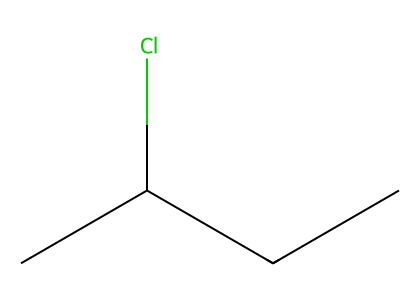
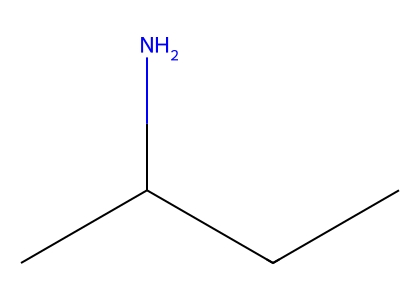
- KCET 2021Set B-21 markMCQQ.A hydrocarbon A (C4H8) on reaction with HCl gives a compound B (C4H9Cl) which on reaction with 1 mol of NH3 gives compound C (C4H10N). On reacting with NaNO2 and HCl followed by treatment with water, compound C yields an optically active compound D. The D is (A) CH3−CH(Cl)−CH2−CH3
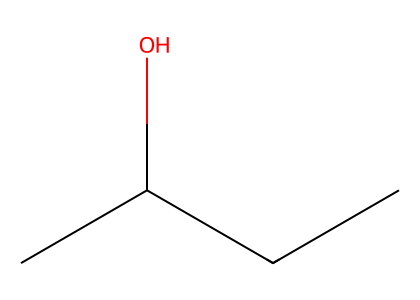
 (B) CH3−CH(OH)−CH2−CH3
 (C) CH3−CH(NH2)−CH2−CH3
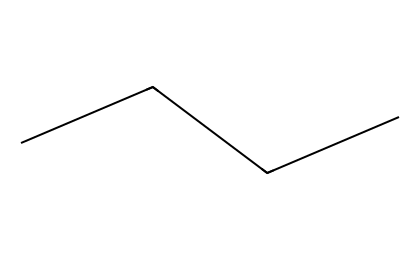
 (D) CH3−CH(H)−CH2−CH3
›Reveal solutionSolution
Butene → 2-chlorobutane → butan-2-amine → (diazotisation + water) butan-2-ol, whose C-2 is a stereocentre — hence optically active.
Step 1 — A: the hydrocarbon C4H8.
Degree of unsaturation =1, so A is a butene. Adding HCl gives C4H9Cl (B).
Step 2 — B: the chloride.
CH3-CH=CH-CH3+HCl⟶CH3-CH(Cl)-CH2-CH3
(For but-1-ene, Markovnikov addition gives the same secondary product, 2-chlorobutane — so B is 2-chlorobutane either way. The chlorine sits on C-2, a secondary carbon.)
Step 3 — C: the amine.
NH3 (1 mol) displaces the halide (nucleophilic substitution):
CH3-CH(Cl)-CH2-CH3+NH3⟶C, butan-2-amineCH3-CH(NH2)-CH2-CH3+HCl
C is a primary aliphatic amine (−NH2 on a secondary carbon).
Step 4 — D: diazotisation followed by water.
NaNO2+HCl generates nitrous acid HNO2 in situ. A primary aliphatic amine forms a very unstable alkanediazonium salt which immediately loses N2; the resulting carbocation is captured by water:
R-NH2NaNO2/HCl[R-N+≡N]H2O, −N2R-OH
⇒ D=CH3-CH(OH)-CH2-CH3(butan-2-ol)
This matches the figure, in which D is drawn with an −OH on C-2 and is labelled 'optically active'.
Step 5 — Check the optical activity. …
- COMEDK 2021Set 2021-B1 markMCQQ.An aliphatic alcohol [X] on heating with Conc. H2SO4 gives a compound [Y]. Compound Y when reacted with HBr and then with aqueous KOH yielded 2-Methylpropan-2-ol. What are the compounds X and Y ? (A) X = Isobutyl alcohol Y= Methylpropene (B) X= Tertiary butyl alcohol Y= But-2-ene (C) X= Sec-butyl alcohol Y= But-2-ene (D) X= n-butyl alcohol Y= But-1-ene
›Reveal solutionSolution
Y must be 2-methylpropene (gives tert-butanol via HBr/KOH); X is isobutyl alcohol, which dehydrates to it.
Retrosynthesis from 2-methylpropan-2-ol ((CH3)3C–OH):
- Aq. KOH on tert-butyl bromide → tert-butanol, so the HBr adduct is (CH3)3C–Br.
- Markovnikov HBr addition giving (CH3)3C–Br comes from methylpropene (CH3)2C=CH2 ⇒ Y = methylpropene. …
🎓Unlock everything free for 14 days
- ✓Full step-by-step solutions
- ✓Concept-first explanations
- ✓Methods, shortcuts & mistakes
- ✓PYQ mapping + timed mock tests
Full access for 14 days. No credit card required.