Q.If 109 electrons move out of a body to another body every second, how much time is required to get a total charge of 1C on the other body?
Concept understanding — Photoelectric Effect
The Photoelectric Effect: When Light Knocks Electrons Loose
Imagine you're throwing tennis balls at a wall covered in loose pebbles. If you throw hard enough, a pebble might get knocked off. That's the basic picture — but the photoelectric effect is the quantum version of this, and it completely shattered classical physics.
The Intuition
Light is made of tiny packets of energy called photons. Each photon carries a specific amount of energy, determined by its colour (frequency). When a photon hits a metal surface, it can transfer its energy to an electron inside the metal. If that energy is enough, the electron breaks free and flies out.
Think of electrons in a metal like people in a room with a high window. To escape, they need enough energy to reach the window sill. A photon is like a boost — but only if it gives enough energy in one shot. No amount of weak boosts (dim light) will work if each individual boost is too small.
The Precise Statement
Ephoton=hf=ϕ+Kmax
Where:
- Ephoton=hf is the energy of a photon (Planck's constant h=6.63×10⁻³⁴ J⋅s, f is frequency)
- ϕ is the work function — the minimum energy needed to remove an electron from that metal
- Kmax is the maximum kinetic energy of the ejected electron
What Classical Physics Got Wrong
Before Einstein (1905), physicists thought light was a continuous wave. They expected:
- Brighter light → more energy per electron → faster electrons
- Any colour would eventually eject electrons if you waited long enough
But experiments showed the opposite:
| Observation | Classical Prediction | Actual Result |
|---|---|---|
| Effect of intensity | Brighter light → faster electrons | Brighter light → more electrons, same speed |
| Threshold frequency | None — any light works eventually | Below a certain frequency, no electrons no matter how bright |
| Time delay | Electrons need time to absorb energy | Electrons appear instantly (within 10−9 s) |
The Key Insight
Einstein said: light behaves like a stream of particles (photons), each with energy hf. One photon interacts with one electron. If hf<ϕ, the electron cannot escape — period. If hf>ϕ, the excess energy becomes kinetic energy:
Kmax=hf−ϕ
This is why:
- Increasing intensity (more photons) ejects more electrons, but each electron still gets the same energy per photon — so their speed doesn't change.
- Below threshold frequency, even a trillion photons per second can't help — each one is too weak individually.
The photoelectric effect proved that light is quantized — it comes in discrete packets. This was the birth of quantum mechanics. Einstein won the 1921 Nobel Prize for this, not for relativity.
A Worked Example
Problem: A metal has work function ϕ=2.0 eV. Light of frequency f=6.0×10¹⁴ Hz shines on it. Find the maximum kinetic energy of ejected electrons. (h=4.14×10⁻¹⁵ eV⋅s)
Step 1: Photon energy
E=hf=(4.14×10⁻¹⁵)(6.0×10¹⁴)=2.48 eV
Step 2: Subtract work function
Kmax=2.48−2.0=0.48 eV
Step 3: Convert to joules if needed
0.48 eV×1.6×10−19=7.68×10⁻²⁰ J
The electron escapes with this much kinetic energy.
Common Mistake to Avoid
Students often think "more intense light means more energy per electron." Wrong. Intensity = number of photons per second. Each photon still has the same hf. More photons = more electrons, but each electron gets the same energy kick.
The Big Picture
The photoelectric effect is your first encounter with wave-particle duality. Light, which we model as a wave for interference and diffraction, behaves as a particle when transferring energy to matter. This duality is central to all of quantum mechanics.
Final takeaway: Light ejects electrons only if each photon carries enough energy individually. The colour (frequency) determines whether ejection happens; the brightness (intensity) determines how many electrons get ejected.
"Photoelectric effect formula and Einstein equation" is among the most-searched Class 12 physics topics, and it is a core result of the Dual Nature of Radiation and Matter chapter in the NCERT/CBSE Class 12 Physics curriculum. Work function and threshold frequency questions built on this concept appear in nearly every JEE Main and NEET physics paper.
Why this formula?
Photoelectric Effect: Why the Key Formulas Hold
The photoelectric effect is a cornerstone of quantum physics. It showed that light behaves as particles (photons) , not just waves. Let's build the reasoning step-by-step.
1. The Core Idea: Energy Conservation
When a photon hits a metal surface, it transfers all its energy to a single electron inside the metal.
- The photon's energy is E=hf, where h is Planck's constant and f is the frequency of light.
- The electron needs a minimum energy to escape the metal — this is called the work function, ϕ.
Why only one electron?
Einstein proposed that light is quantized into discrete packets (photons). A single photon cannot split its energy among multiple electrons — it interacts with one electron at a time.
2. The Photoelectric Equation
If the photon's energy is greater than the work function, the excess energy becomes the electron's kinetic energy after escape:
hf=ϕ+Kmax
Where:
- hf = energy of incident photon
- ϕ = work function (minimum energy to remove electron)
- Kmax = maximum kinetic energy of ejected electron
Why "maximum" kinetic energy?
- Electrons inside the metal have different binding energies.
- Some electrons are near the surface (loosely bound) → get maximum K.
- Others are deeper → lose energy in collisions before escaping → lower K.
3. The Stopping Potential Connection
We measure Kmax using a stopping potential Vs:
Kmax=eVs
Where e is the electron charge. This is because:
- An electric field opposing the electron's motion does work eVs to stop it.
- At the stopping potential, the electron's kinetic energy is exactly balanced by the electric potential energy.
Combining:
hf=ϕ+eVs
This is the Einstein photoelectric equation in its most testable form.
4. Why the Threshold Frequency Exists
From the equation:
hf=ϕ+eVs
If f is too low, hf<ϕ. Then:
- The photon cannot supply enough energy to overcome the work function.
- No electron is ejected, regardless of light intensity.
The threshold frequency f0 is when Kmax=0:
hf0=ϕ⇒f0=hϕ
Why intensity doesn't matter for ejection?
- Intensity = number of photons per second.
- Each photon still has energy hf. If hf<ϕ, even a billion photons won't eject an electron — each photon is individually too weak.
5. Why Kinetic Energy Depends on Frequency, Not Intensity
From Kmax=hf−ϕ:
- Frequency f directly determines Kmax.
- Intensity only affects the number of electrons ejected (more photons → more electrons), not their individual energy.
This was the key experimental contradiction with classical wave theory:
- Classical: Higher intensity = bigger wave amplitude = more energy to electrons.
- Reality: Higher frequency = more energy per electron; intensity only changes current.
6. Summary of Key Relationships
| Quantity | Formula | Why it holds |
|---|---|---|
| Photon energy | E=hf | Light is quantized (Planck-Einstein) |
| Work function | ϕ=hf0 | Minimum energy to escape at threshold |
| Max kinetic energy | Kmax=hf−ϕ | Energy conservation per photon-electron |
| Stopping potential | eVs=hf−ϕ | Electric work balances kinetic energy |
| Threshold frequency | f0=ϕ/h | Below this, no ejection possible |
7. The Deeper "Why" — Particle Nature of Light
The photoelectric effect cannot be explained by classical wave theory because:
- Waves spread energy over the whole wavefront — an electron would take time to absorb enough energy.
- But experiments show instantaneous ejection (within 10−9 s).
- Wave theory predicts kinetic energy should increase with intensity — it doesn't.
Einstein's photon model resolves all three:
- Instantaneous — one photon, one interaction.
- Frequency-dependent — photon energy is hf.
- Intensity-independent — more photons = more electrons, not more energy per electron.
Key takeaway: The photoelectric effect is a direct consequence of energy quantization — both light and electron binding energy are quantized. The formulas are simply conservation laws applied to this quantum world.
Concept: Quantization of charge – charge transfer by electron motion.
Each electron carries a fundamental charge e=1.6×10⁻¹⁹C.
Step 1: Find the charge transferred per second.
I=n⋅e=109×1.6×10−19=1.6×10⁻¹⁰C/s
Step 2: To accumulate total charge Q=1C, the time required is
t=IQ=1.6×10−101=1.61010=6.25×10⁹s
Step 3: Convert to years for perspective (optional but useful):
t=365×24×36006.25×109≈3.15×1076.25×109≈198years
The time required is 6.25×10⁹s or approximately 198 years.
Charge accumulates at a rate determined by the number of electrons transferred per second. At 109 electrons/second, it takes approximately 200 years to accumulate 1C.
Understanding charge transfer
When electrons move from one body to another, they carry their elementary charge e=1.6×10⁻¹⁹C with them. The body losing electrons becomes positively charged, while the body gaining electrons becomes negatively charged. The question asks how long it takes for the receiving body to accumulate a total charge of 1C.
The key insight is that charge builds up at a constant rate if electrons transfer at a steady rate. We need to find the charge transferred per second (the current), then determine how many seconds are needed to reach 1C.
Step-by-step solution
1. Calculate the charge transferred per second
Each electron carries charge e=1.6×10⁻¹⁹C. If 109 electrons move every second, the charge transferred per second is:
I=n⋅e=109×1.6×10−19C/s
I=1.6×10⁻¹⁰C/s
This is effectively the current flowing between the two bodies.
2. Find the time required to accumulate 1C
We know that charge Q=I⋅t, where t is time. Rearranging for time:
t=IQ=1.6×10⁻¹⁰C/s1C
t=1.6×10−101s=1.61010s
t=6.25×10⁹s
3. Convert to more meaningful units
This is an enormous amount of time. Let's convert to years:
t=365×24×36006.25×109years
t=3.156×1076.25×109years
t≈198years
A coulomb is a huge amount of charge at the scale of individual electrons. Even though 109 sounds like a large number, the elementary charge is so tiny that the transfer rate is extremely slow. This is why we rarely see static charges of 1C in everyday life!
Remember that 1A=1C/s. The current here is only 1.6×10⁻¹⁰A, which is a billionth of an ampere — far smaller than typical household currents of a few amperes.
The time required is 6.25×10⁹s or approximately 198 years.
Instead of finding the current first, count the total number of electrons needed to make up 1C, then divide by the rate at which electrons are transferred. Same final answer: t≈6.25×10⁹s≈198 years.
Method: Total-Electron-Count Approach
Rather than treating this as a current problem, we can think of it purely as counting: how many electrons in total does it take to reach 1C, and how long does it take to move that many electrons at the given rate?
- Find the total number of electrons needed for 1C. Each electron carries charge e=1.6×10⁻¹⁹C. If N electrons are needed to make up a total charge Q=1C:
N=eQ=1.6×10−191=6.25×10¹⁸electrons
-
Note the given transfer rate.
The problem states 109 electrons move across every second — this is simply electrons-per-second, a rate, independent of how we choose to compute the answer.
-
Divide total electrons by the rate to get time.
If N electrons must move at a steady rate of 109 electrons per second, the time taken is:
t=rateN=1096.25×1018s
- Simplify.
t=6.25×10⁹s
- Sanity-check by converting to years.
t=3.15×10⁷s/yr6.25×109≈198years
This matches the current-based method exactly, since dividing "total electrons" by "electrons per second" is algebraically the same as dividing "total charge" by "charge per second" — just counted in a different order.
This way of thinking is useful whenever a rate is given in particles per second rather than current directly — count the particles you need first, then bring in the rate.
The time required is 6.25×10⁹s, approximately 198 years.
Common Mistakes & How to Avoid Them
Mistake 1: Using the wrong sign for charge
The error: Students often forget that electrons are negatively charged. They plug q=1.6×10⁻¹⁹C without considering the sign, then get confused when the time comes out negative or when they try to interpret "charge on the other body."
How to avoid:
- Always write: charge on one electron = −e=−1.6×10⁻¹⁹C
- When electrons leave a body, that body becomes positively charged (loss of negative charge).
- The other body receiving electrons becomes negatively charged.
- For the question: "total charge of 1C on the other body" means the other body has −1C (since it gains electrons). But the magnitude is what matters for time calculation.
Correct approach:
Use magnitude only: ∣q∣=1.6×10⁻¹⁹C per electron. The sign tells you the type of charge, not the amount.
Mistake 2: Confusing number of electrons with charge
The error: Students sometimes think 109 electrons per second means 109 coulombs per second, leading to absurdly short times.
How to avoid:
- Remember: Charge is quantized — every electron carries a fixed tiny charge e.
- The rate of charge transfer = (number of electrons per second) × (charge per electron)
I=(109)×(1.6×10−19)=1.6×10⁻¹⁰C/s
Mistake 3: Forgetting to convert units or misplacing powers of 10
The error: Students write 109×1.6×10−19=1.6×10? and mess up the exponent.
How to avoid:
- Do the exponent arithmetic carefully:
109×10−19=10−10
Then multiply by 1.6: 1.6×10⁻¹⁰
- Double-check: 109 is large, 10−19 is tiny — the product should be a very small number.
Mistake 4: Using the wrong formula for time
The error: Students try to use t=Q/I but plug in Q=1C and I=109 (electrons/second) directly, forgetting to convert current to coulombs/second.
How to avoid:
- Always convert to consistent units:
- Q=1C
- I=1.6×10⁻¹⁰C/s (after conversion)
- Then:
t=IQ=1.6×10−101=6.25×10⁹seconds
Mistake 5: Stopping at seconds without converting to a meaningful unit
The error: Students leave the answer as 6.25×10⁹ seconds, which is correct but not very intuitive.
How to avoid:
- Convert to years for a sense of scale:
6.25×10⁹s÷(365×24×3600)≈198years
- This also serves as a reality check — it shows how huge 1C really is in terms of electron transfer.
Quick Summary Checklist
| Step | Common Mistake | Fix |
|---|---|---|
| Charge per electron | Wrong sign | Use magnitude 1.6×10⁻¹⁹C |
| Current calculation | Treat electrons as coulombs | Multiply: n×e |
| Exponent arithmetic | Wrong power of 10 | 109×10−19=10−10 |
| Time formula | Wrong I units | Convert to C/s first |
| Final answer | Leave in seconds | Convert to years for context |
Final correct answer:
t=(109electrons/s)×(1.6×10−19C/electron)1C=6.25×109s≈198years
Showing the 12 most recent of 22 on this concept.
- COMEDK 2026Set 2026-A1 markMCQQ.The variation of the stopping potential ( Vo ) with the frequency of incident radiation( n ) is as given below. [no - threshold frequency. h - Planck's constant e-electronic charge] then the slope of the graph AB with the frequency axis is: (A) eh (B) V0hn0 (C) V0n0 (D) n0V0
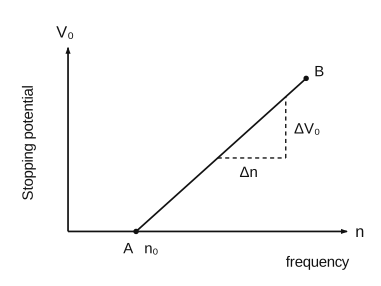
›Reveal solutionSolution
The slope of the stopping potential vs. frequency graph is given by the photoelectric equation eVo=h(n−n0), so the slope is eh. The correct option is (A).
The key concept here is the photoelectric effect equation as formulated by Einstein. The stopping potential Vo is the voltage that just stops the most energetic photoelectrons. The energy of those electrons equals the photon energy minus the work function. When you plot Vo against frequency n, the graph is a straight line whose slope is a fundamental constant ratio.
Why this approach works:
The equation eVo=hn−ϕ (where ϕ=hn0 is the work function) is linear in n. The slope of the Vo vs. n line is therefore h/e. The graph’s intercept on the frequency axis is the threshold frequency n0. The dashed triangle in the figure simply illustrates that slope = ΔVo/Δn, which must equal h/e.
Let’s work through it step by step:
- Write the photoelectric equation. Einstein’s photoelectric equation for the stopping potential is:
eVo=hn−ϕ
where e is the electron charge, h is Planck’s constant, n is the frequency of incident radiation, and ϕ is the work function of the metal.
- Express the work function in terms of threshold frequency. The threshold frequency n0 is the minimum frequency needed to eject electrons, so at n=n0, Vo=0. Substituting:
0=hn0−ϕ⇒ϕ=hn0
Thus the equation becomes:
eVo=hn−hn0=h(n−n0)
- Solve for Vo to see the linear relationship. Divide both sides by e:
Vo=eh(n−n0)
This is of the form Vo=m(n−n0), where m is the slope.
- Identify the slope from the graph. The graph shows Vo on the vertical axis and n on the horizontal axis. The line AB has a constant slope. From the equation, the slope is the coefficient of n:
slope=eh
The dashed triangle in the figure confirms this: slope = ΔnΔVo=eh.
- Check the options.
- (A) eh — matches exactly.
- (B) V0hn0 — not constant; depends on a particular point.
- (C) V0n0 — reciprocal of the intercept ratio, not slope.
- (D) n0V0 — this is the ratio at one point, not the slope.
Watch outA common mistake is to confuse the slope with the ratio V0/n0 or n0/V0. The slope is the change in Vo per change in n, not the value at a single point. The dashed triangle explicitly shows ΔVo/Δn, not Vo/n.
TipYou can also remember: the slope of the Vo–n graph is always h/e for any metal, because the work function only shifts the intercept, not the slope. This is a classic experimental way to measure h/e.
✓Final answerThe correct option is (A).
ANSWER: A
- KCET 2026Set C21 markMCQQ.Work function of the metal is (A) Maximum possible energy acquired by an electron (B) Equal for all metals (C) Minimum energy required by an electron to just eject from metal surface (D) Maximum energy which is given to electron to move out of metal surface
›Reveal solutionSolution
The work function ϕ0 is a property of the metal defined as the minimum energy needed to remove (eject) a free electron from just inside its surface.
Step 1 — Physical picture
Electrons in a metal are bound by attractive forces from the positive ion lattice. To escape the metal surface entirely, an electron must be given at least enough energy to overcome this binding — no less will do, since a smaller energy leaves the electron still trapped.
Step 2 — Definition of work function
This minimum required energy is called the work function, ϕ0, usually expressed in electron-volts (eV). It is NOT the maximum energy an electron can have, and it is NOT the same for all metals — it depends on the specific metal's electronic structure.
✓Final answerThe correct option is (C) — Minimum energy required by an electron to just eject from the metal surface.
- KCET 2026Set C21 markMCQQ.Variation of photoelectric current with anode potential is shown below
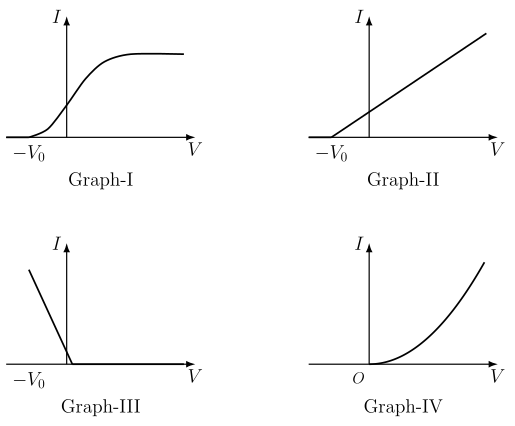 . Choose the correct option (V0 = stopping potential).
(A) Graph-I: the current is zero at the negative anode potential -V0, rises smoothly through the origin as the anode potential increases, and then levels off at a constant (saturation) value at higher positive potentials
(B) Graph-II: the current is zero at -V0 and rises in a straight line with anode potential, continuing to increase without ever levelling off
(C) Graph-III: the current is at its highest value at -V0 and falls in a straight line down to zero near the origin, i.e. current decreases as anode potential increases
(D) Graph-IV: the current starts at zero at the origin itself (no negative stopping-potential intercept is shown) and increases with an upward-curving (concave-up) shape as the anode potential increases
. Choose the correct option (V0 = stopping potential).
(A) Graph-I: the current is zero at the negative anode potential -V0, rises smoothly through the origin as the anode potential increases, and then levels off at a constant (saturation) value at higher positive potentials
(B) Graph-II: the current is zero at -V0 and rises in a straight line with anode potential, continuing to increase without ever levelling off
(C) Graph-III: the current is at its highest value at -V0 and falls in a straight line down to zero near the origin, i.e. current decreases as anode potential increases
(D) Graph-IV: the current starts at zero at the origin itself (no negative stopping-potential intercept is shown) and increases with an upward-curving (concave-up) shape as the anode potential increases›Reveal solutionSolution
Photoelectric current falls to exactly zero at the stopping potential −V0 (a negative potential, not the origin), rises smoothly (not abruptly or linearly forever) as the anode potential increases, and levels off at a constant saturation current once every emitted photoelectron is being collected.
Step 1 — Behaviour at negative (retarding) anode potential
As the anode potential is made increasingly negative, it opposes the motion of the photoelectrons emitted with kinetic energy up to eV0. The current decreases continuously and becomes exactly zero only when the anode potential reaches −V0, the stopping potential — not at the origin, and not abruptly.
Step 2 — Behaviour as the anode potential increases through zero and beyond
As the anode potential increases from −V0 through zero and into positive values, more and more of the emitted photoelectrons (which have a spread of kinetic energies from 0 up to eV0) are attracted to and collected by the anode, so the current rises smoothly (not as a straight line, and not with an upward-curving shape).
Step 3 — Saturation
Once the anode potential is large enough (positive) to collect every photoelectron emitted per second, further increase in potential cannot increase the current any more — the curve levels off at a constant saturation current.
Only Graph-I shows all three features together: zero current at −V0, a smooth rise through the origin, and saturation at higher potentials.
✓Final answerThe correct option is (A) — Graph-I correctly shows the current is zero at −V0, rises smoothly through the origin, and saturates at higher anode potentials.
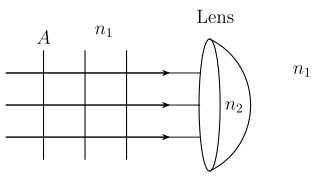
- KCET 2025Set D-41 markMCQQ.If AB is incident plane wave front then refracted wave front in (n2>n1)
 (A) [FIGURE]
(B) [FIGURE]
(C) [FIGURE]
(D) [FIGURE]
(A) [FIGURE]
(B) [FIGURE]
(C) [FIGURE]
(D) [FIGURE]›Reveal solutionSolution
The lens is thicker at the centre and slows light more there, so the wavefront's middle lags: the plane wavefront emerges as a converging spherical wavefront centred on the focus.
Step 1 — Huygens' picture of refraction through a lens.
Inside the lens the wave travels slower: v2=c/n2<v1=c/n1 since n2>n1. The convex lens is thickest at its centre, so the central part of the incident plane wavefront spends the longest time in the slow medium and is retarded most, while the edges (thin glass) get through with least delay.
Step 2 — What that does to the shape.
The centre of the wavefront falls behind the edges, so the flat front AB emerges curved, with its middle bent backwards — that is, the emerging wavefront is a spherical surface whose centre of curvature lies ahead of it (to the right), at the focus F. Drawn on paper, such a converging wavefront looks like a "(" — bulging towards the left, concave towards the right.
Step 3 — Cross-check with the rays.
Rays are normal to the wavefront at every point. A convex lens with n2>n1 converges parallel rays to the principal focus. Rays converging on a point are the radii of spheres centred on that point — so the wavefronts must be spherical caps centred on F, and successive fronts (A′B′ then A′′B′′) get smaller as they close in on the focus. Exactly the picture in option (A).
Step 4 — Eliminate the others.
- (B) plane wavefronts unchanged — that would be a slab of parallel faces, not a lens (no convergence at all).
- (C) tilted plane wavefronts — that is refraction at a plane interface (like a prism/slab), which deviates but does not focus.
- (D) arcs bulging right (centre of curvature to the left) — these are diverging wavefronts, what a concave lens would produce.
✓Final answerThe correct option is (A) — the converging (left-bulging, "(" shaped) spherical wavefronts whose centre of curvature lies to the right, at the focus.
ANSWER: A
- COMEDK 2025Set 2025-A1 markMCQQ.Which of the following statement is wrong regarding the photo electric effect. (A) Photo electric current is directly proportional to the intensity of the incident radiation (B) The maximum kinetic energy of the electrons emitted depends on the intensity of the incident radiation (C) The maximum kinetic energy of the electrons emitted depends on the frequency of the incident radiation (D) The value of the stopping potential increases with the increase in frequency of the incident radiation.
›Reveal solutionSolution
The photoelectric effect shows that the maximum kinetic energy of emitted electrons depends on frequency, not intensity — so statement (B) is wrong.
The photoelectric effect is a cornerstone of quantum physics. It demonstrates that light behaves as discrete packets of energy (photons), and the energy of each photon is proportional to its frequency, not its amplitude (intensity). This is why intensity only affects the number of electrons emitted, not their individual energies. Let’s examine each statement carefully.
-
Statement (A): Photo electric current is directly proportional to the intensity of the incident radiation.
This is correct. Intensity means the number of photons per second. More photons → more electrons ejected → larger current (provided the frequency is above the threshold). So (A) is true.
-
Statement (B): The maximum kinetic energy of the electrons emitted depends on the intensity of the incident radiation.
This is the classic pitfall. In the photoelectric effect, each electron absorbs one photon. The photon’s energy is hf. After overcoming the work function ϕ, the leftover energy becomes kinetic energy:
Kmax=hf−ϕ
Intensity changes the number of photons, not the energy per photon. So Kmax is independent of intensity. Thus (B) is false.
-
Statement (C): The maximum kinetic energy of the electrons emitted depends on the frequency of the incident radiation.
This is correct, as shown by the equation above. Higher frequency → larger Kmax.
-
Statement (D): The value of the stopping potential increases with the increase in frequency of the incident radiation.
Stopping potential Vs is related to Kmax by eVs=Kmax. So Vs=ehf−ϕ, which increases linearly with frequency. Hence (D) is true.
Watch outA common mistake is to think that brighter light (higher intensity) gives electrons more energy. In reality, brighter light only gives more electrons, not faster ones.
TipRemember the photoelectric equation: Kmax=hf−ϕ. It contains frequency f but not intensity. That single fact eliminates option (B) immediately.
✓Final answerThe correct option is (B).
ANSWER: B
-
- COMEDK 2025Set 2025-E1 markMCQQ.The stopping potential when a metal surface is illuminated by light of wavelength λ is 15 V . The stopping potential when the same surface is illuminated by light of wavelength 4λ is 3 V . The ratio of threshold wavelength to the initial incident wavelength λ is: (A) 1:16 (B) 1:15 (C) 16:1 (D) 15:1
›Reveal solutionSolution
Using the photoelectric equation for two different wavelengths, we eliminate the work function to find the threshold wavelength; the ratio of threshold wavelength to λ is 16:1, so the correct option is (C).
Concept & Intuition
The photoelectric effect tells us that the maximum kinetic energy of ejected electrons is Kmax=hf−ϕ, where ϕ is the work function. The stopping potential Vs is related by eVs=Kmax. Since f=c/λ, we can write eVs=λhc−ϕ. With two data points, we can solve for both ϕ and hc, then find the threshold wavelength λth=hc/ϕ. The ratio λth/λ follows directly.
Step-by-step solution
- Write the photoelectric equation for each case For wavelength λ, stopping potential V1=15 V:
e⋅15=λhc−ϕ(1)
For wavelength 4λ, stopping potential V2=3 V:
e⋅3=4λhc−ϕ(2)
- Subtract equation (2) from equation (1) to eliminate ϕ
15e−3e=λhc−4λhc
12e=λhc(1−41)=λhc⋅43
So
λhc=12e⋅34=16e
This tells us the photon energy for wavelength λ is 16 eV (since e is the electron charge, 16e means 16 eV).
- Find the work function ϕ Substitute λhc=16e into equation (1):
15e=16e−ϕ⇒ϕ=e
So the work function is 1 eV.
- Determine the threshold wavelength Threshold wavelength λth satisfies hc/λth=ϕ=e. But we already have hc/λ=16e. Therefore:
λthhc=eandλhc=16e
Dividing the second by the first:
λλth=16
So the ratio is 16:1.
TipNotice that the stopping potentials (15 V and 3 V) differ by 12 V, which directly gives the difference in photon energies. This shortcut avoids solving for hc explicitly.
Watch outA common mistake is to forget that stopping potential is in volts but represents energy in eV when multiplied by e. Always keep the e factor to avoid unit errors.
✓Final answerThe correct option is (C).
ANSWER: C
- COMEDK 2025Set 2025-M1 markMCQQ.Emission of electrons from a metal plate illuminated with monochromatic electromagnetic radiation will always take place provided (A) The plate is positively charged (B) The plate is negatively charged (C) The radiation is sufficiently intense (D) The work function of the plate is less than the energy of a single photon and the plate is uncharged
›Reveal solutionSolution
The key idea is the photoelectric effect: emission occurs when a single photon’s energy exceeds the work function, regardless of intensity or charge, so the correct condition is that the photon energy is greater than the work function and the plate is uncharged (to avoid retarding fields).
The photoelectric effect is a quantum phenomenon: light behaves as particles (photons), each carrying energy E=hf, where h is Planck’s constant and f is the frequency. An electron in the metal needs a minimum energy—the work function ϕ—to escape. If a single photon’s energy is less than ϕ, no electron can be ejected, no matter how many photons (i.e., how intense the light) you throw at it. Intensity only affects the number of emitted electrons, not whether emission starts. The plate’s charge matters because a positive charge attracts electrons (helping emission) and a negative charge repels them (hindering it), but the necessary condition is purely energetic.
Let’s examine each option step by step.
-
Option (A): The plate is positively charged
A positive charge lowers the barrier for electrons to leave, but if the photon energy is below the work function, no electron can absorb enough energy to escape. Positive charge alone cannot create emission; it only assists if emission is already possible. So this is not sufficient.
-
Option (B): The plate is negatively charged
A negative charge repels electrons, making it harder for them to leave. Even if the photon energy exceeds the work function, a strong negative charge can prevent emission. This is not a condition that ensures emission; it often prevents it.
-
Option (C): The radiation is sufficiently intense
Intensity means more photons per second, but each photon still carries the same energy hf. If hf<ϕ, no single photon can eject an electron—classical wave theory fails here. Increasing intensity only increases the number of photons, not their individual energy. So this is incorrect.
-
Option (D): The work function of the plate is less than the energy of a single photon and the plate is uncharged
This is the correct condition. If hf>ϕ, a single photon can transfer enough energy to an electron to overcome the binding energy. The “uncharged” part ensures there is no extra electric field (positive or negative) that could either help or hinder—but the key is that the photon energy exceeds the work function. In the standard photoelectric effect, emission occurs instantly when hf>ϕ, regardless of intensity, provided the plate is neutral or has no retarding field.
Watch outA common mistake is to think that “intense” light means more energy per photon. It doesn’t—intensity is about the number of photons, not their individual energy. The photoelectric effect is a one-photon-one-electron process.
TipRemember the photoelectric equation: Kmax=hf−ϕ. Emission happens when hf≥ϕ. Intensity only changes the current (number of electrons), not the threshold.
✓Final answerThe correct option is (D).
ANSWER: D
-
- KCET 2024Set D-21 markMCQQ.The photoelectric work function for photo metal is 2.4 eV. Among the four wavelengths, the wavelength of light for which photo-emission does not take place is (A) 200 nm (B) 300 nm (C) 700 nm (D) 400 nm
›Reveal solutionSolution
Photo-emission requires photon energy ≥ work function. The threshold wavelength is λ0=ϕhc≈517 nm. Light with wavelength longer than this (lower energy) cannot cause emission. Among the options, 700 nm is the only one above threshold, so no photo-emission occurs for that.
The key idea is the photoelectric effect: an electron is ejected from a metal surface only if the incoming photon carries enough energy to overcome the binding energy (the work function ϕ). If the photon’s energy is less than ϕ, no electron is emitted, no matter how intense the light.
The energy of a photon is E=λhc, where h is Planck’s constant, c is the speed of light, and λ is the wavelength. For photo-emission to occur, we need E≥ϕ. So the condition for no emission is simply E<ϕ, i.e. λ>ϕhc.
Let’s find that threshold wavelength.
-
Write the work function in joules.
ϕ=2.4 eV. Since 1 eV =1.6×10⁻¹⁹ J,
ϕ=2.4×1.6×10−19=3.84×10⁻¹⁹ J.
-
Use the photon energy formula.
hc=6.63×10−34×3×108=1.989×10⁻²⁵ J·m.
The threshold wavelength λ0 is where hc/λ0=ϕ, so
λ0=ϕhc=3.84×10−191.989×10⁻²⁵≈5.18×10⁻⁷ m =518 nm.
TipA faster route: use hc=1240 eV·nm (a standard constant). Then λ0=2.41240≈517 nm. This avoids unit conversions entirely.
-
Compare each given wavelength to λ0.
Photo-emission does not occur for λ>λ0 (lower energy photons).
- 200 nm: <517 nm → emission occurs.
- 300 nm: <517 nm → emission occurs.
- 400 nm: <517 nm → emission occurs.
- 700 nm: >517 nm → no emission.
Watch outA common mistake is to think longer wavelength means higher energy — it’s the opposite. Energy is inversely proportional to wavelength. So the largest wavelength gives the smallest photon energy, and that’s the one that fails to eject electrons.
✓Final answerThe wavelength for which photo-emission does not take place is 700 nm, which corresponds to option (C).
-
- COMEDK 2024Set 2024-E1 markMCQQ.A photon emitted during the de-excitation of electron from a state n to the second excited state in a hydrogen atom, irradiates a metallic electrode of work function 0.5 eV, in a photocell, with a stopping voltage of 0.47 V. Obtain the value of quantum number of the state 'n'. (A) 5 (B) 6 (C) 4 (D) 3
›Reveal solutionSolution
The problem combines the Bohr model for hydrogen with the photoelectric effect: the photon energy from the transition n→3 equals the work function plus the stopping voltage energy, giving n=5. The correct option is (A).
We are told the electron de‑excites from some state n to the second excited state. In hydrogen, the ground state is n=1, first excited state is n=2, and second excited state is n=3. So the transition is n→3.
The emitted photon then hits a metal surface (work function ϕ=0.5 eV) and ejects electrons. The stopping voltage Vs=0.47 V tells us the maximum kinetic energy of the photoelectrons:
Kmax=eVs=0.47 eV.
By the photoelectric equation:
Ephoton=ϕ+Kmax=0.5 eV+0.47 eV=0.97 eV.
Now we need the energy of a photon emitted when an electron in hydrogen drops from level n to level 3. The energy levels in hydrogen are:
En=−n213.6 eV.
So the photon energy is:
Ephoton=En−E3=13.6(321−n21) eV.
Set this equal to 0.97 eV:
13.6(91−n21)=0.97.
- Divide both sides by 13.6:
91−n21=13.60.97≈0.07132.
- Then:
n21=91−0.07132≈0.11111−0.07132=0.03979.
- Take reciprocal:
n2≈0.039791≈25.13.
- So n≈25.13≈5.01. Since n must be an integer, n=5.
Watch outA common mistake is to confuse “second excited state” with n=2. Remember: ground state = n=1, first excited = n=2, second excited = n=3.
TipThe stopping voltage directly gives the maximum kinetic energy in eV because 1 eV=e×1 V. No conversion needed.
✓Final answerThe correct option is (A).
ANSWER: A
- COMEDK 2024Set 2024-M1 markMCQQ.The threshold frequency for a metal surface is 'n0'. A photo electric current 'I' is produced when it is exposed to a light of frequency (611)no and intensity In. If both the frequency and intensity are halved, the new photoelectric current 'I1' will become: (A) I1=41I (B) I1=2I (C) I1=0 (D) I1=21I
›Reveal solutionSolution
The photoelectric current depends on the number of photoelectrons emitted per second, which is proportional to the intensity of light only if the photon energy exceeds the work function. Halving the frequency from 611n0 to 1211n0 makes it below the threshold n0, so no photoelectrons are emitted — the new current is zero. The correct option is (C).
Concept and Intuition
The photoelectric effect has a sharp threshold: no electrons are emitted if the light frequency is below the threshold frequency n0, no matter how intense the light. The current is proportional to the number of photoelectrons per second, which equals the number of photons per second only if each photon has enough energy (hf≥hn0) to kick out an electron. If the frequency drops below n0, even a flood of photons produces zero current.
Here, the initial frequency is 611n0≈1.833n0 — safely above threshold. Halving it gives 1211n0≈0.917n0, which is below threshold. So the current must become zero, regardless of intensity changes.
Step-by-step reasoning
-
Recall the condition for photoelectric emission
A photon of frequency f has energy E=hf. It can eject an electron only if hf≥hn0, i.e. f≥n0. Below n0, no electrons are emitted — the current is zero.
-
Initial situation
Frequency: f1=611n0>n0 → emission occurs.
Intensity: In (some value). The photoelectric current I is proportional to the number of photons per second (since each photon above threshold can release one electron, assuming no other losses). So I∝(intensity).
-
New situation — frequency halved
New frequency:
f2=21×611n0=1211n0
Compare with threshold:
1211n0<n0
Hence f2<n0. No photoelectrons are emitted — the current must be zero.
-
What about the intensity being halved?
Intensity halving is irrelevant here because the frequency condition already fails. Even if the intensity were increased a thousandfold, with f2<n0 the current would still be zero. The intensity only affects the magnitude of current when emission is already possible.
-
Conclusion
The new photoelectric current I′=0.
Watch outA common mistake is to think that halving both frequency and intensity simply reduces the current by a factor (like 41 or 21). But the frequency drop crosses the threshold — that kills the current entirely. Always check the frequency condition first.
TipIn photoelectric problems, frequency determines whether emission happens; intensity only determines how many electrons are emitted if emission is possible. When frequency goes below threshold, the answer is always zero current.
✓Final answerThe correct option is (C).
ANSWER: C
-
- KCET 2023Set A-31 markMCQQ.In the following equation representing β− decay, the number of neutrons in the nucleus X is 83210Bi→X+e−1+νˉ (A) 127 (B) 125 (C) 84 (D) 126
›Reveal solutionSolution
In β− decay, a neutron converts into a proton, so the mass number stays the same but the atomic number increases by 1. The daughter nucleus X has 126 neutrons.
The concept: β− decay conserves mass number but changes atomic number.
In β− decay, a neutron inside the nucleus transforms into a proton, an electron, and an antineutrino. The electron and antineutrino are ejected. The key point: the mass number A (total protons + neutrons) does not change, because a neutron is simply replaced by a proton. The atomic number Z (number of protons) increases by 1, since a new proton appears.
So for the reaction 83210Bi→X+e−1+νˉ, the parent bismuth has Z=83 and A=210. After decay, the daughter nucleus X must have the same A=210, but Z=83+1=84.
Now, the number of neutrons in X is A−Z=210−84=126.
Let’s walk through it step by step.
-
Identify the parent nucleus. Bismuth-210: atomic number Z=83, mass number A=210. So it has 83 protons and 210−83=127 neutrons.
-
Apply the β− decay rule. A neutron changes into a proton. So the total number of nucleons stays 210, but the proton count goes up by one. The daughter nucleus X therefore has Z=84 and A=210.
-
Find the neutron number of X. Neutrons = A−Z=210−84=126.
Watch outA common mistake is to think the mass number decreases because a particle is emitted. But the emitted electron comes from the neutron conversion, not from the nucleus losing a nucleon. The mass number A is unchanged.
TipFor any β− decay, the daughter is the element one place to the right in the periodic table, with the same mass number. Here, Z=84 is polonium (Po), so X is 84210Po.
✓Final answerThe number of neutrons in nucleus X is 126, which corresponds to option (D).
-
- COMEDK 2023Set 2023-E1 markMCQQ.In the photoelectric experiment, the frequency of the incident radiation is doubled. What will be its effect on the photoelectric current? (A) Photoelectric current will be halved (B) Photoelectric current will be doubled (C) Photoelectric current will not change. (D) Photoelectric current will become zero
›Reveal solutionSolution
Photoelectric current is governed by intensity (photon rate), not frequency, so doubling the frequency does not change it.
In the photoelectric effect, the saturation photoelectric current is proportional to the number of photoelectrons emitted per second, which in turn is proportional to the number of incident photons per second — i.e. the intensity of the light.
The frequency of the incident radiation determines the maximum kinetic energy (and hence the stopping potential) of the emitted electrons, following KEmax=hν−ϕ, but it does not by itself determine how many electrons are emitted. Therefore, doubling the frequency (with the source otherwise unchanged) leaves the photoelectric current unchanged.
✓Final answerThe correct option is (C) — Photoelectric current will not change.
🎓Unlock everything free for 14 days
- ✓Full step-by-step solutions
- ✓Concept-first explanations
- ✓Methods, shortcuts & mistakes
- ✓PYQ mapping + timed mock tests
Full access for 14 days. No credit card required.