Q.An electron and a positron are released from (0,0,0) and (0,0,1.5R) respectively, in a uniform magnetic field B=B0i^, each with an equal momentum of magnitude p=eBR. Under what conditions on the direction of momentum will the orbits be non-intersecting circles?
🔒You're viewing a preview — the full solution, concept, methods & PYQ mapping are locked.
🔒 Start your 14-day free trial to unlock the full solution →Concept understanding — Cyclotron Motion Radius
Cyclotron Motion Radius – From Intuition to Formula
Imagine you're pushing a charged ball on a frictionless table, and there's a giant magnet underneath. The moment that ball starts moving, the magnet doesn't pull it or push it forward — it turns it. The force from the magnet always acts sideways, perpendicular to the ball's velocity. So the ball never speeds up or slows down; it just keeps changing direction. If the magnetic field is uniform and the ball keeps moving, it will trace out a perfect circle.
That circle is called cyclotron motion, and the radius of that circle is what we're after.
Why does it curve at all?
The magnetic force on a moving charge is given by:
F=q(v×B)
The cross product means the force is always perpendicular to both the velocity v and the magnetic field B. For a charge moving perpendicular to a uniform field, this force acts as a centripetal force — it constantly pulls the charge toward the centre of a circle, without doing any work (since force is perpendicular to displacement).
So the charge moves in uniform circular motion. The magnetic force provides the necessary centripetal acceleration.
Deriving the radius
For circular motion, the centripetal force required is:
Fcentripetal=rmv2
where m is the mass of the particle, v is its speed, and r is the radius of the circle.
The magnetic force (for v⊥B) has magnitude:
FB=∣q∣vB
Set them equal:
∣q∣vB=rmv2
Cancel one factor of v (assuming v=0):
∣q∣B=rmv
Solve for r:
r=∣q∣Bmv
That's the cyclotron motion radius (also called the Larmor radius or gyroradius).
What the formula tells you
- Faster particle → larger radius (it's harder to turn something moving fast).
- Heavier particle → larger radius (more inertia resists the turn).
- Stronger magnetic field → smaller radius (the turning force is stronger).
- Larger charge → smaller radius (more force for the same field).
If the particle's velocity has a component parallel to B, it doesn't feel any magnetic force in that direction. So the particle moves in a helix — circular motion in the plane perpendicular to B, plus constant speed along B. The radius formula above still applies using only the perpendicular component of velocity, v⊥.
A quick example
A proton (m=1.67×10⁻²⁷ kg, q=1.6×10⁻¹⁹ C) moves at 2.0×10⁶ m/s perpendicular to a 0.50 T magnetic field. …
Concept: cyclotron motion, r=p/(eB).
With B=B0i^, any momentum component along i^ makes a helix. For a circle the momentum must lie in the y–z plane (perpendicular to B); then both particles have
r=eB0p=eB0eB0R=R.
Both circles lie in the plane x=0. Launch the electron and positron at equal angle θ to the y-axis (with opposite z-senses of turning, so the two centres have the same y-coordinate). The positron starts at (0,0,23R), so the centre-to-centre distance is
d=23R−2Rcosθ.
Two equal circles of radius R do not intersect when d≥2R: …
For circles (not helices) the momentum must be perpendicular to B=B0i^, i.e. lie in the y–z plane; then r=p/(eB0)=R for both. Choosing the momenta at equal angle θ to the y-axis (opposite z-senses so the centres line up in y), the centres are 23R−2Rcosθ apart, and the circles avoid each other when this is ≥2R, giving cosθ≤−41.
1. Why the momentum must be in the y–z plane
The field is B=B0i^. A velocity component along i^ feels no force and drifts steadily along x, turning the path into a helix. For a genuine circle the momentum must have no x-component, i.e. it lies in the y–z plane, fully perpendicular to B. Then the radius is
r=eB0p=eB0eB0R=Rfor both particles.
2. Locating the two centres
Each circle's centre lies a distance R from the launch point, along the (centripetal) magnetic force, perpendicular to the momentum. Because p×i^ has no x-component, both circles lie in the plane x=0 and are coplanar. Write each momentum at angle θ to the y-axis; the electron and positron have opposite charge, hence turn in opposite senses, and we choose the geometry so their centres share the same y-coordinate. With the positron released at (0,0,23R) and the electron at the origin, the centres are separated purely along z by
d=23R−2Rcosθ.
3. Non-intersection condition
Two coplanar circles of equal radius R fail to intersect when the distance between their centres exceeds the sum of radii, 2R: …
Method: Circular vs Helical Motion in a Uniform Field, and Locating the Orbit
This method applies to any charged particle released into a uniform magnetic field, where you must decide whether the path is a circle or a helix, find its radius, and (if more than one particle is involved) work out the geometric relationship between their paths.
Steps
Step 1: Split the momentum into components parallel and perpendicular to B
The magnetic force F=qv×B has no component along B, so a velocity component parallel to the field is completely unaffected — it produces steady drift, not curving. Only the perpendicular component is turned into circular motion. If the full momentum has a component along B, the resulting path is a helix, not a closed circle; for a pure circle, the momentum must lie entirely in the plane perpendicular to B.
Step 2: Compute the radius of the circular part
r=qBp⊥
using the perpendicular momentum from Step 1 (here the full momentum, since it is chosen to be purely perpendicular). Equal-magnitude charge and momentum give equal radii regardless of the sign of the charge.
Step 3: Locate the centre of the circle …
Showing the 12 most recent of 16 on this concept.
- KCET 2026Set C21 markMCQQ.A proton, an electron and an α-particle enter at right angles to a uniform magnetic field with the same velocity. If Rp, Re and Rα are the radii of circular paths of these particles, then (A) Rα=Rp=Re (B) Rα>Rp>Re (C) Rα<Rp<Re (D) Rα>Rp=Re
›Reveal solutionSolution
For a charged particle moving perpendicular to a magnetic field, the radius of its circular path is R=qBmv. Compute R for each particle using the same v and B, and compare.
Step 1 — Radius for the proton
Rp=eBmpv
Step 2 — Radius for the electron
The electron has a much smaller mass than the proton (me≈mp/1836) but the same magnitude of charge e:
Re=eBmev≪Rp
Step 3 — Radius for the α-particle …
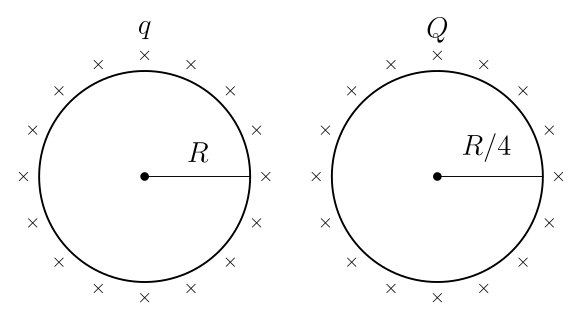
- KCET 2025Set D-41 markMCQQ.A metallic sphere of radius R carrying a charge q is kept at certain distance from another metallic sphere of radius R/4 carrying a charge Q. What is the electric flux at any point inside the metallic sphere of radius R due to the sphere of radius R/4 ?
 (A) ε0Q−ε0q
(B) Zero
(C) ε0q−ε0Q
(D) ε0Q
(A) ε0Q−ε0q
(B) Zero
(C) ε0q−ε0Q
(D) ε0Q›Reveal solutionSolution
Gauss's law: only charge enclosed by a surface contributes net flux, and Q lies outside the sphere of radius R — so its net flux through/inside that sphere is zero.
Step 1 — The geometry.
The figure shows two separate, non-touching metallic spheres: one of radius R carrying charge q on its surface, and one of radius R/4 carrying charge Q on its surface. Neither encloses the other. We are asked for the flux inside the sphere of radius R, due only to the sphere of radius R/4.
Step 2 — Apply Gauss's law.
Gauss's law states that for any closed surface S,
∮SE⋅dA=ε0qenclosed
The crucial word is enclosed. Take any closed (Gaussian) surface lying inside the sphere of radius R. The charge Q is on the other, distant sphere — it is not inside that Gaussian surface. Therefore the charge of the small sphere enclosed by it is zero:
qenclosed, due to Q=0⇒ϕQ=ε00=0
Step 3 — Why an external charge always gives zero net flux. …
- KCET 2025Set D-41 markMCQQ.If the radius of first Bohr orbit is r, then the radius of the second Bohr orbit will be (A) 8r (B) 4r (C) 22r (D) 2r
›Reveal solutionSolution
Bohr's quantisation gives rn∝n2, so going from n=1 to n=2 multiplies the radius by 22=4.
Step 1 — Derive the radius from Bohr's postulates.
Bohr assumed that (i) the Coulomb attraction supplies the centripetal force, and (ii) angular momentum is quantised in units of ℏ.
Force balance:
4πε01rn2e2=rnmvn2⟹mvn2rn=4πε0e2
Quantisation of angular momentum:
mvnrn=2πnh
Step 2 — Eliminate vn.
From the second relation, vn=2πmrnnh. Substituting into the first:
m(2πmrnnh)2rn=4πε0e2
4π2mrnn2h2=4πε0e2
rn=πme2ε0n2h2
Step 3 — Read off the dependence on n.
Everything on the right except n2 is a collection of fundamental constants, so
rn∝n2
Numerically, for hydrogen rn=0.529n2 A˚, where 0.529 A˚ is the Bohr radius a0.
Step 4 — Apply to the two orbits. …
- KCET 2024Set D-21 markMCQQ.Dimensional formula for activity of a radioactive substance is (A) M0L1T−1 (B) M0L−1T0 (C) M0L0T−1 (D) M−1L0T0
›Reveal solutionSolution
Activity = (dimensionless count of nuclei) ÷ (time), so its dimensional formula is simply M0L0T−1.
1. Definition
The activity of a radioactive sample is the rate at which its nuclei disintegrate:
A=−dtdN=λN
where N is the number of undecayed nuclei and λ the decay constant.
2. Dimensions of each factor
- N is a pure number (a count of nuclei) ⇒[N]=M0L0T0.
- dt is a time ⇒[t]=T.
3. Put them together
[A]=[t][N]=TM0L0T0=M0L0T−1
4. Consistency check with the SI unit …
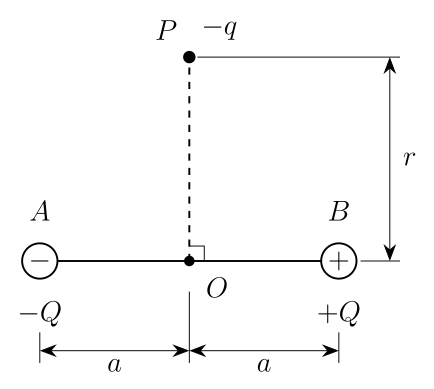
- KCET 2023Set A-31 markMCQQ.In the situation shown in the diagram, magnitude of q≪∣Q∣ and r≫a. The net force on the free charge −q and net torque on it about O at the instant shown are respectively [p=2aQ is the dipole moment]
 (A) 4πε01r2pqk^, 4πε01r3pqi^
(B) −4πε01r2pqk^, −4πε01r3pqi^
(C) 4πε01r3pqi^, +4πε01r2pqk^
(D) 4πε01r3pqi^, −4πε01r2pqk^
(A) 4πε01r2pqk^, 4πε01r3pqi^
(B) −4πε01r2pqk^, −4πε01r3pqi^
(C) 4πε01r3pqi^, +4πε01r2pqk^
(D) 4πε01r3pqi^, −4πε01r2pqk^›Reveal solutionSolution
Use the equatorial (broadside) dipole field E=4πε0r3p directed anti-parallel to p, get F=(−q)E, then take the cross product τ=r×F about O.
1. Set up axes and the dipole moment
Let i^ point along the dipole axis from A(−Q) towards B(+Q), j^ point vertically up from O towards P, and k^=i^×j^ out of the page.
The dipole moment always points from the negative to the positive charge, so
p=2aQi^=pi^
The free charge −q sits at P, on the perpendicular bisector: rP=rj^, with r≫a so the point-dipole (far-field) formulae apply. Also q≪∣Q∣, so −q does not disturb the dipole.
2. Field at an equatorial point
For a short dipole, at a point on the equatorial line,
E=−4πε01r3p=−4πε01r3pi^
The minus sign is the physics: on the broadside position the field is anti-parallel to p (the components along the axis from the two charges cancel, and the components anti-parallel to p add). Note the 1/r3 dependence — this alone kills options (A) and (B), which quote a 1/r2 force.
3. Force on the free charge
F=(−q)E=(−q)(−4πε01r3pi^)=+4πε01r3pqi^
So the force on −q is along +i^, of magnitude 4πε0r3pq. (Sensible: the negative charge is pulled towards the +Q end.)
4. Torque about O …
- KCET 2022Set B-31 markMCQQ.A charged particle of mass ‘m’ and charge ‘q’ is released from rest in an uniform electric field E. Neglecting the effect of gravity, the kinetic energy of the charged particle after ‘t’ seconds is (A) tEqm (B) 2mE2q2t2 (C) mq2E2t2 (D) 2t2E2q2m
›Reveal solutionSolution
The electric force is constant, so the motion is uniformly accelerated: find a=qE/m, then v=at, then KE=21mv2.
Step 1 — Identify the force and the acceleration.
The only force acting (gravity is to be neglected) is the electric force on the charge:
F=qE
Since E is uniform, F is constant, and therefore so is the acceleration. By Newton's second law:
a=mF=mqE
A constant acceleration means the standard kinematic equations apply directly.
Step 2 — Find the velocity after time t.
The particle is released from rest, so u=0. Using v=u+at:
v=0+(mqE)t=mqEt
Step 3 — Compute the kinetic energy.
KE=21mv2=21m(mqEt)2
KE=21m⋅m2q2E2t2
One power of m cancels:
KE=2mE2q2t2
Step 4 — Cross-check by the work–energy theorem.
An independent route must give the same result. The work done by the constant force over the distance travelled s=21at2 is:
W=F⋅s=(qE)(21⋅mqEt2)=2mq2E2t2
By the work–energy theorem, KE=W (since it started from rest) — identical ✓.
Step 5 — Dimensional check on the options. …
- KCET 2022Set B-31 markMCQQ.A magnetic field of flux density 1.0 Wb m−2 acts normal to a 80 turn coil of 0.01m2 area. If this coil is removed from the field in 0.2 second, the emf induced in it is (A) 0.8V (B) 5V (C) 4V (D) 8V
›Reveal solutionSolution
Apply Faraday's law of electromagnetic induction: the induced emf is N times the rate of change of magnetic flux through one turn.
Step 1 — The law.
Faraday's law says an emf appears whenever the flux linked with a coil changes:
ε=−NdtdΦ⟹∣ε∣=NΔtΔΦ (for a uniform change)
The minus sign is Lenz's law — the induced current opposes the change that produced it — and it fixes only the direction, not the magnitude asked for here. The factor N appears because the N turns are in series, so their emfs add.
Step 2 — Initial flux through one turn.
The field is normal to the coil (θ=0, cosθ=1), so
Φi=BAcosθ=(1.0 Wbm−2)(0.01 m2)(1)=0.01 Wb.
(Note 1 Wbm−2=1 T.)
Step 3 — Final flux.
The coil is removed from the field, so
Φf=0 Wb,∣ΔΦ∣=0.01−0=0.01 Wb.
Step 4 — Substitute. …
- KCET 2022Set B-31 markMCQQ.An alternating current is given by i=i1sinωt+i2cosωt. The r.m.s current is given by (A) 2i12+i22 (B) 2i12+i22 (C) 2i1+i2 (D) 2i1−i2
›Reveal solutionSolution
For i = i1sin(wt) + i2cos(wt), the mean square current over a full cycle is <i^2> = <i1^2 sin^2(wt)> + 2i1i2*<sin(wt)cos(wt)> + <i2^2 cos^2(wt)> = i1^2*(1/2) + 0 + i2^2*(1/2) =…
For i = i1sin(wt) + i2cos(wt), the mean square current over a full cycle is <i^2> = <i1^2 sin^2(wt)> + 2i1i2*<sin(wt)cos(wt)> + <i2^2 cos^2(wt)> = i1^2*(1/2) + 0 + i2^2*(1/2) = (i1^2+i2^2)/2 (using <sin^2>=<cos^2>=1/2 and <sin*cos>=0 over a full cycle). So i_rms = sqrt((i1^2+i2^2)/2). Note: options (A) and (B) a …
- KCET 2022Set B-31 markMCQQ.The de-Broglie wavelength of a particle of kinetic energy ‘K’ is λ ; the wavelength of the particle, if its kinetic energy is K/4 is (A) 2λ (B) 4λ (C) λ/2 (D) λ/4
›Reveal solutionSolution
Since λ∝1/K, quartering the kinetic energy doubles the wavelength.
Step 1 — De Broglie relation in terms of kinetic energy.
λ=ph=2mKh
Step 2 — Apply the new kinetic energy K/4. …
- KCET 2022Set B-31 markMCQQ.In a photo electric experiment, if both the intensity and frequency of the incident light are doubled, then the saturation photo electric current (A) Is doubled (B) Becomes four times (C) Remains constant (D) Is halved
›Reveal solutionSolution
Saturation current tracks the photon arrival rate (intensity), never the photon energy (frequency) — so doubling intensity alone doubles the current, regardless of what frequency does.
Why frequency doesn't matter for saturation current. Above the threshold frequency, every absorbed photon ejects one electron. The RATE of electron ejection is set by how many photons arrive per second — that's what intensity measures. Frequency only sets each photoelectron's kinetic energy (via Einstein's equation), not how many …
- KCET 2021Set B-21 markMCQQ.The maximum range of a gun on horizontal plane is 16 km. If g=10 m s−2, then muzzle velocity of a shell is (A) 160 m s−1 (B) 2002 m s−1 (C) 400 m s−1 (D) 800 m s−1
›Reveal solutionSolution
Use Rmax=u2/g (the range at the optimum launch angle of 45∘) and solve for the muzzle speed u.
Step 1 — The range formula and why 45∘ maximises it.
For projectile launched at speed u and angle θ over level ground,
R(θ)=gu2sin2θ.
Since sin2θ≤1 with equality at 2θ=90∘, i.e. θ=45∘, the maximum range is
Rmax=gu2.
The gun's "maximum range" is exactly this quantity — it is the reach at the best possible elevation.
Step 2 — Convert units.
Rmax=16 km=16000 m.
Step 3 — Solve for u. …
- KCET 2019Set A-11 markMCQQ.An electron is moving with an initial velocity v=V0i^ and is in a uniform magnetic field B=B0j^. Then its de Broglie wavelength (A) remains constant (B) increases with time (C) decreases with time (D) increase and decreases periodically
›Reveal solutionSolution
The electron moves in a circular path perpendicular to the magnetic field, so its speed stays constant. Since de Broglie wavelength depends only on speed, it remains constant.
The key idea here is that de Broglie wavelength λ is given by λ=ph, where p is the magnitude of the momentum. For an electron, p=mv (non-relativistic), so λ=mvh. The question reduces to: does the speed v of the electron change in a uniform magnetic field?
A magnetic field exerts a force F=q(v×B) on a moving charge. This force is always perpendicular to the velocity. A force perpendicular to velocity does no work — it changes the direction of motion but not the speed. So v remains constant in magnitude.
Let’s trace the motion step by step.
-
Initial conditions: The electron has velocity v=V0i^ (along the x-axis) and enters a uniform magnetic field B=B0j^ (along the y-axis). The charge of an electron is q=−e.
-
Force on the electron:
F=q(v×B)=−e(V0i^×B0j^)=−eV0B0(i^×j^)=−eV0B0k^
So the force is along the negative z-direction (into the page, if we set axes conventionally). This force is perpendicular to the velocity (which is along i^).
-
Nature of motion: Since the force is always perpendicular to velocity and constant in magnitude, the electron undergoes uniform circular motion in the x-z plane. The magnetic field direction (y-axis) is perpendicular to the plane of motion. The speed v=V0 never changes — only the direction of v changes. …
-
🎓Unlock everything free for 14 days
- ✓Full step-by-step solutions
- ✓Concept-first explanations
- ✓Methods, shortcuts & mistakes
- ✓PYQ mapping + timed mock tests
Full access for 14 days. No credit card required.